Error-Ref.com

You are here: Home / Search for "off center"

Search Results for: off center

Retained Cuds: Vertical Displacement

PART IV. Die Errors:

Cuds:

Retained cuds (with vertical displacement)

Definition: A retained cud is a piece of a die that breaks off completely but is held in place. Retained cuds of the anvil die are held in place by the collar while retained cuds of the hammer die are presumably held in place by the bolts that secure the die in its recess. Retained cuds of the hammer die are much rarer, as die fragments tend to fall out with the assistance of gravity.

In order to diagnose a retained cud, one needs to see vertical displacement and/or horizontal offset. Vertical displacement simply means that the die fragment sinks in below the level of the die face, leaving the coin’s design sitting on a corresponding plateau. Horizontal offset means that the fragment slides along the break, leaving contiguous parts of the design out of alignment with each other on either side of the break.

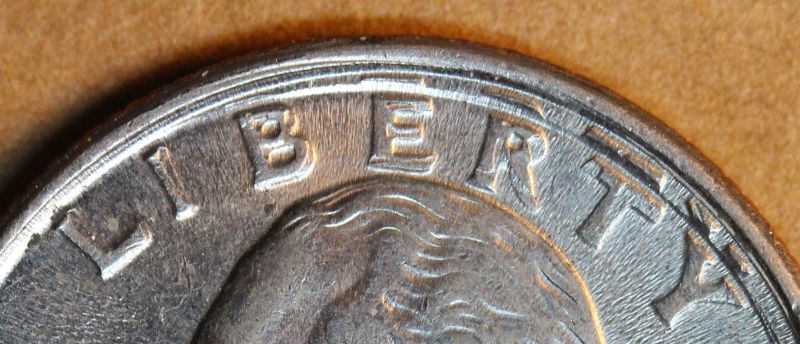
Depicted below is a quarter with a retained cud in the NW quadrant. There is marked vertical displacement of the retained cud because the die fragment sank in below the plane of the die face.
Part II. Die Varieties:


Reduction lathe doubling (master hub doubling)

Master die doubling (master die with a doubled die variety) (CW 7/27/20)

Broken hub (chipped hub) (CW 12/23/13, 5/21/18)

Hubbed-in debris (CW 5/27/13, 1/17/22)

Broken punch

Damaged punch

Defective punch

Longacre doubling (probably impressions of punch shoulders)

Doubled dies (incl. tripled dies, etc)

    • Rotated hub doubling (Class I) (CW 8/8/16)
      • 1872 Seated Liberty dime with 175 degree rotation (ES July/August 2003; CW 2/10/03)
    • Distorted hub doubling (Class II)
    • Design hub doubling (Class III)
    • Offset hub doubling (Class IV)
    • Pivoted hub doubling (Class V)
    • Distended hub doubling (Class VI)
    • Modified hub doubling (Class VII)
    • Tilted hub doubling (Class VIII)
    • Single-squeeze doubled dies (often attributed to Class VIII) (CW 2/14/05, 9/12/05)
      • Centrally-located doubling (CW 3/21/22)
      • Peripheral Doubling (CW 8/8/04)
    • Weaker impression hubbed last (e.g., 1963-D cent) (CW 6/14/10)
    • Centrally-located doubled dies (CW 4/15/19)
      • Rotated

Weak or incomplete hubbing (always part of a doubled die)

Tilted hubbing (always part of a doubled die)

Misaligned hubbing (uncorrected) (CW 5/30/22)

Repunched date (ES July/August 2012; CW 12/14/09)

    • 1956-D cent with repunched 5 (controversial) (CW 9/20/04, 7/16/12)
    • 1957-D cent with repunched 7 (controversial)

Re-engraved date (on master die or working die)

Blundered date (on master die or working die)

    • 1853 Half Dime with Inverted Date, Repunched with Corrected Date

Misplaced date (e.g. digits in denticles) (CW 4/21/03)

Misplaced mintmark

Phantom mintmark (working hub has mintmark incompletely removed)

    • (e.g. faint D and S mintmarks in cents from the late 1990s)

Dual mintmarks

    • 1980 D & S cent (recently delisted)
    • 1956 D & S cent (controversial)

Horizontal mintmarks (inevitably repunched)

Tilted mintmarks (punched in at an angle) (CW 7/28/14)

Rotated Mintmarks (CW 7/28/14)

Inverted mintmarks

Deeply-punched (high-standing) mintmarks (CW 9/29/14)

    • High-standing D mintmark (1987-D, 1988-D, and 1989-D cents)

Weakly-punched mintmarks

Repunched mintmarks (CW 1/20/20)

    • Overlapping mintmarks
    • Totally separated mintmarks
    • Two different fonts
    • Large over small mintmarks

Repunched mint marks on the Jefferson nickel; Book by James Wiles (downloadable version)

Overmintmarks

    • 1938-D/S Buffalo Nickel
    • 1944-D/S cent

Other repunched or re-engraved design elements

    • Denomination
    • Letters
    • Assay value
    • Other design elements

Omitted mintmarks

    • 1982 “no-P” Roosevelt dime
    • 1990 Lincoln proof cent without S-mintmark

COIN WORLD SPECIAL: article posted HERE on 1975-S Roosevelt dime without mintmark.

Omitted date (foreign only) (CW 4/28/14)

Other omitted design elements

Large over small mintmarks

Different mintmark styles and sizes

Overdates (CW 1/23/17)

    • Caused by repunching or re-engraving
      • 1892 over an 18(8)2 Peruvian 1/2 Dino
      • 1958-D Lincoln cent with repunched 7 digit (debunked)
    • Caused by second hubbing of different date (Class III doubled die)
    • Caused by grinding off earlier design and rehubbing or repunching (CW 1/23/17)
      • 1943 over 1942 Jefferson nickel

Dual Dates (earlier date faint)

    • Caused by erasing earlier date on working hub
    • Caused by removing earlier date from working die and re-hubbing (e.g. 1975 Bahamas 5c with faint date “1973” on opposite face)

Wrong dates

    • Date later than final date of issue (e.g., 1913 Liberty Head nickel)
    • Date earlier than first date of issue (e.g., 1954 Mexico 5 centavos – small size)
    • Wrong digits (e.g., 1393/1893 Peruvian peso)
    • Transposed digits

Blundered dies (various types) (CW 8/18/08)

    • Misspelling on working dies
    • 1801 Large Cent: United misspelled IINITED
    • 1863 Patriotic Token; SPOT misspelled (SPOOT)

Special Finish Errors (Proofs, Mint sets, Special Mint Sets, Satin Finish, etc.)

    • Frosting slop-over (proofs) 
    • Offset frosting (proofs) (CW 2/21/11)
    • Design removed by proof polishing (CW 2/21/11)
    • Field lowered by proof polishing (CW 2/14/11)
    • Frosting applied in wrong place (CW 2/28/11)
      • COIN WORLD SPECIAL: article posted HERE “Frosted Freedom” $50 and $100 platinum coins (CW 8/1/11)
    • Frosting omitted
    • Stencil outlines (CW 2/18/13)
    • Incomplete Proof Laser Frosting (CW 9/12/16, 9/6/21)

Design Extension Dimples (CW 4/18/11)

    • COIN WORLD SPECIAL: article posted HERE

Edge Lettering Font Variants

    • Presidential dollars (4-5 types) (CW 10/18/10)

Hidden Initials And Symbols

    • Applied to working die or master die
      • 1973 and 1974 Mexico Bronze 20 Centavos
      • 1984 Mexico 1 Peso
    • Applied to working hub
      • 2023 “extra V” cent (CW 3/27/23)


Green lettering – major heading

Blue lettering – linked to subject matter

Brown lettering – subject matter covered under that heading

Black lettering – no entry yet

Part IV. Die Errors:


Reeding vs. no reeding varieties (foreign only)

Concentric lathe lines (ES Nov/Dec 2003)

    • Various years and denominations
      • Common on the 1996-D Lincoln cent

Rusted dies (CW 12/1/08)

Excessively deep rim gutter

    • 1991 cents

Rockwell test mark left in die (hemispherical bump seen on coin) (ES July/Aug 2006)

Vickers test mark left in die (pyramidal bump) (CW 5/15/17)

Collar manufacturing errors

    • Wide collar (ES Nov/Dec 2002; CW 5/17/10)
      • Created by improper machining or improperly machined broach
      • Created by use of wrong broach
      • Improper use of correct broach
      • Widening due to wear
      • Widening due to 3 or more vertical collar cracks and associated expansion (CW 5/17/10)
    • Abnormal reeding
      • 1921 Morgan dollar with infrequent reeding
      • 1924-D Mercury dime with infrequent reeding
      • 2015 American Eagle 1/10oz gold bullion coin with narrow reeds (CW 7/13/15)
      • Low, narrow reeds caused by truncation of ridges on collar face (ES March/April 2010; CW 1/25/10, 4/16/12)
        • 1964-D 25c
        • 2008-P New Mexico 25c
          • COIN WORLD SPECIAL: article posted HERE

Hub retouching

    • Channeling: Retouching of design element on master and/or working hubs (1920s to 1940s) (CW 7/23/12)
    • Re-engraved master hub (CW 1/1/24)

Die retouching (CW 5/30/16, 9/30/19)

    • Re-engraved designer’s initials “AW” on 1944-D half dollar (CW 2/2/04, 2/16/04, 3/1/04)
    • Re-engraved tail feathers on business-strike 1957-D quarter
    • Re-engraved front of Lincoln’s coat (1953 proof cent)
    • Re-engraved queue on 1952 – 1954 proof nickels
    • 1938 proof nickels with re-engraved letters and design details (ES Jan/Feb 2009)
    • Retouching of the 1944 date on the Lincoln cent master die
    • Retouching of the date on 1946-S Lincoln cent working dies

Die damage (ES Nov/Dec 2004, Jan/Feb 2003; CW 5/21/12)

    • Die dents (ES Nov/Dec 2004, July/August 2005, Nov/Dec 2005; CW 9/15/03, 12/22/14, 3/28/22, 7/31/23)
    • Die scrapes (CW 4/23/07)
    • Accidental die scratches
    • Die gouges
    • Impact scars
    • Accidental die abrasion (CW 9/8/14, 12/16/19)
    • Intentional die abrasion (“die polishing”) (CW 3/29/10, 5/31/10, 9/8/14, 3/20/23)
      • Heavy die scratches
      • Thinning and loss of design elements
        • Two Feather Indian Head Nickel (various dates)
        • 3-legged Indian Head Nickel (1937-D)
        • 3 ½ legged Indian Nickel (1936-D)
      • Abrasion affecting entire die face
      • Localized abrasion
    • Defects related to die polishing
      • Over-polished proof and Special Mint Set dies (CW 2/21/11)
      • Trails and Wavy Steps (ES July/Aug 2006, Sept/Oct 2006, Nov/Dec 2006, Jan/Feb 2011; CW 3/8/10)
      • Localized removal of field from proof polishing (CW 2/14/2011)
        • COIN WORLD SPECIAL: article posted HERE
    • Die attrition errors (ES May/June 2003, March/April 2005, March/April 2009; CW 1/4/10, 12/24/12, 4/14/14, 11/4/19, 7/3/23, 10/16/23)
    • Other forms of peripheral die damage (ES March/April 2005; CW 8/9/21, 3/14/22)
    • Catastrophic die damage (ES March/April 2002; CW 9/15/03, 9/12/11, 9/19/11, 5/20/13, 10/27/14, 6/19/17)
    • Cancelled or defaced dies (foreign only) (CW 5/8/17, 12/31/18)
      • 1994 Hong Kong bimetallic 10 dollars
      • Egypt 25 piastres struck by defaced 50 piastres dies (CW 5/12/14)
      • 1966 Bolivia 10 centavos struck by pair of canceled dies (CW 5/8/17)
      • Chilean test dies with concentric cancellation pattern struck over struck foreign core (CW 5/8/17)
    • Rockwell test mark in die (CW 5/15/17)
    • Vickers test mark in die (CW 5/15/17)
    • Die rings (tiny rings, semicircles, crescents, and spirals)  (CW 2/20/17, 1/18/21, 6/13/22)
        • Centrally-located
        • Offset
  • Collar damage (ES March/April 2010; CW 1/25/10, 4/16/12, 6/17/19)
    • Horizontal abrasion (CW 1/25/10, 4/16/12)
    • Vertical abrasion (CW 6/17/19)

Hubbed-In debris (CW 5/27/13)

Deformed collar (CW 12/18/20)

Clashed dies (ES March/April 2002; CW 3/22/10, 4/30/12)

    • Clash marks
    • Multiple clash marks (CW 6/25/12, 11/11/19)
      • Chatter clash
  • Raised clash marks (CW 8/11/14)
  • Double clash with reciprocal counterclash (Type 1) (ES Nov/Dec 2004; CW 12/13/10, 7/29/19)
  • Misaligned die clashes (ES May/June 2004, July/August 2004; CW 6/25/12)
    • Horizontally misaligned die clash
    • Vertically misaligned (tilted) die clash (CW 1/3/11, 5/9/11)
      • COIN WORLD SPECIAL: article posted HERE
    • Pivoted die clash
    • Radically misaligned, rotated, pivoted clashes – produced at installation? (CW 7/12/10, 12/31/12, 5/27/19)
      • Co-occurrence with conventional clash (CW 8/17/15)
    • Rotated die clash (CW 1/22/18, 6/26/23)
    • Combination clashes
  • Mule clash errors, e.g. (ES July/August 2002; CW 11/17/08, 8/13/18, 8/20/18, 4/8/19)
    • 1864 2c reverse die clashed with Indian cent obverse die
    • 1857 1c obverse die clashed with Seated Liberty 50c obverse die
    • 1857 1c reverse die clashed with Seated Liberty 25c reverse die
    • 1857 1c obverse die clashed with Liberty $20 obverse die
    • (For detailed information concerning the 1857 die clashes CLICK HERE)
    • 1870 Shield nickel obverse clashed with Indian Head cent obverse
    • 1999 cent reverse die clashed with another cent reverse die
  • Floating die clash (collision with die fragments) (ES May/June 2002, May/June 2005; CW 7/19/10)
  • Superclash (full reciprocal design transfer) (CW 3/22/10, 10/22/18)
  • Circumferential clash marks (CW 12/10/18)
  • Grease-enhanced clash marks (CW 10/16/17)
  • Associated with weak strikes (CW 12/2/19)
  • Clashed die progressions (CW 5/15/23)

Collar clash (CW 6/11/07, 2/24/22)

    • Hammer die
    • Anvil die
      • Inverted die setup (uncommon)
      • Traditional die setup (extremely rare) (CW 10/30/23, 12/18/23)
    • Floating collar clash (CW 4/17/17)
    • Misaligned collar clash (CW 2/13/23)

Die damage with design transfer

    • Floating die clash (ES May/June 2002, May/June 2005; CW 7/19/10)
      • Exogenous floating die clash (CW 6/20/22)
    • Floating (Type 2) counterclash (ES May/June 2002, July/August 2002, Sept/Oct 2002, Jan/Feb 2009, Sept/Oct 2011; CW 9/29/08, 12/13/10, 4/9/12, 4/21/14, 6/8/15, 4/23/18, 2/21/22, 12/19/22, 2/20/23)
      • COIN WORLD SPECIAL: article posted HERE
    • Miscellaneous and unexplained forms of design transfer/duplication
      • Some presumed Canadian counterclashes may prove to be something else

Die deterioration/deformation errors

    • Exaggerated conventional die wear (CW 12/27/21)
      • Radial flow lines
      • Concentric flow lines (uncommon)
      • Parallel flow lines (promoted by pre-existing trails)
      • Orange peel texture
      • Design-devouring die wear (thinned letters and numbers) (CW 10/28/13, 2/22/16, 8/23/21)
    • Die deterioration doubling
      • Raised doubling
      • Incuse (CW 2/4/08)
    • “Blebs” or “patches” (die erosion pits) (ES July/Aug 1998; CW 7/21/03)
    • Discrete lumps (CW 4/27/20)
    • Progressive, indirect design transfer (“internal metal displacement phenomenon”, “ghosting”) (CW 6/7/10, 8/17/20)
      • Common in 1946-S and 1948-S cents
    • Surface-level die deformation errors (ES July/Aug 2001, Nov/Dec 2001; CW 9/17/12) (premature, localized, exaggerated, and peculiar patterns of deformation)
      • 1943-S “goiter neck” quarter
      • Detail-erasing die wear (2016-P Harper’s Ferry quarter) (CW 2/27/17)
    • “Ridge rings”
      • On copper-plated zinc cents (CW 2/14/05, 2/28/05)
      • On other U.S. denominations (CW 2/15/21)
      • On world coins (ES Sept/Oct 2006; CW 2/17/14, 11/10/14)
    • Design berms (raised outlines) (CW 5/14/18, 11/6/23)
    • Die subsidence (sunken die) error (ES July/August 2004, Nov/Dec 2004; CW 6/2/03, 11/29/04, 3/12/12, 2/12/18, 8/14/23)
      • e.g., 1924-S – “goiter” cent
      • Co-occurring with split dies
      • Co-occurring with radial, antipodal die cracks (CW 6/20/11)
      • 1988-P nickels with lump on head
        • COIN WORLD SPECIAL: article posted HERE
      • Massive die collapse in 2003-D dime (ES Nov/Dec 2011; CW 8/29/11)
      • Paralleling and flanking die cracks (CW 8/12/13)
      • Recurring die subsidence error (CW 4/4/11, 3/31/14)
      • Linear die subsidence errors (CW 8/12/13)
    • Thermal warping (CW 5/29/23)
    • Design creep
      • Reverse (hammer) 2014-P nickel die (CW 4/20/15)
      • In fractional Euro coins
    • Peripheral die expansion and erosion (CW 8/13/12, 4/13/15)
    • “Starburst” pattern of radial streaks (cause uncertain) (CW 8/15/05, 11/7/05)
    • Reciprocally deformed, convex-concave dies
      • Centrally-located deformation; 2001-P 50c) (ES Sept/Oct 2008; CW 1/19/15)
      • Peripherally-located deformation; India 2 rupees (CW 1/19/15)

Die breaks

    • Cuds (corner die breaks) (CW 10/17/11, 10/4/21)
      • Irregular cuds
      • Ovoid cuds
      • Crescentic cuds (ES March/April 2005; CW 2/15/16)
      • Circumferential cuds (ES March/April 2005; CW 2/15/16)
      • Rim-to-rim cud (ES May/June 2003, CW 12/24/18)
      • Elongate Cuds (CW 12/8/14, 12/21/20, 7/31/23)
      • On off-center or broadstruck coins (CW 9/12/11)
      • Deep vs. shallow die breaks (CW 6/2/20)
    • Retained Cuds (ES Jan/Feb 2006; CW 4/17/06, 7/24/06, 1/24/11)
      • COIN WORLD SPECIAL: article posted HERE
      • Anvil die (diagnosis often in doubt)
      • Hammer die (doubtful) (CW 8/8/13)
      • With vertical displacement
      • With horizontal offset
      • With lateral spread
      • Outthrust (protrudes beyond die face) (CW 3/11/19)
        • Hammer die
        • Anvil die
  • Interior (internal) die breaks (ES May/June 2003; CW 10/25/10, 11/5/18, 8/14/23)
    • Connected to die cracks or splits
    • Freestanding (ES May/June 2005)
  • Retained interior die breaks (ES July/August 2004)
    • Connected to die crack or split
    • Freestanding
  • Rim cuds (CW 5/3/21)
  • Die chips (CW 6/14/19, 7/8/19)
    • On raised die features (CW 2/28/22)
  • Catastrophic die failure (ES May/June 2007; CW 5/20/13, 2/27/23, 6/19/23)
  • Spontaneous breaks
  • Breaks produced by impacts
  • Textured and dimpled cuds (CW 10/17/11, 10/12/20)
  • Cryptic cuds (CW 4/17/23)

Die exfoliation errors (CW 10/19/20)

Collar breaks (collar cuds) (ES May/June 2008; CW 11/22/10, 5/17/10, 11/22/10, 12/19/16)

    • Complete collar break (abrupt loss of entire arc segment)
    • Irregular collar break
    • Chipped collar
    • Vertical collar crack
    • Retained collar break
    • Rotating collar break (ES July/August 2003; CW 1/6/03, 12/12/16, 4/20/20, 12/28/20)
    • Bilateral split collar
    • On off-center strikes (CW 9/9/19)
    • Catastrophic collar failure (CW 7/17/23)

Die cracks (CW 4/25/16)

    • Rim-to-rim
    • Arcing rim-to-rim (“pre-cud”) die crack (ES Jan/Feb 2006; CW 2/8/21)
      • With lateral spread
    • Blind-ended
    • Bi-level die cracks (ES July/August 2004)
      • Protruding marginal die segments (CW 5/19/14)
    • Radial, antipodal die cracks (with centralized subsidence) (ES Sept/Oct 2011; CW 6/20/2011)
    • Die Crazing (Crazed Die)
    • Shattered dies (ES Jan/Feb 2006, May/June 2007; CW 4/7/08, 9/17/18, 4/6/20)
      • Broas Pie Baker Store Card Token of 1863
      • Two or more splits in die
      • Numerous wide, intersecting, raised die cracks
      • Numerous intersecting bi-level die cracks
      • Various combinations of brittle fracture
      • In response to impacts (CW 6/19/17)
    • Impact-Induced Die Cracks (CW 6/19/17)

Split dies (ES Jan/Feb 2006; CW 6/2/03, 4/10/06, 4/17/06, 6/20/2011, 5/11/15, 9/17/18, 4/26/21, 4/18/22, 7/18/22)

    • Median (bisecting) split die
    • Asymmetrical split die (CW 7/31/23)
    • False split (bilateral, radial, antipodal die cracks) (ES Sept/Oct 2011; CW 6/20/2011)


Green lettering – major heading

Blue lettering – linked to subject matter

Brown lettering – subject matter covered under that heading

Black lettering – no entry yet

Part VII. Post-Strike Mint Modifications:


Edge lettering applied after strike
(incuse) (small dollar coins)

    • Absent lettering (CW 4/26/10)
      • Due to bypassing the lettering device
      • Due to excessive spacing between steel wheel and lettering die
    • Vertically misaligned letters (cut off at top)
    • Vertically misaligned letters (cut off at bottom)
    • Wrong spacing between incuse design elements
    • Obliquely-oriented lettering
    • Overlapping letters
    • Two sets of letters
    • Skipped letters
    • Letters on wrong planchet
      • 2007-D Sacagawea dollar with Presidential edge lettering (CW 7/9/12)
    • Chipped letter
    • Lightly impressed letters (weak lettering) (CW 4/26/10)
    • Unusually deep letters (coin squeezed too hard, leaving a rippled margin)
    • Incomplete letters
    • Smeared letters
    • Edge letter font subtypes (CW 10/18/10)
    • Wrong date on edge (doesn’t match any President of that year) (CW 2/22/10, 3/1/10)
      • 2009 Zachary Taylor dollar with 2010-D edge inscription (CW 2/22/10, 3/1/10)
    • Edge lettering on unstruck planchet (CW 3/26/07, 3/17/08)
    • Lettering die inclusion (CW 9/14/15)

Note: Edge lettering and other edge design elements may be impressed during upsetting, during the strike, by a special machine before the strike, or by a lettering device after the strike. Similar-looking defects can occur in each of these processes.  Any edge design that forms a closed interlock between the edge of the coin and the collar cannot be produced during the strike since that will prevent ejection of the coin after the strike.

Special Note: Some presidential dollar coins have had the edge lettering removed outside the mint. Use caution when buying any edge lettering error.

The diagnostics for authentic presidential coin missing its edge lettering are as follows:

1. Diameter should be 26.46 mm. Coins altered outside the mint will have a diameter that is less than 26.46 mm and will have a diameter of approximately 26.21 mm.

2. The coin’s weight should be approximately 7.98 g ± .03 g. Altered coins will weigh less from the removal of the edge lettering. Weights of approximately 7.89 g are commonly seen on altered coins.

3. An unaltered presidential dollar coin will have vertical lines along the edge. These lines are created when the coin is ejected. Altered coins will not normally have these lines, but instead will have horizontal lines. These horizontal lines are from milling or similar machines used outside the mint to remove the letters and are the aftereffects of the metal being abraded off the coin.

67400692

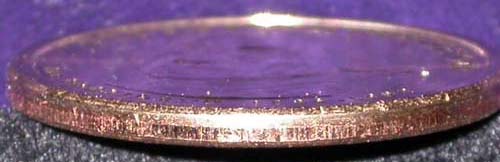
The above image shows the vertical lines present on the edge of an unaltered presidential dollar coin with no edge lettering

Table of edge lettering errors found on the presidential and native American dollar coins

Post-strike chemical treatment

    • Anti-tarnishing Experimental Rinse on Sacagawea dollars

Matte or frosted finish applied after strike

    • Finish omitted on one or both faces (CW 8/1/11, 8/29/11)


Green lettering – major heading

Blue lettering – link to subject matter

Brown lettering – subject matter covered under that heading

Black lettering – no entry yet

Part XI. Non Errors:


Counterfeit Coins

  • All strikes from counterfeit dies
  • First strike authentic; later strikes counterfeit
  • Counterfeit strike on authentic planchet
  • Counterfeit strike on counterfeit planchet
    • Chinese Fabricated Error Coins
    • Henning Counterfeit Nickel

Fabricated or Altered Errors

  • Squeeze jobs (a.k.a. vise jobs, hammer jobs, smash jobs, garage jobs)
  • Dryer coins
  • Coins that are rolled and squeezed in the horizontal plane
  • Spooned coins
  • Acid-dipped coins
  • Coins plated outside the Mint
  • Coins with original plating chemically stripped
  • Pinpoint alterations (date, mintmark)
  • Solder
  • Glue
  • Holed coins
  • Snipped-off and crimped edges
  • Heat damage (blisters, discoloration)
  • Rippled Coins
  • Texas Coins

Enhanced Errors (genuine errors that are subsequently modified)

  • Intentional and Assisted Mint-Made Errors

Damaged Coins

  • Chemical corrosion
  • Environmental discoloration and corrosion
  • Crushed
  • Bent
  • Impact damage
  • Stacked coins crushed and fused in equipment


Green lettering – major heading

Blue lettering – link to subject matter

Brown lettering – subject matter covered under that heading

Black lettering – no entry yet

Part V. Planchet Errors:


Alloy errors

    • Improper alloy mix (CW 12/27/11, 1/30/23, 4/3/23)
      • Poorly mixed alloy
      • Incorrect proportions of metals
      • In conjunction with rolled-thick errors (1941 cents, mainly) (CW 10/15/12)
    • Gas Bubbles (CW 11/19/12)
      • Intact (“occluded”)
      • Ruptured
    • Slag inclusions (ES May/June 2006)
    • Intrinsic metallic inclusions (ES Sept/Oct 2006; CW 12/27/10, 12/27/11, 7/21/14)
    • Lamination errors
      • Loss before strike
      • Loss after strike
      • Lamination cracks
      • Retained laminations
      • Folded-over before strike (CW 10/22/12)
      • Internally split clad layer (CW 10/22/12, 6/26/17)
    • Split planchets
      • Before strike (CW 8/2/10)
      • After strike
      • Wrong Denomination / Off-metal
      • Struck with another planchet on top or beneath
      • Split core (clad coins)
      • Clamshell split (CW 1/28/13)
        • Clamshell folded over before strike (CW 10/22/12, 1/23/13)
      • Hemi-split planchets (CW 10/9/23)
    • Copper-and-zinc composite “shells” (ES May/June 2001)
      • Split-after-strike (N.B. these are probably all detached cap bottoms)
    • Cracked planchets
    • Broken planchets / coins (CW 3/14/11, 9/18/23)
      • Before strike
      • After strike
    • Brittle coins (cross-classified with annealing errors)
      • Radial planchet splits (when struck out-of-collar)
      • Delayed radial stress splits (CW 5/2/22)
    • Planchet cohesion errors (crumbling planchets) (CW 11/22/21)
    • Ragged clips (CW 2/29/16)
    • Ragged notch
    • Ragged perforations (“blowholes”)
    • Fissures — ragged and smooth
    • Stress-induced surface irregularities (CW 4/24/17)
    • Rolling-Induced Fissures

Subsurface Corrosion (CW 12/21/15)

    • Plated coins
      • Copper-plated zinc cents
    • Solid coins

Rolling Mill Errors

    • Rolled-thick planchets
    • Rolled-thin planchets (CW 8/2/10, 7/16/18)
    • Tapered planchets (CW 12/20/10, 12/28/15)
      • On clad coins (clad layer absent) (CW 4/27/15)
    • Rolling indentations (ES Jan/Feb 2000; CW 2/7/11)
    • Rolled-in scrap (ES May/June 2006; CW 2/7/11)
      • Bristles from descaling brush (CW 3/10/03)
    • Roller marks (CW 10/13/14)
    • Rolled-in patterns and textures
      • Rolled-in cloth pattern (CW 3/21/16)

Blanking and Cutting Errors

    • Definition
    • Curved (concave) clips (CW 6/29/15)
      • Crescent curved clips
      • Bowtie clips (ES Nov/Dec 2005; CW 6/16/14)
        • Two large clips at opposite poles – ends rounded
        • Four clips — punch slices through strip with normal hole spacing
        • Struck chopped webbing
    • Straight clips (CW 1/14/13)
      • Smooth straight clips
      • Irregular straight clips
      • Sawtooth clips
      • Incomplete straight clips (actually struck-in cutting burrs)
    • Straight cutting burrs (CW 1/14/13, 5/16/16)
    • Corner clips (“outside corner clip”) (CW 1/14/13)
    • Assay clips (“inside corner clip”) (cross-classified with pre-strike damage) (CW 1/21/13, 6/12/17)
    • Ragged clips (also listed under alloy errors)
    • Incomplete punch (incomplete clip) (ES May/June 2005; CW 3/24/14)
    • Elliptical (convex) clips (ES May/June 2005; CW 4/5/10, 7/11/11)
    • Multiple clips and combination clips (CW 1/27/14)
    • Blanking burrs (“rolling fold”) (ES Jan/Feb 2007; CW 1/31/11, 5/29/17, 9/4/23)
      • COIN WORLD SPECIAL: article posted HERE
    • Concave blanking burrs (CW 5/16/16)
    • Punched-in scrap (ES May/June 2006)

Upset Mill Errors

    • Coins struck on blank (“Type I planchet”)
    • Abnormally weak upset (ES July/August 2005)
    • Abnormally strong upset (best seen on off-center strikes)
    • “Groovy edge” (possibly from worn groove in upset mill)
    • Variation in cross-sectional shape of rim/edge junction of planchet
    • Struck coin sent back through upset mill
    • Abnormal upset (ES Sept/Oct 2005; CW 2/27/12, 11/21/16)
      • Wide, flat edge
      • Smoothly convex edge
      • Abnormally wide proto-rim
    • Squeezed-in debris (upset mill inclusion) (ES May/June 2006; CW 9/6/10)
      • Foil-like metal wraps around edge onto one or both faces
        • e.g. Copper foil on nickels (not from improper annealing)
      • Metal wire wraps around edge onto one or both faces
      • Pellet embedded in edge (CW 9/6/10, 9/22/14)

Edge design errors (impressed into planchet before strike) (includes security edge errors) (CW 6/27/16)

    • Edge design missing
    • Edge design present on normally plain edge (CW 6/27/16)
    • Wrong edge design
    • Edge design too high or too low
    • Interrupted edge design
    • Tilted edge design
    • Broken edging die (CW 6/27/16)

Mispunched center holes (foreign only) (CW 1/7/19)

    • Misaligned holes
    • Double punched center holes
      • One hole centered
      • Both holes misaligned
      • Overlapping holes
      • Totally separate holes
    • Irregular center holes
    • Abnormally small hole
    • Partial hole (from broken hole punch)
    • Circular Indentation (partial penetration)
      • Due to broken-off punch tip
    • Unpunched center hole
    • Hole punched in planchet meant for a solid coin

Annealing Errors

    • Improper annealing (due to excessive heat, prolonged exposure to intense heat, or excessive oxygen in annealing oven) (replaces “sintered plating” and “copper wash”) (ES July/Aug 2010; CW 11/30/09, 2/8/10)
      • Black, brown, red, coppery discoloration (includes “black beauty” nickels)
      • Layer of copper, often peeling

Poorly annealed or unannealed planchets (hard, brittle planchets) (CW 3/14/11)

    • Broken planchets and coins (CW 3/14/11, 9/18/23)
    • Radial cracks in coin (usually struck out-of-collar)

Brittle coins (cross-classified with alloy errors) (CW 3/14/11)

Abnormally hard planchets (CW 12/17/12, 8/15/22)

    • 1954-S nickels
    • 1983-P nickels
      • COIN WORLD SPECIAL: article posted HERE
    • “Superclash” 2000-P nickel (CW 3/22/10)

On undersized or underweight planchets (CW 2/13/12)

Miscellaneous forms of mint discoloration

Plating Errors

    • Incomplete plating
    • Unplated cents (CW 10/26/15, 7/24/23)
    • Cents struck on unplated or partly-plated foreign planchets (CW 3/10/14)
    • Thin plating
    • Thick plating (ES March/April 2009)
    • Blistered plating
      • Circular blisters
      • Linear blisters
      • Intact blisters
      • Ruptured blisters
    • Brassy plating
    • Split Plating (CW 12/18/17)
      • Split Plating Doubling
    • Cracked and Peeling Plating (CW 12/18/17)

Bonding/Bonding Mill Errors (ES, Sept/Oct 2002)

    • Missing clad layer
      • Full
        • Before strike (CW 5/23/22)
        • After strike
        • Before rolling is completed (weight may be close to normal) (ES Sept/Oct 2002, Nov/Dec 2006; CW 5/28/12)
      • Partial
        • Before strike
        • After strike
        • Before rolling is completed
      • Thin cladding
        • With gaps
      • Missing both clad layers (struck core)
        • Core thickness (ES Sept/Oct 2003; CW 3/18/13, 2/3/20)
        • Full thickness
    • Struck Clad layer
      • Separated after strike
        • COIN WORLD SPECIAL: article posted HERE
      • Separated before strike
      • Struck by itself
      • Struck on top of or beneath a normal planchet
    • Clamshell separation (CW 1/28/13)
      • Clad layer folded over before strike
    • Missing core
      • Partial
      • Full (Coreless or all-clad coins) (CW 12/19/11)

Irregular planchets

    • Scraps/fragments (CW 12/21/09, 1/27/20)
      • Normal alloy/composition
      • Off-metal
      • Feeder finger material
      • Foil
      • Heavier than normal coin of same denomination
      • Wider than normal coin of same denomination (along at least one axis)
    • Ragged clip (cross-classified with alloy errors)
    • Ragged notch (cross-classified with alloy errors)
    • “Blowholes” (cross-classified with alloy errors)
    • Fissures (cross-classified with alloy errors)
    • Cracked planchets (cross-classified with alloy errors)

Pristine Planchets (i.e. lacking tumbling marks) (CW 1/11/16)

Pre-Strike Damage (CW 11/15/10, 11/15/10, 1/23/12, 1/30/12, 12/15/14, 4/13/15, 6/8/20)

    • COIN WORLD SPECIALS: articles posted HERE and HERE
    • Assay clips (cross-classified with blanking errors)
    • Rim burrs (CW 1/31/11)
    • Accidentally and intentionally “re-sized” planchets (CW 9/15/10)
    • “Crimp marks” (mostly found on off-metal errors, e.g., 5c/1c, 5c/10c)
    • Rockwell test mark in planchet (circular or oval dimple) (ES July/Aug 2006; CW 10/15/18)
    • Planchet with adjustment marks (gold and silver planchets filed to return heavy planchets to normal weight)
    • Edge rolled, squeezed, and folded-over (or with thin apron produced) (CW 11/15/10, 1/23/12, 6/15/20)
    • Pre-plating damage (zinc cents) (CW 1/23/12)
    • Post-plating damage (zinc cents) (CW 11/15/10)
    • Scraped-in debris (CW 2/23/15)
    • Repetitive pre-strike damage (CW 12/15/14)
    • Other forms of pre-strike damage
      • Gouged (CW 1/14/19)
      • Crushed (CW 4/13/15)
      • Scraped (CW 2/23/15)
      • Torn
      • Crumpled (CW 8/15/11)

Inter-strike Damage (CW 1/9/12, 8/20/12)

    • Cancelled or defaced between strikes (CW 3/25/13)

Trans-strike damage (CW 7/12/21)

Wrong planchet and off-metal errors

    • Wrong planchet, correct composition
    • Off-metal
      • Domestic planchet (CW 6/22/20)
        • Monroe dollar coin struck on a clad dime planchet
        • 1987-P Jefferson nickel struck on clad stock
      • Domestic struck on foreign planchet
        • 1941-P Lincoln cent struck on a Panama 1¼ bronze centesimos
        • 1920-P Lincoln cent struck on a Argentina 10 centavos planchet
        • 1905-P Barber dime struck on a Panama or Philippines five centavos planchet
        • 2000-P Sacagawea struck on a Ghana 100 Cedis ring
      • Foreign planchet
      • Unidentified origin and purpose (orphan) (ES Sept/Oct 2006, Nov/Dec 2006, March/April 2011, May/June 2011; CW 5/10/10, 12/19/11, 1/30/17, 11/30/20, 4/4/22)
      • Defective and damaged off-metal planchets (CW 3/21/16)
      • Foreign denomination struck on U.S. planchet
        • 1970 Philippines 25 Sentimos on a U. S. cent planchet (3.1 g)
        • 1972 Philippines 1 Peso on a U.S. clad 50 cent planchet
        • 2000 Canadian Pride 25 cent coin struck on a United States nickel planchet
      • Pure copper quarters and dimes (covered under bonding mill errors)
      • Pure clad dime (covered under bonding mill errors)
    • Wrong stock errors
      • Correct composition
      • Off-metal (e.g, 1987-P nickel struck on clad quarter stock) (CW 4/22/13, 9/23/13, 9/10/18)
      • Transitional stock planchets (CW 9/23/13)
    • Business strike on special off-metal planchet (CW 2/10/20)
      • (e.g., 40% silver-clad 1974-D and 1977-D Eisenhower dollars)
    • Special strike on business planchet (CW 2/10/20)
      • (e.g., 1973-S Eisenhower dollar on Cu-Ni clad planchet)
    • Business strikes on proof planchets (CW 11/14/11)
    • Proof strike on business planchet
      • COIN WORLD SPECIAL: article posted HERE
    • Wrong date error (covered under mules and die manufacturing errors)
    • Double denomination errors (CW 10/3/22)
      • Same year
      • Different year
      • Over pre-existing wrong planchet/off-metal error (ES Sept/Oct 2017; CW 2/10/2014)
    • Dual country (CW 3/21/11)
      • Same year
      • Different year
    • Intentional overstrikes (not an error)
    • Transitional planchet errors (“wrong series”) (ES Sept/Oct 2001; CW 3/28/16, 8/22/16)
      • Composition/year mismatch with non-overlapping production schedule
        • 1943 bronze cents (CW 4/11/16)
      • Composition/year mismatch with overlapping production schedule
        • 1965 silver dimes and quarters
        • 1964 clad dimes and quarters
      • Intra-year design/composition mismatch
        • 1991 Russia 10 kopek (ES Sept/Oct 2001)
      • Forward-jumping transitional planchet errors (CW 3/20/17)
      • Transitional/wrong denomination error
        • (e.g. 1965 quarter struck on silver dime planchet)
      • “Long pause” transitional planchet errors (CW 4/5/21)
    • Struck on smaller planchet or coin
    • Struck on same size planchet or coin
    • Struck on re-sized planchet (dime design struck on cut-down cent planchet)
    • Struck on larger planchet or coin (CW 8/22/22)
      • 1981 cent on nickel planchet, uniface reverse
      • 1981 dime on cent cap
      • 1981 cent design struck on Susan B. Anthony dollar (several known)
      • 2006 Chilean 10 pesos struck on a 100 pesos bi-metallic planchet
      • Canadian “assisted errors” 1977 – 1981
      • Malaysian “assisted errors” 2005-2007
    • Struck on loose clad layer (covered under bonding mill errors)
    • Weld seam planchets (controversial) (CW 9/24/12)
    • Coins struck on washers, gears, and other hardware
    • Coins struck on “aluminum” feeder fingers
    • Experimental issues (CW 11/23/15, 5/23/16)
      • Experimental wartime planchets (CW 12/7/09, 12/21/09)
      • 1999 and 2000 state quarters on experimental planchets – tests for Sacagawea dollar (CW 11/26/01)
      • 1999 Susan B. Anthony dollars struck on experimental planchets (CW 8/5/02)
      • 1974 aluminum and bronze-clad steel cents (CW 1/13/03)

Bi-metallic errors (foreign only) (ES Nov/Dec 2005)

    • Misaligned core (ES May/June 2007; CW 3/6/23)
    • Misaligned center hole (ES Sept/Oct 2007)
      • Well-seated core (CW 3/6/23)
      • With misaligned core (CW 3/6/23)
    • Double-punched center hole
    • Unpunched center hole
      • Solid disc of ring metal (CW 3/26/18)
      • Solid disc of ring metal with embedded core
      • Solid disc of ring metal with core indent
    • Ring with incomplete punch (ES Sep/Oct 2007)
    • Core with incomplete punch
    • Struck outer ring (ES Jan/Feb 2007)
    • Struck core (ES Nov/Dec 2006)
      • From another denomination
      • From another country (ES Sep/Oct 2009, Nov/Dec 2011)
      • Struck by solid-denomination dies
    • Wrong core inserted (ES Sep/Oct 2013; CW 10/17/22)
      • Core-sized scrap disc of ring material inserted into disc
    • Wrong ring (ES March/April 2007; CW 10/10/22)
    • Ring accidentally punched from solid planchet
    • Ring accidentally punched from solid coin (ES Nov/Dec 2008)
    • Struck ring from another country (restruck)
    • Struck core from another country (restruck)
    • Unstruck core inserted into struck ring and then restruck
    • Abnormally small core (controversial)
    • Abnormally wide center hole (controversial)
    • Abnormally thin core
    • Abnormally thick core
    • Abnormally thin ring
    • Abnormally thick ring
    • Incomplete trilaminar core
      • Missing one layer (ES Mar/Apr 2010)
      • Missing two layers
    • Core punched out of ring strip
    • Ring punched out of core strip
    • Bi-metallic planchet struck by solid-denomination dies
    • Solid-denomination planchet struck by bi-metallic dies (ES Mar/Apr 2014)
    • Bi-metallic planchet struck by wrong bi-metallic design


Green lettering – major heading

Blue lettering – linked to subject matter

Brown lettering – subject matter covered under that heading

Black lettering – no entry yet

Part VI. Striking Errors:


Unstruck blank (“Type I”)

Unstruck planchet (“Type II”)

Die alignment errors

    • Rotated die errors (CW 6/21/10, 7/9/12)
      • Rotated die due to improper installation (fixed rotation)
      • Rotated die due to improper die preparation (fixed rotation)
        • (e.g., grinding flats in wrong spot)
      • Rotated die due to movement after installation (dynamic rotation)
      • Semi-stable rotated die errors (various causes)
        • Characterized by a limited range of motion, a limited number of positions, or the presence of a single dominant position (CW 7/9/12, 8/7/23)
    • Pivoted die errors (probably involves entire die assembly) (CW 6/22/15)
    • Horizontal misalignment (CW 10/27/03, 7/25/16)
      • Hammer die (CW 2/1/10, 6/25/12)
      • Anvil die (ES Sept/Oct 2004, March/April 2005; CW 9/27/10, 1/19/15, 1/4/21, 7/19/21)
        • With misaligned collar
        • With broken collar
      • Dynamic misalignment (CW 6/25/12)
      • Multiple misaligned strikes (CW 10/11/21, 11/29/21)
      • Stable misalignment
      • On double-struck coins
        • On first strike only (CW 8/31/20)
        • On second strike only (CW 5/19/08, 5/23/11, 9/9/13)
        • On both strikes
        • Alignment with off-center strikes (CW 8/19/19, 8/26/19)
    • Vertical misalignment (tilted die error) (ES Jan/Feb 2003, Sept/Oct 2003; CW 12/8/03, 12/20/10, 8/24/15, 10/24/16, 1/8/24)
      • Hammer die (CW 2/1/10, 6/17/13)
      • Anvil die
      • Dynamic misalignment (CW 10/24/16)
      • Stable misalignment (CW 1/29/14)
      • Associated with weak strike (? 2/1/10, 10/8/12, 8/16/21)
      • Associated with off-center strike (? 8/13/18)
    • Dual misalignments (both dies misaligned in different directions) (CW 11/28/11, 5/18/15, 1/9/17, 7/9/18)
    • Compound misalignments (CW 8/24/15)
      • Horizontal and vertical
      • Horizontal and rotated
      • Rotated and vertical
    • Forced misalignments (CW 8/28/17)

Collar alignment errors

    • Misaligned collar
      • Associated with misaligned anvil die
      • Associated with stiff collar error
      • Associated with elliptical strike clip
    • Rotating collar (detectable only when there’s a collar break and a multi-coin progression)

Collar deployment errors

    • Partial collar (CW 2/24/20)
      • Flange with bevel
      • Flange without bevel
      • Tilted partial collar
      • Undulating partial collar (CW 2/24/20, 7/25/22)
      • Re-entry partial collar
      • Incomplete ejection partial collar (CW 12/26/22)
      • Reversed partial collar (not an error)
      • Multiple steps (CW 3/15/21)
    • High deployment of collar with coin metal extruded beneath (doubtful)
    • Broadstrikes
      • Centered
      • Uncentered (CW 7/20/15)
      • Cupped broadstrike
      • Forced broadstrike (CW 1/10/11, 11/30/15)
      • Partial collar broadstrike (shows incomplete, tilted partial collar)
    • Stiff collar errors (ES Nov/Dec 2000; CW 8/25/08)
      • Normal die installation
      • Inverted die installation
      • Association with misaligned dies
      • Association with misaligned collar
      • Strong collar scar
      • Strong collar scar with cupping
      • Planchet forced completely into fully deployed collar (“ram strike”) (ES Nov/Dec 2000, March/April 2001)
      • Elliptical strike clip (ES March/Apr 2000; CW 4/5/10)
      • Associated with weak strike (CW 2/11/13)
    • Collar shimmy (CW 8/21/17, 9/11/17)

Weak Strikes (ES Sept/Oct 2000; CW 5/3/04, 9/11/06, 6/18/07, 3/1/10, 5/23/11, 6/23/14, 8/27/18, 3/2/20, 10/26/20, 11/27/23)

    • Caused by insufficient die approximation
    • Caused by abnormally low ram pressure
    • Invisible strikes (ES March/April 2003, Nov/Dec 2003, March/April 2004, Nov/Dec 2006, May/June 2010; CW 5/3/10, 9/20/10)
      • With indent
      • With partial brockage
      • With struck-through error
    • Followed/preceded by strong strike (CW 7/13/20)
    • Stable series of weak strikes (CW 8/27/18)
    • Weak saddle strike
      • One strike weak, one strong (CW 4/8/13)
      • Both strikes weak (CW 12/12/11)
    • In combination with other striking errors
    • Rim-restricted first strike (CW 3/1/10, 10/10/11, 1/11/16, 2/19/18, 9/23/19)
    • Rim-restricted second strike (CW 9/21/15, 2/13/17)

Skidding Coin Errors (CW 1/29/18)

Abnormally Strong Strikes

    • Due to elevated ram pressure
      • Finning (CW 8/23/04, 7/6/20)
      • Encircling pressure bumps (CW 12/2/23)
    • Due to elevated ram pressure or reduced minimum die clearance
      • Extremely large broadstrike (CW 7/26/10)
      • Extreme stretch strikes with both sides die-struck
    • Due to stacked coins or planchets (CW 12/7/20)
    • Localized, due to die tilt

Stutter Strikes (ES Nov/Dec 2001, Sept/Oct 2007; CW 12/28/09, 7/25/11, 8/10/20)

    • Due to spasmodically collapsing or stiff collar (Type I)
    • Due to planchet flexion (associated with indents and brockages) (Type II)
    • Due to contact with bent planchet or coin (Type III)
      • On face struck by anvil die (CW 8/26/13)

Concentric strike lines generated by a single strike (ES Jan/Feb 2012; CW 12/26/11)

Machine doubling (a.k.a. machine doubling, machine doubling damage, machine damage doubling, mechanical doubling, strike doubling, shift doubling, ejection doubling) (ES July/Aug 2006; CW 3/15/10, 7/24/17, 12/23/19, 3/30/20)

    • “Push doubling” (marginal shelving and sharp interior duplication) (CW 1/9/23)
    • “Slide doubling” (smeared design) (CW 8/14/17)
    • Rotational machine doubling (CW 8/10/15)
    • Intermediate forms
    • Multiple machine doubling in one direction (two, three, and four offset ranks)
    • Machine doubling in more than one direction (up to three directions)
    • Machine doubling on both faces of same coin (CW 3/15/10, 12/23/19)
    • Rim-restricted design duplication (see separate category)
    • Affecting incuse design elements (CW 2/6/06, 1/16/12)
    • Located on top of die break
    • Located on top of die attrition error (CW 4/14/14)
    • On out-of-collar strikes (rare) (CW 11/25/19, 11/21/22)

Rim-restricted design duplication (form of machine doubling) (CW 10/6/03, 2/22/10, 5/24/10, 12/6/10, 5/13/13, 12/30/13, 3/8/21, 4/12/21)

    • 2004 cent (ES March/April 2007; CW 2/22/10)
    • 1994 cents (CW 5/24/10, 8/22/11)
    • 1981-P quarter and 1979-D dime (CW 12/30/13)
    • Presidential dollars (ES Sept/Oct 2007; CW 2/22/10, 12/6/10)
    • Foreign coins (CW 2/22/10)
    • On face struck by anvil die (CW 10/21/13, 7/20/20)
    • Bifacial (7/20/20)
    • In conjunction with push doubling (CW 12/6/10, 7/20/20)

Ejection Doubling (CW 11/7/22)

Skidding Die Errors (CW 8/15/16, 11/27/17)

    • Skidding misalignment
      • Two-stage (CW 4/13/20)
    • Design decapitation error (top of design scraped off)
    • Slide doubling (see Machine Doubling)
    • Design ablation error (design scraped off by die movement on 2nd strike) (ES March/April 2008, Jan/Feb 2011; CW 9/13/10)
    • Combined with tilted die (CW 9/27/21)
    • From broken die (CW 7/26/21)

One-sided double-strikes (ES March/April 2000, Jan/Feb 2002, July/August 2003)

    • Hammer die rotated (CW 11/29/10)
      • Instantaneous
      • Gradual
    • Hammer die misaligned (CW 5/19/08, 5/23/11, 9/9/13, 3/8/21, 4/24/23)
      • Instantaneous
      • Gradual
    • Anvil die misaligned (CW 9/9/13)
    • Anvil die rotated (at least one known example, a proof Kennedy half dollar)
    • Rotated, with rocking die (CW 5/25/20)
    • False one-sided double strikes (CW 11/29/10)

Flat Field Doubling (imperfectly aligned proof strikes) (CW 4/29/13)

Off-center strikes

    • Cupped off-center strikes
      • With collar scar
      • Without collar scar
    • Uniface strikes
    • Stretch strikes
      • Uniface
      • Die struck on both faces (covered under high pressure strikes)
      • With unexplained, flat dent at opposite pole (not a “sideneck strike”)

Chain strikes (CW 4/12/10)

    • Normal chain strikes with straight edge
    • External chain strikes (ES Jan/Feb 2003)
    • Concave, convex, sinuous, and irregular chain strikes (ES Jan/Feb 2001, July/August 2002; CW 4/12/10)

Foreign Object Chain Strike (CW 5/25/15)

    • Chain strike against feeder

Machine Part Impingement (CW 5/25/15)

    • Bilateral
    • Unilateral

Saddle (Tandem) Strikes (CW 6/27/11)

    • Hump present
    • Hump absent
    • Inverted hump (hump points toward reverse die) (CW 9/19/16)
      • Buckling toward anvil die
      • Due to inverted die setup
    • Die position
      • Head-to-head
      • Head-to-base (early to mid- ’70s, mainly)
      • Face-to-back
    • Gap between adjacent dies
      • Narrow
      • Wide
    • With inverted die installation
    • Sideneck strikes (“one-die saddles”) (Expanding planchet collides with side of die neck) (CW 5/30/11)
    • On quarter dollars (CW 12/9/19)

Broadstrikes

  • (covered under collar deployment errors)

Split Plating Doubling

Foldover Strikes (ES July/August 2007; CW 10/10/05, 8/15/11, 1/30/12, 9/15/14)

    • Out-of-collar
    • In-collar
    • With edge strike persisting
    • On struck cents (normal and error)
    • Double foldover strikes (“Z-fold”)
    • Axial fold
    • Paraxial fold
    • Inward fold
    • Outward fold

Edge Strikes (CW 7/18/11, 10/12/15, 3/1/21)

    • Flat
    • Bent
    • With off-center strike or broadstrike produced by continuation of downstroke

Extrusion strikes (an effect, not an independent error) (ES March/April 2004; CW 10/24/11, 1/15/18)

    • With indent or partial brockage
    • Between two indents or partial brockages
    • With struck-through error
      • Struck through clipped planchet
    • With retained cud

Multiple strikes (CW 3/30/15)

    • On-center/Off-center
    • In-collar/out-of-collar
    • Flipover
    • Numerous closely-spaced strikes (ES Nov/Dec 2004; CW 1/11/21)
    • Involving second die pair
    • Delayed second strike (ES July/August 2007; CW 1/9/12, 6/13/16, 6/6/22, 1/23/23)
    • Dual-date double strike (CW 6/13/16)
    • Proof double strikes (CW 9/19/22)

Indents

    • In-collar/out-of-collar
    • Partial
    • Full (CW 7/30/12)
      • Centered
      • Uncentered
    • “Internal” indents (CW 11/1/10, 2/28/16)
      • On obverse
      • On reverse
    • Multiple indents
    • Irregular indents
      • Produced by error coins
      • Produced by clipped planchet
    • Indent by smaller planchet (CW 5/19/08)
    • External disc impressions (CW 3/18/19)
    • Unexpectedly shallow indents (CW 12/28/20)

Brockages

    • Full
      • Centered
      • Uncentered
      • Rotated (relative to die-struck design on opposite face)
    • Partial
      • Conventional
      • Aligned partial brockage (ES May/June 2005; CW 1/17/11, 12/5/22)
        • From partial die cap
        • From elliptical clip coin
        • From elliptical strike clip
      • Internal partial brockage (CW 11/1/10)
    • In-collar/out-of-collar
    • From another denomination (ES May/June 2005; CW 8/1/21)
    • From another error coin
      • From wrong planchet error (CW 11/28/22, 6/12/23)
      • From mangled and crumpled coins (often multi-struck) (CW 10/2/23)
      • From weakly-struck coins (CW 11/20/23)
    • Flipover brockage (CW 4/23/12)
      • On obverse
      • On reverse
    • First-strike brockage
      • “Mirror” brockage (unexpanded, undistorted) (CW 6/13/11, 3/17/14, 5/6/19, 10/28/19, 7/11/22, 6/27/22, 4/10/23)
      • Distorted first-strike brockages
    • Mid-stage and late-stage brockages
    • By struck fragment (CW 6/11/12)
      • Aligned with opposite, die-struck design
      • Not aligned with opposite design
    • From struck die fill (very rare) (CW 8/20/18)
    • From thin pieces of metal (CW 7/23/18)
    • From large dropped filling (CW 5/13/19)
    • Multiple brockages CW 9/26/11)
      • From multiple strikes
      • From clashed cap
      • From multi-struck coin (CW 7/4/22)
      • From more than one coin in striking chamber
      • From coin trapped between die cap and planchet
    • Clashed cap strikes (CW 8/30/10, 11/21/11, 1/13/14)
      • From a late-stage die cap that clashed with the opposite die
      • From a uniface die cap that clashed with the opposite die
      • From an early-stage die cap that clashed with the opposite die
      • From a cap that was striking counterbrockages that clashed with the opposite die
      • From a flipover die cap that clashed with the opposite die (CW 1/13/14)

Counterbrockages

    • Full (CW 10/11/10)
    • Partial (CW 11/8/10)
    • In-collar/out-of-collar
    • Counterbrockage of obverse on obverse
    • Counterbrockage of reverse on reverse
    • Flipover counterbrockage (CW 4/19/21)
    • Early, middle, and late-stage counterbrockages
    • From another error coin
    • Brockage-counterbrockage combination (8 types) (ES Nov/Dec 2009; CW 11/12/12)
    • Multiple counterbrockages (ES March/April 2010)
    • On second strike
    • Rebound counterbrockage (always on 3rd strike) (CW 11/9/15)
    • Secondary counterbrockage (CW 4/19/21)
    • Grease-generated counterbrockage (CW 4/11/22)

Horizontal lipping (CW 11/30/15)

    • In conjunction with in-collar indents, partial brockages, and struck-through errors

Die caps (CW 8/6/13, 1/7/20)

    • Hammer die caps (usually the obverse die)
      • Raised design on working face
      • Brockage on working face
      • Uniface die caps
      • Complex die caps
    • Anvil die caps (usually the reverse die)
      • Cupped toward anvil die, hammer die, both dies at opposite poles, or expanded in the horizontal plane
    • Partial (off-center) die caps (hammer or anvil) (CW 1/17/11)
      • With cupping
      • Without cupping
    • Detached cap bottoms (ES March/April 2001, May/June 2001)
    • Clashed caps (CW 1/22/24)

Capped die strikes (generic — without identifiable images)

    • Struck by uniface die cap
    • Struck through late-stage die cap
    • Struck through cap-like obstruction
    • Struck through split or torn cap
    • Proportional de-expansion (both faces struck through die cap or cap-like obstruction) (CW 11/11/13, 5/28/18)

Struck by impaled die cap (CW 6/10/13)

Capped die doubling (doubling associated with capped die strikes) (ES Sept/Oct 2005; CW 6/18/12, 5/16/22)

    • Shifted/rotated cap strikes (ES May/June 2000, March/April 2012; CW 11/21/11)
      • Correctly-facing incuse design elements (CW 11/3/08, 6/28/10, 6/11/12, 10/19/15, 8/12/19, 10/23/23, 11/13/23)
        • Multiple sets due to several preceding shift-and strike event
    • Unexplained, close raised doubling
      • Expansion ripples
    • Incuse doubling surrounding raised elements (CW 8/24/20)

“Struck-through” errors

    • Struck through fragment
    • Struck through clipped planchet (ES Sept/Oct 2002; CW 8/25/14)
    • Struck through thin struck fragment (CW 6/11/12)
      • Face-up (normally-oriented incuse design elements)
      • Face-down (mirror-image design elements)
      • Trapped between planchet and opposite die (mirror-image design elements)
    • Struck through detached lamination flake (CW 2/7/05, 6/11/12)
    • Struck through clad layer
      • Clad layer unstruck
      • Clad layer previously struck
    • Struck through reeding (CW 11/14/16, 8/21/23)
    • Struck through split planchet
      • Obverse
      • Reverse
    • Struck through hardware (bolts, screws, washers, etc) (CW 3/7/11)
    • Struck through feeder (ES Nov/Dec 2005; CW 3/7/11)
    • Struck-through unidentified machine part (CW 3/7/11)
    • Struck through emery disc (CW 12/16/02)
      • 1986 Silver Eagles struck through emery disc (CW 12/16/02)
    • Struck through “grease” (die fill)
      • Assorted ingredients, textures, viscosities, and consistencies (smooth, coarse, stiff, viscous, etc.)
      • “Greasy ghosts” (ghost images from grease accumulations) (CW 7/5/10, 7/10/17)
      • Grease-mold doubling (ES March/April 2006, July/August 2006, Nov/Dec 2008; CW 8/19/13, 10/20/14)
      • Grease-mediated radial smear (CW 7/31/17)
      • “Spackled dies” (intentionally applied grease) (CW 10/18/21)
      • Bifacial (5/22/23)
    • Filled dies
      • Single design element (CW 6/29/20)
      • Multiple design elements
    • Struck through bulging die filling (CW 1/16/17, 5/20/19)
    • Filled collar/obstructed collar (ES Jan/Feb 2006; CW 9/22/14)
      • With flange
    • Surface Film Effects (ES May/June 2003; CW 8/16/10, 6/11/12, 10/29/12)
      • Surface film doubling
      • Surface film afterimage
      • Surface film transfer
      • Surface film transfer with clash marks
    • Dropped fillings (ES May/June 2003; CW 8/16/10, 6/11/12, 10/29/12)
      • Isolated elements (dropped letter, dropped number) (CW 2/7/05)
      • Conjoined dropped fillings (CW 8/16/10)
      • Large, multi-element dropped fillings (CW 4/19/10, 8/16/10, 11/14/22)
      • Retained dropped fillings
    • Struck through floating encrustation (on second strike) (CW 1/18/16, 6/18/18)
    • Yanked-out fillings (CW 1/16/23)
    • Struck through miscellaneous foreign matter
      • Metal dust, shavings
      • Cloth (CW 5/14/12, 12/3/18, 9/26/22)
      • String (CW 3/9/20)
      • Wire
    • Field-restricted struck-through errors (CW 11/18/13)
    • Split or torn in two by struck-thru object (ES Nov/Dec 2007; CW 3/7/11, 7/13/15)
    • Retained struck-through errors (struck-in errors) (CW 7/18/16, 1/25/21, 9/13/21)
      • Embedded dropped filling (see above)
      • Embedded die fill (shapeless)
      • Die fragment (CW 2/6/23, 3/13/23)
      • Scrap metal
      • “Staple” (bristle from wire brush)
      • Plastic (associated with bullion coins)
      • Metal foil
        • (Cu-Ni)? associated with dimes and nickels)
        • Copper foil (ES Nov/Dec 2007)
      • Rubbery material (from die cover?)

Uniface strikes (cross-classified with indents) (CW 7/30/12, 9/16/19)

    • In-collar (CW 12/5/22)
    • On second strike (CW 11/29/10, 9/16/19, 6/5/23)
    • “Augmented” in-collar uniface strikes (CW 9/14/20)
      • Out-of-collar
        • Centered
        • Off-center

Sandwich strike (coin struck between two coins or planchets) (CW 5/16/11, 10/31/16, 11/20/17, 5/28/18, 3/22/21)

    • Partial
    • Full
    • Between two struck coins
    • Between two planchets
    • Between a coin and a planchet
    • Between struck coin and obverse die cap
    • Between obverse and reverse die cap

Nested coins (CW 3/16/20)

Mated pairs (CW 11/9/20)

Bonded coins

    • pile-ups (clusters)

Strike clips (ES July/Aug 1999, May/June 2001; CW 6/15/15)

    • Vertical shear clips (V)
      • Sheared between die and collar alone
      • Sheared between collar and overlying planchet
    • Horizontal shear clips (H)
    • Tensile strike clips (T)
    • Concave strike clips (V, H, T)
    • Elliptical strike clips (V, H ,T) (CW 4/5/10, 12/5/22)
    • Straight strike clips (H)
    • Saddle strike/strike clips (H)

Detached reeding

    • From forced broadstrikes
    • From stiff collar
    • Torn-off fin

Coin shrapnel (“breakaway fragments”)

    • Angular
    • Crescentic
    • Oval
    • Circular or sub-circular
    • Semilunar
    • Irregular

Intra-Strike Damage (damage coincident with strike) (CW 5/30/11, 12/20/21)

      • Flat contact facet at 6:00 opposite off-center strike
      • Machine part impingement on unstruck portion of off-center coin (CW 5/25/15)
      • Ejection damage to edge of unstruck perimeter.
      • External struck-through errors (with cupping) (CW 3/25/19)
      • Concave damage opposite off-center strike (12/30/19)

Cupping (CW 12/7/09)

    • With and without collar scar
    • In a single strike
    • Associated with multiple strikes
    • With die caps
    • Cupping toward hammer die
    • Cupping toward anvil die
    • Expansion in horizontal plane
    • On unobstructed strikes (CW 3/18/19)
      • Spontaneous
      • Forced
        • By stiff collar
        • By outlying disc of coin metal
        • By foreign metal or machine part

Impact-Induced Warping (CW 3/16/15, 1/13/20)

Malrotation Errors (multi-sides coins only) (CW 3/23/15, 11/8/21)

Proof edge lettering errors (generated during strike by segmental collar)

    • Weak edge design due to segmented collar not closing fully (wide seams)
    • Segments arranged in incorrect sequence (see Die Installation Errors) (CW 4/7/08)


Green lettering – major heading

Blue lettering – linked to subject matter

Brown lettering – subject matter covered under that heading

Black lettering – no entry yet

Peripheral Die Damage

PART IV. Die Errors:

Die Damage: 

Peripheral Die Damage


Definition:
 Peripheral die damage has many causes and results in marginal die loss. A die attrition error is a type of peripheral die damage (see Die Attrition Error).  The edge of the die can be chipped off or worn away as a result of accidental contact with the collar or other machine part.

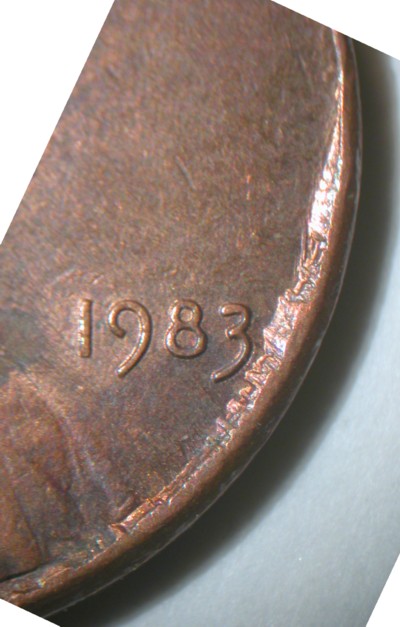
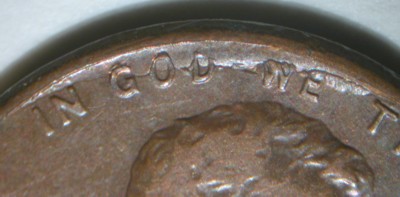
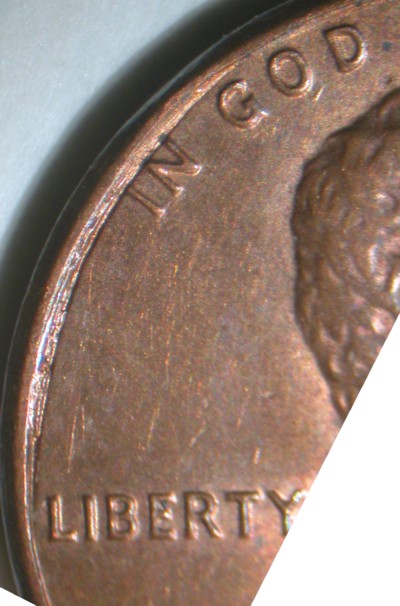
Below are four examples of peripheral die damage.

A long strip of peripheral die damage on the right side of a 1983 Lincoln cent extending from 3:00 to 5:30 (obverse clock position). The internal border has a jagged appearance, but it is clear that it’s not due to a natural, spontaneous fracture. First of all, the design rim appears to be intact, which rules out a cud. Second, within the zone of damage there are numerous short, obliquely oriented ridges extending in from the rim and terminating in the field. These ridges are something you never see in cuds and are clearly the result of mechanical damage.

A second 1983 cent shows a similar case of peripheral die damage. Again, the design rim is intact. This indicates that the damage is restricted to the edge of the field portion of the die or, to put it another way, the medial wall of the rim gutter. Something has chipped or worn away this part of the die.

A third 1983 cent with loss of the outer portion of the field and its replacement by an incuse area of die damage. The cent probably represents a die attrition error. This curved groove is an unusual (but by no means unique) form of die damage and implies the presence of a thin burr extending down from the damaged portion of the die. It would be similar to the burr you get when you file down a piece of metal.
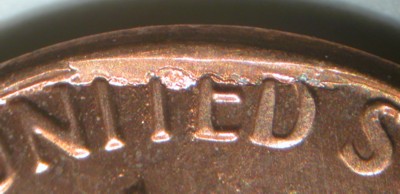
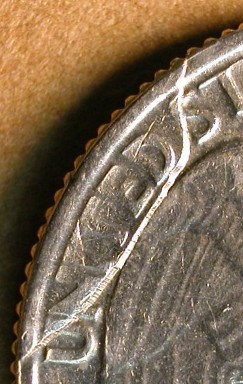
1983 cent with peripheral die damage on the reverse face by UNITED.

Pivoted Die Error

PART VI. Striking Errors:

Die Alignment Errors:

Pivoted die error


Definition:
Any lateral misalignment greater than 10% is likely to involve the entire die assembly.  There just isn’t enough play in the hammer die’s recess to allow this sort of lateral movement.  Even if there was, the die would surely fall out.  It may be that most horizontal misalignments have nothing to do with a loose die and everything to do with an unstable die assembly.

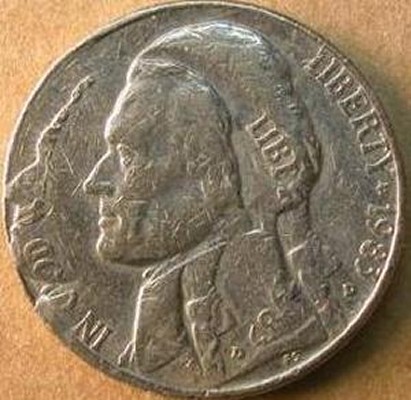
If major horizontal misalignments can be caused by movement of the entire die assembly, then other sorts of lateral movements are also possible.  This 1983-D nickel shows a normal first strike and a possible pivoted die error on the second strike.  The obverse die was shifted to the left about 30% and rotated perhaps 20 degrees.  While this could be a combination of a horizontal misalignment and a rotated die error, it could represent a single movement of the hammer die assembly — a pivot.

In a pivoted die error, the obverse die seems to rotate around a vertical axis that runs along the side of the die shaft and may even occupy empty space lateral to the die shaft.  In actuality, the entire die assembly is pivoting.

As described above, pivoted die errors pose a diagnostic challenge. Unless the apparent rotation is greater than 45 degrees, any potential pivoted die error can also be interpreted as a combination of a horizontally misaligned and rotated die (or die assembly). It takes an unusual error to break this impasse.

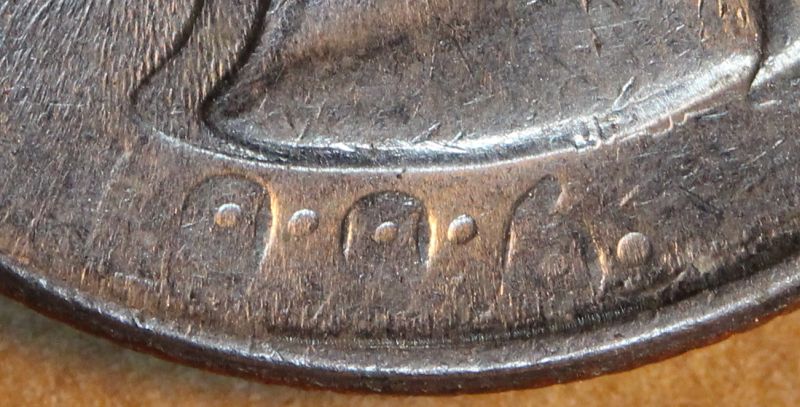
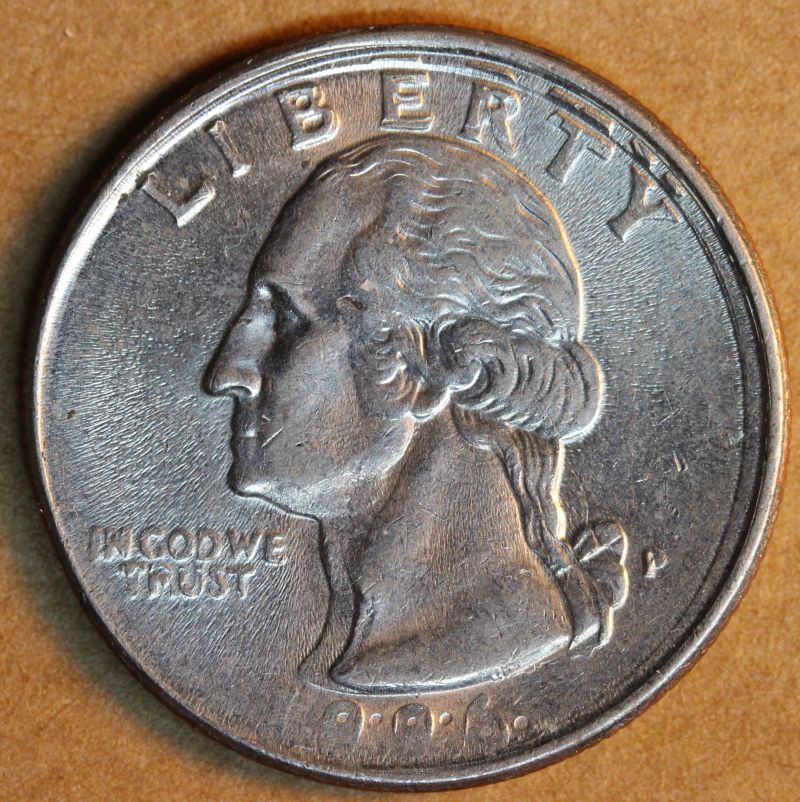
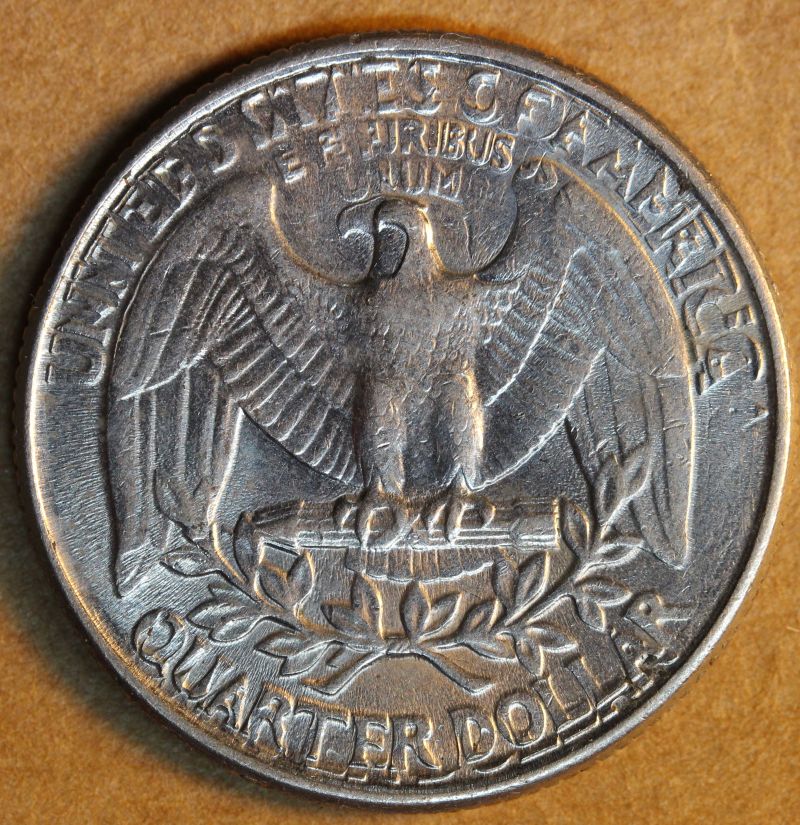
This 1996-P quarter features a centered double strike, with a clockwise rotation of the coin between strikes. The first strike was in-collar while the second strike was out-of-collar (broadstruck). This coin also incorporates a counterclockwise pivot of the obverse (hammer) die between strikes.

As expected, primary and secondary design elements on the reverse face show a consistent rotational offset around the entire perimeter.

The date shows the same rotational offset. However, at the opposite pole, the primary and secondary letters of LIBERTY show a smaller amount of offset that shrinks as one moves from right to left. The first few letters of LIBERTY show no rotational offset at all.

This pattern could only have occurred if the obverse (hammer) die assembly had pivoted counterclockwise as the coin was rotating clockwise. The axis of rotation would have been located near 6:00. Owing to the pivot, the obverse design is shifted slightly more toward the southwest than the reverse is toward the northwest.

Pre-Strike Damage

Part V: Planchet Errors:

Pre-strike Damage:

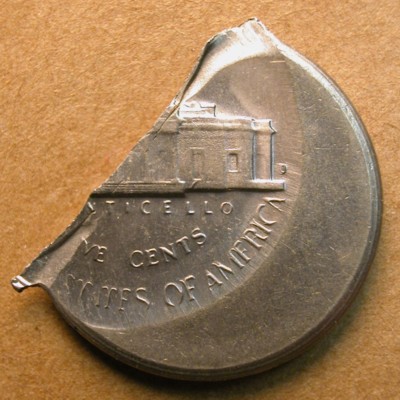
Definition: Pre-strike damage is any damage that occurs after blanking but before the strike.  Its appearance is quite diverse.  Planchets can be scraped, gouged, folded, torn, crimped, cut, and crushed.

In the case of copper-plated zinc cents, damage can occur before plating or after plating.

In the case of Presidential dollars and those Sacagawea dollars with edge lettering, damage can occur after the strike but before lettering is applied.  This can be termed “post-strike/pre-lettering damage”.

Illustrations:
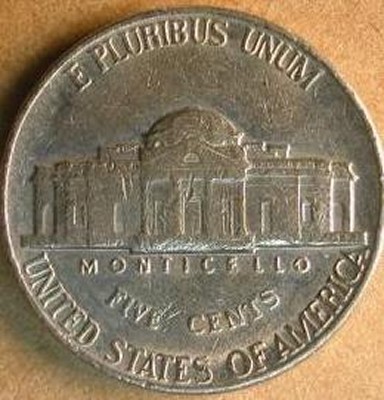
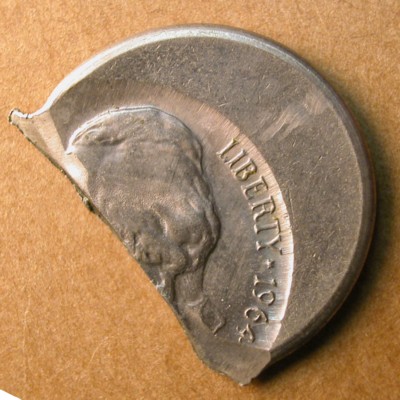
This off-center 1964-D nickel was struck on a planchet that was mechanically severed before the strike.


  • « Previous Page
  • 1
  • …
  • 9
  • 10
  • 11
  • 12
  • 13
  • …
  • 21
  • Next Page »
  • Home
  • Introduction To This Website
  • Error-ref.com News
  • Comprehensive Error-Variety Checklist
  • Index Of Completed Entries
  • Part I. Die Subtypes:
  • Part II. Die Varieties:
  • Part III. Die Installation Errors:
  • Part IV. Die Errors:
  • Part V. Planchet Errors:
  • Part VI. Striking Errors:
  • Part VII. Post-Strike Mint Modifications:
  • Part VIII. Post-Strike Striking Chamber Mishaps:
  • Part IX. Post-Strike Mint Damage:
  • Part X. Wastebasket / Composite Categories:
  • Part XI. Non Errors:
  • Featured Articles Of Interested
  • Interest & Not So Interesting Facts
  • Other Sites And Forums Of Interest
  • Our Thanks Go To
  • About The Authors
  • Contact Us

Copyright © 2026