Error-Ref.com

You are here: Home / Search for "off center"

Search Results for: off center

Partial Off Center Die Caps

PART VI. Striking Errors:

Die Caps:

Partial (off-center) Die Caps:

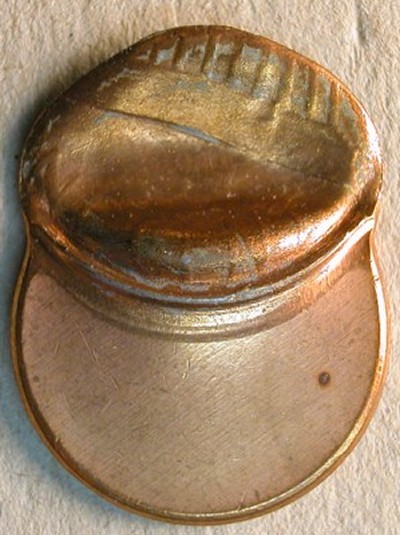
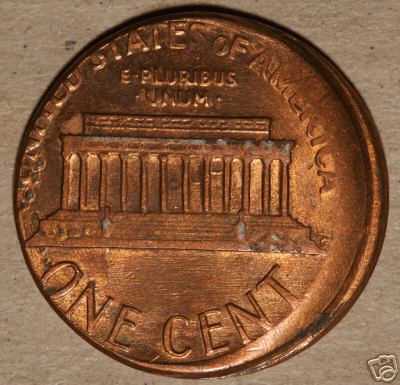
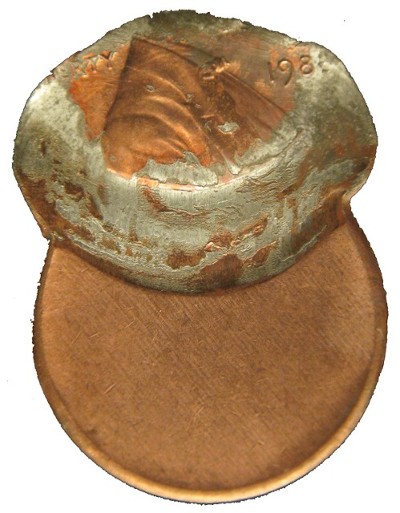
Definition: A partial die cap begins with a coin that is struck off-center and sticks to either the hammer die or the anvil die.  It is then struck into the next planchet, leaving an “aligned” partial brockage (see aligned partial brockage).  Partial die caps involving the hammer die are much more common than those involving the anvil die,since the latter tend to be scraped off by the ejection finger or lifted up by the top of the collar.
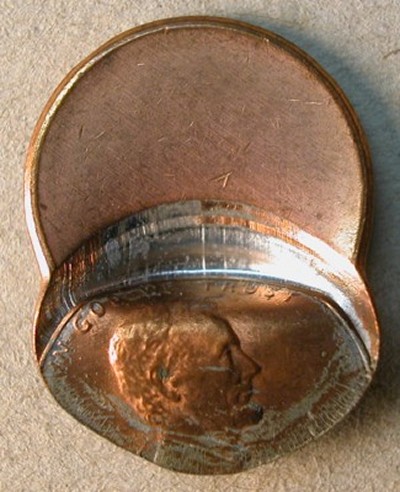
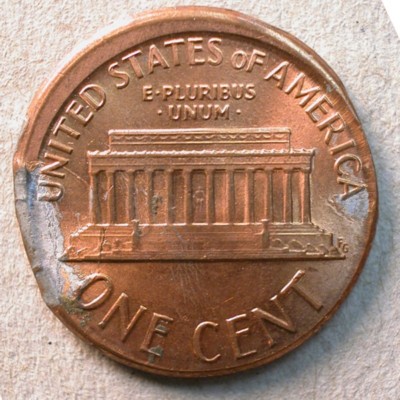
This Lincoln cent is a partial die cap of the hammer (obverse) die.  After it stuck to the obverse die it struck one planchet and fell off.  The raised details of the reverse design are flattened and expanded from that second strike.
Off Center Uniface Stretch Strike

PART VI. Striking Errors:

Off Center Strikes:

Uniface

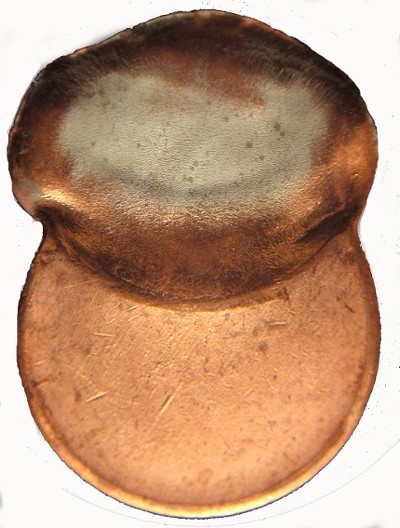
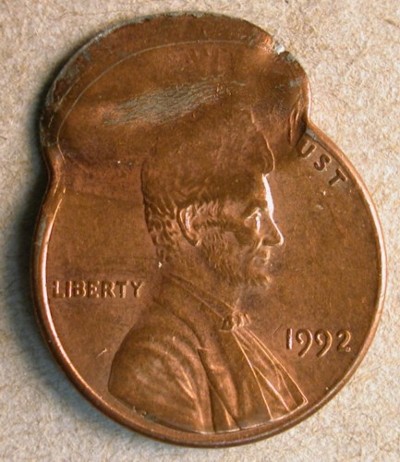
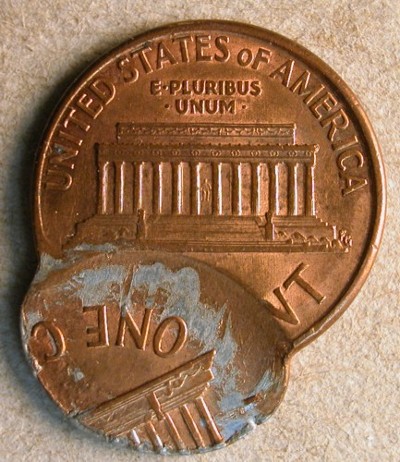
Definition: An off-center strike in which the coin is struck against an underlying or overlying planchet.  The second situation happens less often.  In either case, the face struck against the planchet is featureless; the opposite face is die-struck.  In an off-center uniface strike, the entire face must be featureless.  If any of it is die-struck, it is designated an off-center strike with indent.

Due to the double thickness involved in such an error, effective striking pressure is elevated.  This often produces a “stretch strike” — a coin with an expanded “slide zone”.


This 1988(P) Lincoln cent takes the form of an off-center uniface strike.  It shows an unusual degree of expansion, due either to elevated ram pressure or an unusually small minimum die clearance.  The slide zone in this “stretch strike” is correspondingly wide.
 The second strike on this 1992 cent was off-center with a uniface obverse.

Off Center Strike With Collar Scar

PART VI. Striking Errors:

Off Center Strikes:

With Collar Scar

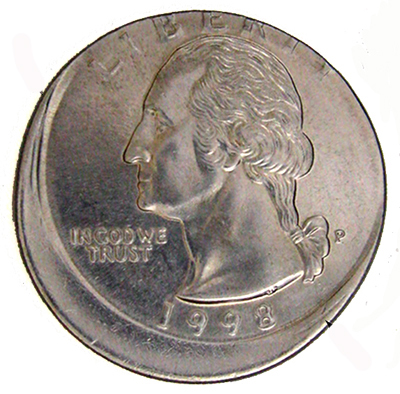
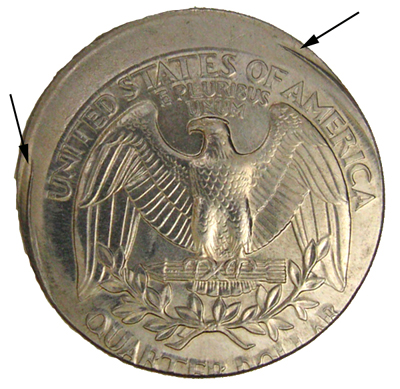
Definition:  An off-center strike will often show a collar scar on the face struck by the anvil die.  A collar scar is a semi-circular groove that lies lateral to the die-struck design and the location of the design rim.  The collar scar is produced when the protruding portion of the off-center planchet is forced down upon the top of the collar by the descending hammer die.  The strength and completeness of the collar scar varies considerably, and a significant fraction of off-center strikes show no collar scar at all.

The above off center struck 1998-P Washington quarter has collar scars on the reverse of the coin (indicated by the black arrows).

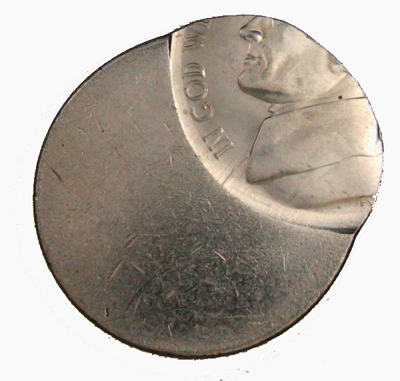
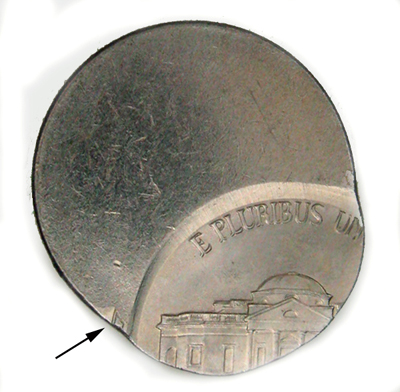
The above undated Jefferson nickel shows a small area of where the collar indented the planchet (indicated by the black arrow).

Cupped Off Center Strike

Part VI. Striking Errors:

Off-center Strikes:

Cupped Off-center Strikes

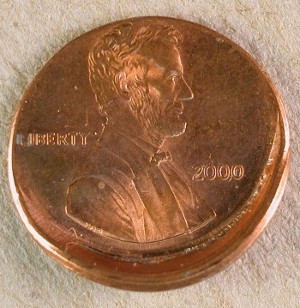
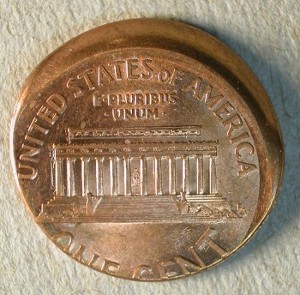
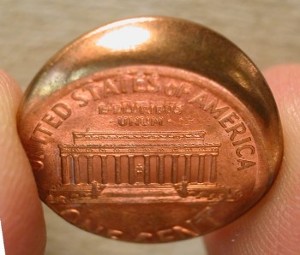
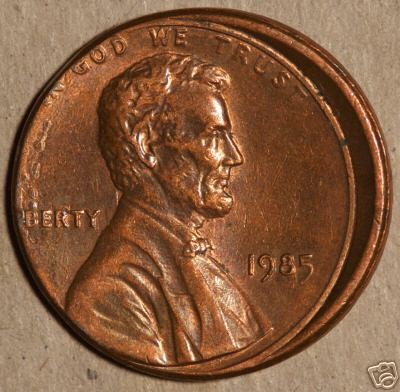
Definition:  As is the case with broadstrikes, off-center strikes can show degrees of cupping ranging from nil to 90 degrees.  In many cases there’s no obvious cause for the cupping.  In other cases, the unstruck portion of the planchet is forced up by a stiff collar.

This 2000 cent shows extreme cupping with no obvious cause.  The wall sticks up about 75 degrees from the horizontal.  No trace of a collar scar is visible on the reverse face (the face struck by the anvil die).


The unstruck portion of this 1985 cent shows significant cupping. It was forced up as the planchet was driven past a stiff collar.  This specimen is therefore a combination of an off-center strike and a stiff collar error.  The collar scar is starkly obvious on the reverse face.


Multiple Strikes On-Center/Off-Center

PART VI. Striking Errors:

Multiple strikes: 

On-center/Off-center

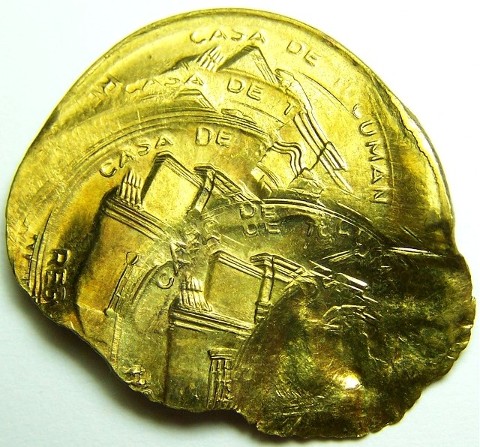
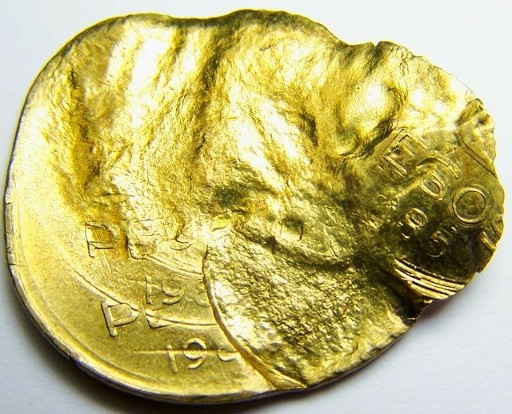
Definition: Multiple strikes can be either on-center or off-center. The reasons for multiple strikes are as varied as the number of strikes that can occur. Ejection failures which prevent a planchet to correctly discharge from the striking chamber are numerous.

A 1985 10 pesos from Argentina which has been struck off-center a minimum of 17 times. This coin was highly distorted by several other planchets entering the striking chamber. Complete details of each strike were obliterated by these intruding planchets.

Edge Strike: With Off-Center Or Broad Strike

PART VI. Striking Errors:

Edge Strike:

Off-center or Broadstrike Produced by Continuation

of the Down Stroke


Definition:
An edge strike is a coin struck on-edge.  It may have entered the striking chamber spinning on its edge.  It may have been kicked up into a vertical position by the insertion finger.  It may have entered the striking chamber rolling along on its edge.  Or it may have been flying through space and managed to get caught by the descending hammer die.

After initial contact, an edge-struck planchet slips and falls on its side.  During this phase it is often kicked out of the striking chamber.  The impact on the edge may cause the planchet to bend.  The presence and severity of the bend is highly variable. The reason the planchet slips may be because it might have not have been perfectly vertical or it might have been sitting in a sloping recess of the die face that caused it to slip.  In either case, folding is not complete.  If it was, the coin would have been converted into a foldover strike (see foldover strike).

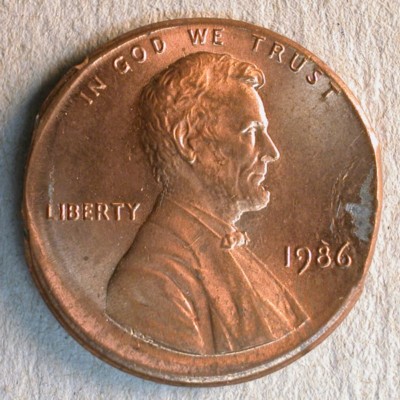
An edge strike can appear at both poles of an otherwise unstruck planchet.  A coin can receive a second strike that also happens to be an edge strike.  Sometimes an edge-struck planchet slips and lands on its side within the striking chamber.  It then receives a conventional strike (centered or off-center) during the completion of the  downstroke of the hammer die.  The last eventuality is illustrated here by a 1986 cent.
This broadstruck 1986 cent was initially struck on-edge.  The edge struck by the obverse die shows the front of Lincoln’s face.  The edge struck by the reverse die shows what appears to be a distorted base of the Lincoln Memorial.  In this same area, some metal was dragged onto the reverse face, creating a small foldover flap (a “paraxial” foldover strike).
 
After being contacted on-edge by the two dies, the coin slipped and fell on its side whereupon it was struck during the completion of the downstroke of the hammer die.  The edge strike and the centered strike were therefore all the result of a single downstroke.
 

Struck Over Pre-Existing Wrong Planchet/Off-Metal Error

Part V. Planchet Errors:

Wrong Planchet and Off-Metal Errors:

Double Denomination Errors:

Struck Over Pre-Existing Wrong Planchet/Off-Metal Error

Definition: A design struck over another design (either domestic or foreign) which was, in turn, struck on the wrong planchet.  Such errors are quite rare, with a significant proportion intentionally fabricated inside the mint.

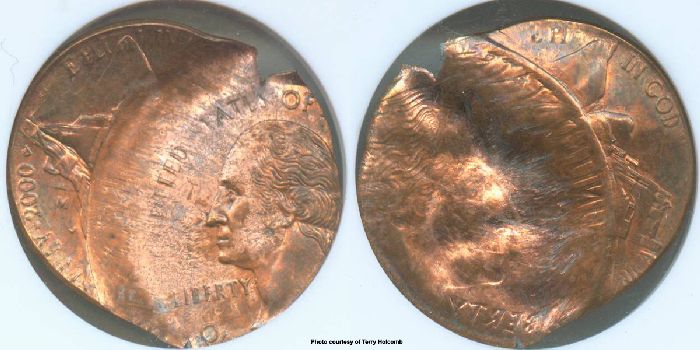
This state quarter design was struck over a 2000-P nickel design which had been, in turn, struck twice on a cent planchet.  The quarter strike was off-center and has a first-strike brockage of the obverse quarter design on its reverse face.  This error may have had some assistance in its creation.  Photos courtesy of Terry Holcomb.


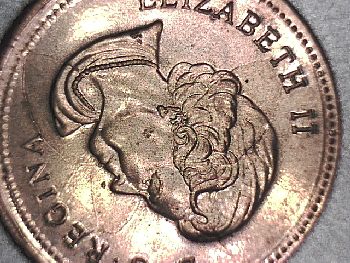
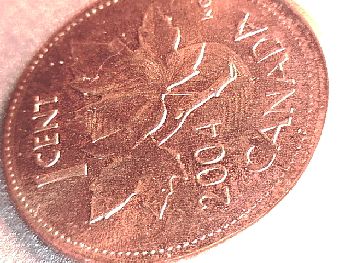
This 2004 Canadian cent design was struck over a 2004 Papua New Guinea 1 tohea design which had itself been struck on a Fiji one cent planchet.  The coin was cherrypicked from eBay by James Zimmerman, who expended a great deal of time and effort in identifying the host coin design and the original purpose of the planchet.  This seems to be a truly accidental error.  Photos courtesy of James Zimmerman.


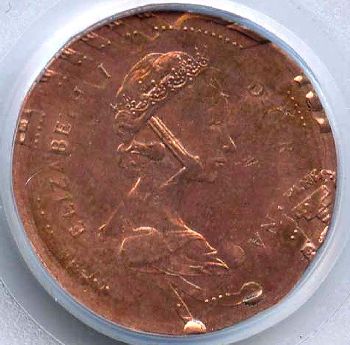
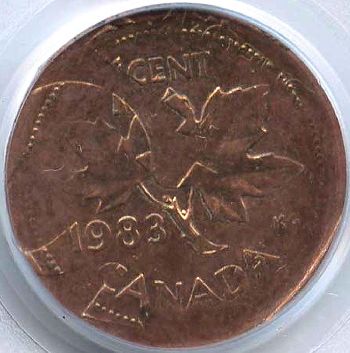
This 1983 Canadian cent design was struck on an Israel 10 shekels design which was originally struck on a Canadian 1 cent planchet.  As such, the final strike generated a dual country / double-denomination error but not a wrong planchet error.  This is almost certainly an intentional error because it was struck in-collar.  The original off-metal coin would have to have been resized after the first strike, which would have caused the coin to expand beyond the diameter of the collar.  Photos courtesy of Fred Weinberg.


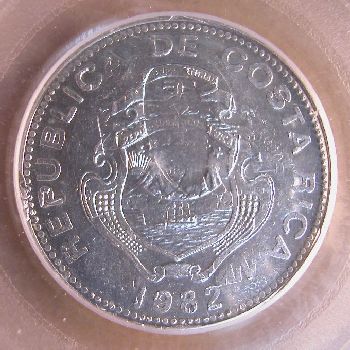
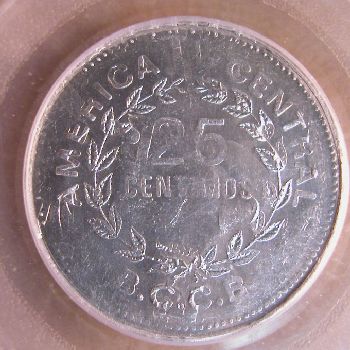
This 1982 Costa Rica 25 centavos design was struck over an Israel 10 shekels design which had originally been struck on a Costa Rica 25 centavos planchet.  As with the previous coin, the final strike generated a dual country/double denomination error but not a wrong planchet error.  And as with the previous coin, the last strike was in-collar, which would have required resizing of the expanded off-metal 10 shekels.  Photos by Mike Diamond

Wrong Planchet And Off Metal Errors

PART V: Planchet Errors:

Wrong Planchet and Off Metal Errors

Definition: A wrong planchet error is exactly what the name indicates – a coin struck on a planchet intended for another denomination (domestic or foreign).  The incorrect planchet may have the same composition (e.g. a quarter struck on a dime planchet) or it may be a different composition (e.g., a quarter struck on a nickel planchet).

An off-metal error is a coin struck on a planchet whose composition does not match the composition that normally characterizes the coin.  While off-metal errors can be wrong planchet errors, this is not always the case.  For example, a dime struck on a copper core is off-metal but is not really a wrong planchet.

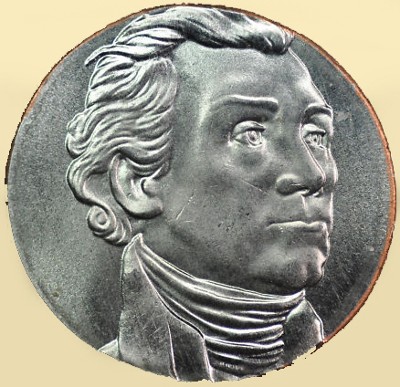
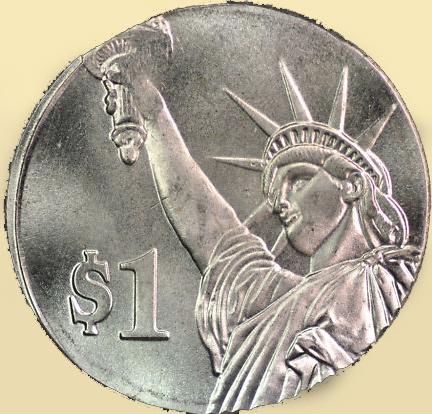
The coin below is both a wrong planchet and an off-metal error.  It is a Monroe Dollar struck on a dime planchet.

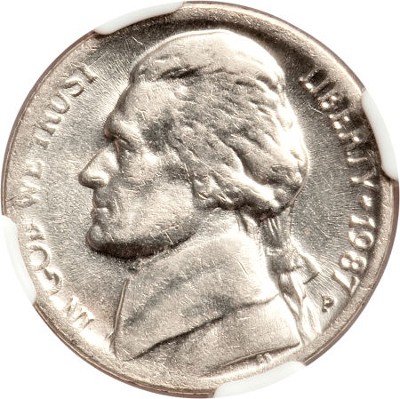
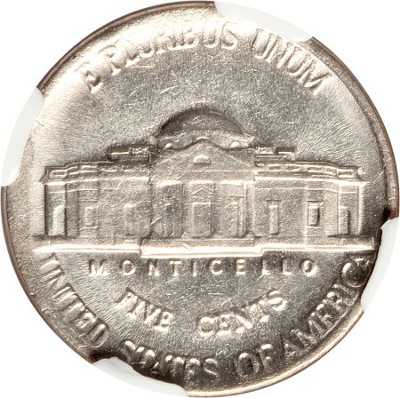
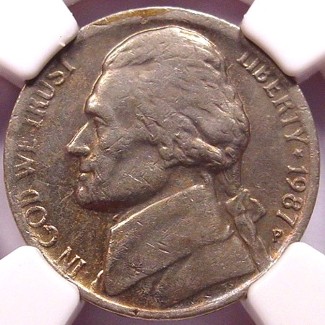
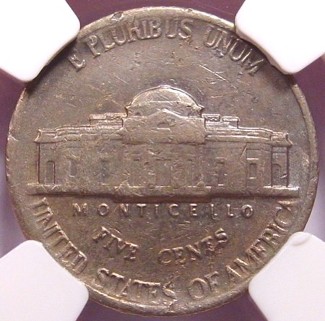
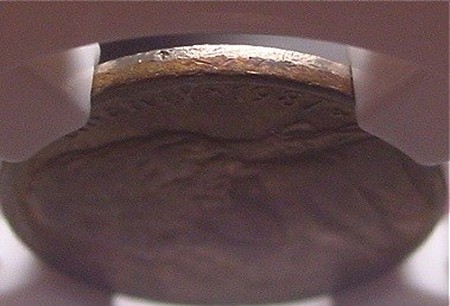
This 1987-P Jefferson nickel was struck on clad quarter dollar stock.  A coil of quarter dollar stock was mistakenly fed into a blanking press punching out nickel blanks.

.

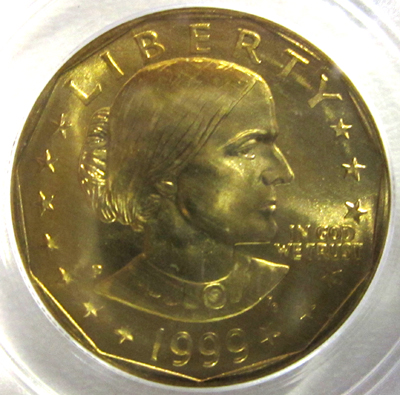
A Sacagawea planchet somehow found its way into the coin press that was striking  1999-P Susan B. Anthony dollars.

 IMG_0619IMG_0622

This coin is comes to us courtesy of Mark Lighterman

Images were taken through an encapsulation.

Wrong Stock: Off Metal

Part V: Planchet Errors:

Wrong Stock:

Off-Metal

Definition:  A wrong stock error emerges when coin metal strip intended for one denomination is sent through a blanking press punching out blanks for another denomination.  The resulting blanks end up with the design and denomination appropriate for the size of the blank.  An example of such an error would be a half dollar struck on quarter dollar stock.

The vast majority of wrong stock errors do not involve a change in the coin’s composition.  A quarter dollar struck on dime stock will still have a normal copper-nickel clad composition.

Wrong stock errors involving strip of the wrong composition are very rare.  Why this is so is rather obvious.  It’s easy to switch coils of metal that are identical in every respect except thickness.  But when the stock has a different color on its surface or edge, that difference is hard to miss.

The best-known off-metal, wrong stock error is a 1987-P nickel struck on copper-nickel clad quarter stock.  The
illustrated coin and the small number of other known specimens weigh around 4.2 grams, which is exactly what you’d predict given the thinner cross-sectional profile of the quarter strip.  Photos courtesy of Jon Sullivan

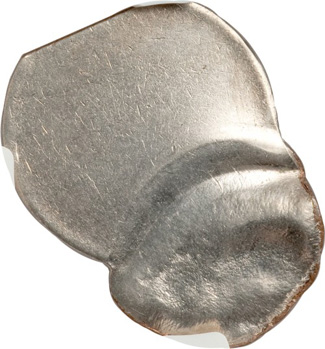
Here a nickel design was struck off-center on a clad planchet that has a straight clip at one pole.  Although no measurements have been taken of this specimen, its diameter seems to match that of a nickel and its thickness seems compatible with a quarter planchet.  It’s almost certainly struck on quarter stock.  In fact, this specimen is probably derived from the leading edge of the same strip that spawned the 1987-P nickels.

Photos courtesy of Heritage Auctions.

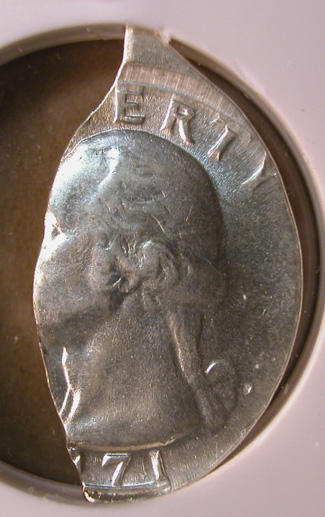
This 1971-D quarter was struck off-center on a quarter-sized silver-clad planchet with a large straight clip.  According to NGC, it weighs 2.4 grams.  The composition is said by NGC to be 80% silver and 20% copper.  It is assumed that this is just a measurement of the surface composition.  This ratio of metal is found only in the clad layers of half dollars minted between 1965 and 1970.  However it also appears in the clad layers of half dollar-size Panama 1/2 balboas produced by the San Francisco Mint between 1967 and 1975.

The planchet is indeed silver-clad, with clad layers composed of 80% silver and 20% copper.  A darker core is visible which is presumably composed of 79% copper and 21% silver.  As in typical silver-clad half dollars, the exposed core appears gray.

The planchet upon which this coin is struck is no thicker than a quarter; therefore this is not simply obsolete half dollar stock.  It would appear that a coil of silver-clad strip intended for 1970-D half dollars was mistakenly rolled to quarter thickness, labeled quarter stock, and then stored away with normal copper-nickel clad quarter strip.  Then, in 1971, the off-metal strip was retrieved from storage, sent through a blanking press punching out quarter blanks, and the rest is history.  The presence of the straight clip indicates that this planchet is probably derived from the leading end of the strip.  Since this is a unique specimen, I suspect someone quickly realized the mistake and stopped the blanking press before the strip could progress very far.

While it’s possible that contemporarily 1/2 balboa strip was reduced to quarter dollar thickness, I view this as less likely since the 1/2 balboa coins were struck in San Francisco and because this coin was struck only one year after cessation of silver-clad half dollar production.  In 1970, only the Denver Mint was producing half dollars, and these were restricted to mint sets.

Struck Clad Layer: Split Off After Strike

PART V. Planchet Errors:

Bonding / Bonding Mill Errors:

Struck Clad Layer:

Split Off After Strike

Definition: A clad layer will sometimes separate from a coin after the strike.  The detached clad layer will show a normal die-struck design on its outer face, and blurred incuse, mirror-image version of the same design on its inner face.
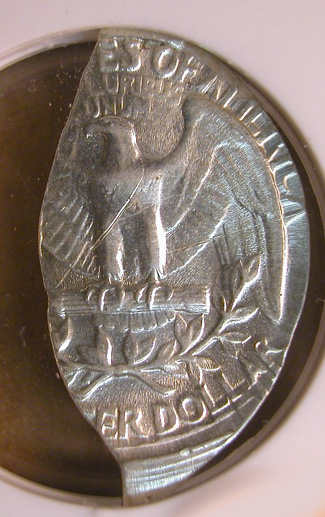
As a practical matter, it is almost impossible to distinguish this error type from clad layers that are struck together with a normal planchet.
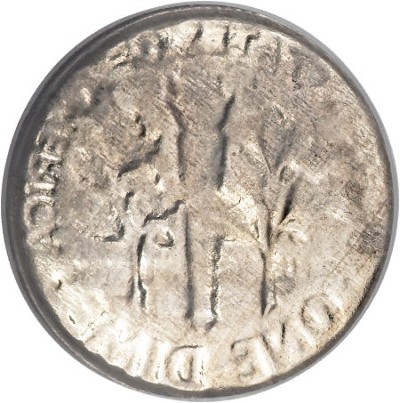
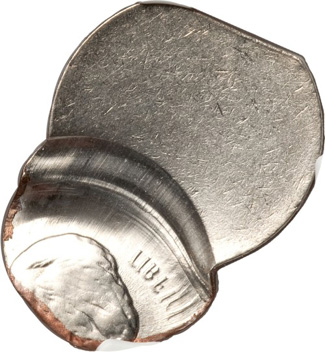
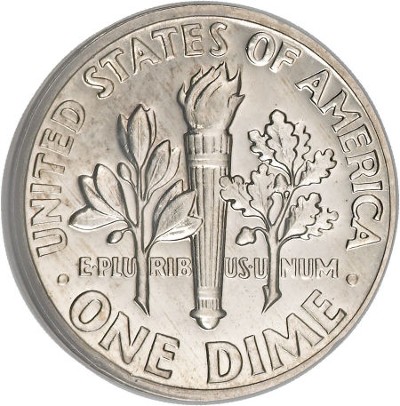
An undated clad layer from a Roosevelt dime is shown below. It may have separated after the strike or it may have been fed into the striking chamber beneath a normal planchet.

Images are courtesy of Heritage Auctions.

  • 1
  • 2
  • 3
  • …
  • 21
  • Next Page »
  • Home
  • Introduction To This Website
  • Error-ref.com News
  • Comprehensive Error-Variety Checklist
  • Index Of Completed Entries
  • Part I. Die Subtypes:
  • Part II. Die Varieties:
  • Part III. Die Installation Errors:
  • Part IV. Die Errors:
  • Part V. Planchet Errors:
  • Part VI. Striking Errors:
  • Part VII. Post-Strike Mint Modifications:
  • Part VIII. Post-Strike Striking Chamber Mishaps:
  • Part IX. Post-Strike Mint Damage:
  • Part X. Wastebasket / Composite Categories:
  • Part XI. Non Errors:
  • Featured Articles Of Interested
  • Interest & Not So Interesting Facts
  • Other Sites And Forums Of Interest
  • Our Thanks Go To
  • About The Authors
  • Contact Us

Copyright © 2026