Error-Ref.com

You are here: Home / Search for "die break"

Search Results for: die break

Chipped Collar

PART IV: Die Errors:

Collar Cuds:

Chipped Collar


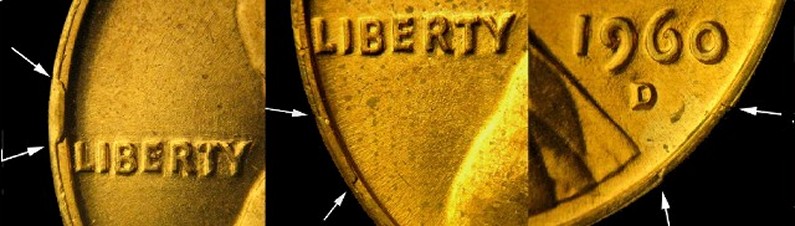
Definition: Bits of the collar can chip off, either spontaneously or as the result of impacts. Collar chips are recognizable on the edge of the coin as small, raised defects. Their appearance differs between smooth-edged and reeded issues. In smooth-edged issues, collar chips typically extend down from the rim struck by the hammer die but seldom reach the opposite rim. In reeded issues they are always vertically oriented and often extend from one rim to the other.

Double-struck 1982 cent with die dents and impact scars on both faces. Two large, contiguous collar chips on the edge extend from 11:00 to 2:00.

Close-up of the two collar chips showing how they extend down from the obverse rim (center image).
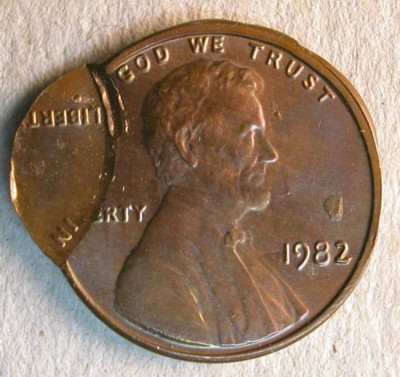
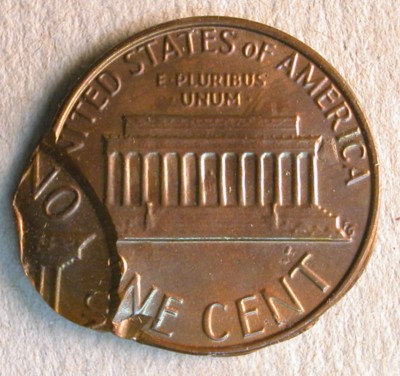
 

The above images show collar breaks on 1960 D small date Lincoln cents.



Class I

Part II. Die Varieties:

Doubled Dies:

Class I (Rotated Hub Doubling):

This class of doubled die is probably the easiest to conceptualize and diagnose.  It emerges from two separate hubbings.  Prior to the second hubbing, the working hub or the working die rotates around its vertical axis (the axis that passes though the center of the hub/die face). Class I doubled dies are listed as showing a clockwise (CW) or counter-clockwise (CCW) rotation.  The direction is determined by which hubbing is clearest and most complete. This is usually the second hubbing (which tends to be deepest).  Exceptions do exist, however.

Doubling typically has a rounded appearance.  When the hubbing impressions are extremely close, the doubled die may only be recognizable from notched serifs and corners, subtle separation lines, or extra thickness.

Below is an overlay diagram of a fictitious Class I doubled die that has a clockwise rotation similar to the King of Doubled Dies, the 1955P DDO-001. Notice how the spread is equal on all devices and increases the farther out you go from the center of the coin.  DDO refers to a doubled die that affects the obverse face of a coin.  DDR refers to a doubled die that affects the reverse face of a coin.

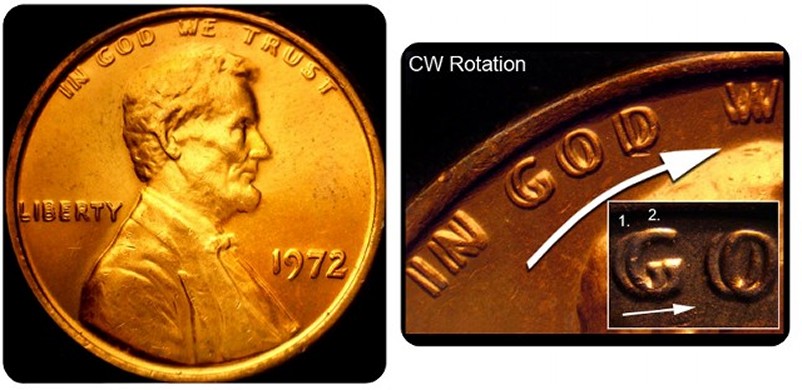
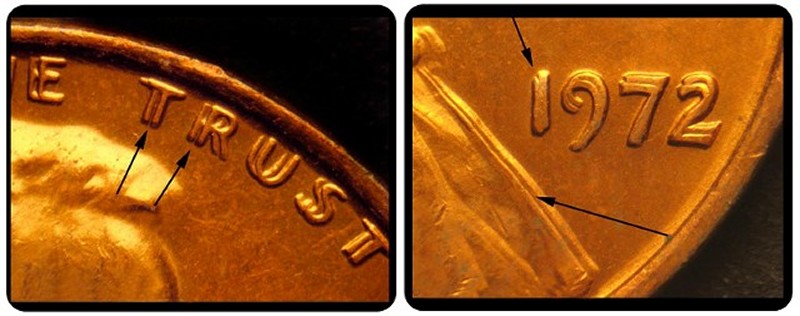
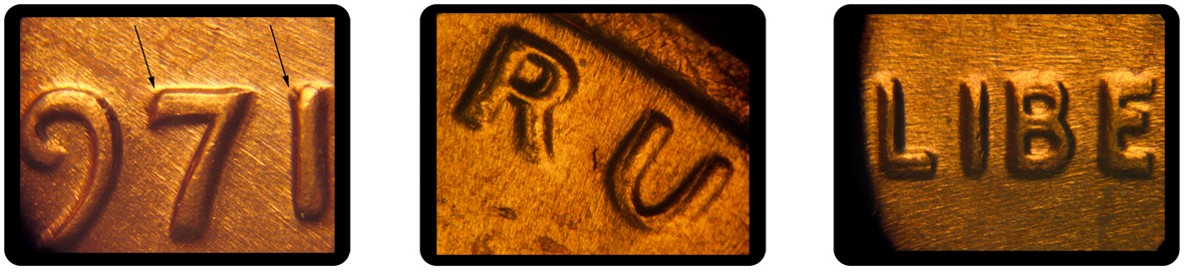
Below are photos of 1972P DDO-001, a Class I DDO with a strong CW spread on all outlying devices and parts of the jacket. A second hubbing typically eliminates interior parts of the design produced by the first hubbing. Therefore doubling is often only detectable in areas bordering the field. Here, only the outside elements of the portrait of Lincoln and the motto show doubling while the centrally-located details are lost to the second hubbing.

Hubbings are ordered from lightest to deepest, either CW or CCW. On the G of GOD you can see that the heavier of the duplicate letters (G-2) is located to the right (clockwise) of the lighter letter (G-1).  It is likely that the heavier letter represents the second hubbing, but this cannot be proven.

Below you can see clear separation between the letters of TRUST. On the first few digits of the date, where design elements are more closely bunched (due to being closer to the center of the design), distinct notching can be seen at the upper and lower corners of numeral 1.

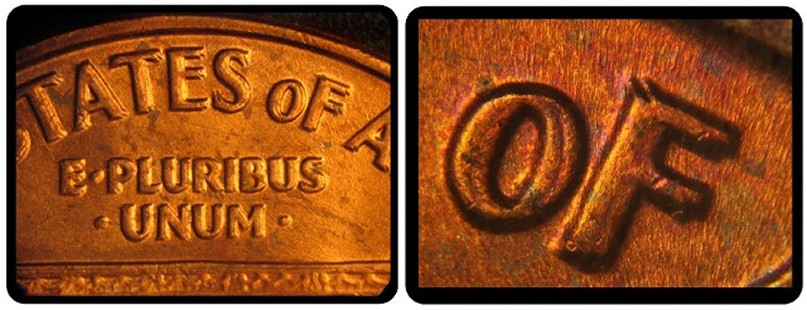
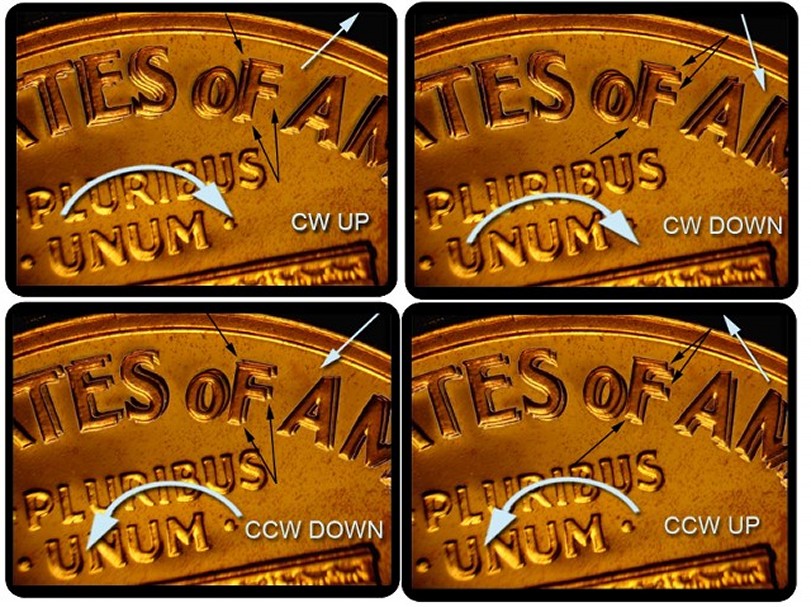
Below is a Class I doubled die on the reverse face of a 1964 cent ( 1964P DDR-001).  It shows a counterclockwise (CCW) spread. Again there is clear separation, notching, and rounded doubling. The doubling is strongest in “STATES oF” due to the axis of rotation being located slightly south of center.

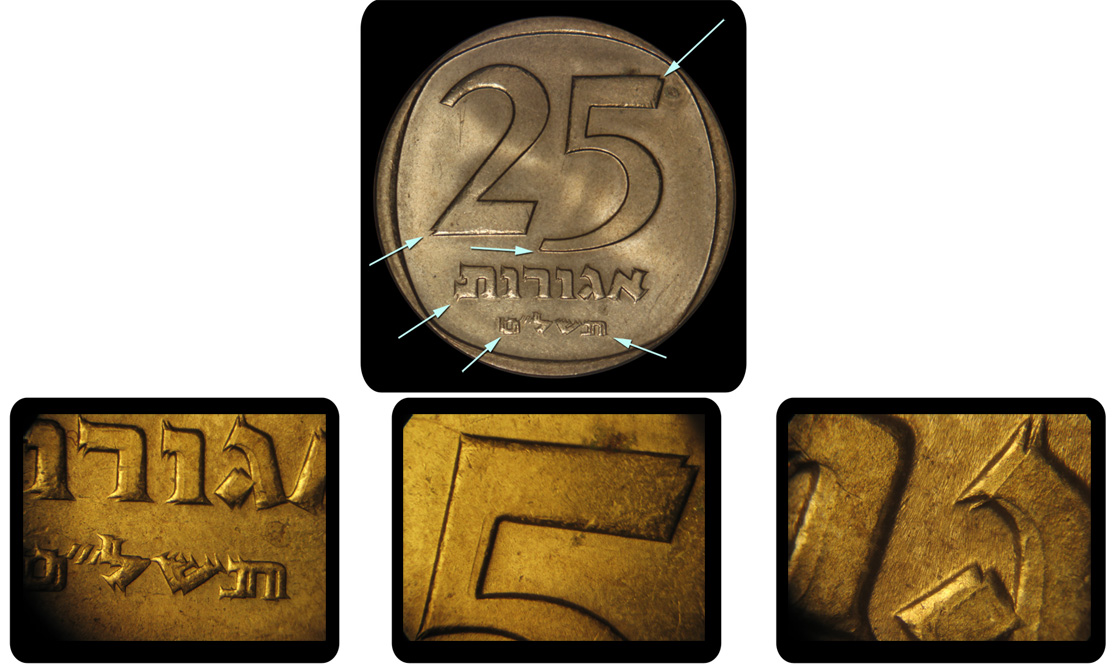
The next example is a DDR on a 1979 Israeli 25 agorot. The spread, best seen in the Hebrew letters located near k12, is elsewhere indicated by notches and subtle separation lines. As would be expected of any Class I doubled die, the doubling is weakest toward the center and strongest toward the perimeter of the coin.

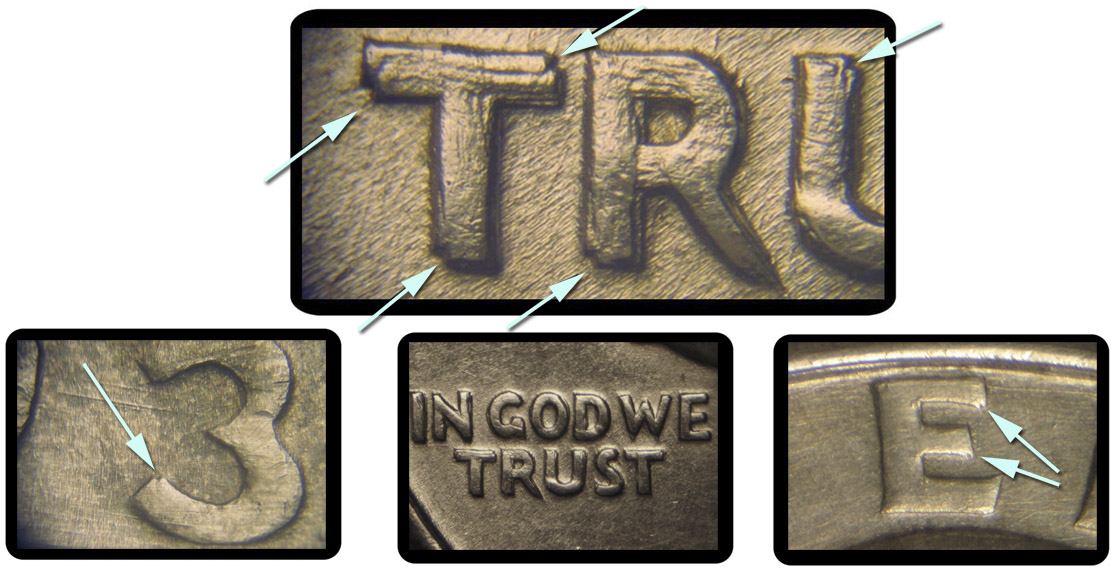
Notching of corners and serifs reflects the presence of closely-spaced letters and numbers.  Often there is a difference in height as well between the closely overlapping design elements. Below is a 1934-D quarter listed as DDO-001 that shows very obvious stepped notching in IN GOD WE TRUST. Subtle doubling, also in the form of notching, is evident on all the peripheral design elements. Detailed photos presented below depict notching in the E of LIBERTY, as well as the 3 of the date.

NOTCHES EXPLAINED:
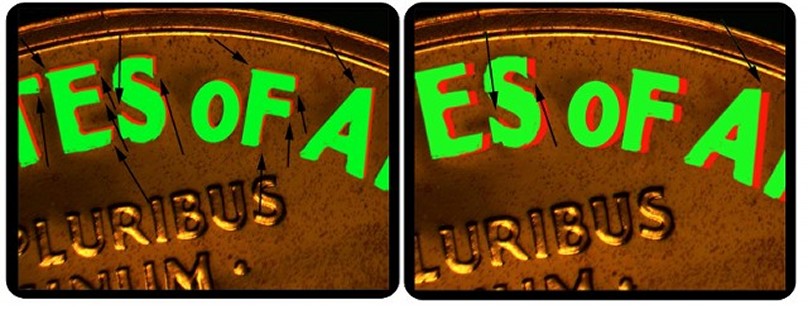
If a die shows hub doubling and there is a rotational shift, the notches will be more apparent. The following illustrations show a hypothetical CCW rotation with Red being the first hubbing and Green the second. The green letters are also slightly south (or down) in relation to the red. While the spread is minor, the notches are obvious. Rounded portions of letters (like the o and S) show the development of a secondary, offset ellipse.

Now we will see a stronger CCW spread where there is very little degree of offset between the hubbings. The result is fewer notches overall, but where the design drops off, such as the serifs on the S or the top of the A, there will be
minor notching or splits. Below are some notching diagrams that will give you an idea of where  Class I (and also Class V) hub doubling can produce notches.

Below are examples of Class I Doubled Dies on various Lincoln cents. 1941 DDO-001

1941 DDO-002

1936 DDO-001

1971 DDO-002

On to CLASS II

All doubled die illustrations are by Jason Cuvelier


Blanking And Cutting Errors

Part V: Planchet Errors:

Blanking and Cutting Errors:

Definition: Any error that can be traced back to 1) the blanking press, 2) the shears, saw, or guillotine that trims the ends of the coin metal strip, or 3) the splitter that divides the coil of coin metal into narrower strips.

Special Note on clipped coins;

Because this sub-section of the Error-Variety Ready Reference is dedicated to “clipped” error coins, it is worth mentioning several diagnostics useful for distinguishing the genuine article from a tampered coin:

1. Blakesely effect. This can potentially develop on any coin struck on a blank whose circular outline is interrupted for any reason, provided that the interruption appeared before the blank entered the upset mill.

The Blakesley effect is located at the pole opposite the deficit. It consists of 1) weakness or absence of the design rim combined with, 2) an especially well-struck edge.

The Blakesley effect reflects the fact that this area of the planchet was never upset. The deficit at the opposite pole prevents the upsetting mill from squeezing the planchet at this point and pushing up a proto-rim.

The Blakesley effect is not always present, especially when the deficit is very large. In the latter case, effective striking pressure is high enough to cause coin metal to completely fill the rim gutter of the die. Effective striking pressure is increased because the entire tonnage of the strike is concentrated on a piece of metal whose area is substantially smaller than a normal planchet.

2. Fade-out and taper of the design rim as it approaches the clip (most clip types will have this feature).

3. “Cut-and-tear texture” on the exposed edge of the clip. Only curved clips and elliptical clips will have this feature. It is also referred to as a “breakaway zone” or a “belly line”. The cut-and-tear texture refers to the microscopic texture of the clipped edge. Part of it is smooth, while part of it is grainy. The grainy part tells you that this was the original bottom of the coin metal strip. As the blanking die (punch) penetrates the coin metal strip, it forces a blank through a hole in a perforated base plate. The sharp, right-angle edge of the blanking die slices through the upper part of the coin metal strip. The lower part of the blank simply tears away from its hole in the coin metal strip as it is pushed down by the flat face of the blanking die.

4. Reversal of position of exposed copper core. This pertains only to curved and elliptical clips in clad issues. In a clad coin, the copper core is asymmetrically exposed along the edge. The position of the exposed copper core “flips” when you transition from a normal edge to the clipped edge. The reason is simple: the normal edge represents the edge of the blank, while the clipped edge represents the edge of the hole.

As the blanking die pushes a blank through the hole in the perforated base plate, the edge of that hole drags the bottom clad layer onto the edge of the blank for a short distance, partly hiding the lower portion of the copper core. Simultaneously, the edge of the blanking die forces some of the top clad layer down onto the edge of the hole in the coin metal strip, partly hiding the upper part of the copper core.

5. Metal flow in design elements bordering the deficit. Metal flow refers to a distortion and stretching-out of letters, numbers, and any other raised feature. It is caused by coin metal “squirting out” beneath the dies.

6. Proper curvature for the type of clip. Be aware that striking pressure and the expansion of the coin can alter the shape of a clip, sometimes drastically. This is especially true if clip is large and if the coin is struck out-of-collar.

MD-13

Die adjustment strike’ remains a persistent, pertinacious myth


By Mike Diamond | May 14, 2011 10:00 a.m. 


Article first published in 2011-05-23, Expert Advice section of Coin World

 This weakly struck 2007 Montana quarter dollar was struck on a Schuler press, which usually doesn’t require adjustment strikes

during setup.

Images by Mike Diamond.

For, many years the writers of this column have made a conscious decision to avoid the term “die adjustment strike” when referring to an exceedingly weak (low-pressure) strike. Synonyms include “die trial,” “test strike,” “trial strike” and “setup piece.” All of these terms assume that a profoundly weak strike represents a coin that was struck as the settings of the coinage press were adjusted.

There is no doubt that die adjustment strikes have been produced through much of the Mint’s history. The word “myth” is instead directed at two common misconceptions; 1) that press adjustment is the sole or primary source of very weak strikes, and 2) that die adjustment strikes escape the Mint in numbers large enough to account for their frequent presence in the marketplace.

Weak strikes arise from two proximate causes — inadequate ram pressure and insufficient die approximation (excessive minimum die clearance). Ram pressure is the tonnage applied to a planchet of normal thickness. Die clearance refers to the closest approach the dies make to each other in the absence of a planchet.

Determining proximate cause

Determining proximate cause is often difficult; assigning ultimate cause is virtually impossible. A simple, centered weak strike could be a die adjustment strike or the product of spontaneous equipment malfunction. The latter category might encompass dies falling out of adjustment, a jam-up in the guts of the press, a mistimed or broken cam (upon which the anvil die rests), a mistimed hammer die, a slack or cracked press frame, a loose or broken knuckle joint, or a broken circuit breaker.

Numerous independent lines of evidence indicate that the vast majority of weak strikes in the marketplace are the product of spontaneous equipment malfunction, with most caused by an increase in minimum die clearance.

Absolute abundance: If weak strikes were the product of die adjustment, they should be very rare, as such test strikes are ordinarily consigned to the furnace. In truth, weak strikes are relatively common. They frequently pop up on the online auction site eBay, and the prices they command are commensurate with their ready availability. Most lower-denomination examples (cent to quarter dollar), cost $50 or less. Shown here is a recently purchased 2007 Montana quarter dollar that cost a mere $35.

Distribution by denomination: If most simple, centered weak strikes were die adjustment strikes, their relative abundance should be proportional to the total number of coins struck and dies used. Cents should therefore be the most common denomination affected by this error.

In my experience, however, the most commonly affected denomination is the dime, followed by the cent, quarter dollar and 5-cent coin. This is exactly the pattern you’d expect from weakness caused by spontaneous press malfunction resulting in insufficient die approximation. Dime planchets are quite thin, enforcing a narrow margin of error when setting the minimum die clearance. Only a slight increase in this safety margin will result in a weak strike. A slight decrease will result in a clash if a planchet is not positioned between the dies — an error that occurs on dimes with great frequency. A larger margin of error exists for thicker planchets.

This distribution pattern is also at odds with the once-popular notion that weak strikes are generated when a press is first turned on and when it’s shut off.

Occurrence with other striking errors: If weak strikes were lucky escapees from a test run, then multi-error weak strikes should be almost nonexistent. In fact, I have observed exceedingly weak strikes in association with a wide range of striking errors: off-center strike, brockaged off-center strike, double strike, triple strike, saddle strike, misaligned die error, rotated die error, clashed dies, indent, partial brockage, full brockage and struck-through. Shown here is a 1983-D Jefferson 5-cent coin with a weak second strike delivered by a rotated (30 degrees) and misaligned (35 percent) hammer die.

http://www.coinworld.com/articles/die-adjustment-strike-remains-a-persistent-pe/

Copyright
2012 by Amos Hobby Publishing Inc. Reposted by permission from the March 22,
2012, issue of Coin World.)


Curved Clips

Part V. Planchet Errors:

Blanking and Cutting Errors:

Curved clips

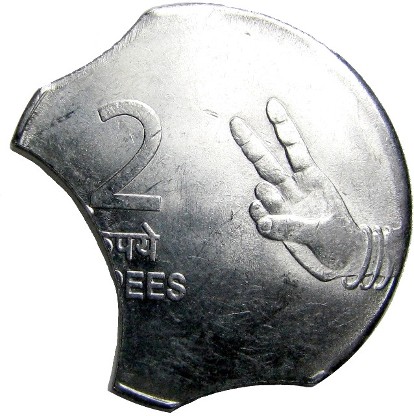
Definition:  A curved clip is generated when a punch (blanking die) overlaps a previously-punched hole in the coin metal strip.  The resulting blank ends up with a concave deficit.  It is believed that a failure  for the coin metal strip to advance properly through the blanking press is the root cause of this planchet error.

Multiple curved clips and overlapping curved clips do occur.

Some prefer the term “incomplete planchet” for this error, but we do not.  “Incomplete planchet” is non-specific and awkward to use.  Saying that a coin was struck on a “curved incomplete planchet” or a “double curved incomplete planchet” creates more headaches than it solves.

Five diagnostics for genuine curved clips are:

1. The pole opposite the clip often shows a weak or absent rim. This is the “Blakesley” effect.

  Special Note: The “Blakesley” effect is not always seen on coins with authentic curved clips which are LARGE.

2. Design elements bordering the clip often show metal flow — a smearing and stretching out of the design.

3. The exposed edge of the clip will usually show a “belly line” or “breakaway zone”. Half of the exposed edge (upper or lower half) will be grainy and the other half smooth.

4. The rim should fade out and taper toward the clip.

5. Reversal of position of exposed copper core. This pertains only to curved and elliptical clips in clad issues. In a clad coin, the copper core is asymmetrically exposed along the edge. The position of the exposed copper core “flips” when you transition from a normal edge to the clipped edge. The reason is simple: the normal edge represents the edge of the blank, while the clipped edge represents the edge of the hole.

For expanded treatment concerning clip diagnostics click here.

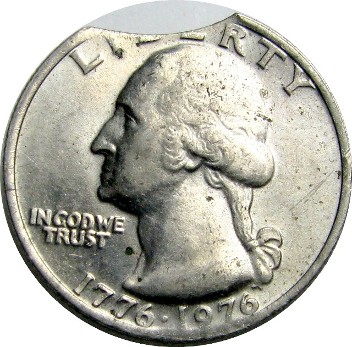
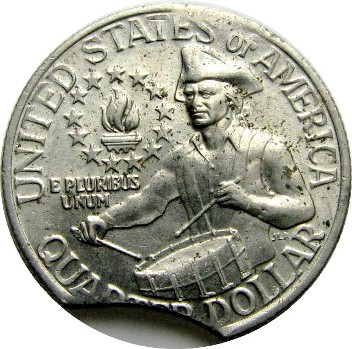
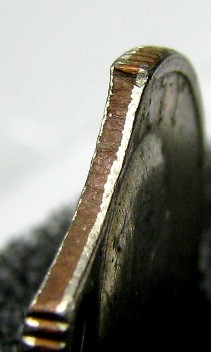
Below is a bicentennial quarter. This specimen displays all five diagnostics for an authentic curved clip on a clad coin. Note the position of the exposed copper core along the edge. The center image illustrates how the core position “flips” from a normal edge and transitions to the clipped edge.


  • « Previous Page
  • 1
  • …
  • 5
  • 6
  • 7
  • Home
  • Introduction To This Website
  • Error-ref.com News
  • Comprehensive Error-Variety Checklist
  • Index Of Completed Entries
  • Part I. Die Subtypes:
  • Part II. Die Varieties:
  • Part III. Die Installation Errors:
  • Part IV. Die Errors:
  • Part V. Planchet Errors:
  • Part VI. Striking Errors:
  • Part VII. Post-Strike Mint Modifications:
  • Part VIII. Post-Strike Striking Chamber Mishaps:
  • Part IX. Post-Strike Mint Damage:
  • Part X. Wastebasket / Composite Categories:
  • Part XI. Non Errors:
  • Featured Articles Of Interested
  • Interest & Not So Interesting Facts
  • Other Sites And Forums Of Interest
  • Our Thanks Go To
  • About The Authors
  • Contact Us

Copyright © 2026