Error-Ref.com

You are here: Home / Search for "mule"

Search Results for: mule

2011 08 11

11th quarter dollar/dollar mule surfaces

Chicago dealer acquires NGC-authenticated coin

By Paul Gilkes-Coin World Staff  July 18, 2011 7:45 a.m.

Article first published in 2011-08-11, New Finds section of Coin World.

NGC graded this most recently reported Sacagawea dollar/Washington quarter dollar error, now the 11th known example, as Mint State 67. It was struck from Die Pair 1. The close-up image shows the diagnostic die crack on the reverse, on the f in of.

Images courtesy of Numismatic Guaranty Corp.
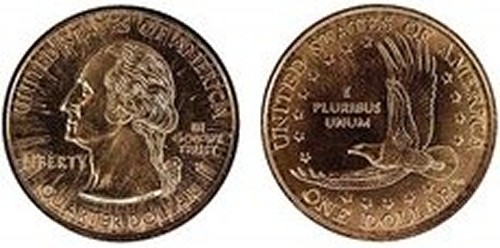
An 11th example of the undated double-denominated Sacagawea dollar/Washington quarter dollar mule error coin has surfaced, 11 years after the first example was found in Arkansas in 2000.

Nicholas P. Brown, owner of Majestic Rarities in Chicago, confirmed to Coin World July 12 his purchase of the coin from its owner, who wishes to remain anonymous. Brown would not disclose the purchase price, and added he had
not yet physically seen the coin.

The coin was submitted to Numismatic Guaranty Corp., which authenticated the coin as an example of the double-denomination mule error and graded it Mint State 67, according to David J. Camire, president of Numismatic Conservation Services, a sister company to NGC for whom he is also the error coin specialist. Camire said the current example is tied for the finest known specimen among the 11 confirmed pieces.

A mule is a coin, token or medal struck with dies not intended to be paired together. What makes the production of this mule error more unusual is that a State quarter dollar obverse die was paired with a Sacagawea dollar reverse die not once, but three times. The known mules are known to have been struck with three separate and distinct die pairs mounted in a coinage press dedicated to the production of dollar coins.

Camire said Brown’s coin was struck from Die Pair 1. The key diagnostic is the reverse for Die Pair 1 exhibits a die crack in the f in of in united states of america that is absent from the reverses from Die Pairs 2 and 3. Complete diagnostics for all three die pairs appear later in this article. Of the now 11 publicly known examples, six are from Die Pair 1, three from Die Pair 2 and two from Die Pair 3. Eleventh example Brown said July 13 that he was one of several persons approached by the unnamed seller about buying the coin, a process that began three weeks before the deal was completed. Brown said once he learned he was the top bidder, he had the seller send the coin directly to NGC for authentication and certification before the transaction would be completed. The transaction was completed, Brown said, after he received confirmation from NGC that the mule had indeed been authenticated as genuine, graded and encapsulated.

Brown would not disclose the specific location of the seller, other than to say the coin came from the East Coast. He said the seller acquired the coin through purchase and held onto it for the past 10 to 10 and a half years. Brown said the individual who sold the coin to him did not learn from the person from whom it was originally purchased how the coin was discovered — whether in change, from a roll or bag of coins, or purchased from someone else.

Brown does not plan to sell the coin at this time, but will have it on display at his table Aug. 16 to 20 at the American Numismatic Association World’s Fair of Money in Rosemont, Ill.

The book 100 Greatest U.S. Error Coins, co-authored by Brown, Camire and California coin dealer and error coin specialist Fred Weinberg, recognizes the quarter dollar/dollar mule as the No. 1 U.S. coin error. The authors suggest that approximately 13 examples are known, but the reference published in 2010 pedigrees 10 publicly known pieces.

Discovery

For error coin collectors, Sacagawea dollars and State quarter dollars offered hobbyists two new series to search through in 2000 in the hopes of finding something valuable. Until May of that year, however, no one suspected that an error would be found that combined designs from both coins.

In June 2000, Numismatic Guaranty Corp. announced that it had authenticated a coin bearing the obverse of a State quarter dollar and the reverse of a Sacagawea dollar, struck on a dollar planchet. The mixture of designs struck by
dies for two different denominations was the first error of its kind confirmed on a U.S. coin in the 208-year history of the U.S. Mint — a type of error called a mule by specialists.

U.S. Mint officials confirmed the mule error in a statement released Aug. 4, 2000.

The quarter dollar/dollar mules discovered in 2000 are undated and bear the P Mint mark for the Philadelphia Mint. The reverse die for State quarter dollars (not used for the mule) bears the date along the top border, the same side as
the design representing the respective state. The date appears on the obverse die for the 2000 to 2008 Sacagawea dollars (also not used).

The first example of the mule was discovered by Frank Wallis in late May 2000 in an Uncirculated 25-coin roll of Sacagawea dollars obtained from First National Bank & Trust in Mountain Home, Ark. The area is part of the St. Louis Federal Reserve District.

NGC graded the Wallis coin Mint State 66, but a month later the coin was crossed over to a Professional Coin Grading Service encapsulation. PCGS also graded the coin MS-66.

Since the original find, grading services have authenticated, in all, 11 examples of the mule. Nine of the coins have been sold, either in private transactions or at auction, at published prices reaching as high as $70,000. Brown notes that the authors of the 100 Greatest book have confirmation of two pieces changing hands for in excess of $200,000. One coin remains the property of the man who found it.

Mint investigation

U.S. Mint officials determined the mules were struck sometime in late April or early May 2000. Coin World sources in 2000 indicated that the Mint may have produced as many as three bins of the coins, although the sources could not tell Coin World what size bins were involved. If the larger of two different bins in typical use at the Mint were involved, the number of mules struck could have totaled several hundred thousand pieces.

When Mint officials discovered the error, they impounded several bins — one that may have contained tens of thousands of the mule errors struck by one press, as well as the bins from two other adjoining coining presses. The coins were ordered destroyed.

Production of the mules led to an intensive investigation by Treasury and Mint authorities. The investigation led authorities to a Federal Reserve-contracted coin terminal and wrapping facility located near the Philadelphia Mint, and authorities advised officials there to be on the lookout for any of the mule errors. An undisclosed number of mules were found at the facility.

While a government investigation found that the errors were produced by mistake and not deliberately, two former Philadelphia Mint coin press operators were prosecuted on charges of selling, but not stealing, up to five of the mules and converting the profits to their own use.

U.S. Mint officials in the summer of 2002 indicated the possibility they might seek forfeiture of some of the double-denomination errors depending on when they were discovered and whether they may have left the Philadelphia Mint
illegally, but to this date officials have not pursued civil forfeiture proceedings.

Three die pairs

Hobby experts by the fall of 2000 had determined that multiple die pairs existed for the coin, which might suggest large numbers of the errors were struck. Government investigators were slow to accept the findings of numismatists that multiple die pairs were used in making the coins; investigators did not accept the findings of numismatists until September 2001.

Here’s how to distinguish the three die pairs:

??Die Pair 1: The reverse for Die Pair 1 exhibits a die crack in the f in of in united states of america that is absent from the reverses from Die Pairs 2 and 3. The obverse exhibits numerous radial striations attributable to stresses involved during striking, resulting from the slight differences in size between the two dies. The discovery coin is from Die Pair 1.

??Die Pair 2: Die Pair 2 exhibits a perfect obverse die, but a reverse that shows three noticeable die cracks: one each projecting from the rightmost points of the stars above the e of one and d of dollar and a third, curved die crack running along the wing directly above these two letters.

??Die Pair 3: For Die Pair 3, the obverse has been described as “fresh and frosty.” The obverse of the Die Pair 3 coins shows just a hint of the radial lines found on the discovery example. A small die gouge appears in front of Washington’s lips. The reverse appears perfect and exhibits no die cracks.

Replicas exist

In addition to the genuine mules, collectors should be aware that altered coins/replicas resembling the mules are also in the market. The pieces are made by several novelty companies and produced by machining out the obverse of a genuine Sacagawea dollar, and then inserting and gluing in a machined-down State quarter dollar with its Washington obverse facing out. The altered piece is then plated over to simulate the color of the Sacagawea dollar.

To identify the replica, look for a seam where the field meets the rim. The altered piece’s weight will be off from the 8.1 grams of a genuine Sacagawea dollar, and the altered piece will produce a thud instead of a distinct ring when tapped, a result of its method of assemblage.

Additional mules surface

Since the discovery of the 2000 mule, several earlier U.S. mules have surfaced and been authenticated: from a 1995-D Lincoln cent obverse die and Roosevelt dime reverse die, struck on a cent planchet; from a 1995 Lincoln cent obverse die and Roosevelt dime reverse die, produced on a dime planchet; and a coin produced from a 1999 cent obverse die and dime reverse die, struck on a cent planchet.

http://www.coinworld.com/articles/11th-quarter-dollar-dollar-mule-surfaces/

Copyright 2012 by Amos Hobby Publishing Inc. Reposted by permission from the March 22, 2012, issue of Coin World.)
2012 03 19

‘Two-tailed’ Canadian cents: mules or pseudo-mules?

By Mike Diamond-Special to Coin World |
March 10, 2012 9:58 a.m.

Article first published in 2012-03-19, Expert Advice section of Coin World

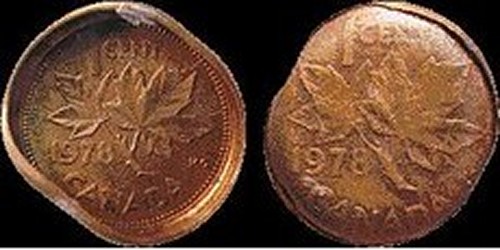
This multi-struck, double-reverse Canadian cent takes the form of a die cap. It could be a two-tailed mule (struck by two reverse dies) or a pseudo-mule.

Images by Mike Diamond.


On page 197 of World’s Greatest Mint Errors (Zyrus Press, 2009), author Mike Byers features a multi-struck 1978 Canadian cent with the reverse design on both faces. The extra strike(s) transformed the coin into a die cap with impressively high walls (see photos).

These details are beyond dispute. What can be questioned is the coin’s status as a two-tailed mule. A mule is a coin struck by mismatched dies. Both Byers and Professional Coin Grading Service state that the coin was struck by two reverse dies, one acting as hammer die and one as the anvil die.

It’s important to note that ordinary Canadian cents are invariably struck with the reverse die acting as the hammer die (the hammer die delivers the impact while the anvil die receives the impact).

Possible pseudo mule?

There’s another, equally plausible diagnosis — that this is a two-tailed pseudo-mule (false mule). Despite carrying the same design on each face, a pseudo-mule is struck using a conventional die setup. The 1978 Canadian cent’s current owner, Chef Ito, sent it to me after I mentioned this possibility.

se events can occur spontaneously or with human assistance. Regardless of its etiology, I strongly suspect that Ito’s coin had help. In 1978 a flood of highly improbable errors emerged from the Royal Canadian Mint, many bearing the cent design.

Dia

A pseudo-mule incorporating the maple leaf design on each face can be created in several ways.

(1) A cent is struck normally, flips over, and lands on top of another planchet. A second strike flattens the original Maple Leaf design while the queen’s bust is obliterated. The double thickness, and the associated increase in effective striking pressure, facilitates complete erasure of the bust.

(2) Two planchets are struck together within the collar, creating two in-collar uniface strikes. In other words, each coin has a blank face. The bottom coin is ejected, while the top coin flips over and lands on another planchet. The original Maple Leaf design is flattened, while the original featureless surface is struck by the hammer die.

(3) A cent sporting an in-collar first-strike brockage of the Maple Leaf design on its bottom face flips over (a brockage is an incuse, mirror-image version of the design). Another planchet is fed on top of the brockaged coin and is struck into it. The bottom face of that newly-struck coin carries a first-strike counterbrockage of the Maple Leaf design.

The

gnosis uncertain

Despite careful study, I was unable to determine if Ito’s coin is a mule or a pseudo-mule. Based on appearance alone, both scenarios seem equally plausible. But from the standpoint of process, a pseudo-mule would seem more likely. Chris Pilliod explained why in an Oct. 2, 2000, Coin World article on a two-headed 1859 Indian Head cent. In most presses, the anvil die has a longer neck than the hammer die. This allows the anvil die to move up and down within the collar and bring the newly-struck coin into the path of the ejection finger. A hammer die installed in the anvil die’s position could not perform this function and, more importantly, could not bring a planchet within range of the properly installed hammer die for a strike.

For a hammer die to act as an anvil die, you need to machine a longer neck. That requires time, equipment, expertise and most problematically, a wider conspiracy. One press operator, working quickly, can create an intentional pseudo-mule. This is probably why all Malaysian double-obverse 1-sen coins show the diagnostic characteristics of a double-struck pseudo-mule (see Feb. 8, 2010 and April 25, 2011, issues of Coin World).

Other Canadian rarities

Two other double-reverse Canadian cents (1980) have been reported (Coin World, Oct. 1, 2001). Both were described and encapsulated as mules. However, both coins show features consistent with a pseudo-mule (see photos of one of the examples, to the left).

(1) One face (“side A”) is sharply struck while the other (“side B”) shows flatter relief and softer details. PCGS reported side B as being “rougher in appearance” while Superior Galleries described a “frosty” surface texture. Both organizations thought Side B was struck by a worn die. However, these attributes are wholly consistent with a second strike against a planchet. Such impacts not only flatten the design, but they often cause a coarsening of the metal crystallites, leaving a matte texture.

(2) Side A has a finned rim. Abnormally high striking pressure caused coin metal to squeeze into the gap between die neck and collar. Two stacked discs could easily have been responsible for an increase in effective striking pressure.

Coin World’s Collectors’ Clearinghouse department does not accept coins or other items for examination without prior permission from News Editor William T. Gibbs. Materials sent to Clearinghouse without prior permission will be returned unexamined. Please address all Clearinghouse inquiries to cweditor@coinworld.com or to 800-673-8311, Ext. 172.

http://www.coinworld.com/articles/two-tailed-canadian-cents-mules-or-pseudo-mul/

Copyright 2012 by Amos Hobby Publishing Inc. Reposted by permission from the March 22, 2012, issue of Coin World.)
2012 04 30

Second cupped, two-tailed Canadian cent surfaces

By Mike Diamond-Special to Coin World | April 14, 2012 9:58 a.m.

Article first published in 2012-04-30, Expert Advice section of Coin World

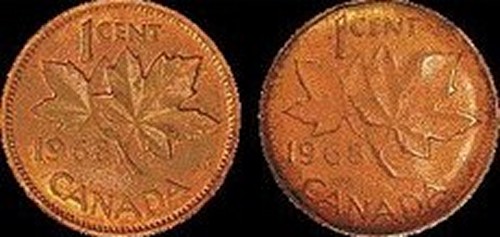
This deeply cupped 1968 Canadian cent carries the reverse design on each face. It is almost certainly a double-struck pseudo-mule.

Images by Mike Diamond.


In the March 19 Collectors’ Clearinghouse column, I reported on a deeply cupped 1978 Canadian cent allegedly struck by two reverse dies. Considered unique at the time, it now has a companion.

After my column came out, I was contacted by Jeff Chapman who sent me photos of a nearly identical example that was struck in 1968. The presence of this second specimen further undermines the idea that either cent represents a two-tailed mule. Chapman’s cent is almost certainly a pseudo-mule that was produced under one of three scenarios described in my earlier column.

1. A cent is struck normally, flips over, and lands on top of another planchet, with the Maple Leaf design facing the planchet. A second strike flattens the original maple leaf design but does not erase it, while the hammer die obliterates the queen’s bust and simultaneously imparts the second Maple Leaf design.

2. Two planchets are struck together within the collar, creating two in-collar uniface strikes. The top coin flips over and comes to rest on the same blank surface or on top of a fresh planchet. The next strike flattens the original Maple Leaf design, while the original featureless surface is struck by the hammer die, which imparts the second Maple Leaf design.

3. A cent sporting an in-collar first-strike brockage of the Maple Leaf design on its bottom face flips over and comes to rest on the anvil die. Another planchet is inserted on top of the brockaged coin and is struck into it. The bottom face of that newly-struck coin carries a first-strike counterbrockage of the Maple Leaf design.

The second scenario would seem to be the most likely explanation for both the 1968 and 1978 cents.

Interestingly, when the 1968 cent was encapsulated by Professional Coin Grading Service, it was provided with a diagnosis entirely different from the 1978 cent. Instead of claiming it was a “die cap struck by two reverse dies,” PCGS described it as an “obverse die cap with reverse counterbrockage.”

It seems PCGS may have entertained a pseudo-mule hypothesis of its own, similar to the third scenario. It’s hard to say for sure, as the description is rather muddled. Chapman’s coin obviously cannot be an obverse die cap, since it is the reverse design that decorates the inside of the cup. Perhaps PCGS meant to call it a reverse die cap. Maybe the grading service was confused in thinking that the Maple Leaf design is on the obverse face. Or perhaps PCGS conflated the hammer die with the obverse die for the cent.

Identifying it as a die cap is easier to understand, but even this claim can be disputed. Effective striking pressure is greatly increased when two discs are stacked on top of each other. If both discs are struck out-of-collar, the top coin will curl up to surround the neck of the hammer die (see the Dec. 7, 2009, Collectors’ Clearinghouse). Only one strike is needed to form an impressive cup.

While the third scenario requires only one strike, scenarios 1 and 2 require two. But since the coin has to flip over between strikes, we still can’t consider the resulting coin a die cap. By definition, a die cap has to be affixed to the same die face through both strikes.

It seems unlikely that the flattened Maple Leaf design on either cent is a flipover, first-strike counterbrockage. Even under carefully managed conditions, the peripheral portions of any first-strike counterbrockage should be closer to the coin’s edge, and might even run off the edge of the coin.

While I haven’t encountered any cupped pseudo-mules among U.S. coins, I have seen coins that were almost certainly struck by them.

Shown here is a Lincoln cent with a perfectly centered, mid-stage flipover brockage of the obverse design on the obverse face. Struck in-collar, it was generated by a “two-headed” pseudo-mule most likely produced under the first scenario. In this case the pseudo-mule definitely became a die cap.

The next specimen is a massively expanded, broadstruck 5-cent coin with an almost perfectly centered flipover brockage of the obverse design on the obverse face. Although faint, the incuse design is complete, establishing it as a first-strike brockage. The strike that generated the brockage also undoubtedly converted the overlying 5-cent coin into a two-headed pseudo-mule (scenario No. 1).

Coin World’s Collectors’ Clearinghouse department does not accept coins or other items for examination without prior permission from News Editor William T. Gibbs. Materials sent to Clearinghouse without prior permission will be returned unexamined. Please address all Clearinghouse inquiries to cweditor@coinworld.com or to 800-673-8311, Ext. 172.

http://www.coinworld.com/articles/second-cupped-two-tailed-canadian-cent-surfac/

Copyright 2012 by Amos Hobby Publishing Inc. Reposted by permission from the March 22, 2012, issue of Coin World.)
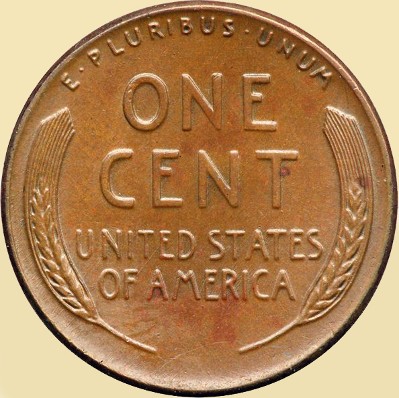
 

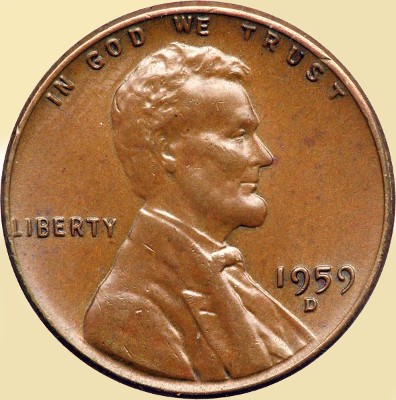
1959-D Lincoln Cent Wheat Back

PART III. Die Installation Errors:

Mules:

Temporal / Transitional Mule:

1959D Lincoln cent with a wheat reverse

There is still an air of mystery surrounding this unique transitional coin. Many feel that this is counterfeit coin. However, the U.S. Mint has confirmed it to be a genuine cent.

The coin was discovered in Walnut Creek, California and originally sold for $1,200 in 1996.

CONCLUSIONS:

“Although the submitted 1959-D Lincoln Cent exhibits the wheat reverse, instead of the Mint specified memorial reverse, the submitted coin exhibits physical characteristics, such as device detail, metal flow, die polish, thickness, diameter, mass and composition, consistent with genuine 1958/59 Lincoln cents. Further, the submitted Lincoln/wheat cent does not exhibit any indications of alterations to the date or evidence of edge alteration, indicating that the submitted coin was a result of combining two genuine coins. Additionally, no characteristics associated with counterfeit coins, such as tool marks, file marks, raised metal or unusual oxidation (“toning”) were observed.”

“In the absence of any evidence that the submitted 1959-D Lincoln/wheat cent is not consistent with having been manufactured by the US Mint, the coin was determined to be a genuine mule (transitional) cent.”

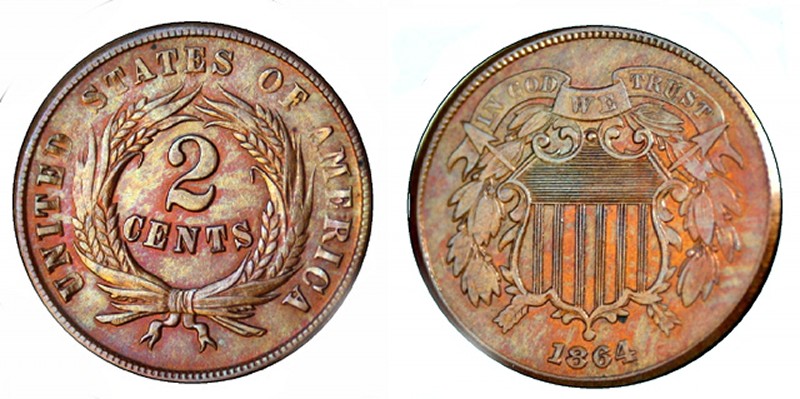
1864 2 Cent Piece Clashed With Indian Head Cent

PART IV. Die Errors:

Die Clashes:

Mule Clash Errors:

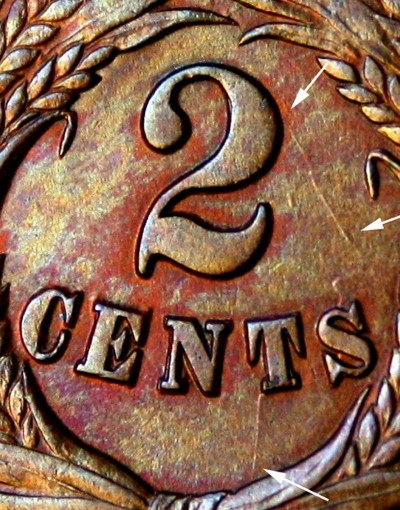
1864 2c reverse die clashed with Indian cent obverse die

Definition: A mule die clash occurs when dies from different denominations clash together.

59533433

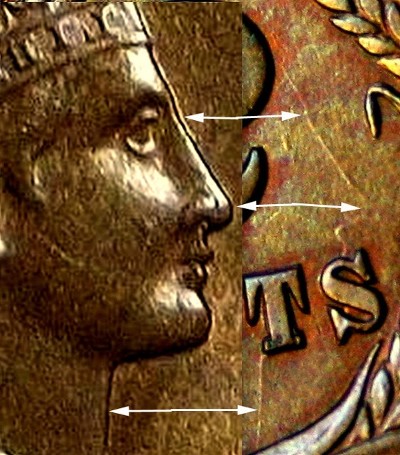
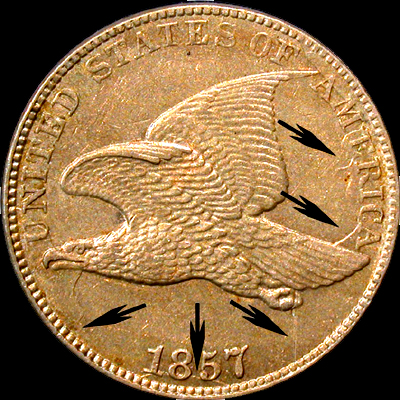
The reverse die that struck this 1864 2-cent piece clashed with the obverse die of an Indian Head cent some time before installation.  All mule clashes are considered to have been intentionally produced. A possible explanation for the three mule clashes found on 1857 Flying Eagle cents was provided by Rick Snow. It can be consulted HERE.

5953367659533683

The image to the left shows the outline of Liberty’s head on the reverse of the 2 cent piece. The image to the right compares the profile of the Indian to the clash marks seen on the reverse of the 2 cent piece. It should be noted that the clash marks are in the medallic position and not in the normal coin orientation.

This example was discovered undiagnosed on eBay by John D. Call.

Images are courtesy of John D. Call,  eBay seller “capped-bust-deals.”

1857 Flying Eagle Cent Clashed With $20.00 Gold Liberty

PART IV. Die Errors:

Die Clashes:

Mule Die Clashes:

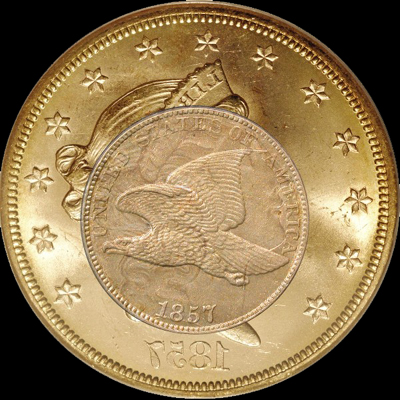
1857 Flying Eagle cent obverse clashed with an 1857 $20.00 Liberty Double Eagle obverse

Definition: A mule die clash occurs when dies from different denominations clash together.

In this clashing of dies, the obverse of the 1857 Flying Eagle cent has been clashed with the obverse of the 1857 Liberty Double Eagle.

For more information concerning this die clash CLICK HERE

1857 Fly Eagle Cent With 1857 Slh

PART IV. Die Errors:

Die Clashes:

Mule Die Clashes:

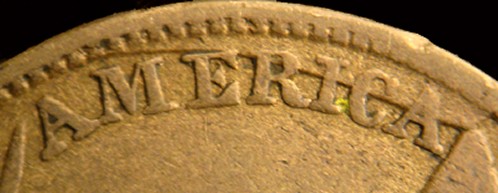
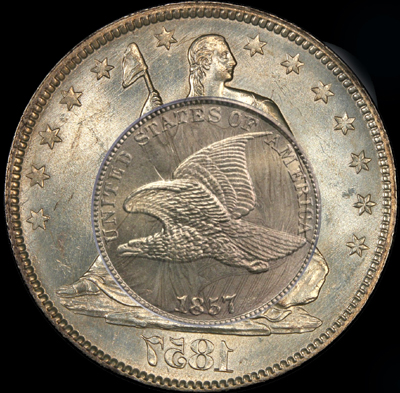
1857 Flying Eagle cent obverse clashed with a 1857

Seated Liberty half dollar obverse

Definition: A mule die clash occurs when dies from different denominations clash together.

The more pronounced clash mark is the line from Liberty’s arm passing through the word AMERICA.

For more information concerning this unusual die clash  CLICK HERE.

1857 Flying Eagle Cent Clashed With 1857 Slq

PART IV. Die Errors:

Die Clashes:

Mule Die Clashes:

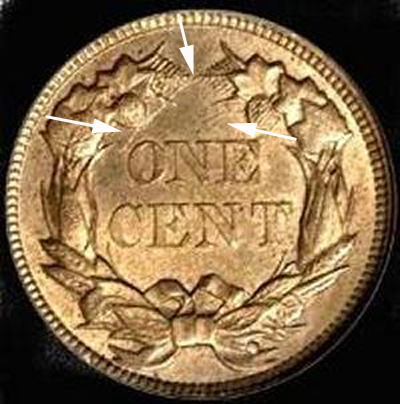
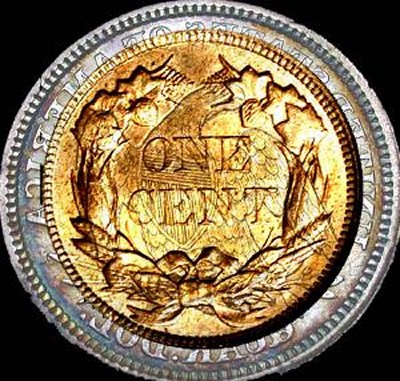
1857 Flying Eagle cent reverse clashed with a 1857

Seated Liberty quarter reverse

Definition: A mule die clash occurs when dies from different denominations clash together.

The head of the eagle from the Seated Liberty quarter can be see clashed into the reverse die of the flyoing Eagle cent above the words ONE CENT.

For more information concerning this clash CLICK HERE

  • « Previous Page
  • 1
  • 2
  • 3
  • 4
  • Home
  • Introduction To This Website
  • Error-ref.com News
  • Comprehensive Error-Variety Checklist
  • Index Of Completed Entries
  • Part I. Die Subtypes:
  • Part II. Die Varieties:
  • Part III. Die Installation Errors:
  • Part IV. Die Errors:
  • Part V. Planchet Errors:
  • Part VI. Striking Errors:
  • Part VII. Post-Strike Mint Modifications:
  • Part VIII. Post-Strike Striking Chamber Mishaps:
  • Part IX. Post-Strike Mint Damage:
  • Part X. Wastebasket / Composite Categories:
  • Part XI. Non Errors:
  • Featured Articles Of Interested
  • Interest & Not So Interesting Facts
  • Other Sites And Forums Of Interest
  • Our Thanks Go To
  • About The Authors
  • Contact Us

Copyright © 2026