2011 04 18

Dimpled Andrew Johnson Presidential dollars defy diagnosis

 By Mike Diamond | April 09, 2011,10:00 a.m.

Article first published in 2011-04-18, Expert Advice section of Coin World

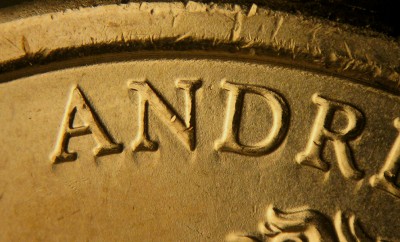
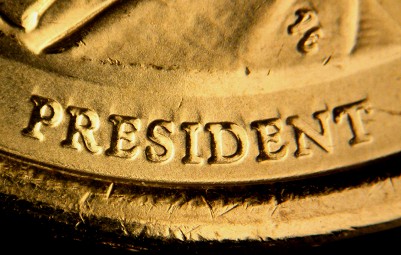
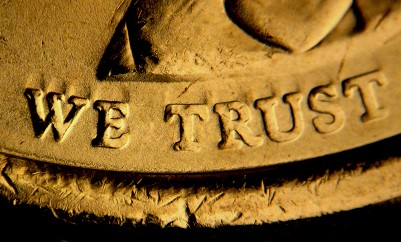
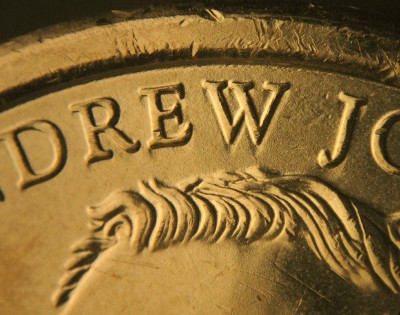
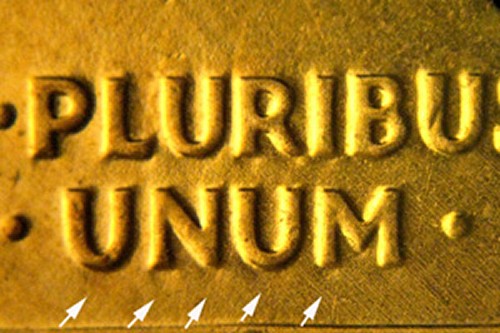
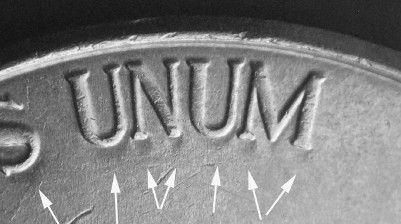
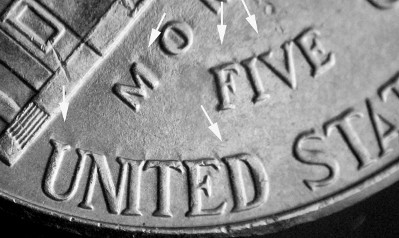
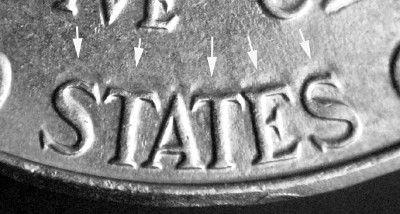
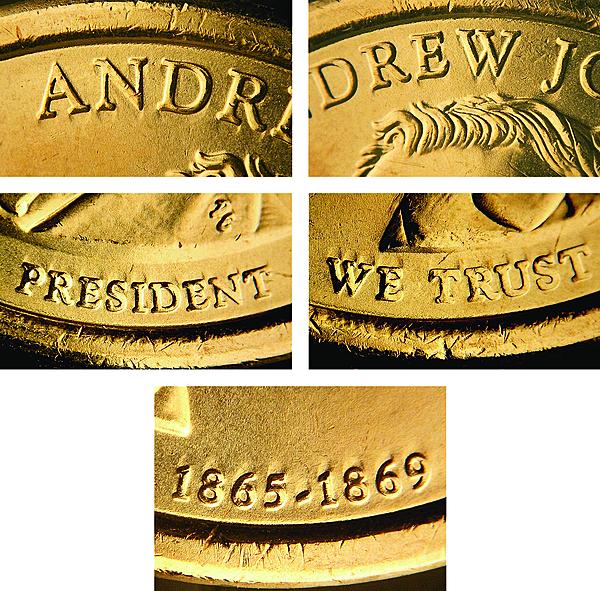
 Dimples extend inward from all the peripheral letters and numbers on the obverse face of this 2011-D Andrew Johnson Presidential dollars. The dimples were apparently produced by corresponding elevations on the field portion of the die. The origin of these elevations is unclear.

 Images courtesy of Mike Diamond

 51810228 (1)

In my capacity as an error researcher I am frequently confronted with unfamiliar and, at times, inexplicable errors. It is an experience that most longtime collectors and researchers find familiar.

My colleague Robert “BJ” Neff was recently handed a doozy of a mystery by error dealer Fred Weinberg. He sent Neff three 2011-D Andrew Johnson Presidential dollars that show a peculiar effect on the obverse face. All of the peripheral design
elements display a shallow dimpled field along their inner side. In other words, the dimples form a centrally directed, converging radial pattern. The effect is easily seen in the accompanying photos, all of which were taken by Neff.

The first problem to address was whether these dimples represented a die error, a planchet error or a striking error. It was immediately apparent that the anomaly was present on the die face. The dimples are identical on all three dollars, and a careful study of die markers undertaken by Neff showed that they were all struck by the same die pair. The presence of dimples on the coin means that the field portion of the die face must have been elevated right next to each peripheral design
element.

But what could produce such elevations? My thoughts initially gravitated toward some form of die deterioration doubling. Incuse forms of die deterioration doubling are known among copper-plated zinc cents and on some state quarters. But I’ve never seen a case in which the incuse doubling is located along the inner margin of the normal, raised design elements. Most of the time the doubling extends from the lateral margin of the affected design elements.

Finally, incuse die deterioration doubling is associated with other signs of die deterioration, such as a swollen field or concentric ripples in the field. None of the Andrew Johnson dollars show signs of die deterioration; they seem to conform to an early die state. Still, I can’t entirely dismiss a novel form of premature,
incuse die deterioration doubling.

Could the defects have been present on master die or a working hub? Probably not, since we’d then expect the dimples to be more widespread among Andrew Johnson dollars. Right now it looks like the dimples are restricted to a single working die.

I had to abandon the idea that the dimples were caused by an abnormally soft working hub or an abnormally hard working die. Either could result in slight compression of raised elements on the face of the working hub and possibly displace enough metal alongside each element to a form pressure ridge. However, were that pressure ridge to be driven into the face of the working die, it would leave a recess. And that, in turn, would leave a bump instead of a dimple on the coin.

 Neff has speculated that the dimples arose during the final phases of hubbing as a result of uneven cooling and contraction of the working die face. He correctly notes that the working die heats up during hubbing as the harder working hub forces its way down through the cone-shaped face of the unfinished working die.

After the “squeeze” is completed, the working die begins to cool and, according to Neff, contracts ever so slightly. If the cooling and contraction is uneven and particularly severe, one side of each peripheral recess on the working die face might find its way blocked by the corresponding raised element on the face of the working hub. This could cause a slight pressure ridge to form before the hub is lifted off the die face. The pressure ridge would be responsible for the dimple on the coin’s surface.

While this scenario is possible, I would have expected the phenomenon to have appeared before now and to be much more common.

 Until we have a better understanding of the nature and origin of these dimples, it’s best to assign them a nonspecific designation. I would suggest something along the lines of “dimpled design extensions” or “design extension dimples.” While I’m not a great fan of placeholder terms, it’s the best we can do. We certainly wouldn’t be alone in this. After all, astrophysicists have applied the terms “dark matter” and “dark energy” to phenomena that they don’t understand.

I invite the readers of this column to submit other examples of dimples. Perhaps other dies will show the effect. A larger, more diverse sample might illuminate the situation.


Coin World’s Collectors’ Clearinghouse department does not accept coins or other items for examination without prior permission from News Editor William T. Gibbs. Materials sent to Clearinghouse without prior permission will be returned unexamined. Please address all Clearinghouse inquiries to: cweditor@coinworld.com or to (800) 673-8311, Ext. 172.


http://www.coinworld.com/articles/dimpled-andrew-johnson-presidential-dollars-d/


Copyright
2012 by Amos Hobby Publishing Inc. Reposted by permission from the March 22,
2012, issue of Coin World.)


2011 08 11

11th quarter dollar/dollar mule surfaces

Chicago dealer acquires NGC-authenticated coin

By Paul Gilkes-Coin World Staff  July 18, 2011 7:45 a.m.

Article first published in 2011-08-11, New Finds section of Coin World.

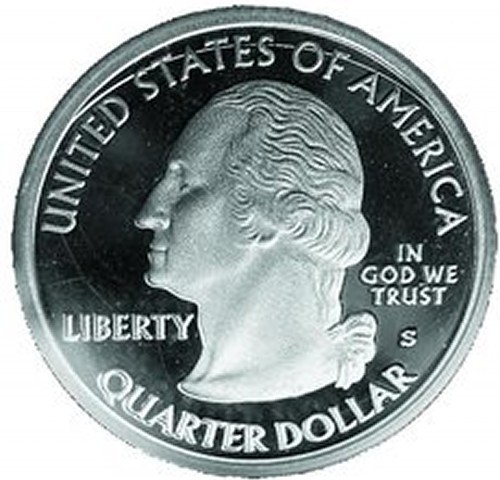
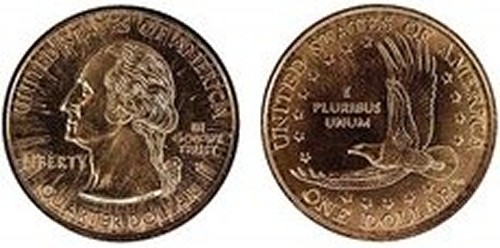
NGC graded this most recently reported Sacagawea dollar/Washington quarter dollar error, now the 11th known example, as Mint State 67. It was struck from Die Pair 1. The close-up image shows the diagnostic die crack on the reverse, on the f in of.

Images courtesy of Numismatic Guaranty Corp.

An 11th example of the undated double-denominated Sacagawea dollar/Washington quarter dollar mule error coin has surfaced, 11 years after the first example was found in Arkansas in 2000.

Nicholas P. Brown, owner of Majestic Rarities in Chicago, confirmed to Coin World July 12 his purchase of the coin from its owner, who wishes to remain anonymous. Brown would not disclose the purchase price, and added he had
not yet physically seen the coin.

The coin was submitted to Numismatic Guaranty Corp., which authenticated the coin as an example of the double-denomination mule error and graded it Mint State 67, according to David J. Camire, president of Numismatic Conservation Services, a sister company to NGC for whom he is also the error coin specialist. Camire said the current example is tied for the finest known specimen among the 11 confirmed pieces.

A mule is a coin, token or medal struck with dies not intended to be paired together. What makes the production of this mule error more unusual is that a State quarter dollar obverse die was paired with a Sacagawea dollar reverse die not once, but three times. The known mules are known to have been struck with three separate and distinct die pairs mounted in a coinage press dedicated to the production of dollar coins.

Camire said Brown’s coin was struck from Die Pair 1. The key diagnostic is the reverse for Die Pair 1 exhibits a die crack in the f in of in united states of america that is absent from the reverses from Die Pairs 2 and 3. Complete diagnostics for all three die pairs appear later in this article. Of the now 11 publicly known examples, six are from Die Pair 1, three from Die Pair 2 and two from Die Pair 3. Eleventh example Brown said July 13 that he was one of several persons approached by the unnamed seller about buying the coin, a process that began three weeks before the deal was completed. Brown said once he learned he was the top bidder, he had the seller send the coin directly to NGC for authentication and certification before the transaction would be completed. The transaction was completed, Brown said, after he received confirmation from NGC that the mule had indeed been authenticated as genuine, graded and encapsulated.

Brown would not disclose the specific location of the seller, other than to say the coin came from the East Coast. He said the seller acquired the coin through purchase and held onto it for the past 10 to 10 and a half years. Brown said the individual who sold the coin to him did not learn from the person from whom it was originally purchased how the coin was discovered — whether in change, from a roll or bag of coins, or purchased from someone else.

Brown does not plan to sell the coin at this time, but will have it on display at his table Aug. 16 to 20 at the American Numismatic Association World’s Fair of Money in Rosemont, Ill.

The book 100 Greatest U.S. Error Coins, co-authored by Brown, Camire and California coin dealer and error coin specialist Fred Weinberg, recognizes the quarter dollar/dollar mule as the No. 1 U.S. coin error. The authors suggest that approximately 13 examples are known, but the reference published in 2010 pedigrees 10 publicly known pieces.

Discovery

For error coin collectors, Sacagawea dollars and State quarter dollars offered hobbyists two new series to search through in 2000 in the hopes of finding something valuable. Until May of that year, however, no one suspected that an error would be found that combined designs from both coins.

In June 2000, Numismatic Guaranty Corp. announced that it had authenticated a coin bearing the obverse of a State quarter dollar and the reverse of a Sacagawea dollar, struck on a dollar planchet. The mixture of designs struck by
dies for two different denominations was the first error of its kind confirmed on a U.S. coin in the 208-year history of the U.S. Mint — a type of error called a mule by specialists.

U.S. Mint officials confirmed the mule error in a statement released Aug. 4, 2000.

The quarter dollar/dollar mules discovered in 2000 are undated and bear the P Mint mark for the Philadelphia Mint. The reverse die for State quarter dollars (not used for the mule) bears the date along the top border, the same side as
the design representing the respective state. The date appears on the obverse die for the 2000 to 2008 Sacagawea dollars (also not used).

The first example of the mule was discovered by Frank Wallis in late May 2000 in an Uncirculated 25-coin roll of Sacagawea dollars obtained from First National Bank & Trust in Mountain Home, Ark. The area is part of the St. Louis Federal Reserve District.

NGC graded the Wallis coin Mint State 66, but a month later the coin was crossed over to a Professional Coin Grading Service encapsulation. PCGS also graded the coin MS-66.

Since the original find, grading services have authenticated, in all, 11 examples of the mule. Nine of the coins have been sold, either in private transactions or at auction, at published prices reaching as high as $70,000. Brown notes that the authors of the 100 Greatest book have confirmation of two pieces changing hands for in excess of $200,000. One coin remains the property of the man who found it.

Mint investigation

U.S. Mint officials determined the mules were struck sometime in late April or early May 2000. Coin World sources in 2000 indicated that the Mint may have produced as many as three bins of the coins, although the sources could not tell Coin World what size bins were involved. If the larger of two different bins in typical use at the Mint were involved, the number of mules struck could have totaled several hundred thousand pieces.

When Mint officials discovered the error, they impounded several bins — one that may have contained tens of thousands of the mule errors struck by one press, as well as the bins from two other adjoining coining presses. The coins were ordered destroyed.

Production of the mules led to an intensive investigation by Treasury and Mint authorities. The investigation led authorities to a Federal Reserve-contracted coin terminal and wrapping facility located near the Philadelphia Mint, and authorities advised officials there to be on the lookout for any of the mule errors. An undisclosed number of mules were found at the facility.

While a government investigation found that the errors were produced by mistake and not deliberately, two former Philadelphia Mint coin press operators were prosecuted on charges of selling, but not stealing, up to five of the mules and converting the profits to their own use.

U.S. Mint officials in the summer of 2002 indicated the possibility they might seek forfeiture of some of the double-denomination errors depending on when they were discovered and whether they may have left the Philadelphia Mint
illegally, but to this date officials have not pursued civil forfeiture proceedings.

Three die pairs

Hobby experts by the fall of 2000 had determined that multiple die pairs existed for the coin, which might suggest large numbers of the errors were struck. Government investigators were slow to accept the findings of numismatists that multiple die pairs were used in making the coins; investigators did not accept the findings of numismatists until September 2001.

Here’s how to distinguish the three die pairs:

??Die Pair 1: The reverse for Die Pair 1 exhibits a die crack in the f in of in united states of america that is absent from the reverses from Die Pairs 2 and 3. The obverse exhibits numerous radial striations attributable to stresses involved during striking, resulting from the slight differences in size between the two dies. The discovery coin is from Die Pair 1.

??Die Pair 2: Die Pair 2 exhibits a perfect obverse die, but a reverse that shows three noticeable die cracks: one each projecting from the rightmost points of the stars above the e of one and d of dollar and a third, curved die crack running along the wing directly above these two letters.

??Die Pair 3: For Die Pair 3, the obverse has been described as “fresh and frosty.” The obverse of the Die Pair 3 coins shows just a hint of the radial lines found on the discovery example. A small die gouge appears in front of Washington’s lips. The reverse appears perfect and exhibits no die cracks.

Replicas exist

In addition to the genuine mules, collectors should be aware that altered coins/replicas resembling the mules are also in the market. The pieces are made by several novelty companies and produced by machining out the obverse of a genuine Sacagawea dollar, and then inserting and gluing in a machined-down State quarter dollar with its Washington obverse facing out. The altered piece is then plated over to simulate the color of the Sacagawea dollar.

To identify the replica, look for a seam where the field meets the rim. The altered piece’s weight will be off from the 8.1 grams of a genuine Sacagawea dollar, and the altered piece will produce a thud instead of a distinct ring when tapped, a result of its method of assemblage.

Additional mules surface

Since the discovery of the 2000 mule, several earlier U.S. mules have surfaced and been authenticated: from a 1995-D Lincoln cent obverse die and Roosevelt dime reverse die, struck on a cent planchet; from a 1995 Lincoln cent obverse die and Roosevelt dime reverse die, produced on a dime planchet; and a coin produced from a 1999 cent obverse die and dime reverse die, struck on a cent planchet.

http://www.coinworld.com/articles/11th-quarter-dollar-dollar-mule-surfaces/

Copyright 2012 by Amos Hobby Publishing Inc. Reposted by permission from the March 22, 2012, issue of Coin World.)

2011 12 26


2011-12-26


Concentric
‘strike lines’ don’t always indicate multiple strikes


By Mike Diamond-Special
to Coin World
 |
Dec. 17, 2011 9:59 a.m.
 

Article
first published in 2011-12-26, Expert Advice section of Coin World


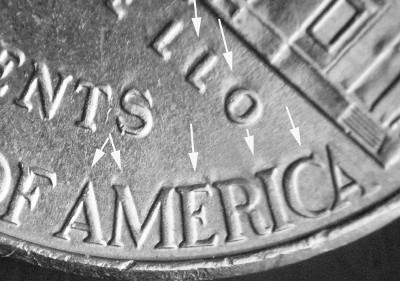
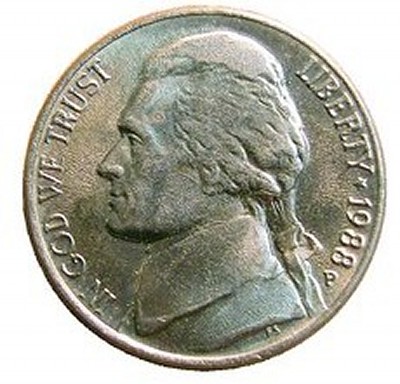
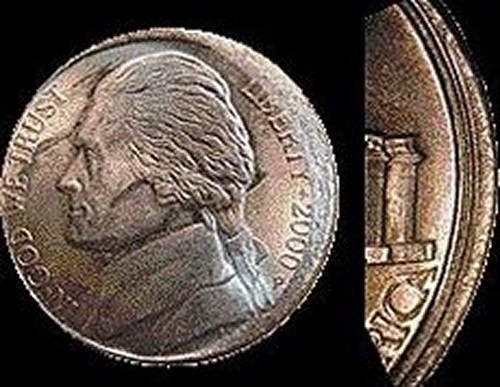
Four concentric strike lines formed on
the reverse face of this broadstruck 2000-P Jefferson 5-cent coin. The faint
concentric lines in the field are unrelated. They are concentric lathe marks —
a die error.


Images by Mike Diamond.


Multiple
strikes are often hard to spot when no movement of the coin occurs between
strikes. Collectors rely on a number of diagnostic clues to identify such
“close multi-strikes.” One such clue is the presence of concentric strike
lines.


Concentric
strike lines are circular or semicircular grooves or steps produced by the edge
of the field portion of the die and sometimes the outer edge of the rim gutter
of the die. An intermediate strike line can reflect the presence of collar
clash, which occurs when the rim gutter is damaged by contact with the top of
the collar. Close examination of spacing, contour and stepwise elevation of the
strike lines is necessary to distinguish those created by multiple strikes from
those that simply result from contact with different parts of the die
perimeter.


Strike
lines are located in the “slide zone” of off-center and broadstruck coins. The
slide zone forms as coin metal squeezes out between the dies and picks up fine
radial striations in the process. A strike line interrupts these striations.


It
would be nice if strike lines always indicated the presence of extra strikes,
but this is not the case. For example, they sometimes form opposite a “stiff
collar” error. The planchet represented by the illustrated 2000-P Jefferson
5-cent coin was not perfectly centered in the striking chamber when it was
struck. The right side rested against a stiff, but still mobile collar. The
obverse face (struck by the anvil die) was left with a sloping, featureless
shoulder that terminates laterally in a strong collar scar. On the reverse
face, four concentric strike lines can be detected between the edge of the
field and the unstruck portion of the planchet.


The
multiple strike lines were produced early in the downstroke as the hammer
(reverse) die skittered across the surface of the planchet as the collar
collapsed.


These
strike lines happen to be a minor expression of a Type I stutter strike. Had
the bounces been higher and wider, a thin crescent of die-struck design would
have been left in the gap between the inner and outer series of strike lines. A
Type I stutter strike is shown in the Dec. 28, 2009, “Collectors’
Clearinghouse” column.


I’m
not sure what caused the extensive series of strike lines present on the
obverse face of the illustrated 1993-P Washington quarter dollar. The broad
crescent on the left carries no fewer than six concentric lines. I doubt they
represent an incipient stutter strike.


On
the reverse face, strangely distant from the die-struck design, are two short but
very deep arcs of collar contact, located at 6:00 and 8:30. At this distance,
I’m skeptical that the collar could have provided sufficient resistance for
even a loose hammer die to skitter. This hypothesis would also have to
incorporate the unlikely assumption that the hammer (obverse) die contacted the
planchet in a very misaligned position and that it skittered its way to a
centered position by the time the downstroke was completed.


An
equally dubious scenario has the planchet squeezing out beneath a jittery
hammer die. Instead of a “slide zone” forming with conventional radial
striations, a series of partial rings was generated. The stumbling block here
is that this presumptive slide zone is far too wide relative to the strength of
the strike, which was quite modest. The slide zone on the reverse face is
extremely narrow.


Almost
as puzzling are the two to three concentric strike lines present on the left
side of the reverse face of a broadstruck 1998-D Roosevelt dime. The coin shows
are no signs of collar contact at all, which would seem to rule out a Type I
stutter strike. Here, at least, it seems possible that the planchet squeezed
out beneath a jittery hammer (reverse) die, leaving a series of curved lines.


Coin World’s Collectors’ Clearinghouse department does
not accept coins or other items for examination without prior permission from
News Editor William T. Gibbs. Materials sent to Clearinghouse without prior
permission 


http://www.coinworld.com/articles/concentric-strike-lines-dont-always-indicate-/


Copyright
2012 by Amos Hobby Publishing Inc. Reposted by permission from the March 22,
2012, issue of Coin World.)


Copyright © 2026