Error-Ref.com

You are here: Home / Search for "radial"

Search Results for: radial

Grease-mediated radial smear

Part VI. Striking Errors:

“Struck-through” errors:

Struck through die fill:

Grease strikes:

Grease-mediated radial smear


Definition: Radial smearing of the design caused by “grease” (die fill).  The edges of the design that face toward the center of the coin are smeared toward the rim.  Radial smearing can affect both interior and peripheral design elements.  Although the mechanism is conjectural, the effect is likely caused by the interplay between viscosity, die convexity, and planchet expansion.  It’s possible that as the die is pushing its way into the planchet it is also squeezing the grease outward.  As the grease makes contact with metal that’s rising into the die’s recesses, it smears the metal outward in a radial fashion.

In rare cases, the direction of smear can be toward the center of the coin, or in both directions simultaneously.

Grease-mediated radial smear is similar in appearance to the metal flow that affects broadstrikes and off-center strikes and to a form of machine doubling called slide doubling.  Although all produce a smearing effect, they are unrelated.
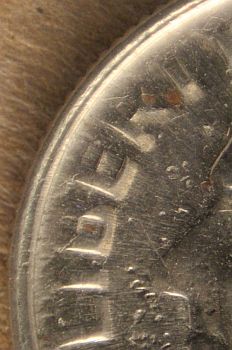
 

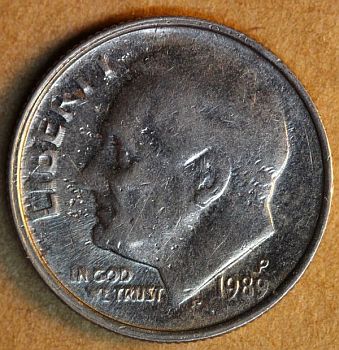
This 1989-P dime shows radial smearing of the peripheral design elements.  The effect is best seen on LIBERTY.  Note that the direction of smear is identical to the radial flow lines that developed in the field portion of the die as the result of die wear.
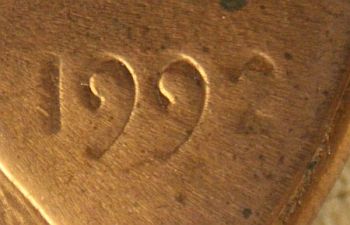
 

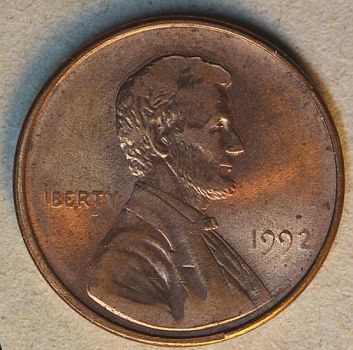
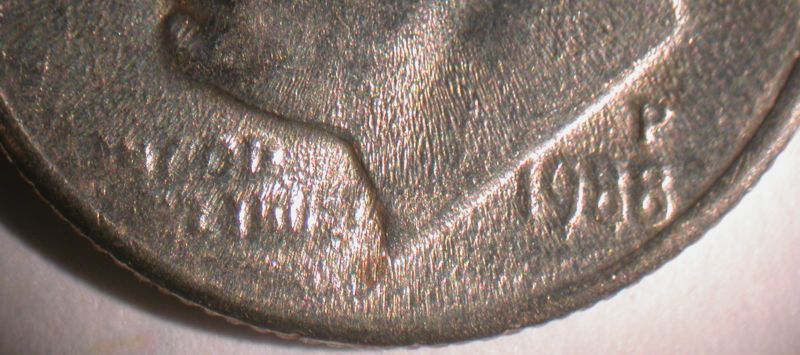
In this specimen, grease-mediated radial smear has affected the date and, to a lesser extent, LIBERTY.  A close-up of the date shows the direction of smear.  Once again, radial die flow lines follow the direction of smear.
Radial Flow Lines

PART IV. Die Errors:

Die Deterioration / Deformation Errors:

Severe Die Wear:

Radial Flow Lines

Definition: As the die ages, the cold metal flow from striking planchets will groove the die face in a radial pattern.

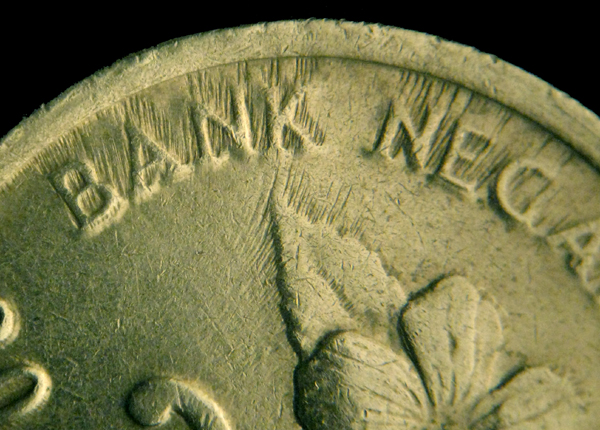
The 20 Sen coin from the Bank Negara Malaysia shows severe die deterioration. The letters in BANK and NEGARA show deep, radial grooved lines caused by cold metal flow. Die deterioration is present around the leaf of the hibiscus flower. The bottom of the letters also show die deterioration doubling.


The 1988-P dime shows strong radial flow lines.

Bilateral Radial Antipodal Die Cracks

Part IV. Die Errors:

Die Cracks:

Bilateral, Radial, Antipodal Die Cracks


Definition: Radial die cracks that develop at opposite poles and converge toward the center of the die face.  These are often mistaken for split dies.  The difference is that these cracks do not meet in the center.  Distinguishing between radial antipodal die cracks and split dies is made difficult by the frequent occurrence of a central zone of subsidence in both types of errors.  In other words, the die face tends to sink in and the design becomes unclear or non-existent within the zone of subsidence.


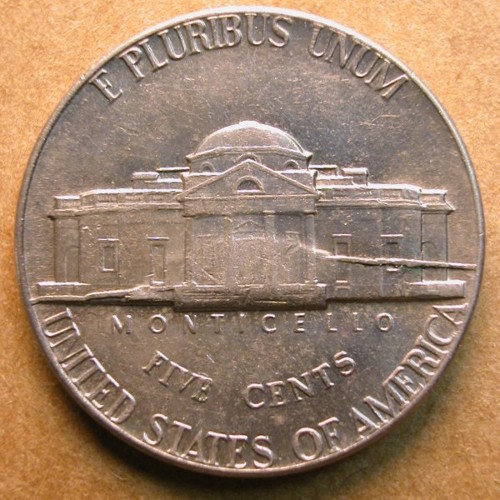
The reverse face of this 1974-D nickel shown above has a pair of radial, antipodal die cracks.  These cracks fail to meet in the center of the design and are not aligned with each other.  Although there is a die subsidence error in the center of the die face, the central design remains clear enough to establish that no crack crosses it from one end to the other.  The crack extending in from the left side peters out as it enters the top of Monticello’s staircase.  The crack that extends in from the right pinches out as it meets the column on the right.

Machine Part Impingement

Part VI. Striking Errors:

Machine Part Impingement

Definition: This error occurs when a coin is pinned and pinched between two machine parts during the strike.  For modern US coins struck with inverted dies in a high-speed Schuler press, the two machine parts are paired feeder/ejector fingers that form the arms of a notch that cradle the planchet and (subsequently) the newly-struck coin.  The feeder/ejection fingers lie at the expanded tip of feeder/ejector arm that looks like a wrench.  Each “wrench” is one of many that fit into a rotating plate that fits the definition of a rotary or dial feeder.

Machine part impingement errors are associated with off-center strikes and with double- and multi-struck coins in which most of the strikes are off-center.  When the dies strike the off-center planchet or coin and the off-center feeder that cradles it, the two elements expand radially.  The facing edges flow together, leaving the coin with a convex facet we call a “foreign object chain strike”.  The portion of the planchet or coin that projects outside the striking chamber is pushed laterally by the expanding coin metal and expanding feeder metal.  The pole opposite the convex facet collides with the other arm of the feeder/ejector, leaving the edge of the coin with a dent and often a warped surface.

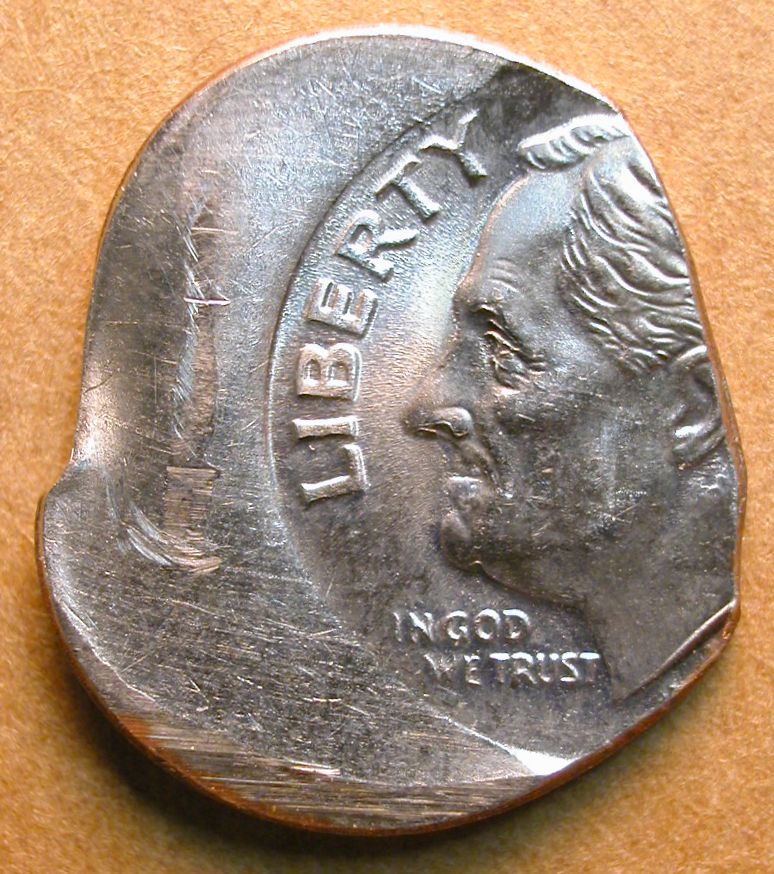
bilateral_MPI_10c_obvbilateral_MPI_10c_rev

This off-center dime was pinned and pinched between two machine parts.  The right side of the coin shows a gently convex foreign object chain strike.  Here the expanding edge of the dime collided with the expanding internal edge of the feeder/ejection finger.   At the opposite pole, the unstruck portion of the dime was pushed laterally into the other feeder/ejection finger.  This collision pushed in the planchet’s edge, warping the unstruck portion of the dime.  This is an example of intra-strike damage.

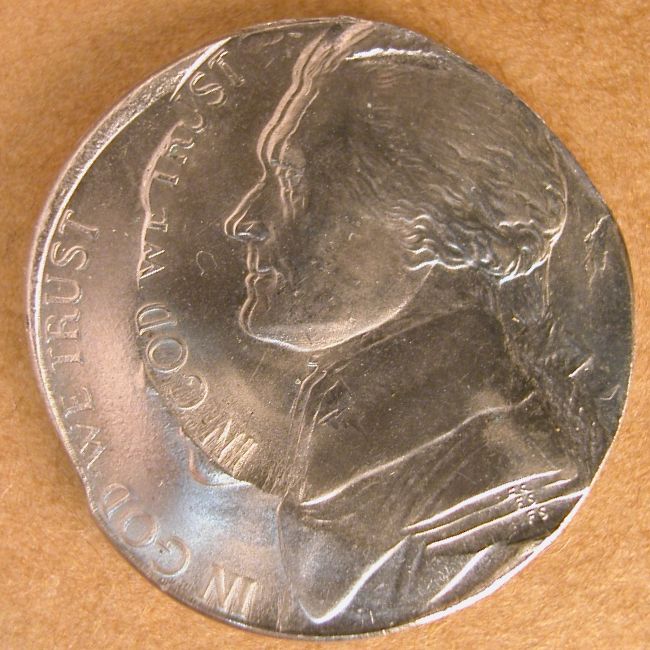
quad_stk_5c_obvquad_stk_5c_rev

This quadruple-struck nickel was pinned and pinched between two feeder/ejection fingers during the last three strikes.  After a normal first strike, the nickel received three closely-spaced off-center strikes that are well-separated from the initial strike.  This is a typical pattern for multi-strikes suffering from machine part impingement.  It’s almost certain that the misplaced and mistimed feeder/ejection arm prevents the coin from leaving the striking chamber entirely.

On the right side there is a long, relatively straight contact facet that represents a foreign object chain strike.  Once again, the culprit is one of the two feeder/ejection fingers that cradle the coin.  The left side of the coin was pushed in when the portion of the coin lying outside the striking chamber was pushed into the other feeder/ejection finger.

Impact-Induced Warping

Part VI. Striking Errors:

Impact-Induced Warping

Definition: A well-accepted principal holds that any part of a coin or planchet that remains between the dies throughout the strike should be flat on both faces.  That makes abundant sense since both die faces are essentially flat.  There is a notable exception, though.  Sometimes, when a coin is greatly thinned by the strike, it develops a warped surface as soon as the hammer die retracts.  The face struck by the hammer die bows upward while the opposite face develops a complementary pucker.

     The buckling of the coin may be due to the heat that is generated by the strike.  Another possibility is that the coin experiences “radial springback”.  In this phenomenon, the coin metal is radially stretched by the strike, but retains some resilience.  When the pressure is lifted, the coin contracts radially, causing the thin metal to buckle.

     Impact-induced warping is most commonly seen and most severe in uniface strikes (coins struck against another planchet).  The aggregate double thickness increases the effective striking pressure and the coin’s final thickness will be half the minimum die clearance.  These two factors produce a thinner coin.

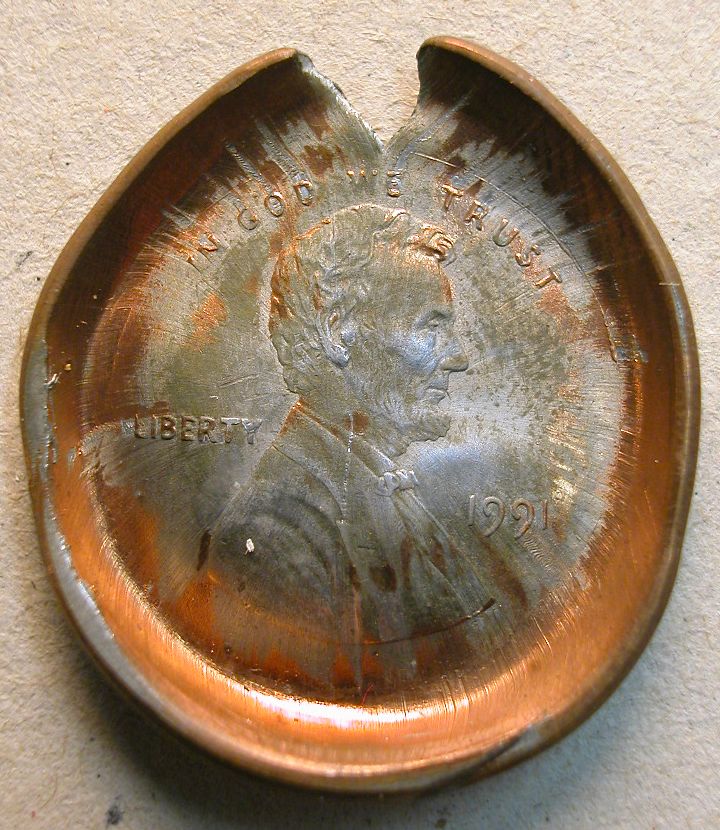
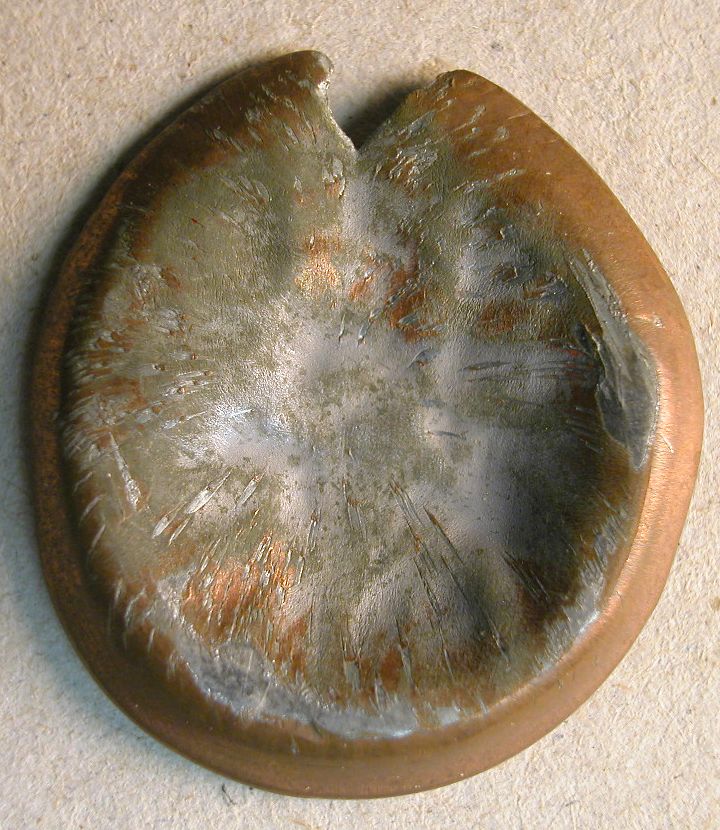
 02a_cupped_uniface_bs_1c_1991_obv 02b_cupped_uniface_bs_1c_1991_rev

     This 1991 cent takes the form of a cupped, uniface broadstrike.  The planchet represented by this coin was struck against an underlying planchet.  Neither planchet was confined by the collar.  The center of the obverse face bulges upward while the featureless reverse face is strongly concave

Shattered Die

PART IV. Die Errors

Die Cracks:

Shattered Die

Definition: A “shattered die” features numerous intersecting die cracks.  Along with the profusion of die cracks, a shattered die can also incorporate other forms of brittle fracture such as die breaks and retained die breaks.

A shattered die often indicates a terminal die state, i.e., a die just short of catastrophic failure.  A series of coins struck by a shattered die can often be arranged in a progression of increasing severity.

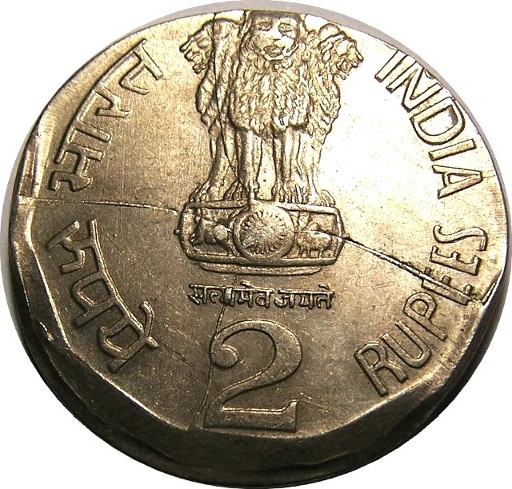
A network of intersecting bi-level cracks constitutes one type of shattered die. In a bi-level die crack, there is vertical displacement at the site of the crack. This means the die face has sunk in on one side of the crack.

An example of converging radial bi-level die cracks can be seen in this 2000 Indian 2 rupees coin. These bi-level die cracks meet in the center of the obverse face.

49080279_scaled_512x489

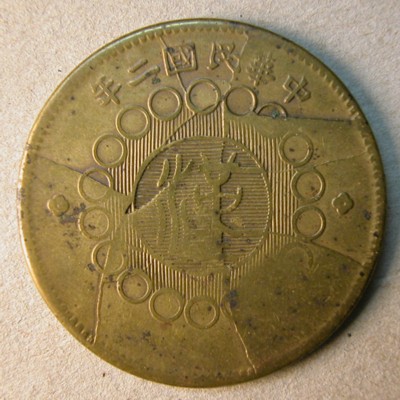
A more extensive set of bi-level die cracks can be seen below in a 1913 Chinese 100 cash coin.  The obverse face shows at least seven bi-level die cracks and a few smaller conventional die cracks. At least one crack shows characteristics of both. This is not that unusual, as you can have both horizontal spread and vertical displacement in the same location, or a transition from vertical displacement to horizontal spread as you proceed along the crack. Despite its tenuous structural integrity, this die was nowhere near terminal failure and was likely able to strike quite a few more coins in this condition.

 4926231749262318

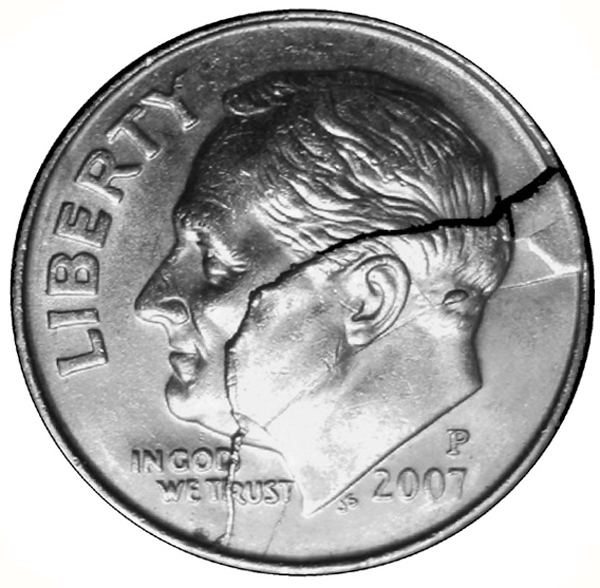
The shattered die found on this 2007-P Roosevelt dime consists of a 50% retained cud with numerous bi-level die cracks within the body of the retained cud.  At least seven similar shattered obverse dies are known among 2007-P dimes.

60271989

This coin is in the collection of Richard Creny. Image by R. Mentzer.


The shattered die shown below has extensive evidence of brittle fracture. Many types of brittle fracture may be represented, e.g., die breaks, retained die breaks, die cracks, a split die, etc. The die may or may not be approaching catastrophic failure (see Catastrophic Die Failure). Not surprisingly, a series of coins struck by a shattered die can often be arranged in a progression of increasing severity.

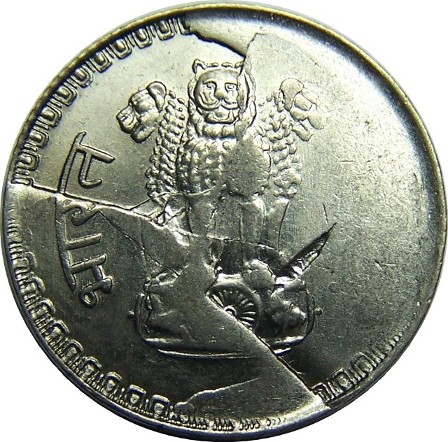
Note: Two separate specimens are shown below.

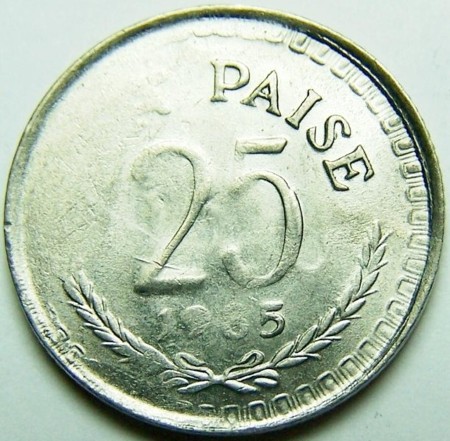
The 1985 India 25 paise shown below Features a large retained cud, a small retained interior die break, and numerous die cracks, most of them bi-level. The right side of the obverse face and the corresponding left side of the reverse face are weakly struck. This is largely due to a tilted die error (vertical misalignment) of the entire obverse face. The left side of the obverse is quite strongly struck, despite the large retained cud. This should have led to a reduction in effective striking pressure. The fact that it didn’t indicates that this part of the obverse die face was tilted down, while the opposite pole was tilted up. This tilt was most likely due to a break at the base of the die or through the shaft of the die – a break that allowed the die to tilt down strongly toward one pole.

 6071168360711691 60822613

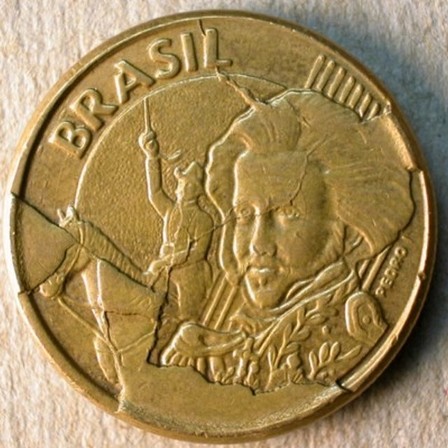
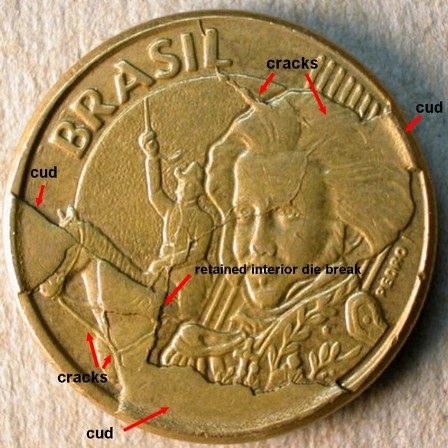
The 2002 Brazilian 10 centavos shown below expresses various forms of brittle fracture.  There are three cuds, one retained interior die break, and a tracery of intersecting die cracks of both the conventional and the bi-level type.

60711717 60711720


Well Defined Rings On Euro Coins

PART IV. Die Errors:

Die Deterioration / Deformation: 

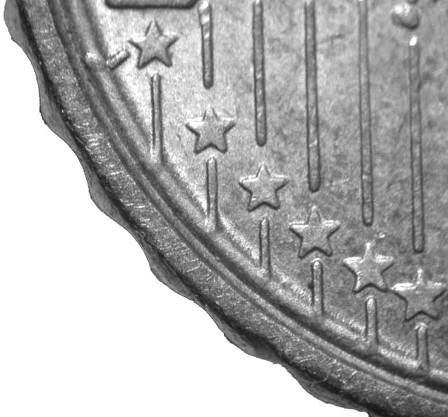
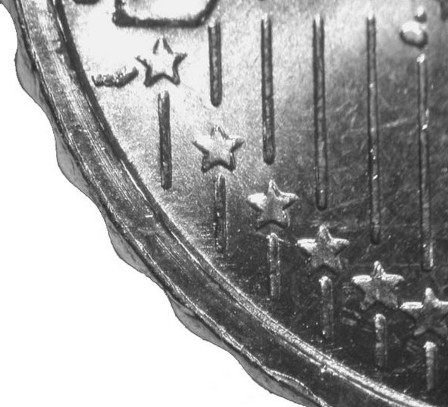
Well-defined rings on Euro coins

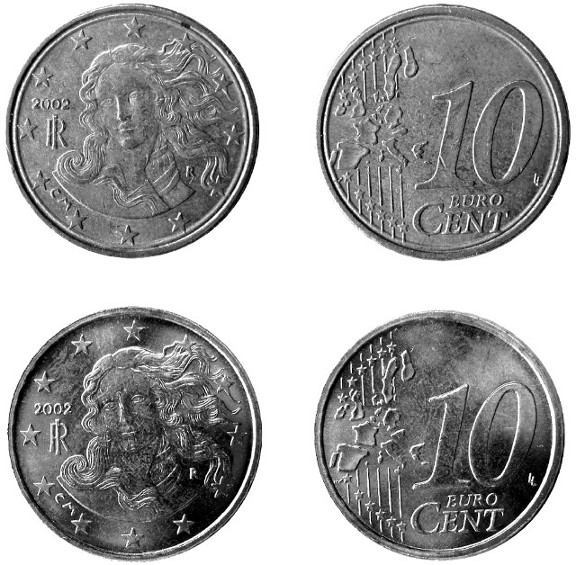
Raised rings with varying degrees of completeness are often found on zinc cents just inside the design rim, and these are universally recognized as manifestations of die deterioration. Die deformation rings are sometimes found on other U.S. denominations. At first the rings  on this Euro coin seem too complete, too sharply defined, too uniform, too narrow, and display too high a relief to represent die deformation. The fact that an identical ring is present on both faces seems to further undermine the die deterioration scenario. Inside the rings there are no signs of conventional die deterioration (e.g., radial flow lines; orange peel texture).

Still, there seems to be no other explanation other than die deterioration.  The design continues on top of the ring, which would be consistent with die deterioration.  Similar rings have been found in coins from Thailand.

Obverse and reverse of the ringed and normal version 10 cent Italian Euro coin.

Close-up of the southwest quadrant of the reverse face of the ringed Euro coin.

Close-up of the southwest quadrant of the reverse face of the normal coin.

Surface Film Effects

Part VI. Striking Errors:

Struck-Through Errors:

Surface Film Effects

Definition:  A thin film of oil on a planchet, a coin, or a die can produce a number of eye-catching effects. 

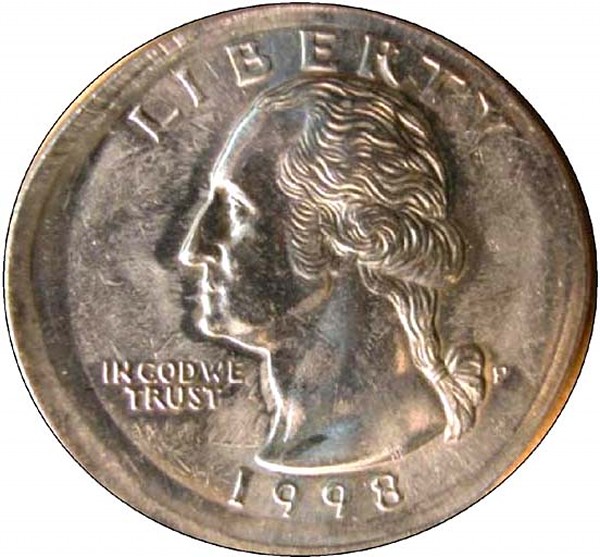
The simplest effect is surface film doubling.  It generally appears in coins that are broadstruck or struck off-center.  Expansion of the coin is necessary for the phenomenon to develop.  In surface film doubling a corona surrounds centralized design elements like busts and buildings.  Surface film doubling can also extend radially from more peripheral design elements.  Surface film doubling is especially common in nickels struck in the year 1964.  Surface film doubling generally takes the form of a highly reflective area that appears dark when viewed face-on.

This broadstruck 1998-P quarter shows surface film doubling surrounding Washington’s bust.

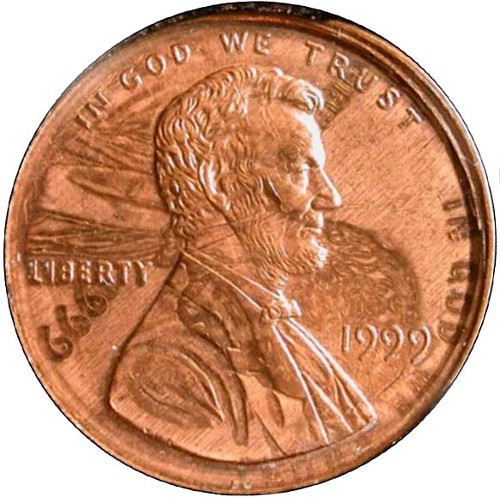
Double-struck coins will occasionally show a surface film afterimage.  When an oily coin shifts position and is struck again, the topography of the original image can be largely or completely erased.

However, a thin layer of oil can preserve many of the details of the first strike in the form of a ghost image.  Surface film afterimages vary in their clarity, completeness, and color.  A surface film afterimage can be darker or lighter than the surrounding field.  It can take the form of a dark outline surrounding what used to be raised design elements.  It can manifest as an area of enhanced reflectivity that appears dark when viewed directly from above.

This double-struck 1999 cent shows a very complete surface film afterimage on the obverse face.  In this specimen, the afterimage is an area of enhanced reflectivity, which appears dark in the photo.  The reverse face (not shown) shows no afterimage.
The rarest surface film effect is surface film transfer.  It takes the form of a strongly offset or rotated ghost image in a coin that is struck once.  Only a handful of cases are known among U.S. coins.  It requires an unusual set of circumstances and can occur in two ways.

Scenario 1: An oily planchet is struck, shifts position, and is struck again.  The second strike transfers an oily imprint of the design to one or both dies.  The double-struck coin is ejected and a fresh planchet is fed into the striking chamber.  The die with the transferred oily image then transfers that image to the planchet.

Scenario 2:  An oily die strikes a coin, transferring the oil to the coin.  The coin then shifts position and is struck again.  This transfers the oil back to the die in the form of a faint image.  The double-struck coin is then ejected and a fresh planchet is fed in.  The next strike transfers the oily image back to the planchet.

Surface film transfer can leave an image that is darker or lighter than the surrounding field or one that has greater reflectivity.

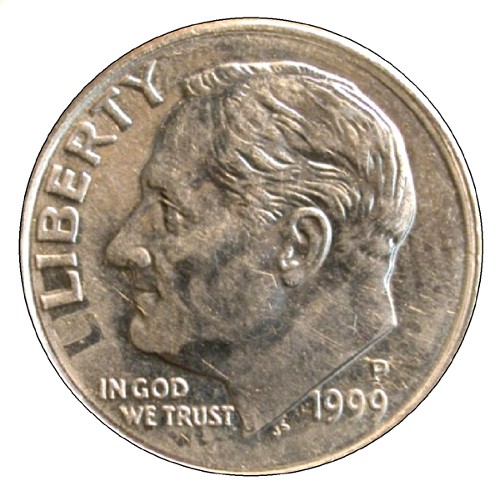
This 1999-P dime shows a case of surface film transfer on the obverse face.  The transferred elements include the LIB of LIBERTY and WE TRUST.

Surface film effects can enhance the clarity and completeness of faint clash marks.  This is most often seen among copper-plated zinc cents.  However, the effects of an oil film are rather hard to distinguish from the faint clash marks themselves.

Rockwell Test Mark In Planchet

Part V: Planchet Errors:

Pre-strike Damage:

Rockwell test mark in planchet


Definition:
A Rockwell hardness tester is used to measure the hardness of metals in the U.S. Mint. It measures the depth of penetration of a steel or diamond-tipped pin relative to the applied force.

When applied to a planchet, the Rockwell test mark will appear as a small circular pit with a smooth floor.  Such planchets are supposed to be discarded. If a planchet with a Rockwell test mark is struck by coinage dies, the pit is not erased. The pit’s original circular outline may, however, be distorted into a slight oval as the coin expands beneath the impact of the dies.

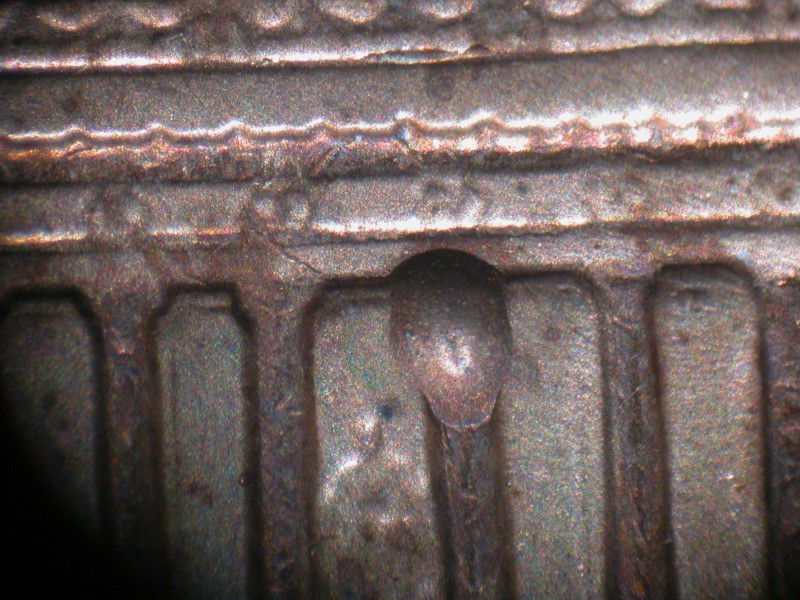
Depicted below is a 1971-S cent with a Rockwell test mark on the reverse face, above and to the right of Lincoln’s statue. This coin falls in with expectations derived from sparse written sources.

This particular example was authenticated by “Lonesome” John Devine and is convincing. The floor of the cup-shaped depression is completely smooth, as would be expected of a dimple produced by a pin tipped by a small steel ball. Although there is no metal flow in the design bordering the crater, there is also no trace of a pressure ridge, indicating that the defect was present before the strike. The pit is oval, rather than circular, but this can be attributed to distortion produced by the strike.

All alleged Rockwell test marks in planchets are now considered suspect, including the 1971-S cent described above.

This pit has a smooth floor and oval shape. It was long assumed that the originally circular outline was altered by the strike, but I now see this as unlikely. First of all, the pit is near the center of the coin, where converging lines of radial tensile stress meet and where radial expansion would have been limited. Second, the pit’s long axis is oriented north-south, instead of oriented toward 12:15. Third, the pit’s long axis overlies and is aligned with a Memorial column. Coin metal rising into a column recess would also have flowed toward the pit, shrinking the circle’s north-south diameter.

This pit, and others like it, may represent the impressions of spherical pellets that fell onto the coin metal strip and were stretched out during rolling. They also might be the impressions of oblong objects that were struck into the coins and then fell out.

Rockwell1971Scent

Part IV. Die Errors:


Reeding vs. no reeding varieties (foreign only)

Concentric lathe lines (ES Nov/Dec 2003)

    • Various years and denominations
      • Common on the 1996-D Lincoln cent

Rusted dies (CW 12/1/08)

Excessively deep rim gutter

    • 1991 cents

Rockwell test mark left in die (hemispherical bump seen on coin) (ES July/Aug 2006)

Vickers test mark left in die (pyramidal bump) (CW 5/15/17)

Collar manufacturing errors

    • Wide collar (ES Nov/Dec 2002; CW 5/17/10)
      • Created by improper machining or improperly machined broach
      • Created by use of wrong broach
      • Improper use of correct broach
      • Widening due to wear
      • Widening due to 3 or more vertical collar cracks and associated expansion (CW 5/17/10)
    • Abnormal reeding
      • 1921 Morgan dollar with infrequent reeding
      • 1924-D Mercury dime with infrequent reeding
      • 2015 American Eagle 1/10oz gold bullion coin with narrow reeds (CW 7/13/15)
      • Low, narrow reeds caused by truncation of ridges on collar face (ES March/April 2010; CW 1/25/10, 4/16/12)
        • 1964-D 25c
        • 2008-P New Mexico 25c
          • COIN WORLD SPECIAL: article posted HERE

Hub retouching

    • Channeling: Retouching of design element on master and/or working hubs (1920s to 1940s) (CW 7/23/12)
    • Re-engraved master hub (CW 1/1/24)

Die retouching (CW 5/30/16, 9/30/19)

    • Re-engraved designer’s initials “AW” on 1944-D half dollar (CW 2/2/04, 2/16/04, 3/1/04)
    • Re-engraved tail feathers on business-strike 1957-D quarter
    • Re-engraved front of Lincoln’s coat (1953 proof cent)
    • Re-engraved queue on 1952 – 1954 proof nickels
    • 1938 proof nickels with re-engraved letters and design details (ES Jan/Feb 2009)
    • Retouching of the 1944 date on the Lincoln cent master die
    • Retouching of the date on 1946-S Lincoln cent working dies

Die damage (ES Nov/Dec 2004, Jan/Feb 2003; CW 5/21/12)

    • Die dents (ES Nov/Dec 2004, July/August 2005, Nov/Dec 2005; CW 9/15/03, 12/22/14, 3/28/22, 7/31/23)
    • Die scrapes (CW 4/23/07)
    • Accidental die scratches
    • Die gouges
    • Impact scars
    • Accidental die abrasion (CW 9/8/14, 12/16/19)
    • Intentional die abrasion (“die polishing”) (CW 3/29/10, 5/31/10, 9/8/14, 3/20/23)
      • Heavy die scratches
      • Thinning and loss of design elements
        • Two Feather Indian Head Nickel (various dates)
        • 3-legged Indian Head Nickel (1937-D)
        • 3 ½ legged Indian Nickel (1936-D)
      • Abrasion affecting entire die face
      • Localized abrasion
    • Defects related to die polishing
      • Over-polished proof and Special Mint Set dies (CW 2/21/11)
      • Trails and Wavy Steps (ES July/Aug 2006, Sept/Oct 2006, Nov/Dec 2006, Jan/Feb 2011; CW 3/8/10)
      • Localized removal of field from proof polishing (CW 2/14/2011)
        • COIN WORLD SPECIAL: article posted HERE
    • Die attrition errors (ES May/June 2003, March/April 2005, March/April 2009; CW 1/4/10, 12/24/12, 4/14/14, 11/4/19, 7/3/23, 10/16/23)
    • Other forms of peripheral die damage (ES March/April 2005; CW 8/9/21, 3/14/22)
    • Catastrophic die damage (ES March/April 2002; CW 9/15/03, 9/12/11, 9/19/11, 5/20/13, 10/27/14, 6/19/17)
    • Cancelled or defaced dies (foreign only) (CW 5/8/17, 12/31/18)
      • 1994 Hong Kong bimetallic 10 dollars
      • Egypt 25 piastres struck by defaced 50 piastres dies (CW 5/12/14)
      • 1966 Bolivia 10 centavos struck by pair of canceled dies (CW 5/8/17)
      • Chilean test dies with concentric cancellation pattern struck over struck foreign core (CW 5/8/17)
    • Rockwell test mark in die (CW 5/15/17)
    • Vickers test mark in die (CW 5/15/17)
    • Die rings (tiny rings, semicircles, crescents, and spirals)  (CW 2/20/17, 1/18/21, 6/13/22)
        • Centrally-located
        • Offset
  • Collar damage (ES March/April 2010; CW 1/25/10, 4/16/12, 6/17/19)
    • Horizontal abrasion (CW 1/25/10, 4/16/12)
    • Vertical abrasion (CW 6/17/19)

Hubbed-In debris (CW 5/27/13)

Deformed collar (CW 12/18/20)

Clashed dies (ES March/April 2002; CW 3/22/10, 4/30/12)

    • Clash marks
    • Multiple clash marks (CW 6/25/12, 11/11/19)
      • Chatter clash
  • Raised clash marks (CW 8/11/14)
  • Double clash with reciprocal counterclash (Type 1) (ES Nov/Dec 2004; CW 12/13/10, 7/29/19)
  • Misaligned die clashes (ES May/June 2004, July/August 2004; CW 6/25/12)
    • Horizontally misaligned die clash
    • Vertically misaligned (tilted) die clash (CW 1/3/11, 5/9/11)
      • COIN WORLD SPECIAL: article posted HERE
    • Pivoted die clash
    • Radically misaligned, rotated, pivoted clashes – produced at installation? (CW 7/12/10, 12/31/12, 5/27/19)
      • Co-occurrence with conventional clash (CW 8/17/15)
    • Rotated die clash (CW 1/22/18, 6/26/23)
    • Combination clashes
  • Mule clash errors, e.g. (ES July/August 2002; CW 11/17/08, 8/13/18, 8/20/18, 4/8/19)
    • 1864 2c reverse die clashed with Indian cent obverse die
    • 1857 1c obverse die clashed with Seated Liberty 50c obverse die
    • 1857 1c reverse die clashed with Seated Liberty 25c reverse die
    • 1857 1c obverse die clashed with Liberty $20 obverse die
    • (For detailed information concerning the 1857 die clashes CLICK HERE)
    • 1870 Shield nickel obverse clashed with Indian Head cent obverse
    • 1999 cent reverse die clashed with another cent reverse die
  • Floating die clash (collision with die fragments) (ES May/June 2002, May/June 2005; CW 7/19/10)
  • Superclash (full reciprocal design transfer) (CW 3/22/10, 10/22/18)
  • Circumferential clash marks (CW 12/10/18)
  • Grease-enhanced clash marks (CW 10/16/17)
  • Associated with weak strikes (CW 12/2/19)
  • Clashed die progressions (CW 5/15/23)

Collar clash (CW 6/11/07, 2/24/22)

    • Hammer die
    • Anvil die
      • Inverted die setup (uncommon)
      • Traditional die setup (extremely rare) (CW 10/30/23, 12/18/23)
    • Floating collar clash (CW 4/17/17)
    • Misaligned collar clash (CW 2/13/23)

Die damage with design transfer

    • Floating die clash (ES May/June 2002, May/June 2005; CW 7/19/10)
      • Exogenous floating die clash (CW 6/20/22)
    • Floating (Type 2) counterclash (ES May/June 2002, July/August 2002, Sept/Oct 2002, Jan/Feb 2009, Sept/Oct 2011; CW 9/29/08, 12/13/10, 4/9/12, 4/21/14, 6/8/15, 4/23/18, 2/21/22, 12/19/22, 2/20/23)
      • COIN WORLD SPECIAL: article posted HERE
    • Miscellaneous and unexplained forms of design transfer/duplication
      • Some presumed Canadian counterclashes may prove to be something else

Die deterioration/deformation errors

    • Exaggerated conventional die wear (CW 12/27/21)
      • Radial flow lines
      • Concentric flow lines (uncommon)
      • Parallel flow lines (promoted by pre-existing trails)
      • Orange peel texture
      • Design-devouring die wear (thinned letters and numbers) (CW 10/28/13, 2/22/16, 8/23/21)
    • Die deterioration doubling
      • Raised doubling
      • Incuse (CW 2/4/08)
    • “Blebs” or “patches” (die erosion pits) (ES July/Aug 1998; CW 7/21/03)
    • Discrete lumps (CW 4/27/20)
    • Progressive, indirect design transfer (“internal metal displacement phenomenon”, “ghosting”) (CW 6/7/10, 8/17/20)
      • Common in 1946-S and 1948-S cents
    • Surface-level die deformation errors (ES July/Aug 2001, Nov/Dec 2001; CW 9/17/12) (premature, localized, exaggerated, and peculiar patterns of deformation)
      • 1943-S “goiter neck” quarter
      • Detail-erasing die wear (2016-P Harper’s Ferry quarter) (CW 2/27/17)
    • “Ridge rings”
      • On copper-plated zinc cents (CW 2/14/05, 2/28/05)
      • On other U.S. denominations (CW 2/15/21)
      • On world coins (ES Sept/Oct 2006; CW 2/17/14, 11/10/14)
    • Design berms (raised outlines) (CW 5/14/18, 11/6/23)
    • Die subsidence (sunken die) error (ES July/August 2004, Nov/Dec 2004; CW 6/2/03, 11/29/04, 3/12/12, 2/12/18, 8/14/23)
      • e.g., 1924-S – “goiter” cent
      • Co-occurring with split dies
      • Co-occurring with radial, antipodal die cracks (CW 6/20/11)
      • 1988-P nickels with lump on head
        • COIN WORLD SPECIAL: article posted HERE
      • Massive die collapse in 2003-D dime (ES Nov/Dec 2011; CW 8/29/11)
      • Paralleling and flanking die cracks (CW 8/12/13)
      • Recurring die subsidence error (CW 4/4/11, 3/31/14)
      • Linear die subsidence errors (CW 8/12/13)
    • Thermal warping (CW 5/29/23)
    • Design creep
      • Reverse (hammer) 2014-P nickel die (CW 4/20/15)
      • In fractional Euro coins
    • Peripheral die expansion and erosion (CW 8/13/12, 4/13/15)
    • “Starburst” pattern of radial streaks (cause uncertain) (CW 8/15/05, 11/7/05)
    • Reciprocally deformed, convex-concave dies
      • Centrally-located deformation; 2001-P 50c) (ES Sept/Oct 2008; CW 1/19/15)
      • Peripherally-located deformation; India 2 rupees (CW 1/19/15)

Die breaks

    • Cuds (corner die breaks) (CW 10/17/11, 10/4/21)
      • Irregular cuds
      • Ovoid cuds
      • Crescentic cuds (ES March/April 2005; CW 2/15/16)
      • Circumferential cuds (ES March/April 2005; CW 2/15/16)
      • Rim-to-rim cud (ES May/June 2003, CW 12/24/18)
      • Elongate Cuds (CW 12/8/14, 12/21/20, 7/31/23)
      • On off-center or broadstruck coins (CW 9/12/11)
      • Deep vs. shallow die breaks (CW 6/2/20)
    • Retained Cuds (ES Jan/Feb 2006; CW 4/17/06, 7/24/06, 1/24/11)
      • COIN WORLD SPECIAL: article posted HERE
      • Anvil die (diagnosis often in doubt)
      • Hammer die (doubtful) (CW 8/8/13)
      • With vertical displacement
      • With horizontal offset
      • With lateral spread
      • Outthrust (protrudes beyond die face) (CW 3/11/19)
        • Hammer die
        • Anvil die
  • Interior (internal) die breaks (ES May/June 2003; CW 10/25/10, 11/5/18, 8/14/23)
    • Connected to die cracks or splits
    • Freestanding (ES May/June 2005)
  • Retained interior die breaks (ES July/August 2004)
    • Connected to die crack or split
    • Freestanding
  • Rim cuds (CW 5/3/21)
  • Die chips (CW 6/14/19, 7/8/19)
    • On raised die features (CW 2/28/22)
  • Catastrophic die failure (ES May/June 2007; CW 5/20/13, 2/27/23, 6/19/23)
  • Spontaneous breaks
  • Breaks produced by impacts
  • Textured and dimpled cuds (CW 10/17/11, 10/12/20)
  • Cryptic cuds (CW 4/17/23)

Die exfoliation errors (CW 10/19/20)

Collar breaks (collar cuds) (ES May/June 2008; CW 11/22/10, 5/17/10, 11/22/10, 12/19/16)

    • Complete collar break (abrupt loss of entire arc segment)
    • Irregular collar break
    • Chipped collar
    • Vertical collar crack
    • Retained collar break
    • Rotating collar break (ES July/August 2003; CW 1/6/03, 12/12/16, 4/20/20, 12/28/20)
    • Bilateral split collar
    • On off-center strikes (CW 9/9/19)
    • Catastrophic collar failure (CW 7/17/23)

Die cracks (CW 4/25/16)

    • Rim-to-rim
    • Arcing rim-to-rim (“pre-cud”) die crack (ES Jan/Feb 2006; CW 2/8/21)
      • With lateral spread
    • Blind-ended
    • Bi-level die cracks (ES July/August 2004)
      • Protruding marginal die segments (CW 5/19/14)
    • Radial, antipodal die cracks (with centralized subsidence) (ES Sept/Oct 2011; CW 6/20/2011)
    • Die Crazing (Crazed Die)
    • Shattered dies (ES Jan/Feb 2006, May/June 2007; CW 4/7/08, 9/17/18, 4/6/20)
      • Broas Pie Baker Store Card Token of 1863
      • Two or more splits in die
      • Numerous wide, intersecting, raised die cracks
      • Numerous intersecting bi-level die cracks
      • Various combinations of brittle fracture
      • In response to impacts (CW 6/19/17)
    • Impact-Induced Die Cracks (CW 6/19/17)

Split dies (ES Jan/Feb 2006; CW 6/2/03, 4/10/06, 4/17/06, 6/20/2011, 5/11/15, 9/17/18, 4/26/21, 4/18/22, 7/18/22)

    • Median (bisecting) split die
    • Asymmetrical split die (CW 7/31/23)
    • False split (bilateral, radial, antipodal die cracks) (ES Sept/Oct 2011; CW 6/20/2011)


Green lettering – major heading

Blue lettering – linked to subject matter

Brown lettering – subject matter covered under that heading

Black lettering – no entry yet

  • 1
  • 2
  • 3
  • Next Page »
  • Home
  • Introduction To This Website
  • Error-ref.com News
  • Comprehensive Error-Variety Checklist
  • Index Of Completed Entries
  • Part I. Die Subtypes:
  • Part II. Die Varieties:
  • Part III. Die Installation Errors:
  • Part IV. Die Errors:
  • Part V. Planchet Errors:
  • Part VI. Striking Errors:
  • Part VII. Post-Strike Mint Modifications:
  • Part VIII. Post-Strike Striking Chamber Mishaps:
  • Part IX. Post-Strike Mint Damage:
  • Part X. Wastebasket / Composite Categories:
  • Part XI. Non Errors:
  • Featured Articles Of Interested
  • Interest & Not So Interesting Facts
  • Other Sites And Forums Of Interest
  • Our Thanks Go To
  • About The Authors
  • Contact Us

Copyright © 2026