Error-Ref.com

You are here: Home / Search for "off center"

Search Results for: off center

Second Strike Misalignment: Horizontal

PART VI. Striking Errors:

Multiple Strikes:

Second Strike Misalignment (Horizontal)

Definition: This error occurs when a coin is struck at least twice and the subsequently strikes shows an offset in direction.

A horizontal, vertical, pivoted, or rotational misalignment can occur on the second strike after a normal first strike. It’s also possible for a misaligned die strike to precede a normal second strike, although this has only indirectly been documented through clash marks.

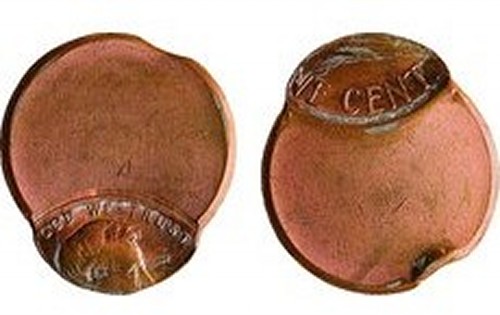
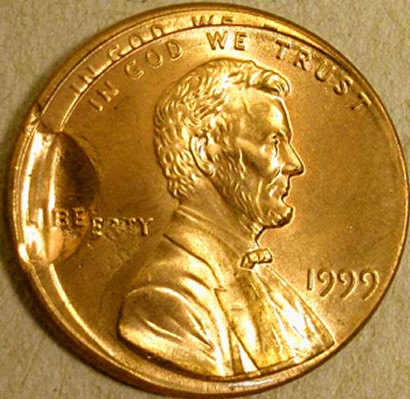
In this 1999 cent, the hammer (obverse) die was centered during the first strike.  Between the first and second strike, it shifted to the right about 10%.  Before the hammer die descended a second time, an unstruck planchet intruded into the striking chamber, leaving an indent on the left side.  Details of the first strike can be seen in the floor of the indent.  The second strike also shows a partial collar error
Sideneck Strike

PART VI. Striking Errors:

Saddle Strikes:

Sideneck Strike

Definition: A sideneck strike involves a collision between the unstruck edge of an off-center coin and the neck of the adjacent hammer die. During an off-center strike, the struck tongue of metal expands in all directions.  This expansion pushes the unstruck portion of the planchet sideways.  If it’s positioned just right, the pole opposite the struck tongue of metal will collide with the adjacent hammer die.

A sideneck strike leaves a smooth, curved indentation at the pole opposite the off-center strike.  This error is as close as you can come to a saddle strike without actually being a saddle strike.  Sideneck strikes often show a pattern of buckling identical to that of a humped saddle strike.

Other terms used to refer to this error include “almost saddle strike” and “one-die saddle strike.”
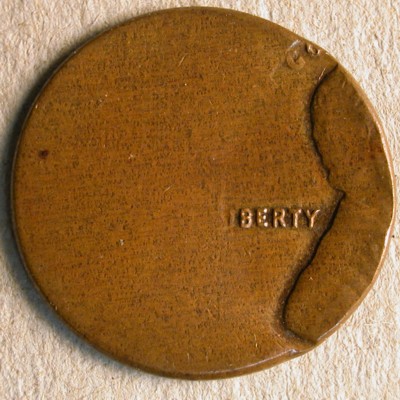
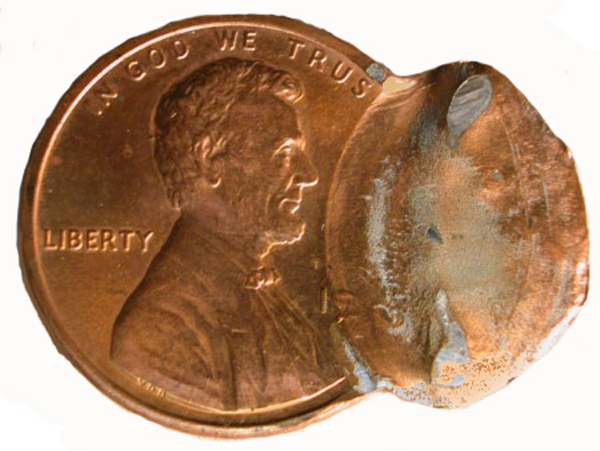
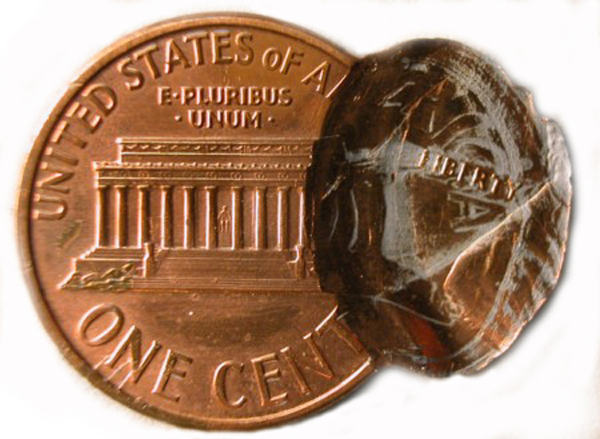
The Lincoln cent shown below shows an off-center strike in association with a sideneck strike. The characteristic concave facet is easily seen.

Split Or Torn In Two By Struck Through Object

PART VI. Striking Errors:

Striking Errors:

Split or Torn in Two by Struck Through Object

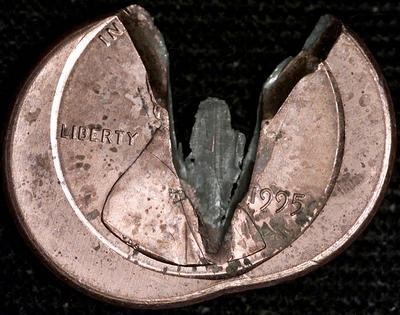
Definition: The term “struck-through” (or struck-through) is a non-specific label for a coin that is struck through just about anything – grease, debris, plastic, metal fragments, etc. Strike-throughs that involve large, thick, solid objects are rarer and more desirable than other types. Rarest of all are coins that are actually torn asunder when a foreign object is struck into them.

Key diagnostics for a coin torn apart by a foreign object are as follows:

  1. A deficit with an irregular shape.
  2. The edge of the deficit slopes outward toward the opposite face.
  3. The vertical cross-sectional profile of the pinched-off edge is either straight or concave.
  4. The sloping face ends in a knifelike edge.
  5. The design on the opposite face continues right up to the sharp edge without any sign of weakness.
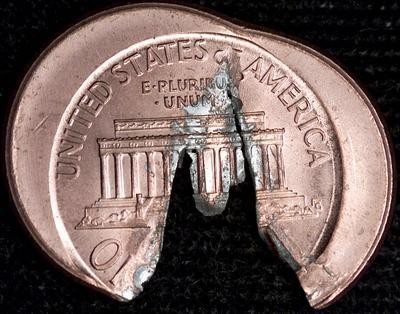
This 1995 cent was split down the middle by a thick, angular object. It may have been a piece of hardware or a broken
machine part.
Photos courtesy of Rich Schemmer.

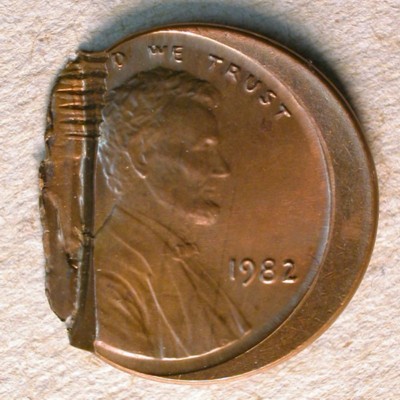
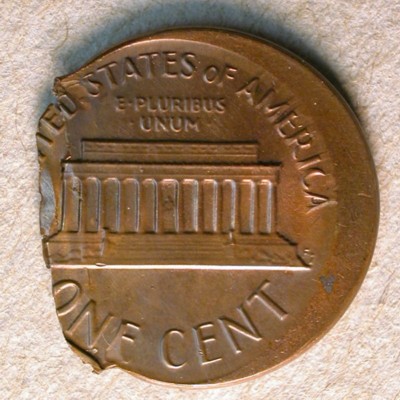
This off-center 1982 cent was struck through a threaded bolt on the left side. The left side of the coin was pinched off and lost as a result of the impact.

Coin courtesy of Sean Reynolds.

Split Planchet After Strike

Part V: Planchet Errors:

Alloy Errors:

Split planchets, After strike

Definition: Split planchet errors are normally restricted to planchets comprised of a solid metal alloy including aluminum, bronze, nickel, & silver.

A split after strike planchet will always weigh less than a normal planchet. A fine to coarse striation pattern will be clearly evident on the face which splits away.

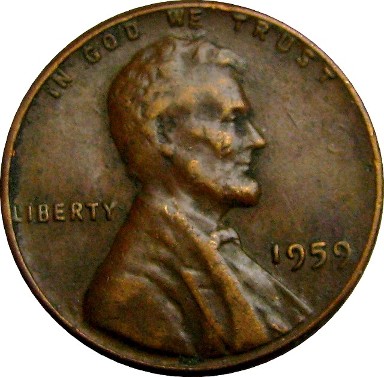
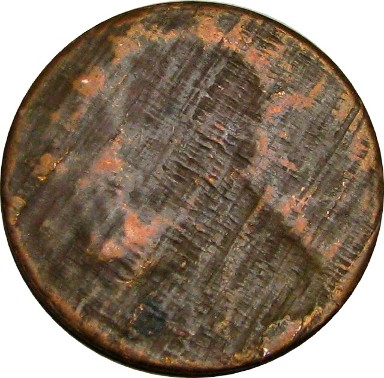
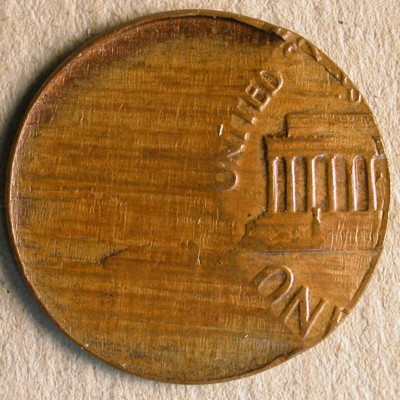
1959 Lincoln memorial cent whose reverse face split off after after being struck. Notice the obverse face has a strong strike. The entire memorial reverse face is gone and instead only a muted, striated ghost of the memorial building and Lincoln’s profile can be seen. This split layer weights 1.4 g.

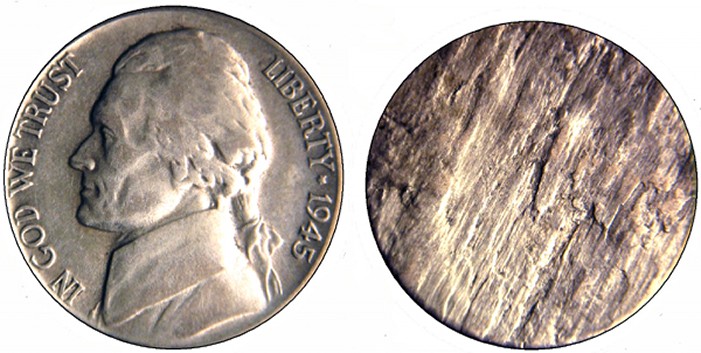
Another example of a split planchet after the strike is this 1945 Jefferson nickel. The reverse of the coin split away after the coin was struck leaving a 3.1 gram obverse.

Split Plan Before

Part V: Planchet Errors:

Alloy Errors:

Split planchets, Before strike

Definition: Split planchet errors are normally restricted to planchets composed of a solid alloy.  Among U.S. coins, cents and nickels are the most commonly affected denominations.  Split planchet errors should not be confused with “separation errors”, which only affect clad  and plated coins.  Separation errors are bonding errors, not alloy errors.

A coin struck on a split planchet will always weigh less than a normal coin. A coin struck on a split-before-strike planchet will show a pattern of striations on the split face.  The texture of the striations varies from coarse to fine.  If a strike is unusually strong, most of the striations may be effaced.  However, most split-before-strike planchets show a weak strike, because the thinner planchet is closer to the minimum die clearance.

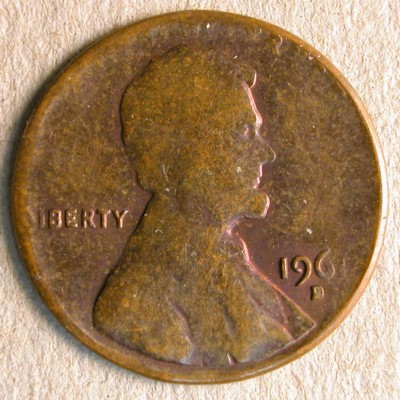
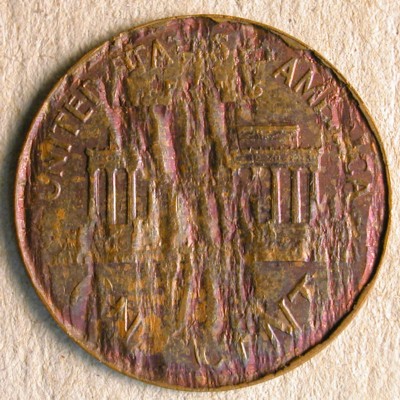
Shown below is a 1961-D cent struck on a split planchet.  The pattern of striations is unusually coarse.

Depicted below is a cent struck off-center on a split planchet.  The striations are readily apparent.

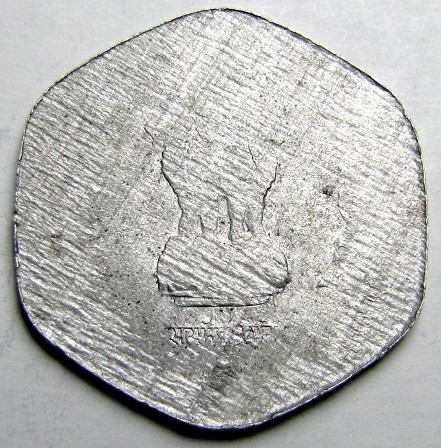
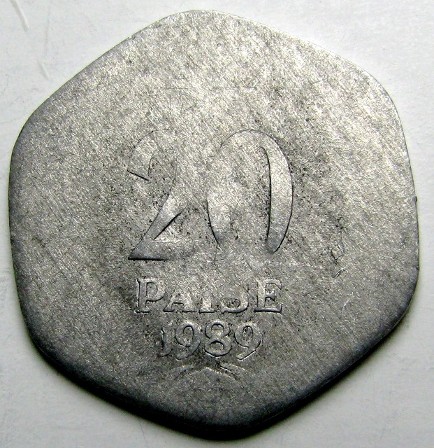
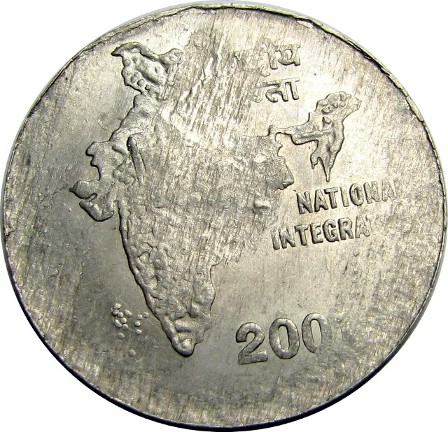
The 20 paise Indian coin below is comprised of aluminum. This very thin split planchet weighs 1.0 g, well below the normal 2.25 g. The obverse face has an an extremely coarse pattern of striations with very little design detail present. The reverse face has just the date and denomination having been struck.

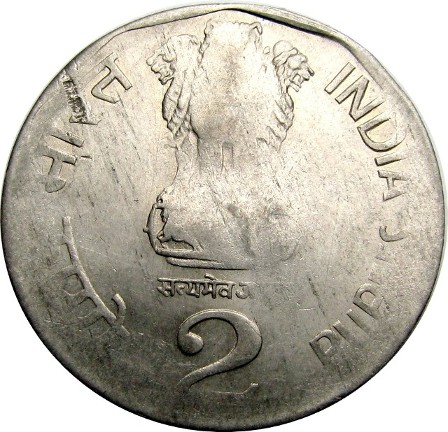
The two rupee Indian coin below is comprised of a nickel alloy. This planchet weighs 3.2 g, well below the normal 6.0 g. The obverse face has an expected weak strike with much design detail absent. The reverse face shows coarse striations with a combination of weak and strongly struck design.

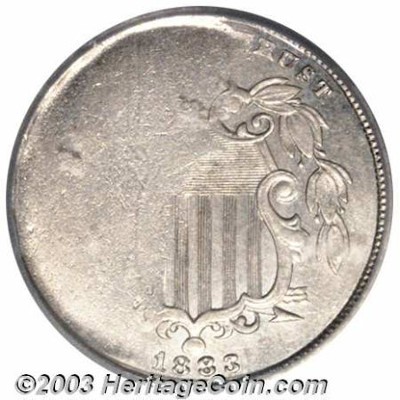
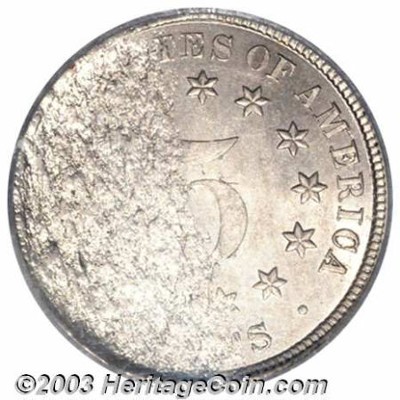
 Approximately half the reverse face of this 1888 shield nickel peeled off before the strike. This part of the coin was
consequently left too thin for any design to strike up.

Images are courtesy of Heritage Auctions.

Split Planchet After Strike Wrong Denomination


PART VI. Planchet Errors:


Split Planchet:


After Strike:


Wrong Denominational Planchet / Off-metal:


Definition:A coin was struk on the wrong denominational planchet and split after the strike.


A cent planchet found its way between Eisenhower dollar dies and was struck. After the strike, the coin split in two along its edge. The half coin pictured above, shows a partial reverse design along with a uniface “obverse”.


Images are courtesy of Heritage Auctions.


Split Plating Doubling

PART V. Planchet Errors:

Plating Errors:

Split plating doubling

Definition: Best expressed and most often seen among broadstrikes and off-center strikes, split plating doubling is restricted to copper-plated zinc cents.  When the planchet is struck, the portion trapped beneath the dies expands in all directions.  The thin copper plating is subjected to tensile as well as compressive stress.  The tensile stress causes the copper plating to rupture, exposing the underlying zinc.  The exposed zinc often outlines large centrally-located design elements, like busts and buildings.  Split plating doubling can, however, involve any design element, including peripheral ones.

Another factor involved in split plating doubling is a tendency for the copper plating to catch on the sharp corners of the recesses in the die face.  This can tear open the copper plating as the coin expands.

Split plating doubling has also been referred to as “split-line doubling”, but this term has been largely abandoned.


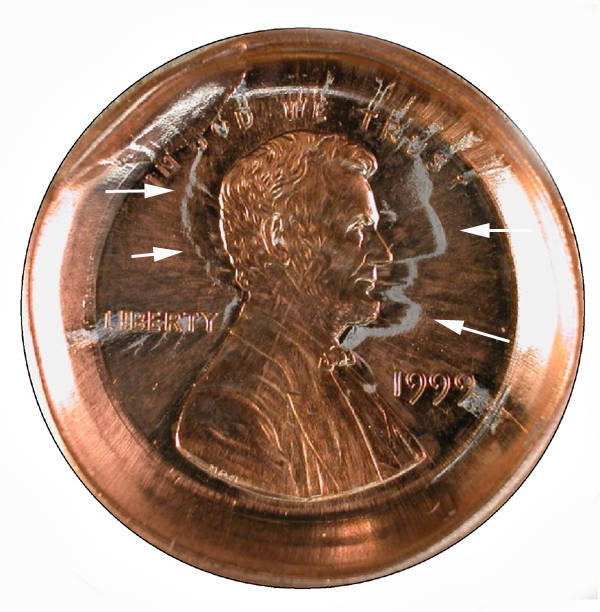
A dramatic case of split plating doubling is seen above in a 1999 cent that takes the form of an enormously expanded, strongly cupped broadstrike.  A small indent can be seen at 10:00.  The exposed zinc surrounds Lincoln’s bust.  Other areas of exposed zinc are associated with LIBERTY and IN GOD WE TRUST.

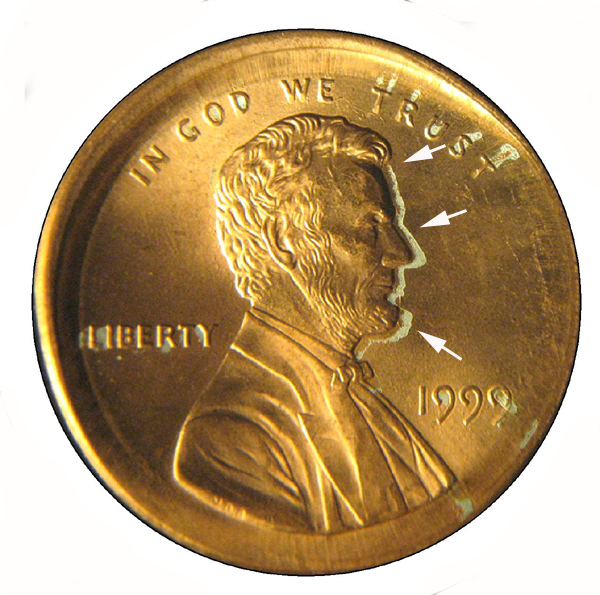
This broadstruck 1999(P) Lincoln cent developed split plating doubling in front of Lincoln’s profile. The split plating is indicated by white arrows.

Split Plating Afterimage

PART X. Wastebasket / Composite Categories:

Ghost Images:

Split Plating Afterimage

Definition: This uncommon effect is restricted to double-struck copper-plated zinc cents.  It is most often associated with off-center uniface strikes and generally is found on the die-struck face.  During a second strike, tensile stresses are magnified along the sharp sides and corners of first-strike design elements.  If the plating is somewhat thinner than normal, it can stretch to the breaking point, exposing the underlying zinc.  The exposed zinc will record the presence of first-strike design elements that have otherwise been obliterated.

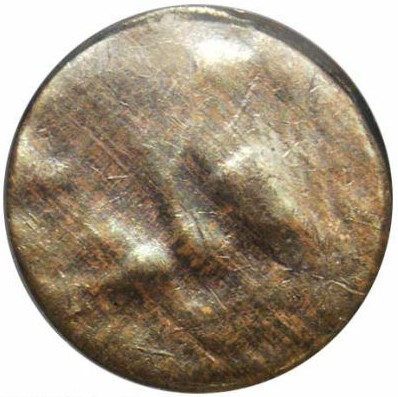
This copper-plated zinc cent, struck sometime in the 1980-s, takes the form of a flipover double strike.  The second strike is off-center and uniface (struck against an underlying planchet).  The die-struck obverse face of the second strike displays a split plating afterimage of the reverse design.  The afterimage consists of the letters ERICA and the right side of the Lincoln Memorial

Stiff Collar Strike

PART VI. Striking Errors:

Collar Deployment Errors:

Stiff Collar Error

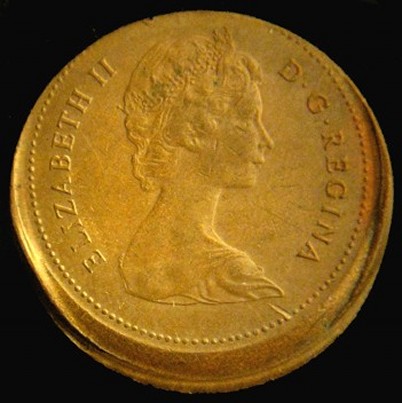
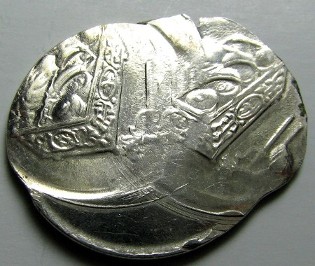
Definition: A stiff collar error occurs when an off-center planchet is forced down on top of a collar that is frozen in the “up” position.  This causes severe warping of the coin.  A rounded shoulder is produced on the face struck by the anvil die.  The shoulder ends laterally at a strong collar scar.  A short lip may extend lateral to the collar scar.  On the face struck by the hammer die we generally see the development of a thick vertical flange.
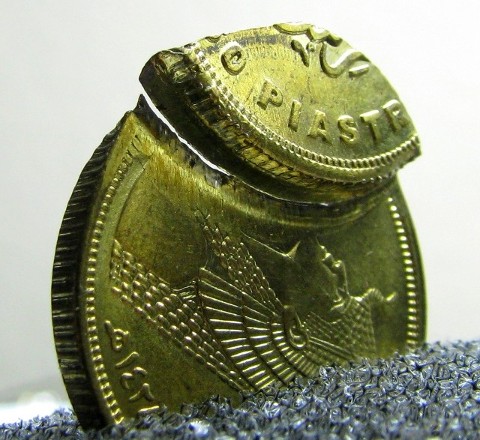
The hammer die can drive a coin completely into a fully deployed collar.  Sometimes the collar is partly deployed.  Sometimes the collar is partly depressed but then freezes in a partly deployed position.

Most stiff collar errors are minor off-center strikes or uncentered broadstrikes.  A few are very far off-center.

The ultimate expression of a stiff collar error is an elliptical strike clip.  Here a planchet is sheared in two between the descending hammer die and the top of the collar (see elliptical strike clip).
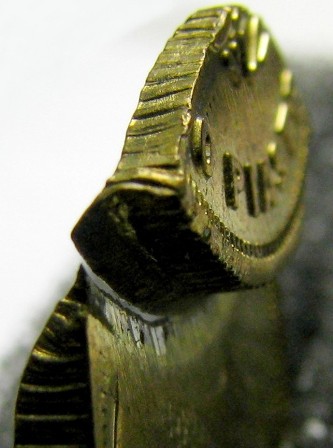
Minor horizontal misalignments of the hammer die occur rather frequently in conjunction with stiff collar errors.  The enormous shear forces set up between the hammer die, planchet, and collar tend to nudge the hammer die (or die assembly) in the opposite direction.
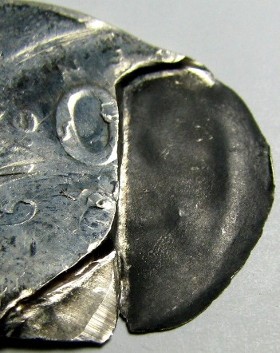
In some presses, like the Schuler press, stiff collar errors of varying severity are associated with the majority of minor off-center strikes and uncentered broadstrikes.  Evidently the collar is designed to budge only grudgingly in this press.  Because of this, we might want to refer to this phenomenon as simply a “stiff collar effect” when we’re dealing with issues where the phenomenon is common.

Stiff collar errors are frequently confused with partial collar errors.  They are not the same thing, although the two errors can co-occur.

Below is a flipped over double-struck Egyptian 2007 50 piastries. During the second, off-center strike, the hammer die forced the coin down into a collar frozen and fully deployed in the “up” position. This nearly sheared the coin in two. Had the off-center strike been severed, it would have resulted in the production of a double-struck elliptical strike clip and a coin with a curved strike clip.


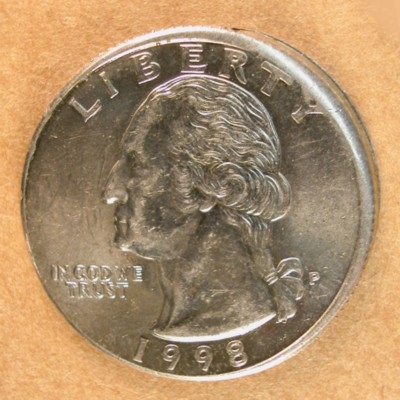
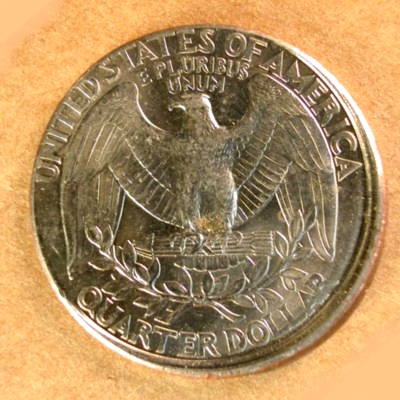
Below is a 1998 Washington quarter with stiff collar error.
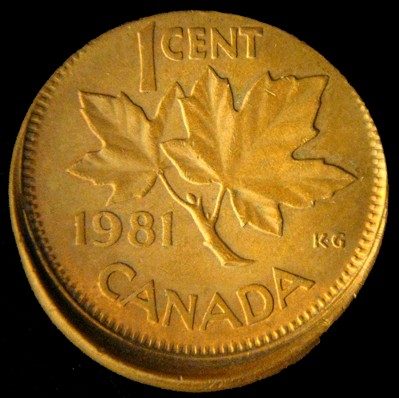
The images below show a 1981 Canadian cent with a stiff collar strike.

Struck Through Feeder Finger

PART VI. Striking Errors:

Struck Through Errors:

Struck Through Feeder Finger

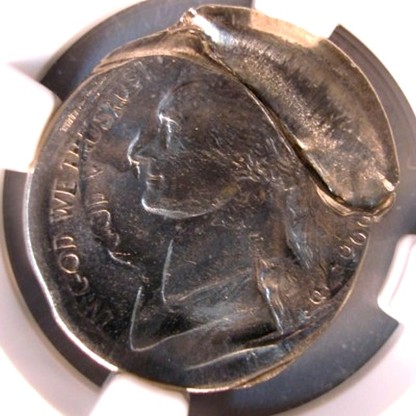
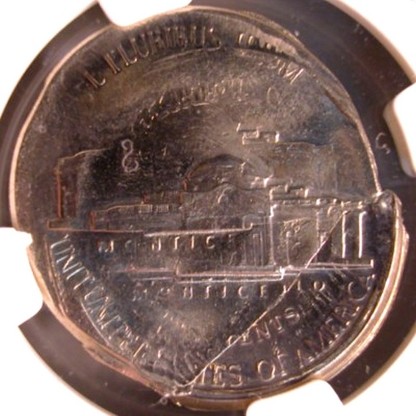
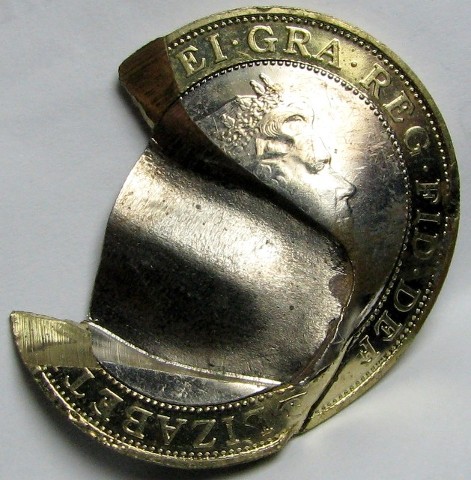
Definition: A coin struck through a feeder finger will feature a very deep impression, often with vertical walls. The margins of the impression will be concave, straight, or angular.  A sharp angle will often mark the corner of a feeder finger.  The floor of the indentation will usually show a texture distinctly different from that left by a planchet, sometimes smooth, sometimes coarse.  A dark discoloration may be present in the floor of the impression.  Coins are often split or torn apart when struck through a feeder finger.

Note: Several specimens are shown below.

Below is a triple-struck nickel struck through the part of the feeder finger that cradles the planchet. The force of the impact nearly tore off the metal beneath it. It’s tenuously connected to the rest of the coin at one end. The loose flap was telescoped beneath the main part of the coin, probably when the coin was encapsulated.

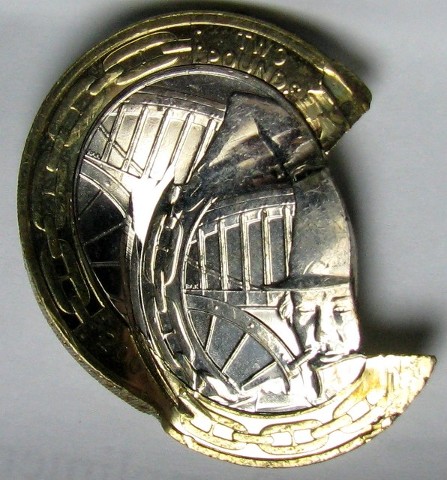
Double-struck 2006 Isambard Brunell two pounds. This big bi-metallic split & tore as it was struck through a very large, malfunctioning feed finger.

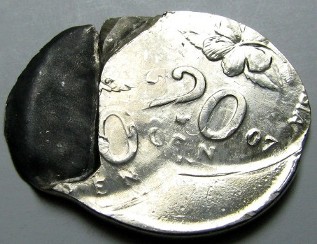
Multi-struck 2007 Malaysian 20 sen struck through feeder finger.

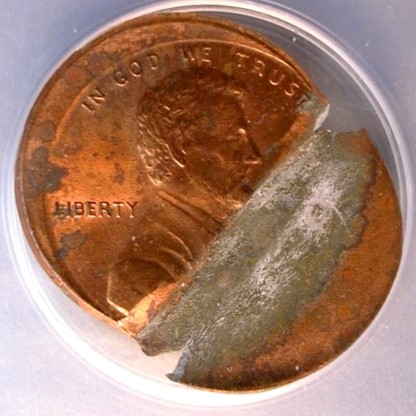
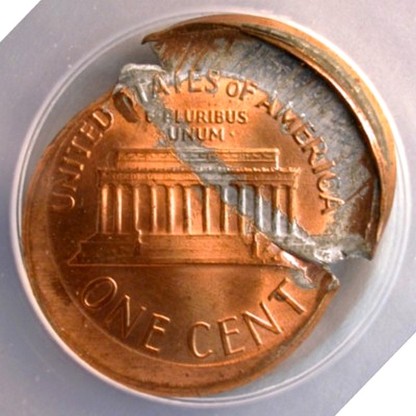
This off-center cent was apparently struck through the side of a feeder finger.  The medial wall of the impression is vertical and the floor is very thin.


  • « Previous Page
  • 1
  • …
  • 7
  • 8
  • 9
  • 10
  • 11
  • …
  • 21
  • Next Page »
  • Home
  • Introduction To This Website
  • Error-ref.com News
  • Comprehensive Error-Variety Checklist
  • Index Of Completed Entries
  • Part I. Die Subtypes:
  • Part II. Die Varieties:
  • Part III. Die Installation Errors:
  • Part IV. Die Errors:
  • Part V. Planchet Errors:
  • Part VI. Striking Errors:
  • Part VII. Post-Strike Mint Modifications:
  • Part VIII. Post-Strike Striking Chamber Mishaps:
  • Part IX. Post-Strike Mint Damage:
  • Part X. Wastebasket / Composite Categories:
  • Part XI. Non Errors:
  • Featured Articles Of Interested
  • Interest & Not So Interesting Facts
  • Other Sites And Forums Of Interest
  • Our Thanks Go To
  • About The Authors
  • Contact Us

Copyright © 2026