Error-Ref.com

You are here: Home / Search for "off center"

Search Results for: off center

Stutter Strike Type I

Part VI: Striking Errors:

Stutter Strikes:

Stutter Strike Type I

Definition: A stutter strike occurs when the hammer die makes transient contact with a planchet without there being any resistance provided by the anvil die.  Resistance is provided by other means.  After the initial light contact, the hammer die completes its downstroke in a position medial to the site of original contact.  The stutter strike is restricted to a thin outlying crescent that is sharply demarcated from the adjacent complete design.  Directly opposite the stutter strike, on the face struck by the anvil die, the original surface of the planchet persists unaltered.

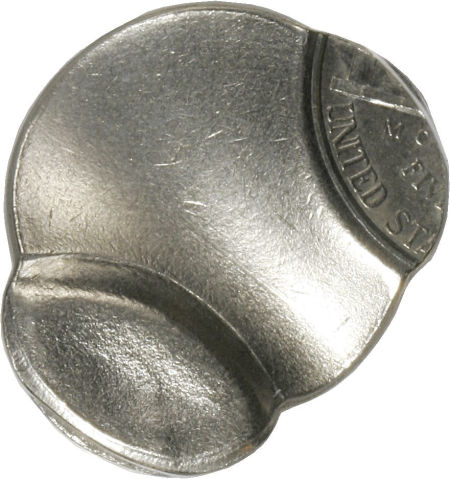
In a Type I stutter strike resistance is provided at one pole by a stiff but still somewhat mobile collar.  It’s surmised that the die, die assembly, or collar has to be loose as well because stiff collar errors are common but stutter strikes are not. After the collar gives way, the hammer die completes its descent in a position slightly medial to the original point of contact.  The thin outlying crescent will be abruptly demarcated from the adjacent complete design.  The die-struck crescent will, at best, contain the tips of peripheral letters.


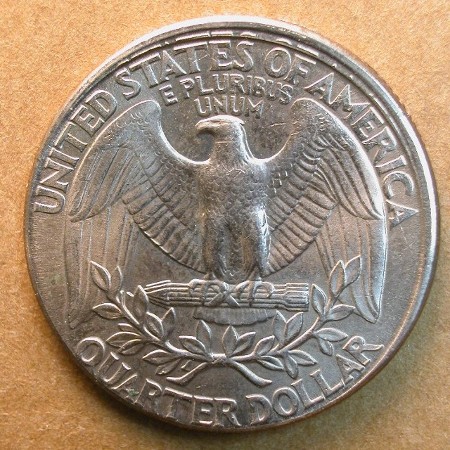
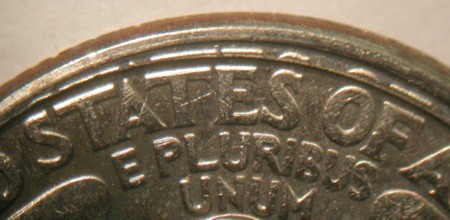
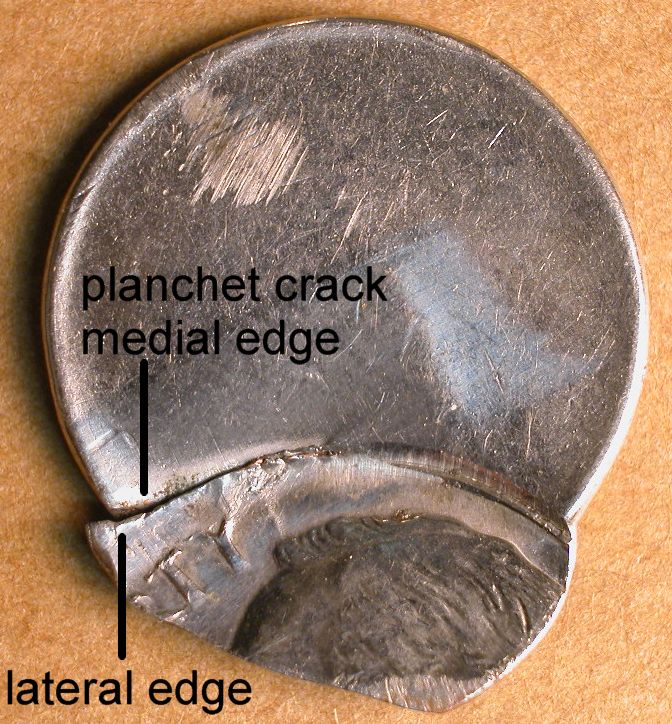
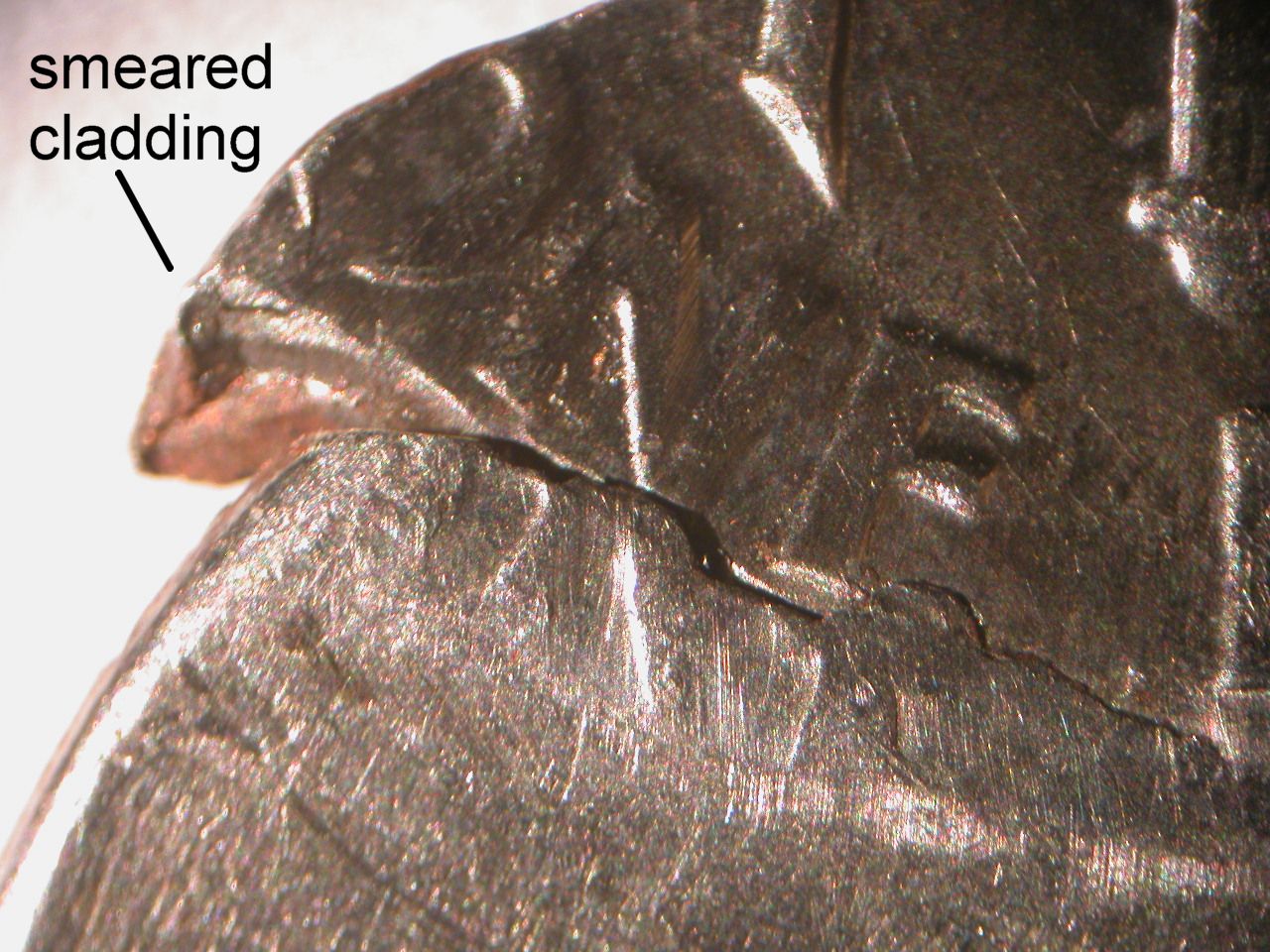
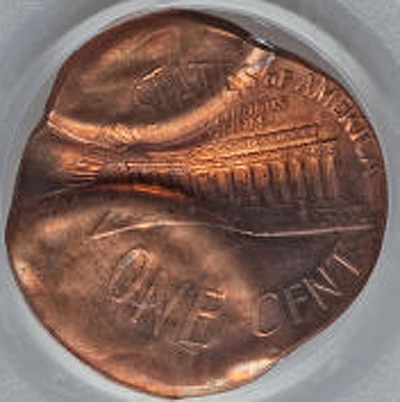
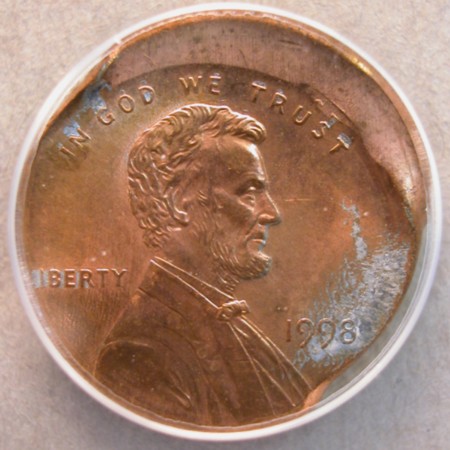
This 1998-P quarter shows a Type I stutter strike on its reverse face. The coin was struck by inverted dies, meaning that the reverse die was the hammer die.  The planchet was fed into the striking chamber in a slightly off-center position, with the southern pole of the obverse face resting on the lip of the collar or against its beveled entrance.  The collar resisted being depressed for a split second, allowing some die-struck letters to form at the periphery of the planchet.  This also produced a weak, sloping shoulder on the obverse face.  The collar then collapsed, allowing the hammer die to complete its downstroke without further warping the planchet.  The coin shows a partial collar error next to the stutter strike.
Stutter Strike Type III

Part VI. Striking Errors:

Stutter Strikes:

Type III Stutter Strike

Definition: A stutter strike occurs when the hammer die makes transient contact with a planchet without there being any resistance provided by the anvil die.  Resistance is provided by other means.  After the initial light contact, the hammer die completes its downstroke in a position medial to the site of original contact.  The stutter strike is restricted to a thin outlying crescent that is sharply demarcated from the adjacent complete design.  Directly opposite the stutter strike, on the face struck by the anvil die, the original surface of the planchet persists unaltered.

The rarest form of stutter strike is the Type III stutter strike.  It occurs when a bent, folded, or crumpled planchet or coin is present in the striking chamber.  The deformation of the disc can occur before, during, or between strikes.  If the bent disc is rendered unstable while sitting on a flat surface, it can tilt and slide sideways during initial contact with the hammer die.  A Type III stutter strike can occur on either face.
A Type III stutter strike can form on the face struck by the hammer die when a severely bent planchet enters the striking chamber or when a bend forms in a coin during an initial strike.  The descending hammer die contacts the apex of the bend while the planchet rests on two points at opposite poles.  This makes for a very unstable situation.  After initial contact, the wobbly planchet slides out of the way, carrying the initial point of contact out beyond the boundaries of the striking chamber. A Type III stutter strike can form on the face struck by the anvil die if an unstable point of contact lies near the margin of the die face.

More information on this error type can be found in the December 28, 2009 and August 26, 2013 Coin World.

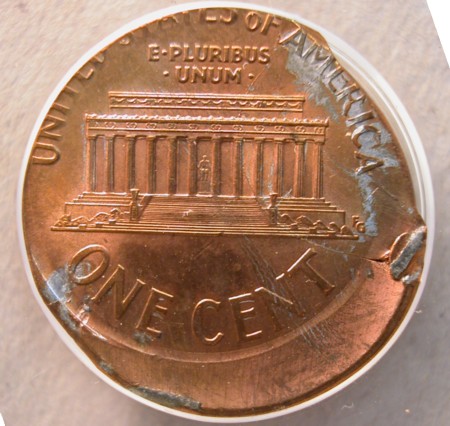
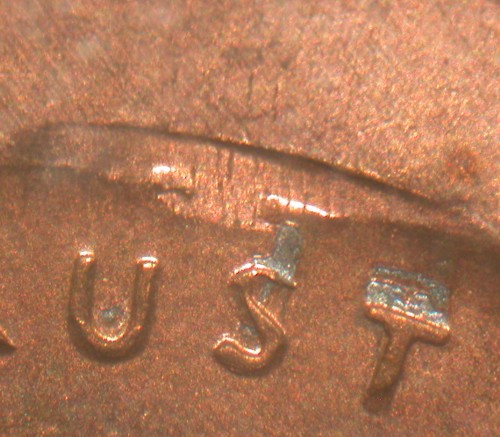
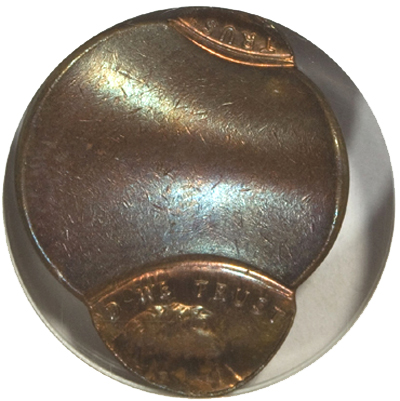
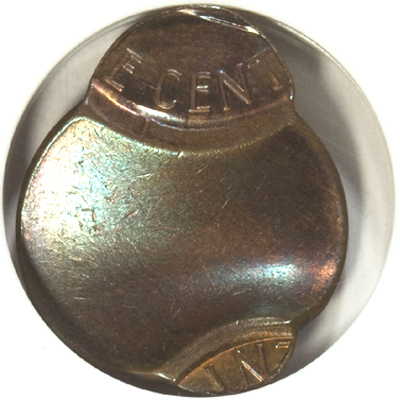
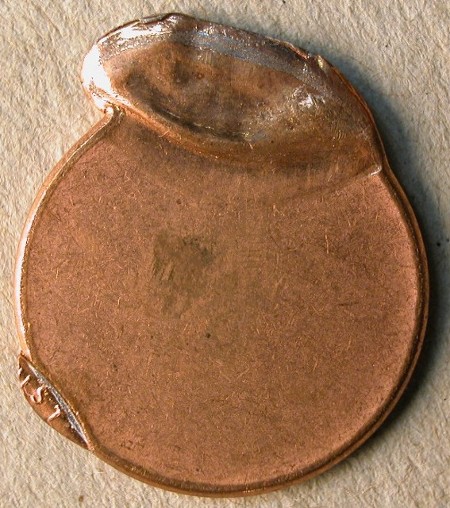
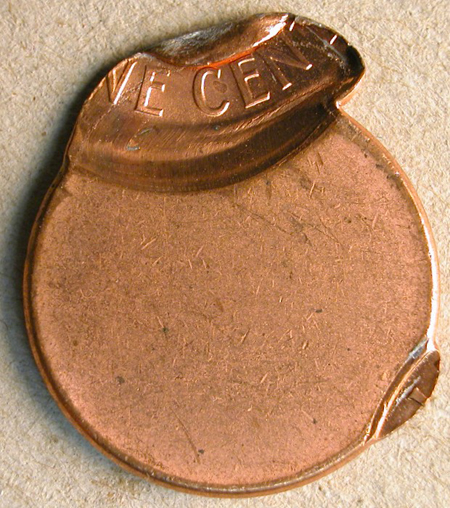
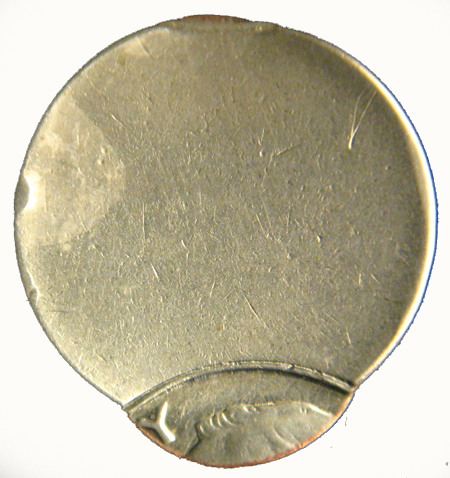
This 1998 cent started out as an edge strike.  In other words, the planchet was struck while standing or spinning on-edge.  The initial impact bent the planchet in the middle, but the planchet slipped before it could be folded over completely to form a foldover strike.  As the hammer die’s downstroke continued, the bent planchet was supported at two points located at opposite poles on the planchet’s edge while the convex surface of the bend faced toward the hammer die.  As the hammer die continued its descent, it contacted the apex of the bend, generating the upper parts of the letters “ST” (of TRUST).  This brief impact caused the planchet to shift sideways, carrying these partial letters beyond the die face.  The completion of the hammer die’s downstroke produced an off-center strike with an edge strike at 10:00 and a paraxial foldover strike at 4:00.  That highly asymmetrical foldover strike takes the form of a flap of metal embedded in the reverse face.

01a_TIII_stutter_stk_10c_obv01b_TIII_stutter_stk_10c_rev 02_TIII_stutter_stk_10c_close

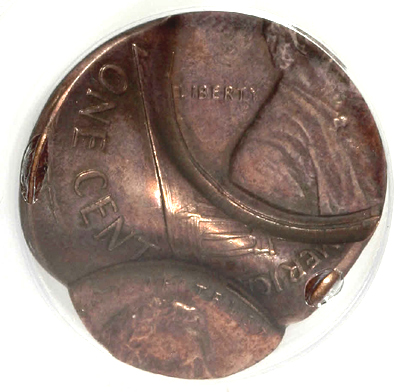
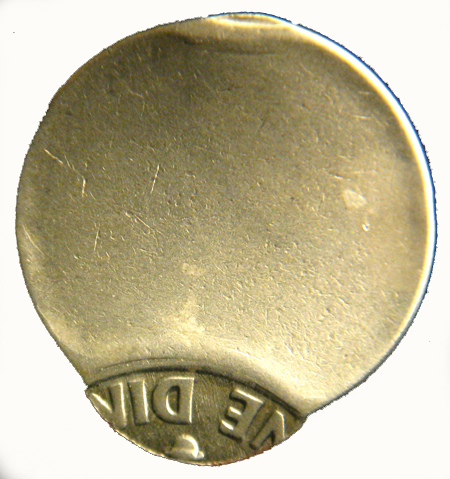
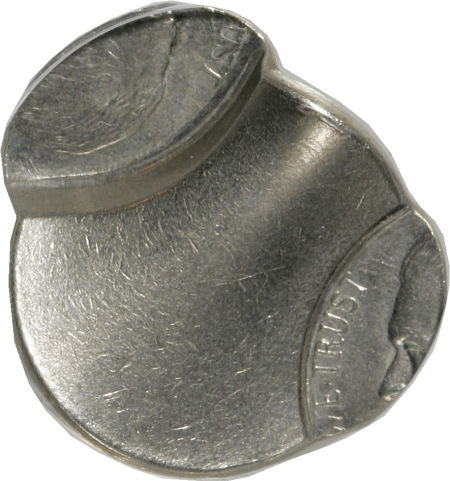
This dime planchet entered the striking chamber with a long tear or fissure in it.  One edge of the fissure rode over the other edge.  The overlapping edges of the fissure were pressed against each other when the planchet was struck off-center.  The initial impact of the reverse (anvil) die generated a partial set of letters (“ONE”) on the lower of the two telescoped surfaces.  Increasing striking pressure caused the edges to flatten out and separate, carrying the partial letters beyond the edge of the anvil die.  Completion of the strike generated a normal off-center strike above the partial letters.  This off-center strike is also a chain strike.

Stutter Strike Type II

PART VI. Striking Errors:

Stutter Strikes:

Stutter Strikes due to planchet flexion (Type II):

Definition: A stutter strike is a rare error that can be thought of as the polar opposite of machine doubling. While the extra impressions of machine doubling occur after the downstroke of the hammer die reaches its lowest point, a stutter strike occurs before the downstroke has completed its downward trajectory. In a stutter strike, the hammer die makes initial light contact with the surface of the coin, but completes its descent in a slightly different position relative to the original point of contact. The result is a thin crescent of design at the outer margin of coin, distinctly separate from the definitive strike.

A stutter strike can result from movement of the die, movement of the coin, or expansion of the coin during the downstroke. It always occurs together with at least one other press malfunction or error. Associated errors include an off-center strike or broadstrike atop a stiff collar, an indent or partial brockage, or a loose die in combination with any of the aforementioned errors.

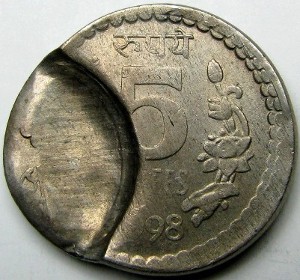
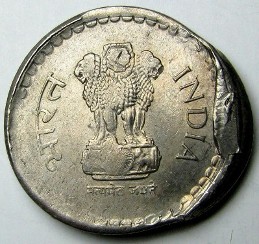
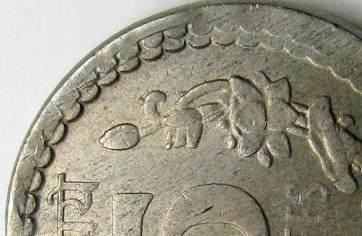
The Indian 1998 5 rupees below features a double row of denticles opposite a large  indent on the reverse face. As with most Indian coins, the reverse face was struck by the hammer die. While the double row of denticles may appear to be a double-strike, closer inspection shows that it is, instead, a stutter strike.
In the case of this 5 rupees coin, the factors underlying the production of a double row of denticles appears to be the indent, in combination with a loose hammer die or die carriage. The presence of an intrusive planchet caused uneven pressure to be applied to the planchet represented by this coin. The area overlain by the intrusive planchet received the initial force of the strike, which tipped up the part of the planchet lying beyond the indent. The elevated outer portion of the planchet contacted the perimeter of the descending hammer die so that the former picked up an initial row of denticles. Simultaneous with that contact, the hammer die shifted medially and completed its downstroke, producing the second row of denticles along with the main strike. The main strike is misaligned relative to the obverse design, which was struck by the anvil die.


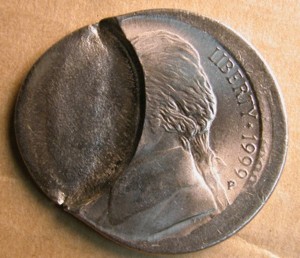
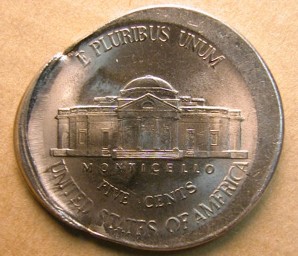
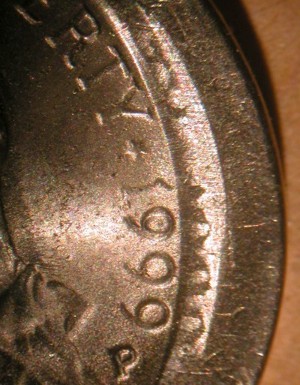
The stutter strike shown below is associated with an indent on the left side of the obverse face. The intrusive planchet was contacted first by the descending hammer die. This caused the right side of the underlying planchet to angle up and meet the hammer die on its way down. That light initial contact left a weakly-struck crescent on the right side of the coin that contains the TY of LIBERTY and the date. As the hammer die continued its descent, it compressed both planchets. This caused both planchets to expand in all directions. The expansion of the underlying planchet carried the lightly-struck crescent on the right side beyond the edge of the striking chamber.  The hammer die then completed its descent, producing the definitive design.

The stutter strike lies lateral to the definitive design on both the obverse and reverse face. It is opposed on the reverse face by the original unstruck surface of the planchet.

Super Clash: 2000 P Jefferson Nickel

PART V: Annealing Errors:

Abnormal Hard Planchet:

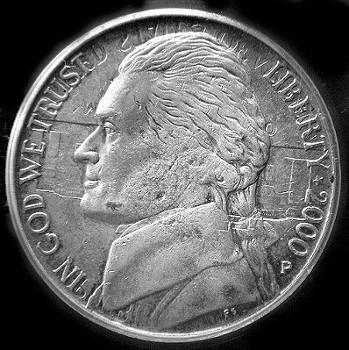
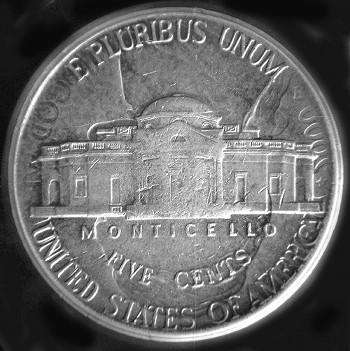
Super Clash; 2000-P Jefferson nickel

This 2000P Jefferson nickel more than likely has the strongest clashed dies that left both the obverse and reverse dies intact.

Virtually every design element has been crossed transferred to the opposing die face. Only the obverse center has no traces of clash marks.

Although the dies are aligned correctly for the strike. The clash has a 5° offset from the horizontal plane. It is not known which die has offset during the clash.

We have David Dukette to thank for finding this gem and it is encapsulated by PCGS with a grade of AU-58.

For more pictures of this die clash click HERE


Surface Film Effects

Part VI. Striking Errors:

Struck-Through Errors:

Surface Film Effects

Definition:  A thin film of oil on a planchet, a coin, or a die can produce a number of eye-catching effects. 

The simplest effect is surface film doubling.  It generally appears in coins that are broadstruck or struck off-center.  Expansion of the coin is necessary for the phenomenon to develop.  In surface film doubling a corona surrounds centralized design elements like busts and buildings.  Surface film doubling can also extend radially from more peripheral design elements.  Surface film doubling is especially common in nickels struck in the year 1964.  Surface film doubling generally takes the form of a highly reflective area that appears dark when viewed face-on.

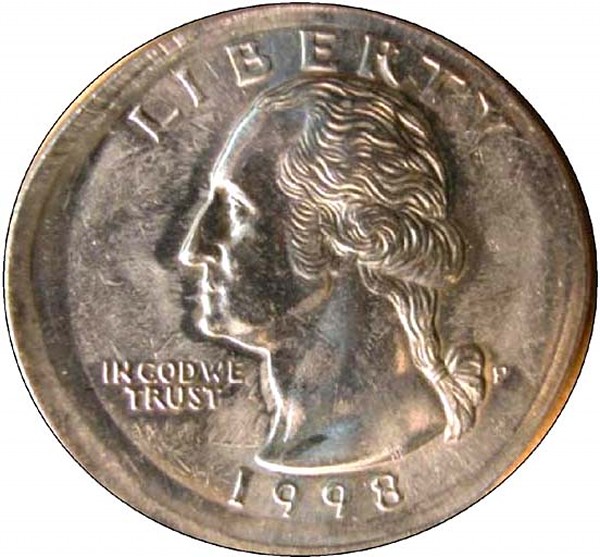
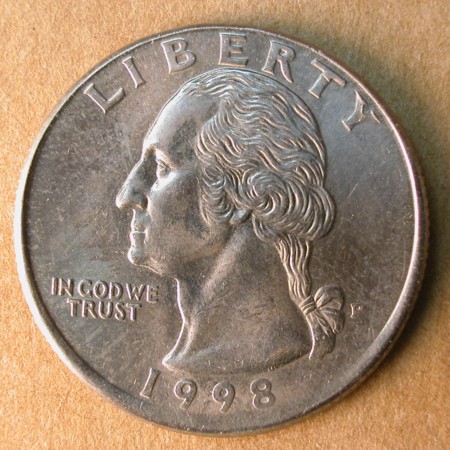
This broadstruck 1998-P quarter shows surface film doubling surrounding Washington’s bust.

Double-struck coins will occasionally show a surface film afterimage.  When an oily coin shifts position and is struck again, the topography of the original image can be largely or completely erased.

However, a thin layer of oil can preserve many of the details of the first strike in the form of a ghost image.  Surface film afterimages vary in their clarity, completeness, and color.  A surface film afterimage can be darker or lighter than the surrounding field.  It can take the form of a dark outline surrounding what used to be raised design elements.  It can manifest as an area of enhanced reflectivity that appears dark when viewed directly from above.

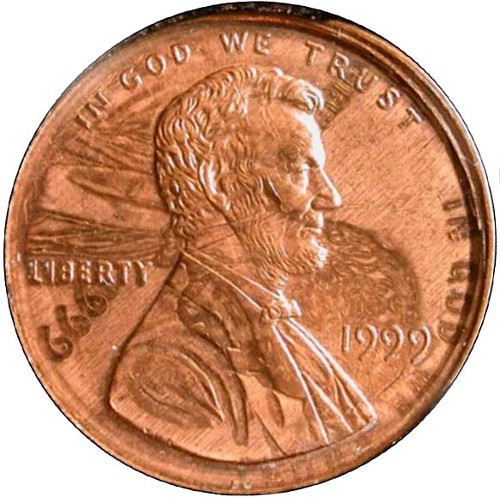
This double-struck 1999 cent shows a very complete surface film afterimage on the obverse face.  In this specimen, the afterimage is an area of enhanced reflectivity, which appears dark in the photo.  The reverse face (not shown) shows no afterimage.
The rarest surface film effect is surface film transfer.  It takes the form of a strongly offset or rotated ghost image in a coin that is struck once.  Only a handful of cases are known among U.S. coins.  It requires an unusual set of circumstances and can occur in two ways.

Scenario 1: An oily planchet is struck, shifts position, and is struck again.  The second strike transfers an oily imprint of the design to one or both dies.  The double-struck coin is ejected and a fresh planchet is fed into the striking chamber.  The die with the transferred oily image then transfers that image to the planchet.

Scenario 2:  An oily die strikes a coin, transferring the oil to the coin.  The coin then shifts position and is struck again.  This transfers the oil back to the die in the form of a faint image.  The double-struck coin is then ejected and a fresh planchet is fed in.  The next strike transfers the oily image back to the planchet.

Surface film transfer can leave an image that is darker or lighter than the surrounding field or one that has greater reflectivity.

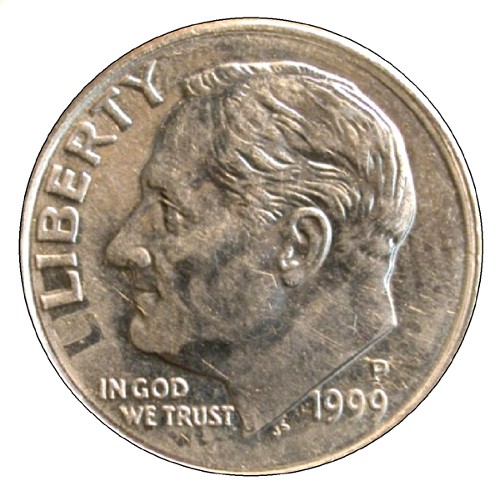
This 1999-P dime shows a case of surface film transfer on the obverse face.  The transferred elements include the LIB of LIBERTY and WE TRUST.

Surface film effects can enhance the clarity and completeness of faint clash marks.  This is most often seen among copper-plated zinc cents.  However, the effects of an oil film are rather hard to distinguish from the faint clash marks themselves.

Saddle Strike Head To Base

PART VI. Striking Errors:

Saddle Strike:

Head-to-Base Orientation

Definition: A saddle strike occurs when a planchet or coin receives two simultaneous off-center strikes by two adjacent die pairs.

While most saddle strikes show a head-to-head orientation of the two obverse designs, other orientations have been observed.  A head-to-base orientation is common in the early to mid-1970s, but does occur sporadically in other years.

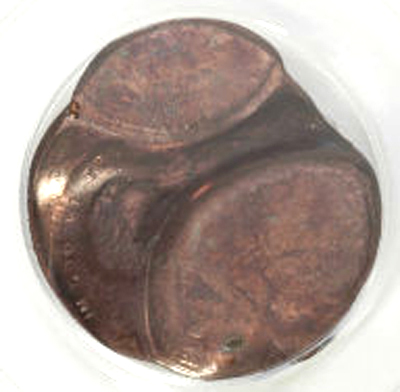
This triple-strike is in the form of a flipover saddle strike on a previously struck, off-center cent.  The saddle strike shows a head-to-base orientation.

Images are courtesy of Heritage Auctions.

Saddle Strike Head To Head

PART VI. Striking Errors:

Saddle Strike:

Head-to-Head Orientation

Definition: A saddle strike is defined as planchet or coin that received two simultaneous strikes from two adjacent die pairs.  Most saddle strikes show a head-to-head orientation of the two obverse designs.

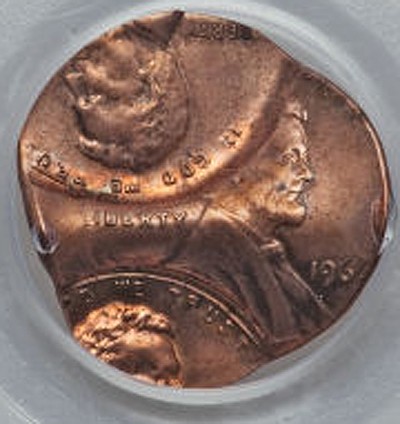
The 1964(P) Lincoln cent pictured below failed to eject properly and ended up straddling two adjacent die pairs. It was then struck again. The tandem off-center strikes show the familiar head-to-head orientation.

Images are courtesy of Heritage Auctions.

Saddle Strike Wide Gap Between Adjacent Dies

PART VI. Striking Errors:

Saddle Strikes:

Wide Gap Between Adjacent Dies

Definition: The distance between adjacent striking chambers in dual and quad presses was increased in the mid- to late-1970s.  As a result, the size of the two off-center strikes is reduced relative to earlier saddle strikes.

The undated Lincoln cent saddle strike shown below has a wide gap between the two off-center strikes.

Images are courtesy of Heritage Auctions.

The post 1964 Roosevelt dime shown below became somewhat centered between two striking chambers resulting in a saddle strike.


Saddle Strike With Hump

PART VI. Striking Errors:

Saddle Strikes:

With Hump

Definition: A saddle strike occurs when a planchet or coin is struck simultaneously by two adjacent die pairs. Such a situation can only arise in a dual or quad press.  A quad press contains a total of four die pairs arranged in two couplets. The unstruck interval between the two tandem off-center strikes often buckles upward, forming a hump or a “saddle”.


Above is a photograph of an undated Jefferson nickel with a humped saddle strike.  The larger of the two off-center strikes is uniface, meaning that the reverse face was struck against an underlying planchet.

Images courtesy of Heritage Auctions.

Saddle Strike Without Hump

PART VI. Striking Errors:

Saddle Strike:

No Hump:

Definition: A saddle strike occurs when a planchet or coin receives two simultaneous off-center strikes from two adjacent die pairs.  In most saddle strikes, the unstruck interval between the two off-center strikes bows upward to form a hump or a “saddle”.  When a hump doesn’t form,it’s still possible to diagnose the error.  Useful diagnostics include the following:

  1. The lack of a “slide zone” in one or both off-center strikes.
  2. A consistent orientation of the two strikes.  In most years, saddle strikes show a head-to-head orientation of the two obverse designs.
  3. A consistent minimum distance between the two off-center strikes (e.g., about 11.5 mm in recent cents).
  4. A slight tendency for one or both off-center strikes to squeeze beneath the unstruck part of the planchet.
  5. The frequent presence of a low pressure ridge just medial to the internal margin of the off-center strike.

This is a flat saddle strike.  A slide zone is present on the larger strike because it is uniface.  The dies exert pressure on this part of the coin first because of the double thickness.  That allows a slide zone to sometimes form.  The smaller off-center strike shows no slide zone.

  • « Previous Page
  • 1
  • …
  • 6
  • 7
  • 8
  • 9
  • 10
  • …
  • 21
  • Next Page »
  • Home
  • Introduction To This Website
  • Error-ref.com News
  • Comprehensive Error-Variety Checklist
  • Index Of Completed Entries
  • Part I. Die Subtypes:
  • Part II. Die Varieties:
  • Part III. Die Installation Errors:
  • Part IV. Die Errors:
  • Part V. Planchet Errors:
  • Part VI. Striking Errors:
  • Part VII. Post-Strike Mint Modifications:
  • Part VIII. Post-Strike Striking Chamber Mishaps:
  • Part IX. Post-Strike Mint Damage:
  • Part X. Wastebasket / Composite Categories:
  • Part XI. Non Errors:
  • Featured Articles Of Interested
  • Interest & Not So Interesting Facts
  • Other Sites And Forums Of Interest
  • Our Thanks Go To
  • About The Authors
  • Contact Us

Copyright © 2026