Error-Ref.com

You are here: Home / Search for "off center"

Search Results for: off center

Part X. Wastebasket / Composite Categories:


Ghost images
(CW 8/1/11)

    • Progressive, indirect design transfer (a.k.a. internal metal displacement phenomenon, ghosting, heavy design transfer) (CW 6/7/10)
    • Worn clash marks
    • Thin planchet (CW 8/2/10)
    • Split planchet (CW 8/31/15)
      • Split-before-strike (CW 8/2/10)
      • Split after-strike
    • Coin thinned by strike(s)
    • Weak strike (CW 4/11/11)
    • High pressure strike
    • “Greasy ghost” (CW 7/5/10)
    • Surface film afterimage (CW 5/2/11)
    • Surface film transfer (CW 5/2/11)
    • Split plating afterimage (CW 5/2/11)
    • Coarsened crystallite afterimage (CW 5/2/11)
    • Slide zone ghost letters (? 11/16/15)
    • Incuse ghost images associated with capped die strikes (CW 10/25/21)

Doubling

    • Die Deterioration Doubling
      • Raised
      • Incuse
    • Machine Doubling
    • Stutter strikes (3 types)
    • “Abrasion doubling” (extremely doubtful) (CW 7/15/13)
    • Split plating doubling (CW 3/26/12)
    • Surface film doubling
    • Grease-mold doubling (CW 8/19/13)
    • Longacre doubling
    • Offset laser-etched frosting on proof dies (CW 2/21/11)
    • Plating disturbance doubling (CW 3/28/11)
    • Flat-field doubling (imperfectly aligned proof strikes (CW 4/29/13)

Embedded matter (CW 12/14/09)

    • Poured-in
      • Slag
      • Intrinsic metallic inclusion
    • Rolled-in
    • Punched-in (by blanking die)
    • Squeezed-in (upset mill inclusion) (CW 9/6/10)
    • Scraped-in (CW 2/23/15)
    • Struck-in
    • Lettering die inclusion (CW 9/14/15)

Edge overhangs (CW 11/30/15)

    • Partial collar errors
    • Horizontal lipping
    • Stiff collar errors
    • Forced broadstrikes


Green lettering – major heading
Blue lettering – linked to subject matter

Brown lettering – subject matter covered under that heading

Black lettering – no entry yet

Unidentified Origin And Purpose

Part V: Planchet Errors:

Wrong planchet and off-metal errors: 

Unidentified origin and purpose (Orphan)

This survey just scratches the surface of diversity found within the outer limits of the off-metal & wrong planchet universe. These outer limits are fun to explore, but don’t expect any easy answers.  Error collectors enjoy pondering these mysteries, & hold out the hope of solving some of them. Enjoy the images posted & pick up a bit of an expanded education along the way.

Orphan wrong planchet and off-metal errors can be grouped into a number of categories:

1. Originally normal planchets that are so profoundly and strangely damaged that they are no longer recognizable.

2. Non-standard planchets that may have been intended for a foreign denomination, a token, or a medal and that somehow got mixed up in the supply stream.

3. A coin struck on planchet whose composition matches that of another U.S. coin, but whose size, weight, and appearance fails to correspond to any normal issue.

4. Coins composed of a conventional U.S. or foreign alloy/composition that present an oddly rough or unfinished appearance.

5. Coins struck on defective or damaged foreign planchets.

6. Planchets or blanks with a composition that is seldom, if ever, used in coinage.

7. Coins of normal diameter and relatively normal appearance, but with a density (specific gravity) that is significantly higher or lower than normal.

8. Discs that are completely bizarre with respect to appearance, composition, density, or texture.

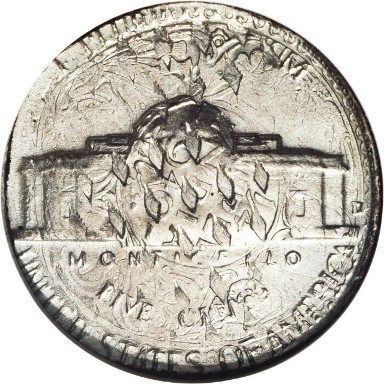
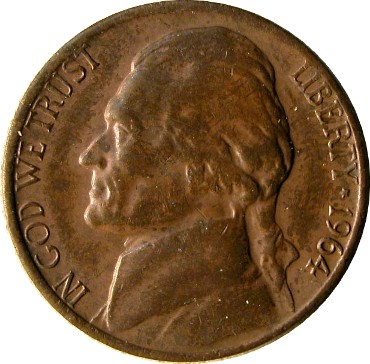
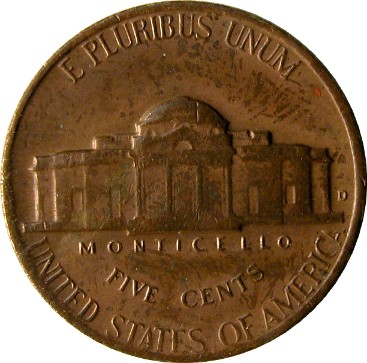
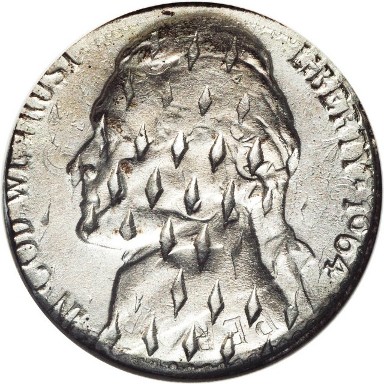
1964 Jefferson nickel struck over a 1940 India ¼ rupee. Prior to the strike, the Indian coin was cancelled with a waffle pattern of diamond-shaped indentations. This coin is not unique; on page 262 of the 5th edition (1991) of Alan Herbert’s Minting Varieties and Errors we find a photo of a 1964 cent struck over a cancelled 1942 India ¼ rupee.


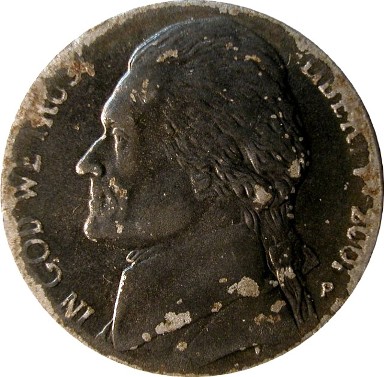
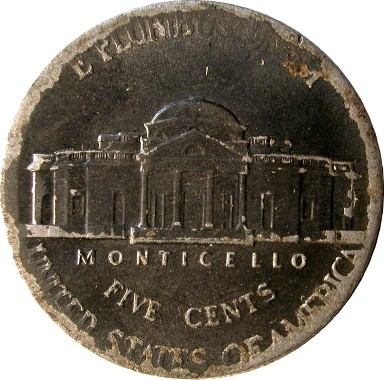
2001-P Jefferson nickel struck on a steel planchet. Strongly attracted to a magnet, the steel is covered by a glossy black cortex of uncertain composition. Underweight at 3.33 g, the cortex has flaked away around the edges and elsewhere, revealing underlying gray steel.

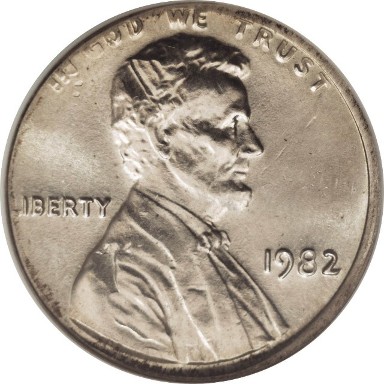
1982 cent struck on a dime-sized silver-alloy planchet (84% Ag/ 16% Cu). The coin is also double-struck.

Photos courtesy of Heritage Auctions. 


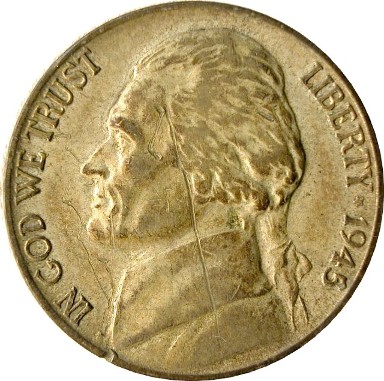
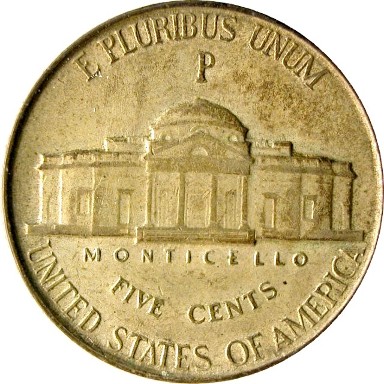
1945-P wartime nickel that is abnormally heavy (5.58 g). It paradoxically exhibits abnormally low density (Specific Gravity = 8.58). Density is not only lower than a silver-copper-manganese alloy, but is lower than copper-nickel. Instead of a typical sharp ring, the coin produces a low thud when tapped. A green tint adds an exotic flair to a rather unexceptional appearance.

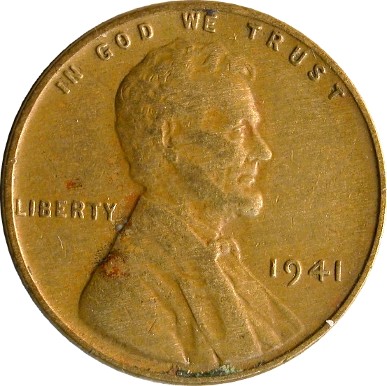
1941 Lincoln cent struck on a heavy, brass planchet. Although abundant, the origin of these planchets remains a mystery.

An off-center nickel struck on a normal-diameter, underweight (3.38 g), and badly pitted planchet. The pits are filled with a hard white matrix.

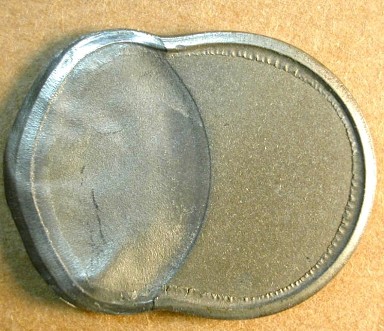
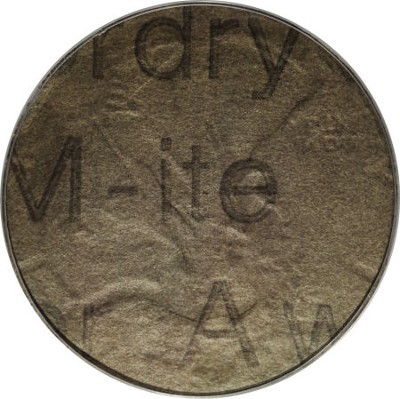
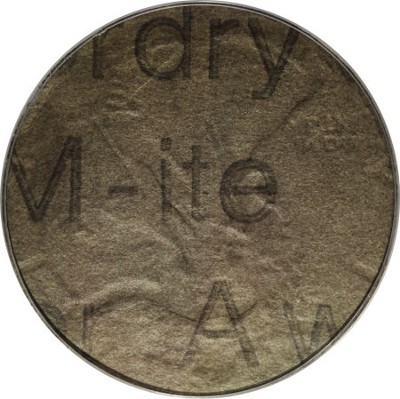
This off-center nickel was struck on a slate-gray planchet with a very peculiar pattern of upset or edge damage.

It was struck some time in the 1980’s and features an off-center uniface strike. The weight, size, and density of this slate-gray planchet matches that of a nickel but its appearance is quite unexpected. The interior shows a fine, uniform matte texture without contact marks. The edge has been squeezed and rolled, and a thin pleated apron of metal has been forced onto both faces. This all occurred before the strike.

1964-D Jefferson nickel struck on a copper-plated copper-nickel planchet. This composition does not correspond to that of any nation’s coins. Although fully struck, it weighs a modest 3.88 grams. A strategic edge scraping revealed a thick, uniform layer of copper over a copper-nickel core. Copper-plated copper-nickel is a composition that is not to be found in any denomination produced by any mint. It does not appear to be an improperly annealed planchet, as the copper, thick as it is, exhibits no cracking or flaking.

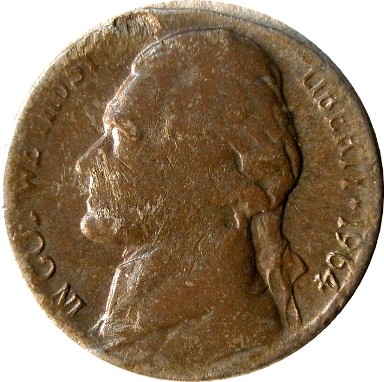
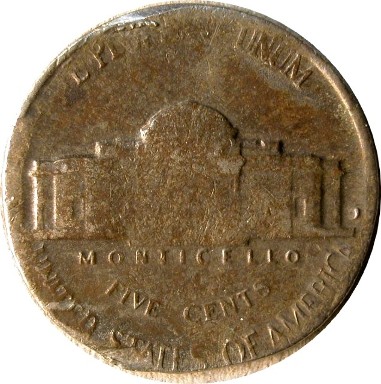
1964-D Jefferson nickel was struck on a thin planchet that weighs only 2.92 grams. Several other nickels of similar appearance are known from this time period.

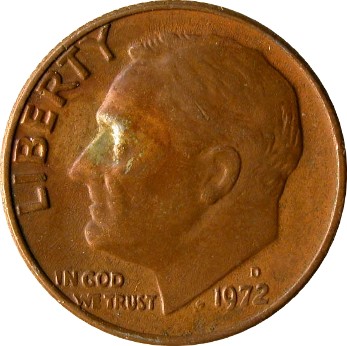
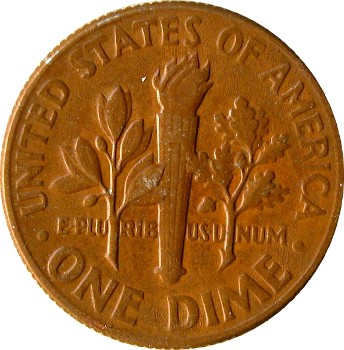
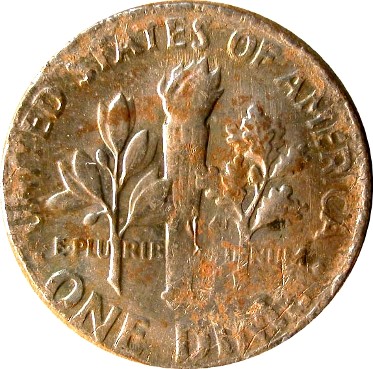
1972-D Roosevelt dime struck on what appears to be a solid copper-alloy planchet.  At 2.20 grams, it weighs slightly less than the average for normal dimes (2.28g). Small flecks of gray metal are embedded in it and seem to be part of the alloy, rather than struck-in. A rim scraping on the reverse reveals only copper.

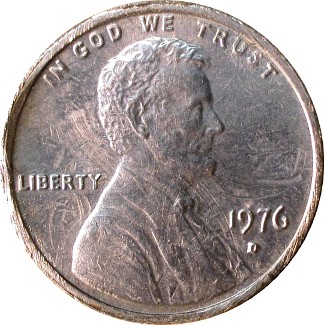
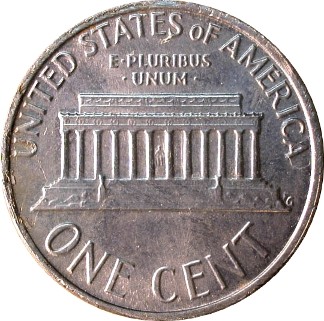
1976-D Lincoln cent was struck on a solid copper-nickel planchet that weighs 3.76 grams.  Its specifications don’t match up with any planchet the Mint was producing for any foreign country at the time.  It remains a mystery.

Coin courtesy of Fred Weinberg.


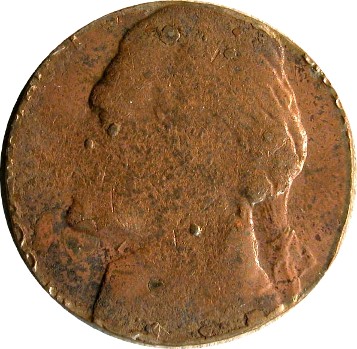
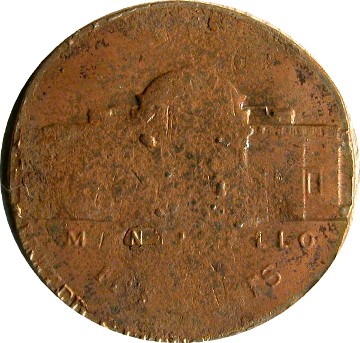
This Jefferson nickel was struck on a small, (1.86 g), lumpy copper-nickel planchet covered by a dull brown patina. A planchet with a decidedly bizarre appearance, its origin and destination are completely opaque.

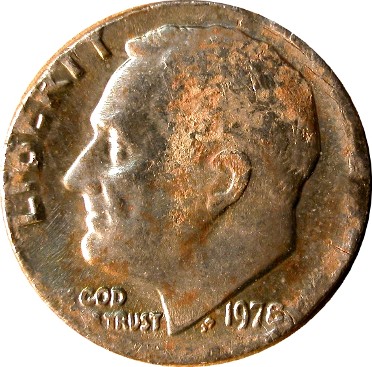
The last specimen is a 1978 Roosevelt dime which is undersized, extremely thin & light at 1.20 grams. Its outline is slightly irregular and its surface and edge have a rather rough texture. All surfaces show a mash-up of copper- and nickel-colored patches. The edge shows no trace of a normal “sandwich” of two clad layers enclosing a copper core. Appearances suggest that this might be an “agglomerated planchet”. An agglomeration of copper and copper-nickel flakes can theoretically form in the rolling mill. Bits of metal can accumulate at the edges of the rolling mill or in the interstices of the mechanism. These can accumulate into fairly substantial heaps that then have the potential of falling out onto the strip and being rolled and compressed into solid masses. Plenty of quarters and other clad denominations struck on irregular “fragments” that show a similar patchwork of copper- and nickel-colored areas have been researched. These seem likely to be agglomerated planchets, but whether this circular dime planchet falls into the same category is questionable. Fine cracks in the reverse face expose underlying copper. Whether the interior is truly solid copper cannot be determined.

Lacking a normal clad composition, it remains a complete mystery.

Totally Separated Mintmarks

PART II. Die Varieties:

Repunched Mintmarks:

Totally Separated Mintmarks


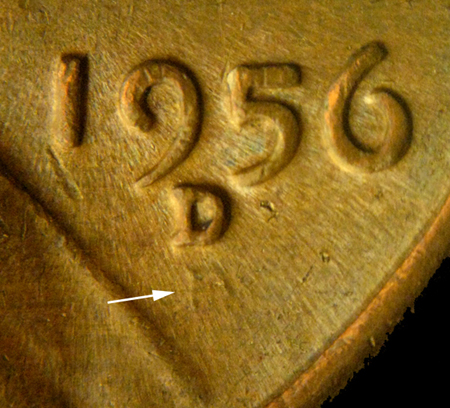
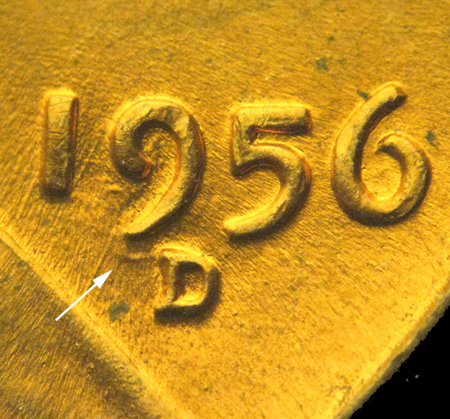
Definition: This entry is rather self-explanatory.  In this rare form of repunched mintmark variety, two mintmarks representing the same letter are so offset from each other that they do not overlap.  They are still relatively close to each other, though.  When one of the mintmarks is very distant from the other and is well outside the normal zone in which mintmarks are punched, we call this a misplaced mintmark.  A few examples of the latter are known, including a Lincoln cent in which an extra D-mintmark is seen protruding from the front of Lincoln’s coat.
A somewhat related die variety is the “dual mintmark”.  Here two mintmarks representing two different letters are punched in so that they do not overlap.  The controversial dual mintmark variety, Lincoln cent 1956-D & S no.1,  belongs to this category and can be found HERE.

The two 1956-D Lincoln cents shown above have totally separated mintmarks. The image to the left shows a faint D mintmark south of the main mintmark. The image to the right shows a faint D mintmark in the tail of the 9.

Trails

PART IV. Die Errors:

Defects Related to Die Polishing:

Trails and Wavy Steps

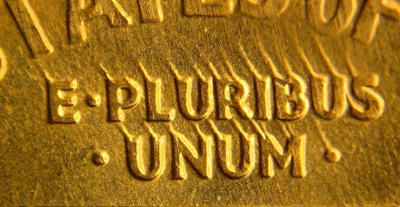
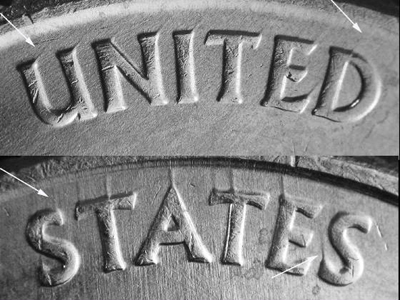
Definition:Trails or Trail Lines are raised tendrils that extend from affected design elements and gradually narrow and fade out.  They reflect the presence of grooves in the die face.  Trails most often extend from the corners of letters and numbers. This affect can be seen on all modern U. S. Coins (as early as 1921) as well as foreign coins.

Trails are generated by clumsy die polishing.  Wavy steps  are a form of trails.

Trails are produced when a rotary polishing or buffing tool is applied to the die face. Felt fibers or soft bristles are gathered together within the die’s recesses and further concentrated at the corners of design elements.  The spinning fibers erode a gully into the field portion of the die face.
In the July 17, 2017 issue of Coin World, Will Brooks and photographer Ray Parkhurst provided multiple lines of evidence in support of the die polishing theory. Later, Sean Moffat experimentally reproduced trails by taking a finished die and applying a fine diamond grit to the die face.  A rotating polishing tool swirled the grit around for 20-30 seconds.  When the grit was cleaned off, a faint set of trails was exposed.  The experiment was filmed and can be seen at https://drive.google.com/file/d/0Bw4Q1NCUjY_aeUFsNUtSMlpLdU0/view.

For more information concerning this anomaly type, visit this site: click  HERE

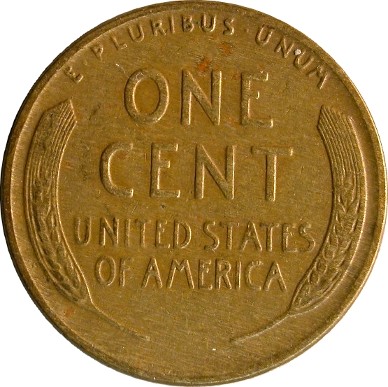
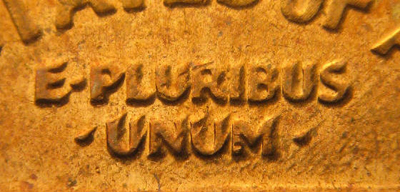
The images below show trail lines affecting E . PLURIBUS . UNUM . on the reverse of two different Lincoln cents.


1999P-1DER-033T

1994P-1DER-023T


The two images below, show trail lines affecting Washington quarters. The image to the left is an obverse die on a California statehood quarter with trails from the words UNITED STATES. The image to the left is on the reverse die of a Wyoming statehood quarter with trails affecting the words THE EQUALITY STATE.


2005P(CA)-25DEO-001T

2007D(WY)-25DER-001T

Struck On Emery Discs

PART V. Planchet Errors:

Wrong Planchet and Off-metal Errors:

Struck on Emery Discs

Definition: This error occurs when an emery disc and a planchet enter the striking chamber at the same time. One side of the planchet and the emery disc will receive a full strike, while the other side will receive a “struck through” strike.

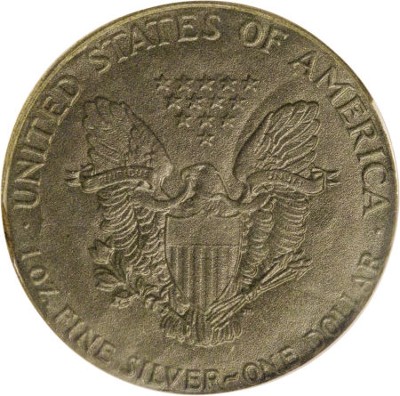
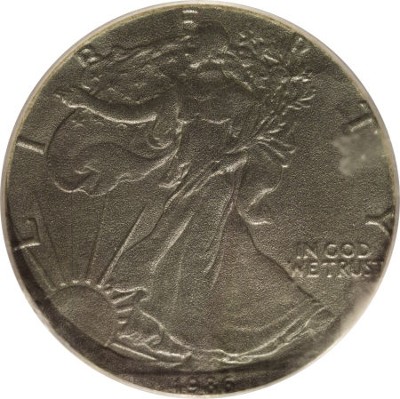
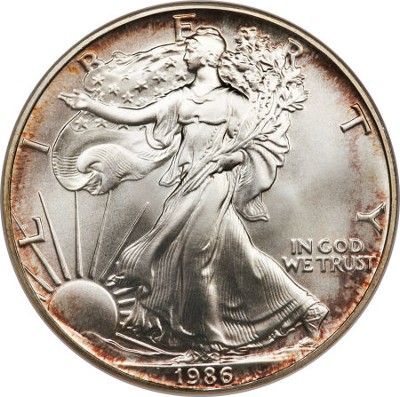
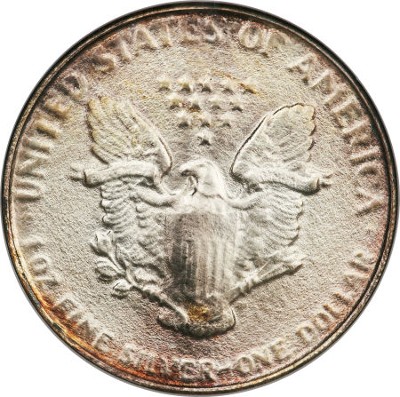
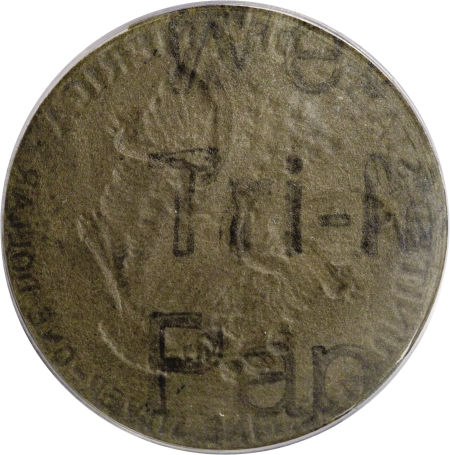
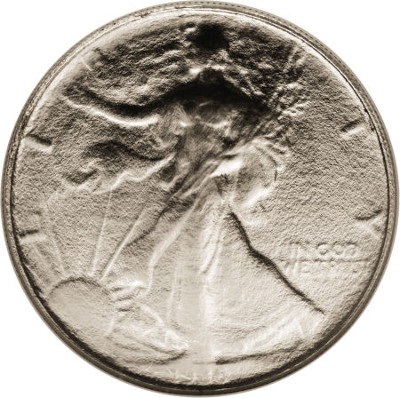
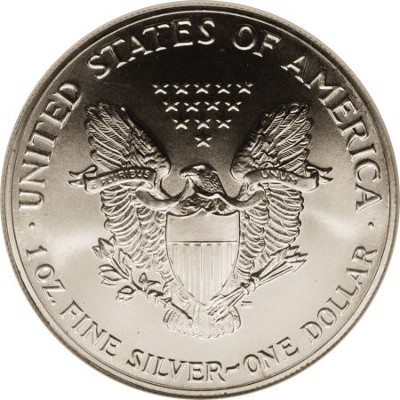
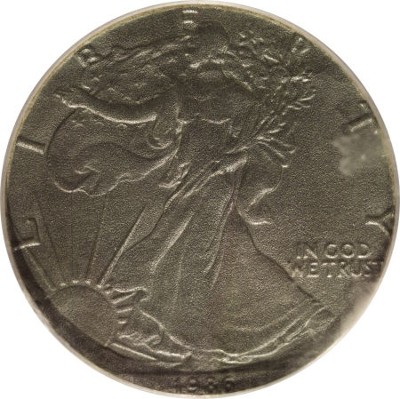
This 1986 American Silver Eagle was struck on a wafer-thin emery disc which is typically affixed to a buffing wheel and was presumably used at the Mint to help prepare dies. Somehow, an emery disc with an unpeeled backing entered the striking chamber first and covered the reverse die. A silver eagle planchet was then feed on top of the disc and struck. The result is pictured below. Click HERE to see the Silver Eagle that was struck through.

Images are courtesy of Heritage Auctions.

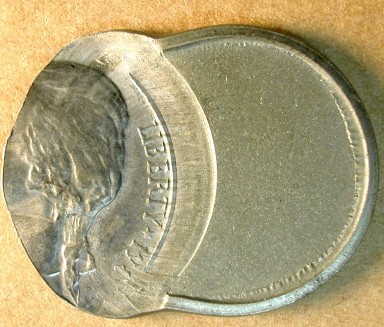
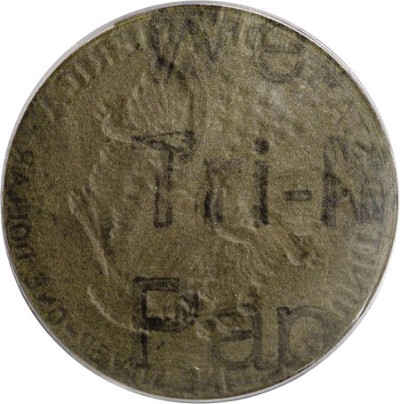
Another similar situation arose with the 1986 Silver Eagle pictured below. However, in this instance the planchet entered the striking chamber first and was covered by the emery disc. The result was an emery disc with a struck obverse with a bleed through image. The obverse of the silver eagle had a normal reverse, but had a struck through an emery disc obverse. Click HERE to see that Silver Eagle.
Images are courtesy of Heritage Auctions.

Struck Through Hardware

PART VI. Striking Errors:

Struck Through Errors: 

Struck Through Hardware

Definition: When it comes to foreign objects finding their way into a coinage press, almost anything goes. Bolts, screws, washers, and machine parts such as a feeder finger are occasional targets. Any coin trapped between a die and any of these objects is severely traumatized.

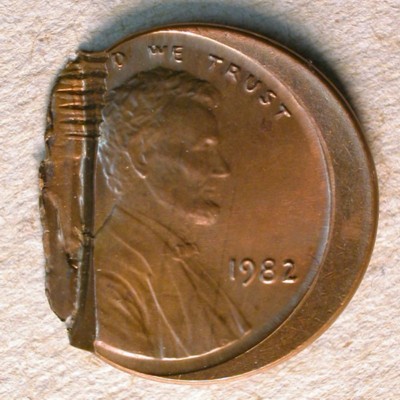
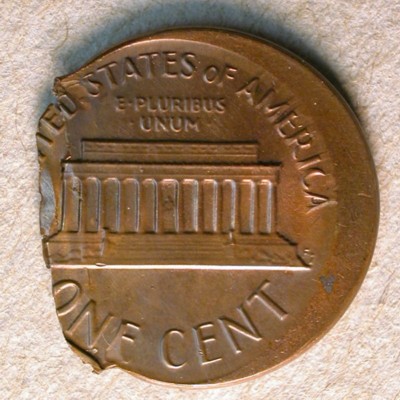
This off-center 1982 cent was struck through a threaded bolt on the left side. The left side of the coin was pinched off and lost as a result of the impact.

Coin courtesy of Sean Reynolds.

Struck On Aluminum Feeder Fingers

PART V. Planchet Errors:

Struck On ‘Aluminum’ Feeder Fingers

Definition: A coin that is struck on a feeder finger.  For U.S. coins, only aluminum or aluminum alloy feeder fingers are known to be involved.  World coins have been struck on feeder fingers of many different alloys.  U.S. coins are struck on “breakaway” feeder fingers that are designed to break off if struck by the dies.  Coins struck onfeeder fingers can represent a strike on what was an intact feeder finger or a strike on a feeder fingerfragment that broke off shortly before the strike was delivered

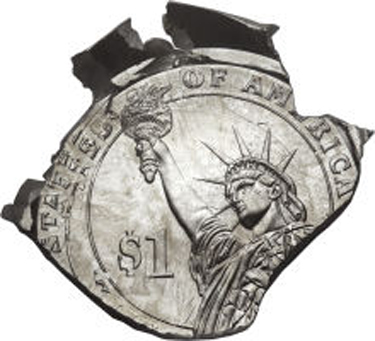
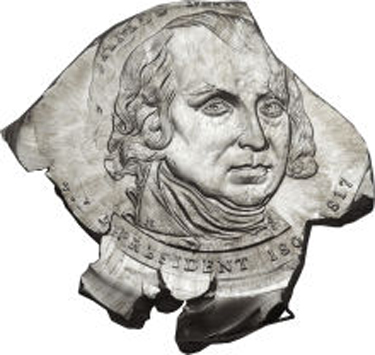
This 2007(?) John Madison dollar coin was struck twice on aluminum feeder fingers.

Images are courtesy of Heritage Auctions.

Struck Through Metal Dust Or Shavings

PART VI. Striking Errors:

“Struck-Through” Errors:

Struck Through Miscellaneous Foreign Matter:

Struck through metal dust or shavings


Definition: A wide range of foreign objects, from large to microscopic can end up being struck into planchets and coins.  Metal dust is a common contaminant in coinage presses and generally leaves tiny, irregular pits in the coin’s surface.  However, if the metal is of a different composition and color, and if it’s retained, it can easily be seen under a microscope.  When it’s combined with lubricant and dirt, metal dust contributes to a compacted, hardened form of “grease” that is frequently struck into coins.

Metal shavings are also sometimes struck into coins.  These can be broken off rim burrs, many of which are produced a split second before the strike by the feeder mechanism.  Other metal shavings will have different origins from elsewhere in the press and from earlier stages in the minting process.  Impressions of metal shavings are generally curved and fang-like.

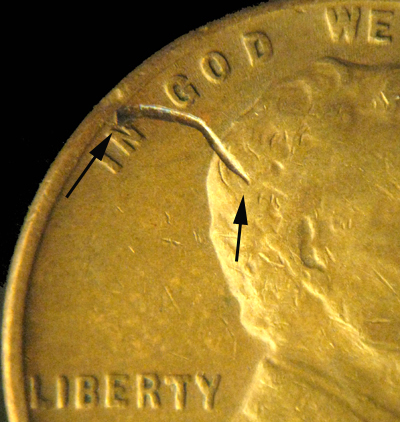
This 1945-P Lincoln cent was struck through an irregular foreign object which entered the striking chamber at the same time as the planchet that is represented by this coin. The object may have been a shaved-off rim burr.

Struck Through A Split Die Cap

PART VI. Striking Errors:

Struck Through Errors:

Struck Through a Die Cap:

Struck Through a Split or Torn Die Cap


Definition: As the floor of a late-stage die cap gets increasingly thin, it can develop tears or can split like the skin of an overripe tomato.  The result is a coin with part of the design blurred (a ghost image) and part of the design unobstructed.  Tears can also develop in the wall of a cap.

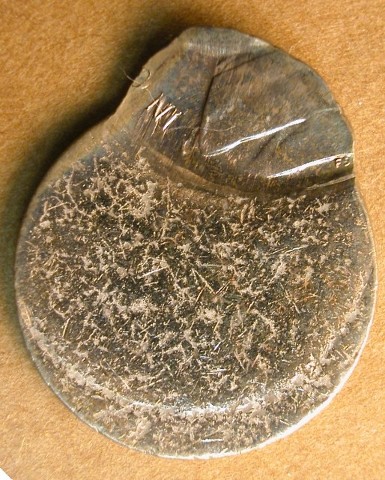
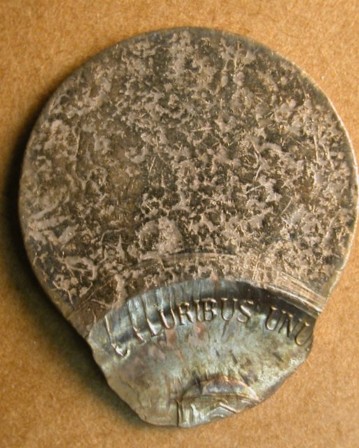
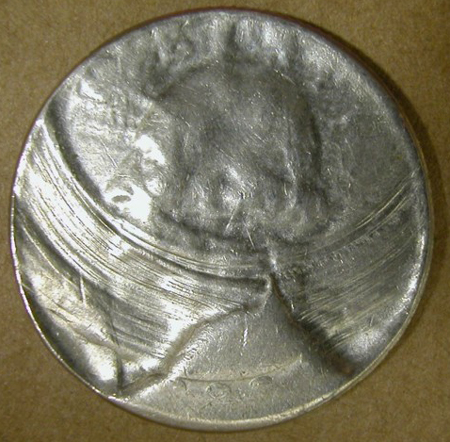
Shown below is a 1983-? quarter dollar struck through a dislodged, laterally-shifted, torn die cap.  After falling off the obverse die, the cap moved northward.  At some point a triangular tear developed in the wall of the cap.  The formerly vertical wall was flattened by the strike and simultaneously generated a semicircular “zone of collapse” on the obverse face of the coin.  A triangle of weakly-struck die-struck design protrudes through the gap.  The reverse face is featureless and puckered.  This is one type of “extrusion strike“.

Struck Through Emery Disc

PART VI. Striking Errors:

Silver Eagle Struck on Emery Disc

Definition: For a time the Mint produced a matte finish on silver eagle dies by applying a rough-surfaced emery disc to the die face and having the die strike a planchet.  The planchet was then supposed to be discarded and the emery disc peeled off the die face.  A few Silver Eagle coins have been found struck through the emery disc.  These either represent planchets that were not discarded or cases in which the emery disc was not peeled off the die face.  Coins struck through an emery disc show a very blurred, rough design.

The 1986 Silver Eagle pictured below had its reverse struck through an emery disc.

Images are courtesy of Heritage Auctions.

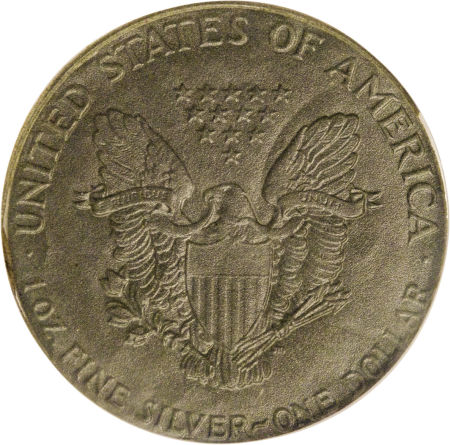
The emery disc that is pictured below was struck by a 1986 silver eagle reverse die

Images are courtesy of Heritage Auctions.

.

The 1986 silver eagle pictured below had its obverse struck through an emery disc.

Images are courtesy of Heritage Auctions.


The emery disc that is pictured below was struck by a 1986 silver eagle obverse die.

  • « Previous Page
  • 1
  • …
  • 5
  • 6
  • 7
  • 8
  • 9
  • …
  • 21
  • Next Page »
  • Home
  • Introduction To This Website
  • Error-ref.com News
  • Comprehensive Error-Variety Checklist
  • Index Of Completed Entries
  • Part I. Die Subtypes:
  • Part II. Die Varieties:
  • Part III. Die Installation Errors:
  • Part IV. Die Errors:
  • Part V. Planchet Errors:
  • Part VI. Striking Errors:
  • Part VII. Post-Strike Mint Modifications:
  • Part VIII. Post-Strike Striking Chamber Mishaps:
  • Part IX. Post-Strike Mint Damage:
  • Part X. Wastebasket / Composite Categories:
  • Part XI. Non Errors:
  • Featured Articles Of Interested
  • Interest & Not So Interesting Facts
  • Other Sites And Forums Of Interest
  • Our Thanks Go To
  • About The Authors
  • Contact Us

Copyright © 2026