Error-Ref.com

You are here: Home / Search for "off center"

Search Results for: off center

Use of Canceled and Defaced Dies

Part III. Die Installation Errors:

Use of Canceled and Defaced Dies


Definition: When a die is pulled from service it is first defaced before being sent out to be recycled.  When a design is retired, the remaining dies are canceled or defaced so that no further coins can be struck.  Installation of a canceled or defaced die is unlikely to be an accident and the coins struck by them must be considered intentional errors.

A coin struck by canceled dies will still show most of the design, but the surface will be crossed by one or more thick ridges that may run in parallel or may intersect.  These ridges represent grooves cut into the die face.

A coin struck by defaced dies will show little of the design. Surface details are replaced by a coarsely textured or lumpy surface.

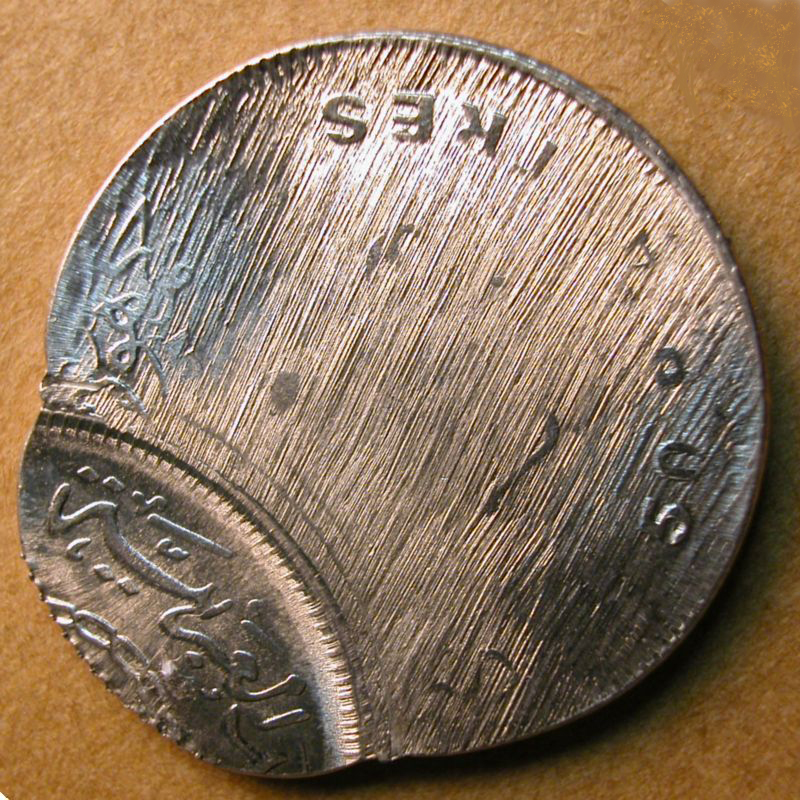
No examples exist of coins struck by canceled or defaced dies within the U.S. Mint.  Several examples are known from other countries. These include a bimetallic 1994 Hong Kong 10 dollar coin with two parallel ridges on each face.  We also have the unique Egyptian coin described below.
defaced_die_Egypt_50p_revdefaced_die_Egypt_50p_obv

This Egyptian 25 piastres planchet was first struck 80% off-center by 25 piastres dies.  It was then struck within a 50 piastres collar by a pair of 2010 Egypt 50 piastres dies that had most of the design ground off.  The defaced 50 piastres dies only contacted the unstruck portion of the off-center 25 piastres coin.  The struck tongue was left untouched by the second strike because its reduced thickness was apparently less than the minimum die clearance of the 50 piastres press.

The 50 piastres reverse die was rotated approximately 120 degrees counterclockwise relative to the obverse die (medal rotation is normal).

The 25 piastres denomination is struck on a planchet composed of nickel-plated steel while the 50 piastres design is normally struck on a planchet composed of brass-plated steel.  We therefore have in this double-denomination error the rare trifecta of a planchet error (off-metal/wrong planchet), a die error (defaced), and a striking error (off-center first strike and rotated die error on second strike).
Foreign Object Chain Strike

Part IV. Striking Errors:

Foreign Object Chain Strike

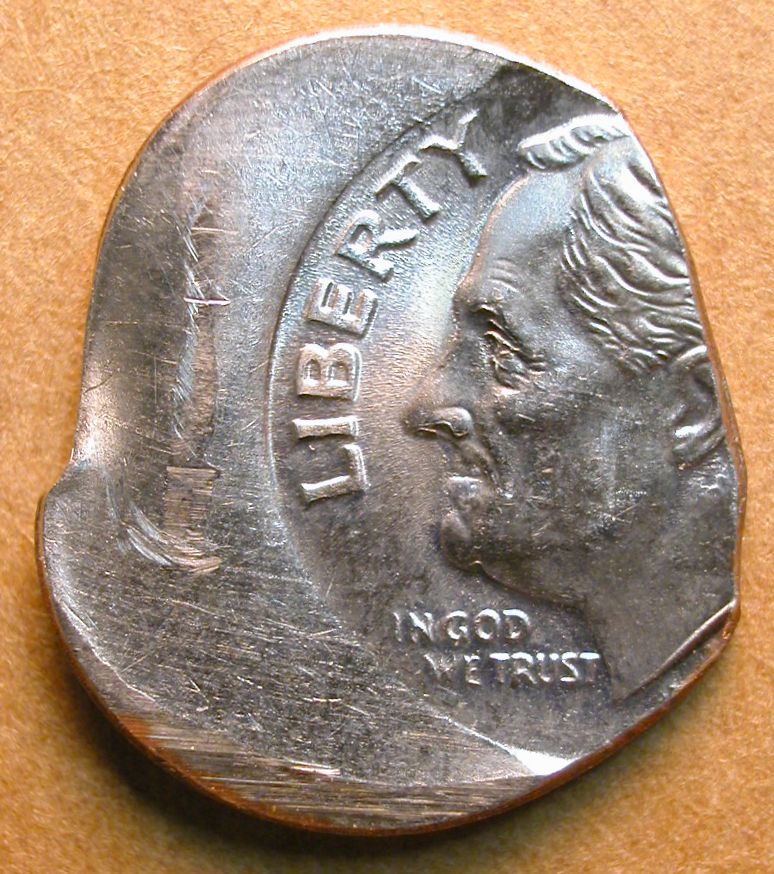
Definition:  A conventional chain strike occurs when the expanding edges of two adjacent discs of coin metal (2 planchets, 2 coins, or one of each) meet and flow together.  A foreign object chain strike occurs when the edge of a coin metal disc and the edge of a foreign object meet and flow together.  Right now, the only recognized foreign object chain strikes involve one member of a pair of feeder/ejection fingers that extend from the same feeder arm.  These errors can therefore also be classified as a form of machine part impingement. Foreign object chain strikes involving other intrusive elements would be hard to recognize, unless they left a tell-tale residue on the edge of the coin or if they left the chain-struck edge with a very peculiar shape and/or texture.

The vast majority of foreign object chain strikes co-occur with a form of intra-strike damage at the opposite pole produced when the protruding portion of the off-center coin is pushed into the other feeder/ejection finger.

Most foreign object chain strikes are seen in multi-struck coins.  These are invariably struck by inverted dies installed in the high-speed Schuler press.

bilateral_MPI_10c_obv bilateral_MPI_10c_rev

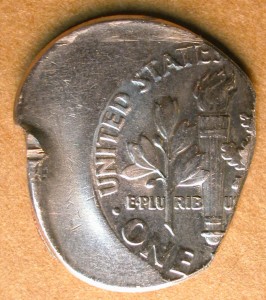
This off-center dime shows a foreign object chain strike on the right side.  Here the edge of the dime and the internal edge of a feeder/ejection finger met and flowed together.  The edge of the dime is slightly convex and bears a 13 millimeter long contact facet.  The opposite pole was pushed in when the protruding portion of the off-center coin was pushed into the other feeder/ejection finger. This form of intra-strike damage almost always accompanies a foreign object chain strike.  The two together form a pattern of bilateral machine part impingement.

quad_stk_5c_obvquad_stk_5c_rev

This quadruple-struck nickel shows a foreign object chain strike on the right side.  Here the expanding edge of the nickel met the expanding edge of a feeder/ejection finger, leaving the former with a relatively straight edge.  At the opposite pole we again see impact damage from the other feeder/ejection finger.

Machine Part Impingement

Part VI. Striking Errors:

Machine Part Impingement

Definition: This error occurs when a coin is pinned and pinched between two machine parts during the strike.  For modern US coins struck with inverted dies in a high-speed Schuler press, the two machine parts are paired feeder/ejector fingers that form the arms of a notch that cradle the planchet and (subsequently) the newly-struck coin.  The feeder/ejection fingers lie at the expanded tip of feeder/ejector arm that looks like a wrench.  Each “wrench” is one of many that fit into a rotating plate that fits the definition of a rotary or dial feeder.

Machine part impingement errors are associated with off-center strikes and with double- and multi-struck coins in which most of the strikes are off-center.  When the dies strike the off-center planchet or coin and the off-center feeder that cradles it, the two elements expand radially.  The facing edges flow together, leaving the coin with a convex facet we call a “foreign object chain strike”.  The portion of the planchet or coin that projects outside the striking chamber is pushed laterally by the expanding coin metal and expanding feeder metal.  The pole opposite the convex facet collides with the other arm of the feeder/ejector, leaving the edge of the coin with a dent and often a warped surface.

bilateral_MPI_10c_obvbilateral_MPI_10c_rev

This off-center dime was pinned and pinched between two machine parts.  The right side of the coin shows a gently convex foreign object chain strike.  Here the expanding edge of the dime collided with the expanding internal edge of the feeder/ejection finger.   At the opposite pole, the unstruck portion of the dime was pushed laterally into the other feeder/ejection finger.  This collision pushed in the planchet’s edge, warping the unstruck portion of the dime.  This is an example of intra-strike damage.

quad_stk_5c_obvquad_stk_5c_rev

This quadruple-struck nickel was pinned and pinched between two feeder/ejection fingers during the last three strikes.  After a normal first strike, the nickel received three closely-spaced off-center strikes that are well-separated from the initial strike.  This is a typical pattern for multi-strikes suffering from machine part impingement.  It’s almost certain that the misplaced and mistimed feeder/ejection arm prevents the coin from leaving the striking chamber entirely.

On the right side there is a long, relatively straight contact facet that represents a foreign object chain strike.  Once again, the culprit is one of the two feeder/ejection fingers that cradle the coin.  The left side of the coin was pushed in when the portion of the coin lying outside the striking chamber was pushed into the other feeder/ejection finger.

Raised clash marks

Part IV. Die Errors:

Clashed Dies:

Raised Clash Marks

Definition:  Clash marks are generated when dies collide in the absence of a planchet.  Each die transfers part of its design to the opposite die in the form of faint, raised, normally-oriented design elements.  Clash marks are generally confined to the field portion and shallowest devices of the die face.

While clash marks are expected to appear on a coin as incuse, mirror-image features, there are exceptions, both real and apparent.

Raised clash marks may occur in the event of a relatively light collision.  If, on the die face, a narrow strip of field is situated between two relatively broad elements, only that narrow strip will make an (incuse) impression on the opposite die.  The coin will therefore show a correspondingly raised, mirror-image design element.

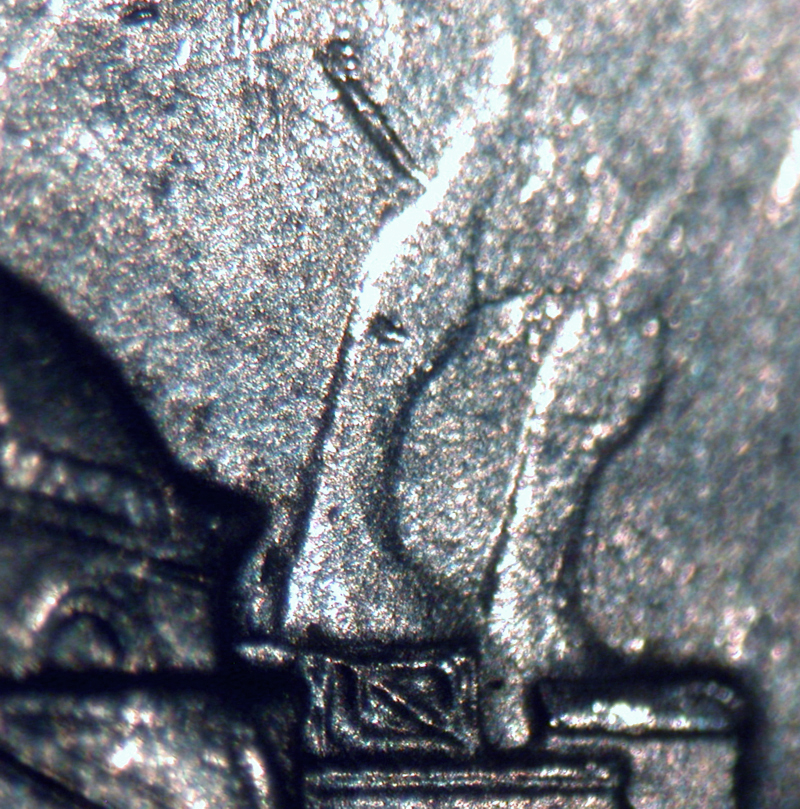
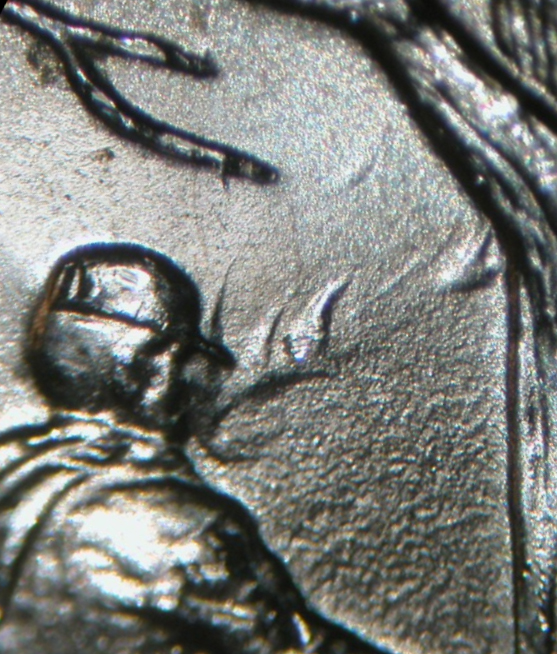
02_Monticello_on_fire_1983P_5c

Two “flames” erupt from the roof of Monticello on this 1983-P nickel.  They represent a pair of identical, offset, raised clash marks that depict the gap between Jefferson’s neck and queue (“ponytail”).

03_Vermont_clash

The reverse face of this 2001-P Vermont quarter dollar shows a raised clash mark that has been whimsically interpreted as a vapor cloud emerging from the maple-tapper’s mouth.  The “winter breath” clash mark is actually the area where Washington’s wig meets his neck.

Raised clash marks are also the inevitable result of a clash involving design elements intended to be incuse on a coin.  The corresponding features on the die face are therefore raised, and they will penetrate the opposing die in the event of a clash.  The resulting incuse, normally-oriented accessory design elements will be transferred to a coin as raised, mirror-image design elements.

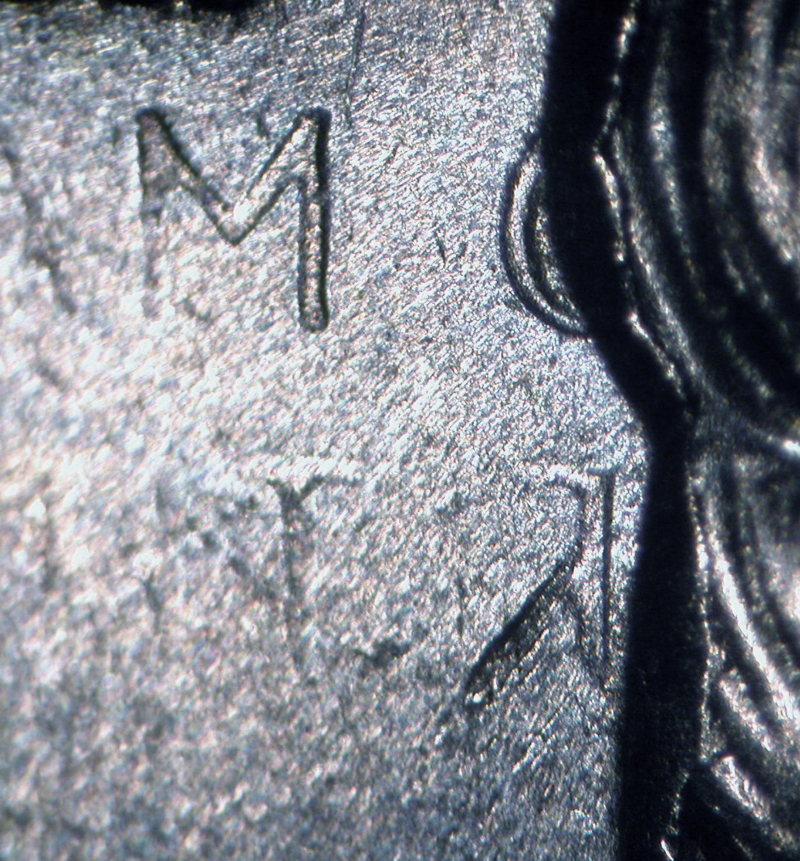
04c_NH_25c_clash_close

The reverse design of the New Hampshire quarter contains the incuse legend OLD MAN OF THE MOUNTAIN.  When transferred to the obverse die, they appear on the coin as raised, mirror-image letters.  On this particular 2000-P New Hampshire quarter, behind Washington’s inverted head. we find the letters (OL)D MA(N) on the top line and (O)F TH(E) on the next line.

Early, Mid & Late-Stage Counterbrockages:

PART VI. Striking Errors:

Counterbrockages:

Early, Mid & Late-Stage Counterbrockages:

Definition: A counterbrockage occurs when an error coin with a brockage is struck into a planchet.

NOTE: Counterbrockages can be in-collar, out-of-collar, centered, or off-center. They can be aligned with, or rotated relative to, the opposite, die-struck face. The degree of expansion and distortion depends on how many previous planchets were struck and whether one or both participants in the error were confined by the collar.

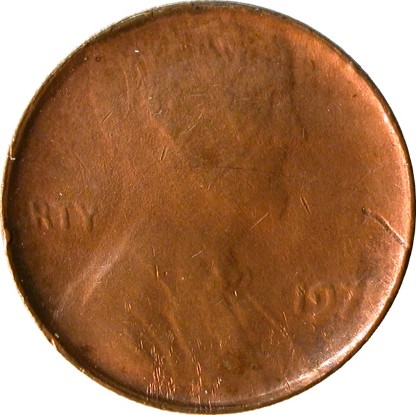
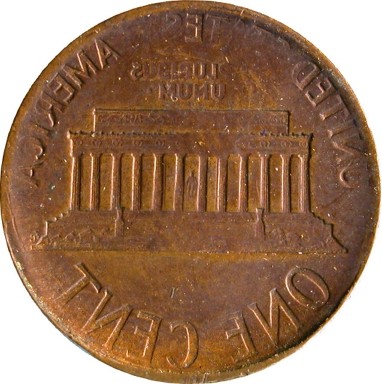
The 1975 cent shown displays an early-stage counterbrockage of the obverse design on the obverse face. It was produced when an obverse die cap with a brockage of the obverse design on the reverse face struck a succession of planchets, this being one of them.

First Strike Brockages

PART VI. Striking Errors:

Brockages:

First Strike Brockages

Definition: A brockage is an incuse, mirror-image design generated when a coin is struck into a planchet.

NOTE: Brockages can be in-collar, out-of-collar, centered, or off-center. They can be aligned with, or rotated relative to, the opposite, die-struck face. The degree of expansion and distortion depends on how many previous planchets were struck and whether one or both participants in the error were confined by the collar.

A Lincoln memorial cent with an in-collar, first-strike brockage of the reverse design on the obverse face. A cent that had stuck to the obverse (hammer) die was struck into the next planchet that was fed into the striking chamber beneath it.


MD-12

Machine parts above collar can impede expanding

coins

By Mike Diamond | May 21, 2011 10:00 a.m.
Article first published in 2011-05-30, Expert Advice section of Coin World

51863654


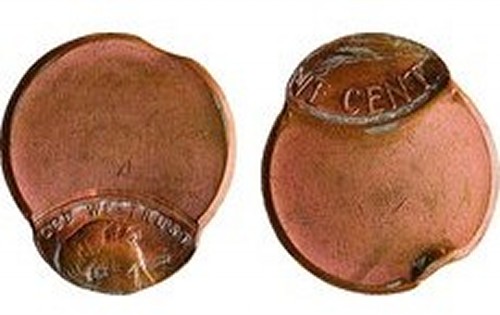
An off-center cent with a “sideneck strike.” Driven toward the northeast by the expanding die-struck portion of the coin, the unstruck edge collided with the side of the adjacent hammer die neck.

Images by Mike Diamond.

As a coin is struck, its expansion is abruptly halted by the surrounding collar.

When the collar fails to deploy, a coin expands in all directions. As a result, all off-center strikes and broadstrikes are wider than a normal coin, to varying degrees.

On some occasions a coin’s expansion is impeded, and the edge damaged, by machine parts positioned above the collar plate.

The most familiar obstacle to unfettered expansion is the neck of an adjacent hammer die. In a dual or quad Bliss press (the last of which was retired in 2005), the close proximity of adjacent die pairs results in the occasional production of a “sideneck strike,” also referred to as an “almost saddle strike” or a “one-die saddle strike.”

A typical example is shown here in an off-center Lincoln cent. At the pole opposite the 1 o’clock position of the obverse face, we see a deep, concave notch and an associated pressure ridge. The planchet represented by this coin lay partly within one striking chamber and almost managed to encroach on the adjacent striking chamber. In other words, the coin fell just short of becoming a “saddle strike.” When struck, the expanding die-struck area pushed the unstruck portion toward the adjacent striking chamber. It collided with the side of the hammer (obverse) die neck as the latter was striking its own coin.

Sideneck strikes are always concave and always closest to the adjacent striking chamber. In most years, this chamber would lie along a line drawn from the 1 o’clock position in Lincoln cents, or the 11 o’clock position in Jefferson 5-cent coins and Roosevelt dimes.

Strike-related edge damage of another kind is seen in an undated Jefferson 5-cent coin. The pole opposite the off-center strike has a flat, vertically oriented contact facet. It appears that the facet was produced when the unstruck portion of the planchet was pushed south by the expanding die-struck area and collided with a machine part. Another possibility is that the coin was hit while momentarily immobilized by the two dies.

In either case, we can’t be sure what machine part was responsible, although I suspect a feeder finger. I’ve encountered these flat facets on quite a few off-center and double-struck cents and 5-cent coins. In each case, the strike is about 70 percent off-center and the contact facet lies opposite the base of the bust.

The introduction of the Schuler press introduced new types of strike-related edge damage. This press uses a single die pair, with the reverse die operating as the hammer die. The damage is primarily associated with multi-struck coins. A representative example is provided by a quadruple-struck 5-cent coin. The first strike was normal. The other strikes were delivered about 20 percent off-center and are closely spaced. Edge damage is present on both the right and left sides. The contact facet on the right side is convex, slightly beveled, and extends from 12 o’clock to 2:30.

The dies evidently struck whatever machine part rested against the coin. On the left side the coin buckled when it collided with a hard object. The contact facet here is quite compact and lies next to the w of we. It’s possible that the coin was pushed laterally into an obstruction by expansion produced by the off-center strikes. It’s also possible that an object hit the coin as the latter was temporarily immobilized between the dies.

This type of edge damage can be found on numerous multi-struck cents, 5-cent coins, and Washington quarter dollars struck by Schuler presses. The pattern is consistent, although the long facet and the short facet can be located on either the right or the left side.

The affected coins all show a sequence of strikes involving a normal (or at least centered) first strike, and one or more closely spaced off-center strikes. Coins in which the off-center strikes are widely spaced or erratically positioned typically do not show this edge damage. The long facet that hugs the edge of the off-center strikes is almost certainly caused by contact with a feeder finger. I’m not sure about the short facet.

Coin World’s Collectors’ Clearinghouse department does not accept coins or other items for examination without prior permission from News Editor William T. Gibbs. Materials sent to Clearinghouse without prior permission will be returned unexamined. Please address all Clearinghouse inquiries to cweditor@coinworld.com or to (800) 673-8311, Ext. 172

http://www.coinworld.com/articles/machine-parts-above-collar-can-impede-expandi/

Copyright 2012 by Amos Hobby Publishing Inc. Reposted by permission from the March 22, 2012, issue of Coin World.)


Ragged Clips

PART V. Planchet Errors

Blanking and Cutting Errors:

Ragged clips:

Definition: A coin with a ragged clip has its circular outline interrupted by a very irregular edge.  Ragged clips are traditionally thought to be derived from the unfinished leading or trailing end of the coin metal strip.  While these ends are supposed to be trimmed, this step can be accidentally (or intentionally) skipped.

While ragged clips are sometimes referred to as “end of sheet” or “end of strip” clips, this same area is also a likely source for straight clips (see Straight Clip).  Therefore the term “ragged clip” is preferred.

Ragged clips can also be derived from the middle of the strip.  As the strip is rolled out, ragged fissures sometimes develop. If a blanking die slices through such a fissure, the resulting blank will have a ragged clip indistinguishable from one derived from the ends of the strip.

The shape of a ragged clip is highly variable.  Many are straight, some form “ragged notches” and some turn into “ragged fissures”.

The edge texture of a ragged clip is invariably rough and shows some graininess

Ragged clips are sometimes confused with broken coin and broken planchet errors.

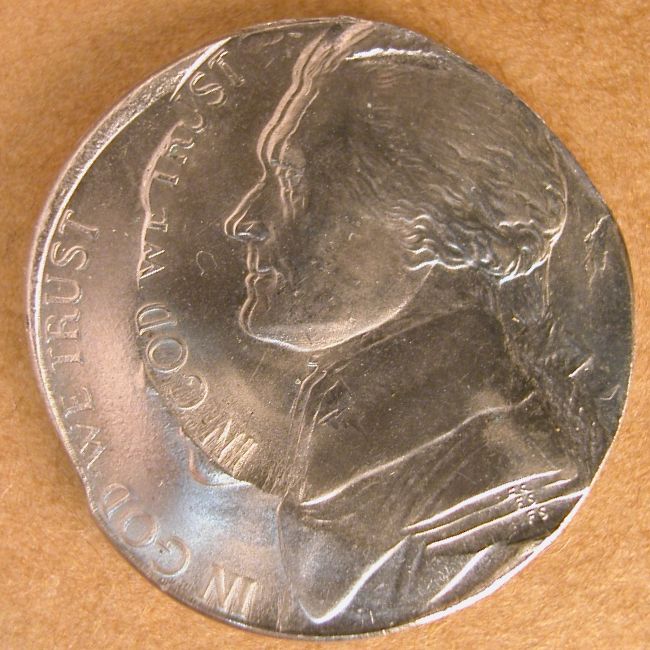
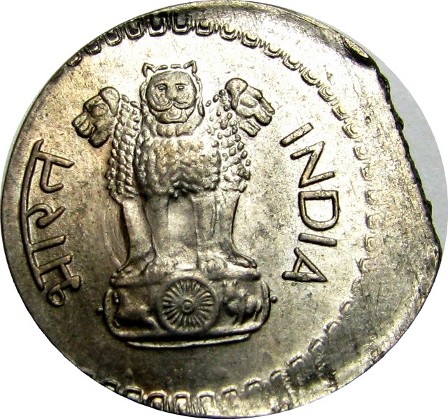
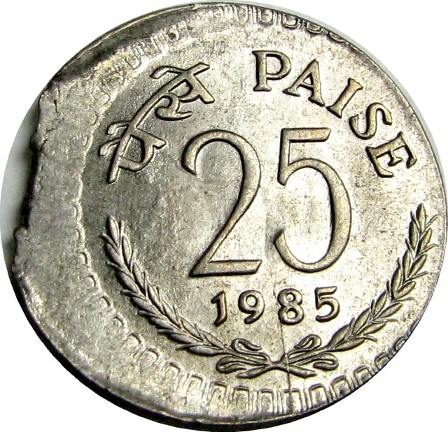
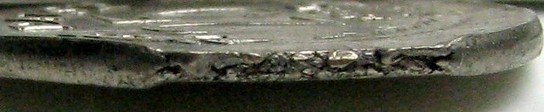
The three images below are a 1985 Indian 25 paise struck off-center with a ragged clip planchet. The lower image isan oblique angle of the grainy edge of the ragged clip.

49447406_scaled_448x41949446841_scaled_448x43249446838_scaled_544x112

Wrong Date

PART II. Die Varieties:

Wrong Date:

Date Later Than Final Issue:

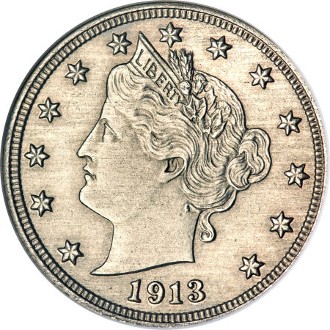
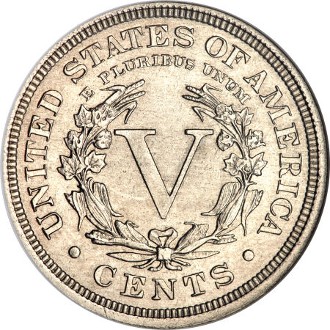
1913 Liberty Head nickel

Definition: A coin carrying a date later than the last official date for the issue.

The 1913 Liberty Head nickel is a famous example of a coin struck with a date later than the final issue date. The final year for this issue was 1912.  It was replaced in 1913 by the Indian Head or Buffalo nickel. However, five 1913 Liberty head nickels were minted.  They are thought to have been intentionally fabricated.

Below are images of the “Hawaii Five-O” 1913 Liberty Head nickel. Images courtesy of Heritage Auctions.


Washington Quarter Obverse with Sacagawea Reverse

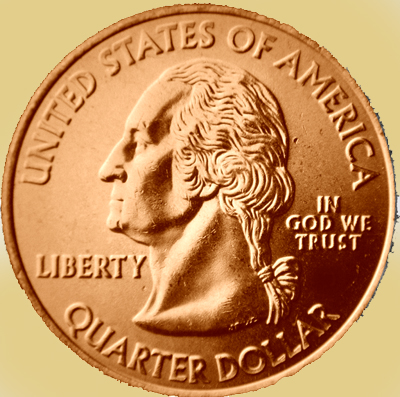
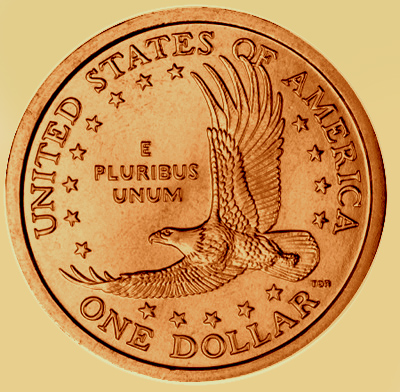
Washington quarter obverse with a 2000P Sacagawea

dollar reverse.


Debuting in May of 2000, this slip up was destined to make history. At the time, it was the only known “mule” coin in United States history.

For those who are not professional numismatists, a mule is a pairing of two different coin designs on one coin — in this case, a State Quarter and the brand new Sacagawea dollar. Previous to the discovery specimen of this famous coin, mules were not known to exist in United States coinage, though commonly found in foreign series.

After authentication and subsequent confirmation of its existence by the United States Mint, a firestorm of controversy was set off. How could this happen? Was it intentional? The biggest debate — was it legal to own?

After near forensic inspection and an unconfirmed report by an anonymous US Mint employee, it was determined that the anomaly was produced due to the similar sizes of the “coin dies” of a State Quarter and the new Sacagawea dollar. A coin die is the part of a coin press that places the design on the coin. Ironically, this was the very reason that the previous dollar coin, the Susan B Anthony, was despised by the public.

The quarter die was placed into a press currently in production of Sacagawea dollars. The rest is history — several coins were struck before the error was discovered. Many of the coins were discovered before reaching the public and were subsequently destroyed.

Interestingly, upon closer inspection of the 10 known specimens, it’s apparent that the errors were produced at three separate times. It’s theorized that these are “copycat” errors produced by rogue US Mint employees after word spread of the first discovery. Many of the coins were discovered in Philadelphia, the home of the primary United States Mint.

While it’s been nearly a decade since the last sale of the Sacagawea Mule, it’s speculated that they could bring a whopping $250,000 at auction.

8 of the 10 known specimens have been handled by the author, Fred Weinberg of Beverly Hills.

There are now ten (10) confirmed specimens of the Sacagawea Dollar/Quarter Mule. The ten confirmed specimens are:

Mule #1. The “Discovery” specimen, found in Mountain Home, Arkansas by Frank Wallis. Originally sold by Bowers
& Merena Auction Galleries at the 2000 ANA Philadelphia Millennium Sale for $29,900. Purchased from Dwight Manley by Fred Weinberg in late June 2001 and then sold to Tommy Bolack for $67,000.

PCGS MS-66 (Die Pair #1)

Mule #2. The “eBay” specimen, sold by Delaware Valley Rare Coin Co., in Bromall Pennsylvania for $41,395 in July 2000. Purchased at the Heritage Numismatic Auctions Signature Sale held June 1, 2001 at the Long Beach Coin Expo for a then record price of $56,350, by Tommy Bolack. NGC MS-67 (Die Pair #2)

Mule #3. The “Heritage Auction” specimen, sold in the Heritage Numismatic Auction Pre-ANA Sale August 6, 2000 for $31,050. Then into a private collection, after being purchased off an eBay Auction in October 2000. Currently owned by Tommy Bolack. NGC MS-66 (Die Pair #2)

Mule #4. The “Margolis” specimen, originally from Fred Weinberg of Encino, CA. Sold by Arnold Margolis to a private collector in September 2000 for $47,500. PCGS MS-65 (Die Pair #1)

Mule #5. The “Greg Senske” specimen, found in Cape Girardeau, Missouri. This coin was discovered Sept. 2000 in change from a cashier at a cafeteria, and was in a 25-coin roll of Sacagawea $1, wrapped in a U.S. Mint designated paper wrapper. This piece is not on the market at this time. NGC MS-67 (Die Pair #3)

Mule #6. The “Fred Weinberg” specimen, discovered on the East Coast in June 2000 and sold by Fred Weinberg at the Long Beach Coin Expo October 5, 2000 for $50,000 to an anonymous collector. Purchased in May 2003 for $75,000 by Tommy Bolack. PCGS MS-66 (Die Pair #1)

Mule #7. The “Philadelphia” specimen, purchased by Tommy Bolack from Maryland Coin Exchange in early February 2001 for $48,000. MCE purchased this piece from the man who discovered it in a roll of dollars in July 2000 in Pennsylvania. NGC MS-64 (Die Pair #2)

Mule #8. The “Tommy, Bolack-1” specimen, purchased in June 2001. The purchase price was not disclosed. PCGS MS-66 (Die Pair #1)

Mule #9. The “Tommy Bolack-2” specimen purchased in July 2001. The purchase price was not disclosed. PCGS MS-65 (Die Pair #1)

Mule #10. The “Treasury” specimen, first reported in August 2001 by a convenience store owner who received it in payment in his downtown Philadelphia store in summer 2000. It was taken by Treasury Dept. officials in August 2001 to verify authenticity and to examine the piece at the Philadelphia Mint. It was returned by the Treasury Department in October 2001 and subsequently purchased by Fred Weinberg, who sold it in November 2001 to Tommy Bolack for $70,000.

  • « Previous Page
  • 1
  • …
  • 4
  • 5
  • 6
  • 7
  • 8
  • …
  • 21
  • Next Page »
  • Home
  • Introduction To This Website
  • Error-ref.com News
  • Comprehensive Error-Variety Checklist
  • Index Of Completed Entries
  • Part I. Die Subtypes:
  • Part II. Die Varieties:
  • Part III. Die Installation Errors:
  • Part IV. Die Errors:
  • Part V. Planchet Errors:
  • Part VI. Striking Errors:
  • Part VII. Post-Strike Mint Modifications:
  • Part VIII. Post-Strike Striking Chamber Mishaps:
  • Part IX. Post-Strike Mint Damage:
  • Part X. Wastebasket / Composite Categories:
  • Part XI. Non Errors:
  • Featured Articles Of Interested
  • Interest & Not So Interesting Facts
  • Other Sites And Forums Of Interest
  • Our Thanks Go To
  • About The Authors
  • Contact Us

Copyright © 2026