Error-Ref.com

You are here: Home / Search for "off center"

Search Results for: off center

Design Ablation Errors

Part VI. Striking Errors:

Skidding Die Errors:

Design Ablation Errors

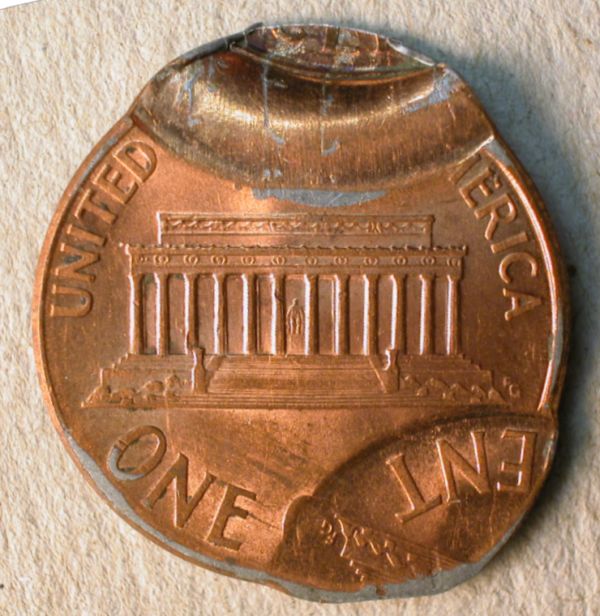
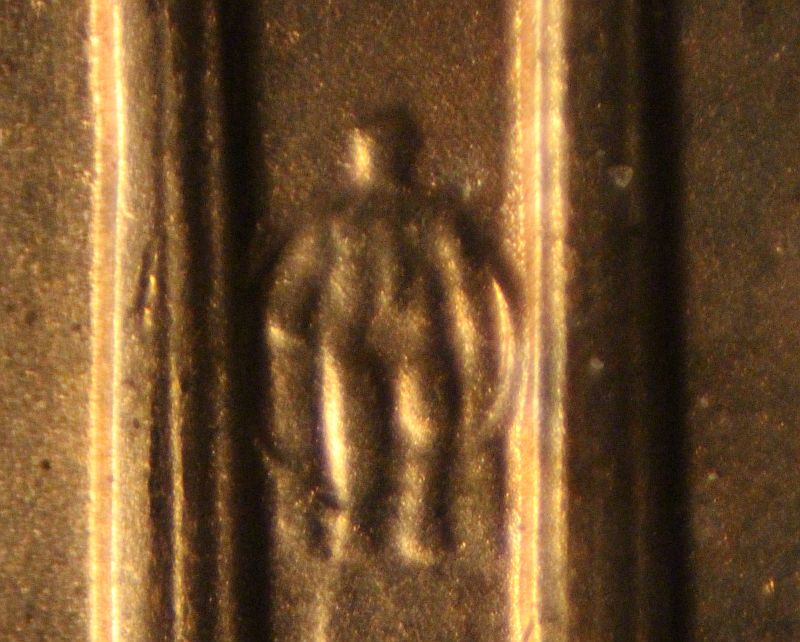
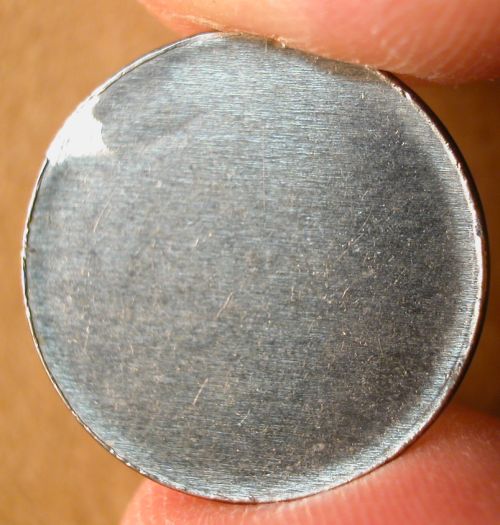
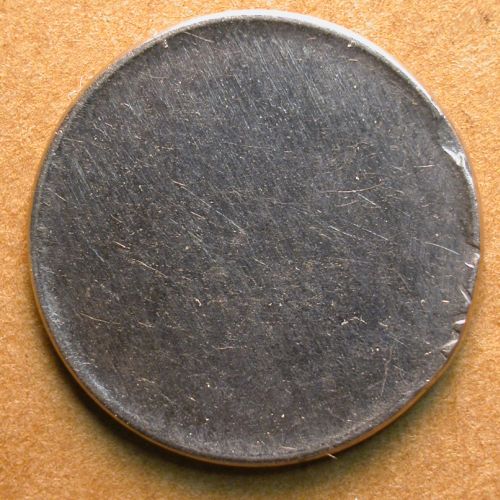
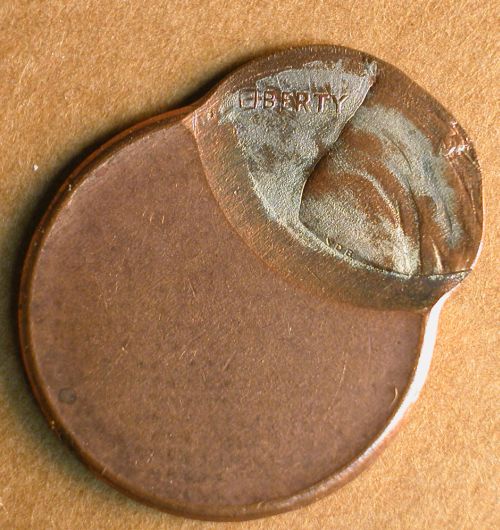
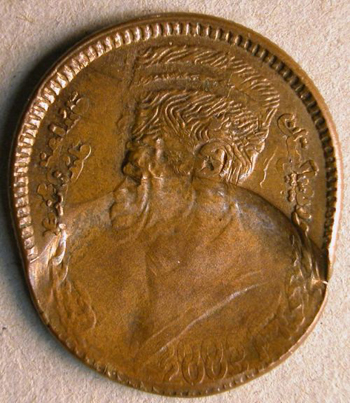
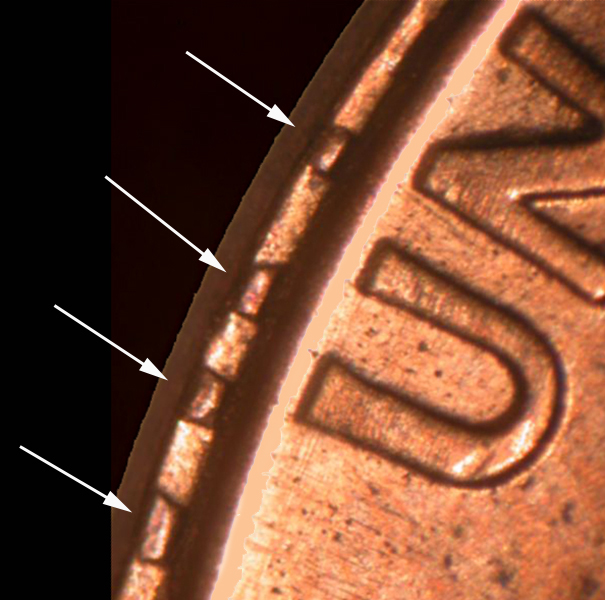
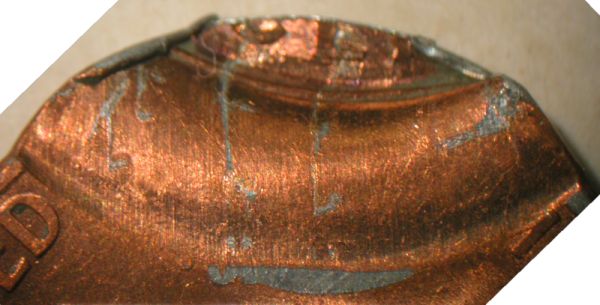
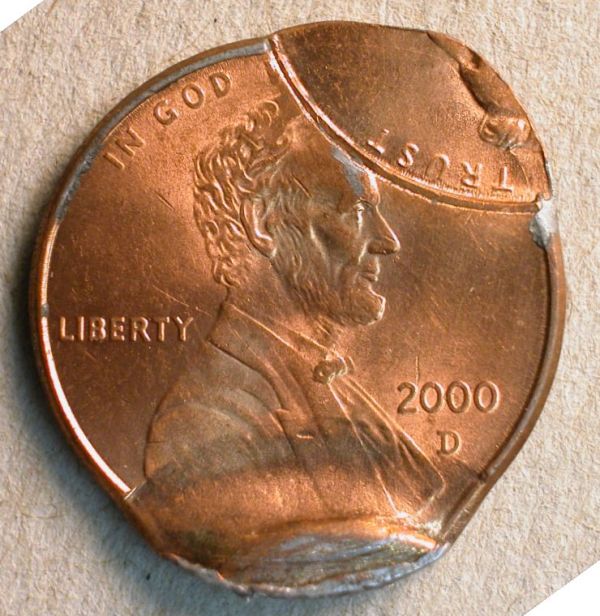
Definition: The scraping-off of a coin’s design during a second strike by a laterally shifting hammer die.  The only known example of this error type is seen in a quadruple-struck 2000-D cent (see photos).  This specimen was struck by inverted dies (reverse die as hammer die) in a dual or quad press.  The first strike was perfectly normal.  The second strike was 73% off-center and uniface.  During this second strike, the hammer die contacted the reverse face directly while the obverse face rested on an underlying planchet.  After sinking into the coin a short distance, the hammer die shifted several millimeters northward, completely scraping off the first-strike design.  The hammer die then seems to have retracted in preparation for the next strike.  The final two off-center strikes were delivered in tandem as a conventional saddle strike.  The larger of the two off-center strikes is die strike on both faces.  The smaller off-center strike is uniface, with the reverse face being die-struck.  This smaller off-center strike was presumably delivered by the same hammer die that generated the design ablation error on the previous strike.
Design_ablation_2000D_1c_close

Design_ablation_2000D_1c_obvDesign_ablation_2000D_1c_rev

Skidding Die Errors

Part VI. Striking Errors:

Skidding Die Errors

Definition: Skidding die errors occur when a laterally-shifting die slides across the surface of a planchet or coin, scraping the surface.  Severe cases always involve the hammer die.  The error can occur as the hammer die is completing its downstroke, after the hammer die has reached the lowest point of its downstroke, and during the first moments of retraction.  These errors can occur in the course of a single strike or during a second strike.  Different names are applied to skidding die errors depending on their appearance and when they occur.  Four types of skidding die errors are recognized and are the subject of separate entries:
  1. Skidding misalignment.  This occurs as the die is penetrating the planchet.
  2. Design ablation error.  This occurs during a second strike as a horizontally shifting hammer die scrapes off the design generated during the first strike.
  3. Design decapitation error.  This occurs during the retraction phase as a horizontally shifting hammer die removes the highest points of the design.
  4. Slide doubling.  This occurs immediately after the hammer die reaches the lowest point of its downstroke.  The die shifts laterally without lifting up, smearing the design and piling up the relocated metal into a series of ridges.  This entry can be found as a sub-entry of Machine Doubling.


skidding_misalignment_1999D_no1_obv skidding_misalignment_1999D_no1_rev

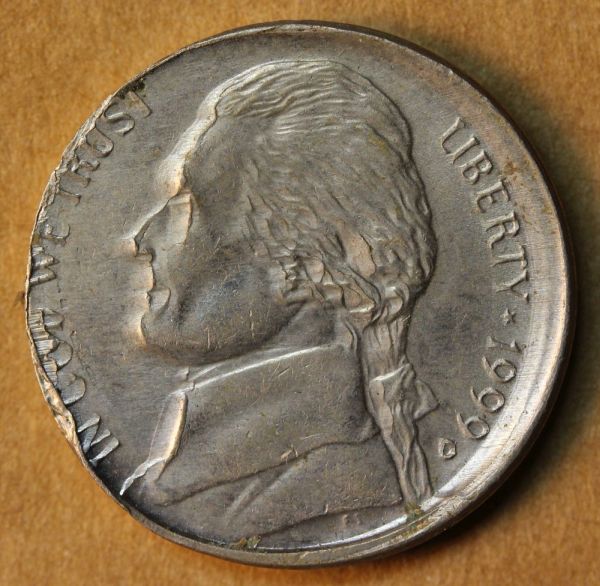
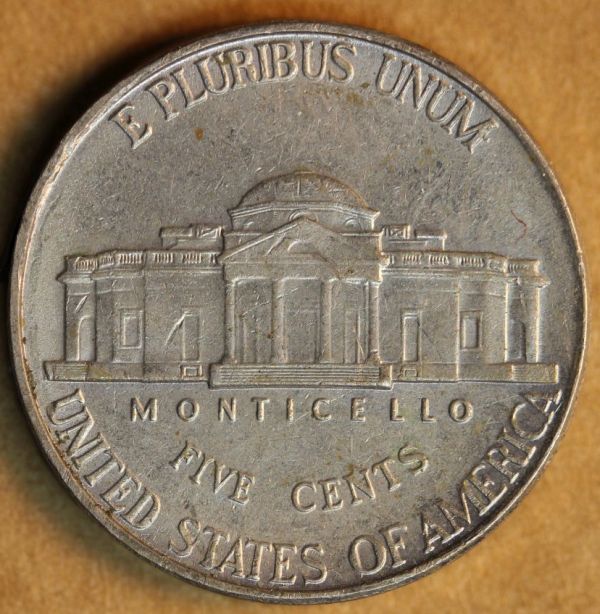
This 1999-D nickel shows a skidding misalignment on its obverse face.  At first contact the hammer die was in its normal, centered position.  As it sank down into the planchet it shifted to the left and finished its downstroke in a misaligned position.  After reaching the lowest point of its downstroke, the hammer die shifted to the right, smearing the newly-struck design.  This second movement falls into the category of strike doubling.

Die Rings (Tiny Rings, Semicircles, Crescents, And Spirals)

Part IV. Die Errors:

Die Damage:

Die rings (tiny rings, semicircles, crescents, and spirals)


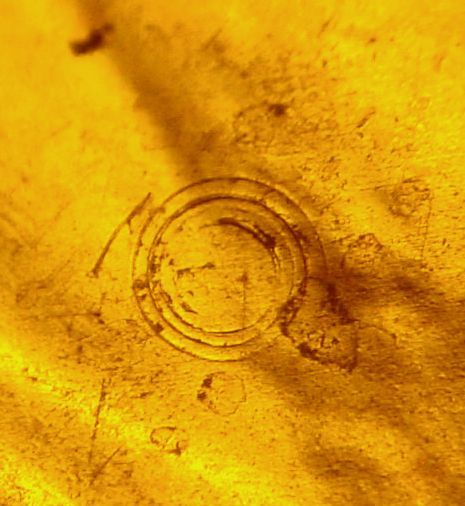
Definition: Tiny rings, semicircles, crescents, and spirals that usually appear in the center of the coin or nearby. Their origin is a mystery and it’s likely that they have more than one cause.

Many rings are isolated, while others form concentric arrays. Size is somewhat variable, ranging from a fraction of a millimeter to almost 2 millimeters. Die rings can be smooth or have a rough appearance. They occur on all denominations from cent to quarter dollar. They can appear on either face, irrespective of whether that face was struck by the hammer or the anvil die.

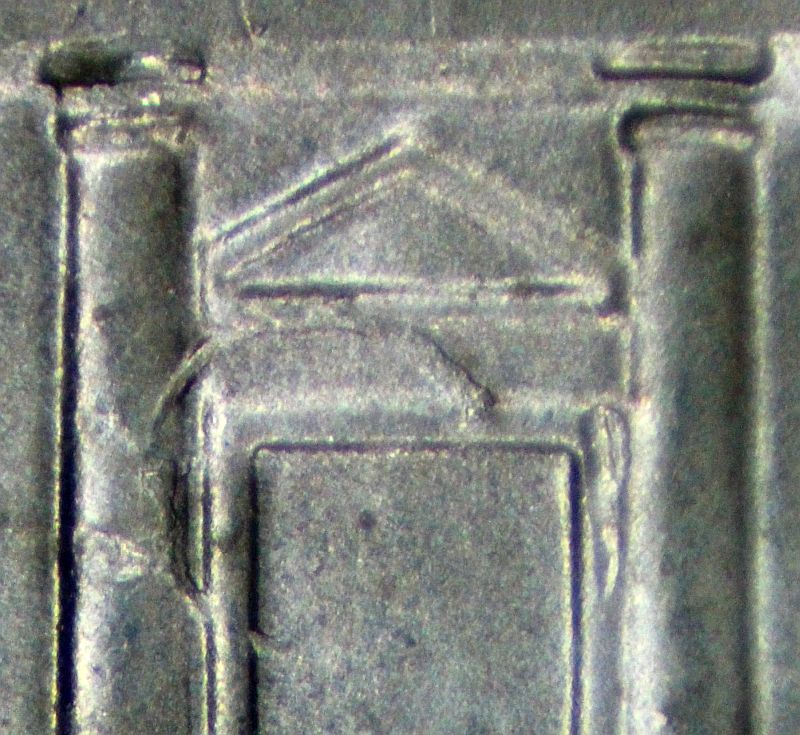
Two offset crescents or semicircles overlap tip-to-tip to form a composite ring that encircles Lincoln’s statue on the reverse face. A number of reverse 2004 cent dies show similar rings or partial rings on the reverse face.

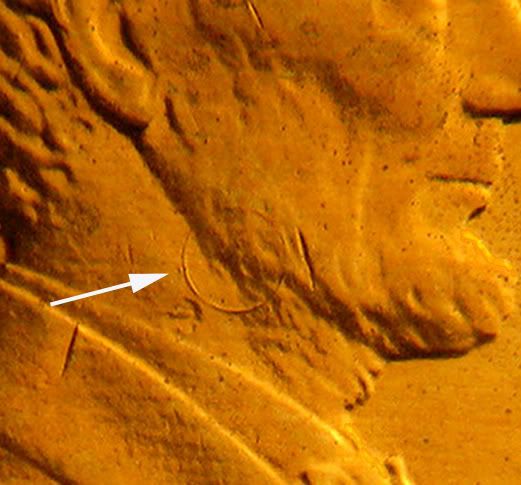
A single complete ring overlies Lincoln’s neck and jawline on this 1988 cent. Photo courtesy of Jason Cuvelier.

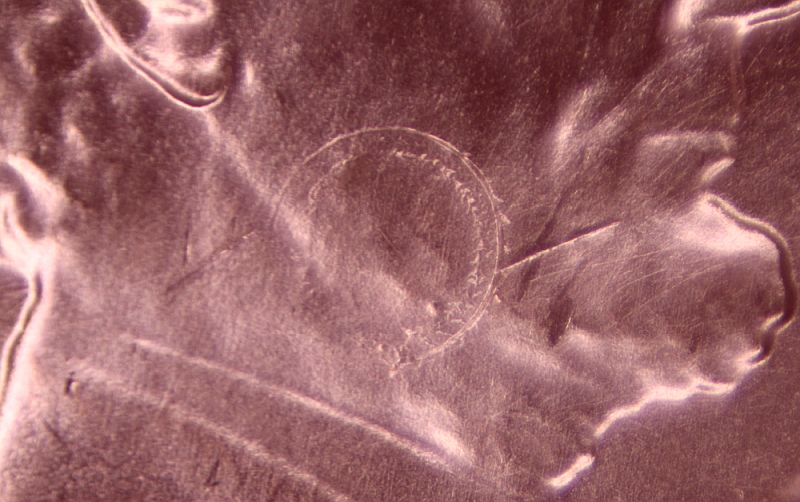
A concentric pair of relatively large, centrally-located, “spiky” die rings appears on the obverse face of this 2018 Lincoln cent.

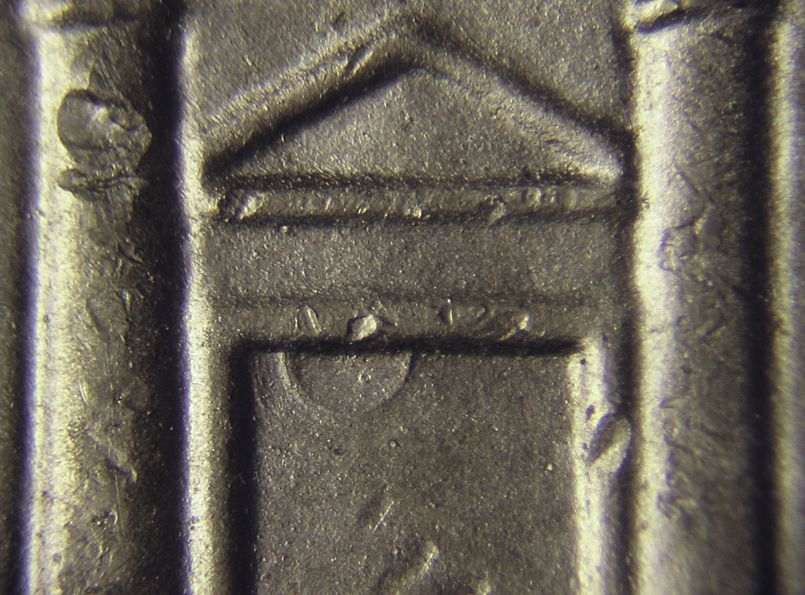
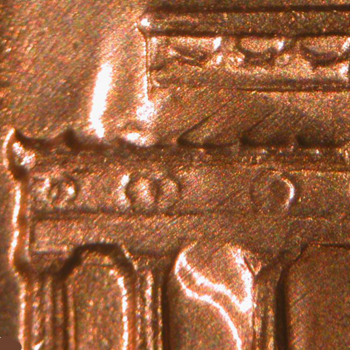
This clearly defined, tiny die ring is surrounded by additional faint, closely-spaced concentric rings. This is one of many recent reverse nickel dies with rings in Monticello’s doorway. Many rings occur in isolation and most are identical in size to this one. Positions vary slightly but it seems all of them are slightly to the left of center. Dates range from 2012-P to 2015-P.
[2014-P in photo]

This 2012-P nickel features a relatively large, incomplete ring on the reverse face. Its large size, irregular margins, and coarse texture suggest it has a different origin from the small rings.

A centrally-located raised spiral appears on the obverse face of this 2010 cent. Photo courtesy of Richard Cooper.

Struck Through Floating Encrustation

Part IV. Striking Errors:

Struck-Through Errors:

Struck Through Floating Encrustation

Definition: A floating encrustation is a piece of compacted die fill or caked-on grime that enters the striking chamber and is struck into a coin.  Stiff, caked-on grime can come from the bowels of the press.  The lubricated joints and rods are a magnet for dust and dirt.  This material can stiffen over time and then break off.  Die fill (“grease”) is a compacted layer composed of lubricant, dirt, and metal dust that accumulates on the die face.  Pieces can break away to form nondescript struck-through errors.  In either case, the resulting struck-through error resembles a conventional “grease strike”.

The impression left behind by a floating encrustation can be expected to show:

  1. Soft or indistinct margins
  2. Variable depth (reflecting variable thickness of the foreign material)
  3. Variable topography (potentially smooth to rough)
  4. Occasional gaps or thin areas that allow the design to emerge.

There are only two practical ways to distinguish a floating encrustation impression from a grease strike:

  1. Assemble a progression (defined by die markers) that shows the sudden appearance of a struck-through area.
  2. Find a double-struck coin in which the first strike is unobstructed and the second strike is partly or fully obstructed.

floating_encrustation_Argentina_10c_obvfloating_encrustation_Argentina_10c_rev

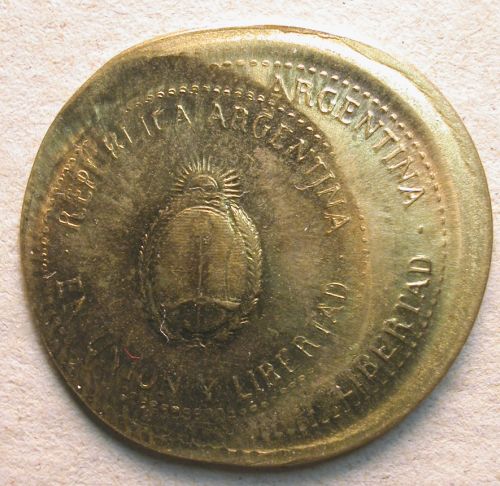
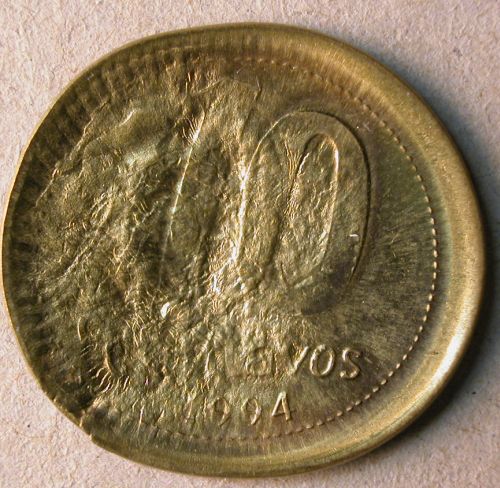
This broadstruck 1994 Argentina 10 centavos shows an unobstructed first strike.  The second strike was almost fully obstructed on the reverse face by what seems to have been a floating encrustation.  The reverse face was struck by the hammer die.  First-strike elements are flattened, but retain sharp margins.  The only second-strike element to emerge is the C of CENTAVOS.  The irregular texture and indistinct margins of the struck-through area are consistent with a floating encrustation.
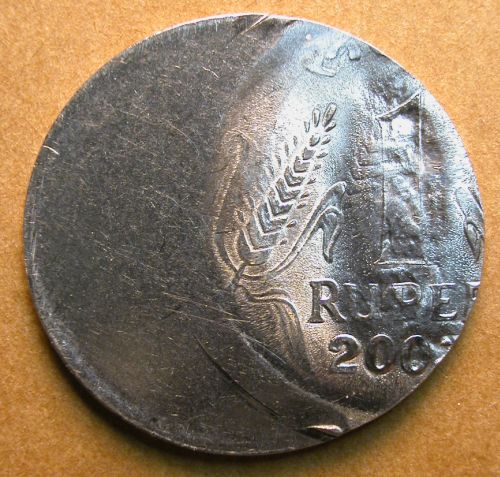
floating_encrustation_India_2003_1rupee_obvfloating_encrustation_India_2003_1rupee_rev

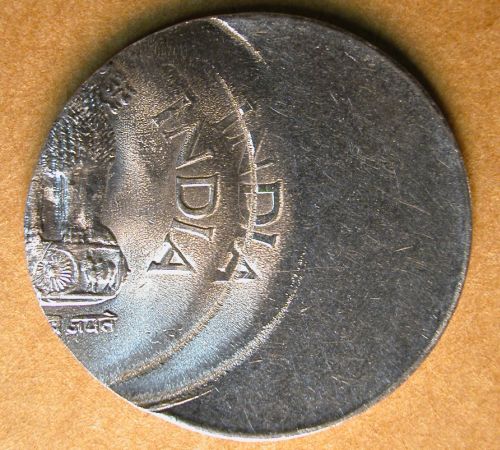
This double-struck 2003 India 1 rupee coin shows an unobstructed first strike.  The second strike was fully obstructed on the reverse face, which was struck by the anvil die.  The minimal flattening of the first-strike elements and the variable depth and topography of the impression are inconsistent with a uniface strike against another steel 1 rupee planchet.  I suspect a dollop of stiff grime entered the striking chamber and somehow found itself between the anvil die and the off-center coin on top.  The subsequent strike flattened the crud deposit into a disc-like shape.


Pristine Planchets

Part V. Planchet Errors:

Pristine Planchets

Definition: A planchet that lacks the usual tumbling marks and instead has a surface free of imperfections.  Faint roller marks are often present.

A blank (and later on, a planchet) goes through a rough-and-tumble existence as it travels toward the striking chamber.  It picks up small nicks and dings (tumbling marks) as it jostles against equipment and other planchets.  Tumbling marks are picked up as planchets travel along conveyors and are dropped into hoppers and tote bins.  Tumbling marks are even more likely to be inflicted as planchets bounce around in the rotating annealing oven.  Additional hazards await within the rotating, perforated cylinders that spin blanks and planchets through a quench tank, a chemical rinse bath, and a dryer.

Tumbling marks are eventually erased during a normal strike.  But they will persist in the case of off-center strikes and weak strikes.

Off-center strikes and weak strikes that lack tumbling marks present a conundrum.  There are several possibilities (not necessarily mutually exclusive):

  1. The planchet was just lucky.
  2. The planchet skipped the annealing oven.  The annealing oven appears to be the apparatus most likely to bang up a planchet.  Also, a non-annealed planchet is work-hardened, and resists damage.
  3. The planchet was abnormally hard as the result of a problem with the alloy.
  4. The planchet was prepared for a special purpose.

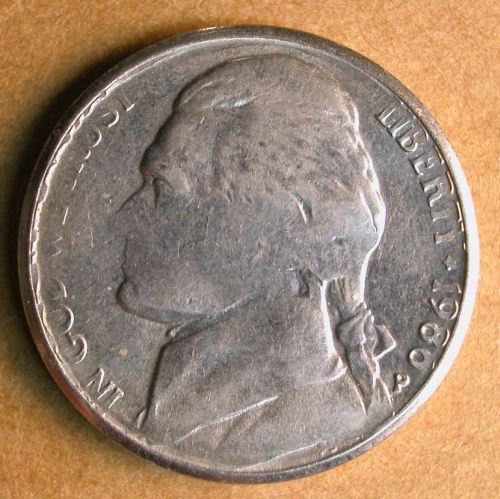
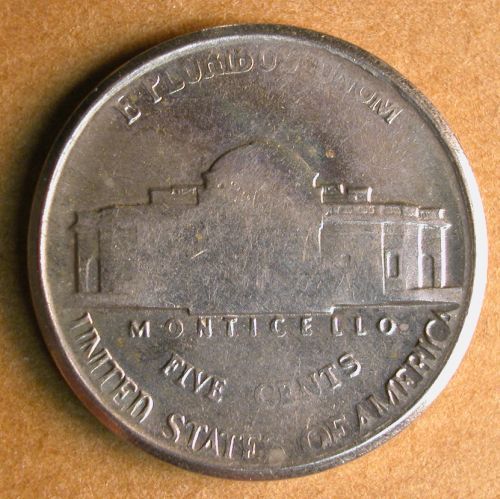
pristine_plan_1986P_5c_obvpristine_plan_1986P_5c_rev

The design of this 1986-P nickel did not strike up completely.  The incomplete strike appears to be the result of an abnormally hard planchet rather than a weak strike.  Unstruck areas are devoid of tumbling marks and instead show fine roller marks.  I suspect this planchet bypassed the annealing oven.

pristine_plan_oc_weak_stk_10c_obvpristine_plan_oc_weak_stk_10c_obv_obliqueObverse

pristine_plan_oc_weak_stk_10c_rev                                                                                     Reverse

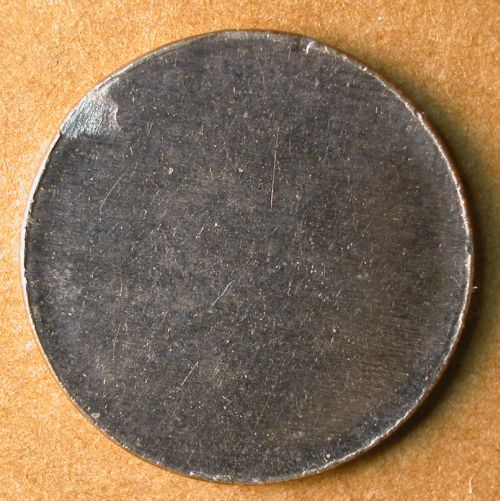
This dime received and exceedingly weak, 70% off-center strike.  Design elements are almost completely restricted to the planchet’s proto-rim.  Obverse elements consist of Roosevelt’s lower lip, chin, throat, and the back of his neck.  Reverse elements consist of part of the torch’s flame, and two olive leaves.  The planchet is devoid of tumbling marks and instead has a bright, smooth surface covered by fine roller marks.


This may be a specially prepared planchet, although it’s not a proof.  The planchet shows an unusual pattern of upset.  The proto-rim is unusually sharp and narrow, while the edge is gently convex instead of trapezoidal in vertical cross section.


FUN 2016 Winter Convention

Once again Florida United Numismatics will be in the great city of Tampa, Florida. This year’s FUN show will be conducted at the Tampa Convention Center from January 7th until January 10th, 2016. This is the same venue where we held the very successful 2011 Winter Fun Convention.

Our bellwether show will offer over 600 tables of the finest dealers, with a huge assortment of coins and currencies from both the United States and abroad. There will be educational exhibits that will astound one’s mind and there are sixteen extremely interesting numismatic presentations from some of the leading experts in this hobby being held from Thursday until Saturday.

As always, leading this show’s attraction is the world class auctions by Heritage, who seem to always have some very interesting, unusual and very rare coins and paper money up on the auction blocks.

It is again our honor to have the U. S. Mint and Bureau of Engraving and Printing at this show; they always have outstanding exhibits. Special guest Abraham Lincoln (Dennis Boggs) will be present as well as Piedmont Gold Panners who will have their full set-up for those willing to try their luck in getting that valued nugget of gold. They will show you the ins and outs of panning for gold and all that you find you can keep.

If you are looking to have that certain coin graded and encapsulated, the four top end Third Party Grading companies will be in attendance; ANACS, ICG, NGC and PCGS. If it is numismatic supplies that you need, Leaphart, Lighthouse, Whitman and Wizard will be at this show as well.

There will be special sections for “Ancient & Foreign Dealers” and be sure to visit the “Specialty Clubs” area for some great give-aways and information on joining these specialty clubs.

On Saturday the 9th of January, 2016, YN and Scout Merit Badge programs will be conducted at the show in a prearranged area.

Folks, this is one numismatic coin show that should be on everyone’s “bucket list”. So, bring the family and friends for there are extraordinary sights and events for all ages and genders at this wonderful extravaganza.

For more information, follow the below links:

YN and Scout Merit badge

FUN Convention Information

Tampa Convention Center Parking

Slide Zone Ghost Elements

Part X. Wastebasket/Composite Categories:

Ghost Images:

Slide Zone Ghost Elements

Description: Outlines and silhouettes of peripheral letters (and occasionally the last digit of the date) located in the slide zone of off-center zinc cents.  The ghost elements consist of exposed zinc surrounded by intact copper plating.  Plating of just the right thickness, combined with just the right striking pressure, produces slight disruption of the copper plating.  The ghost elements record the point of initial contact between the dies and the planchet.

Slide_zone_ghost_letters_obvSlide_zone_ghost_letters_rev

The reverse face of this off-center copper-plated zinc cent shows ghost letters in the slide zone.  The letters of UNITED STATES take the form of outlines and silhouettes of exposed zinc.  There are no slide zone ghost elements on the obverse face.


Rebound Counterbrockages

PART VI: Striking Errors

Counterbrockages:

Rebound Counterbrockage

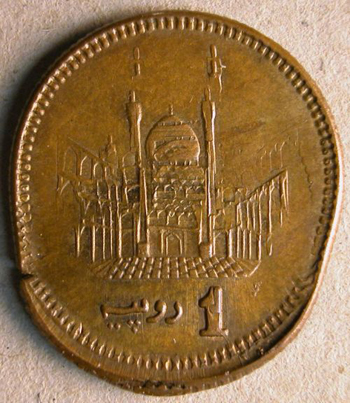
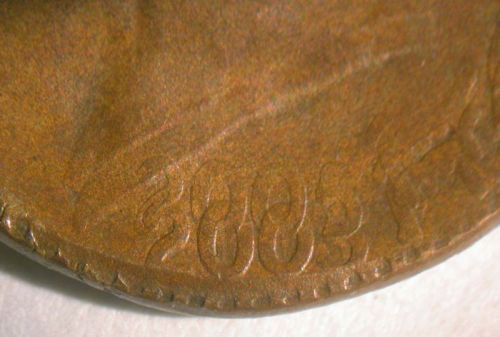
Definition:  A counterbrockage produced during a third strike that closely overlaps flattened first-strike design elements.  The sequence of events begins when a struck coin and an unstruck planchet are both present in the striking chamber.  After a normal first strike, the coin is struck a second time with a planchet partly or completely covering one face.  This leaves an indent on the first coin whose floor is adorned by flattened first-strike design elements.  The intrusive planchet is converted into a broadstrike or off-center coin that has a first-strike brockage on one face.  After the second strike, the intrusive brockaged coin shifts position relative to the indented, double-struck coin.  The brockaged coin is driven back into the indent, with the brockaged elements acting as a “soft die”.  The brockaged elements generate a counterbrockage that overlaps the flattened first-strike elements.

Pakistan_1rupee_rebound_cbrkge_2005_obv Pakistan_1rupee_rebound_cbrkge_2005_rev rebound_cbr_Pakistan_1rupee_2005_date

This 2005 Pakistan 1 rupee coin received a normal first strike.  It was then struck a second time in a slightly off-center position while partly covered by an intrusive planchet.  This produced an indent in the bottom coin within which lay flattened first-strike elements that include Mohammed Jinnah’s neck and the date.  The overlapping planchet was converted into an off-center coin with a first-strike brockage of the obverse design on its reverse face.  After the second strike, both the double-struck coin and the brockaged off-center coin shifted toward the north, with the off-center coin lagging behind slightly.  The brockaged face of the off-center coin was driven back into the indent, producing a set of raised, counterbrockage elements that overlap the flattened first-strike elements.  In this photo, the counterbrockage date is located in an offset position south of the original date.

More information on this error can be found at this link:

http://www.coinworld.com/news/us-coins/2015/10/collectors-clearinghouse–several-ways-to-a-

Rim-restricted Second Strikes

Part VI. Striking Errors:

Weak Strikes:

Rim-restricted Second Strikes

Description: A second strike in which minimum die clearance has increased to such an extent that the dies only touch down on the design rim.  Second strikes of this nature must also be off-center strikes.

Rim-restricted second strikes can be confused with similar-looking but unrelated striking errors.  If it’s only slightly off-center, a rim-restricted second strike will look very much like a case of rim-restricted design duplication.  The latter is a form of machine doubling in which the hammer die (it’s nearly always the hammer die) bounces off the surface of the coin, shifts to one side, and lands lightly on the design rim.  If the second strike is significantly off-center, then a rim-restricted second strike can be confused with a double strike in which the first strike is off-center and minimally expanded while the second strike is centered.

01a_weak_ds_2005_1c_obv copy01b_weak_ds_2005_1c_rev  01c_weak_ds_2005_1c_IGW copy 01e_weak_ds_2005_1c_UN copy01d_weak_ds_2005_1c_ONE copy

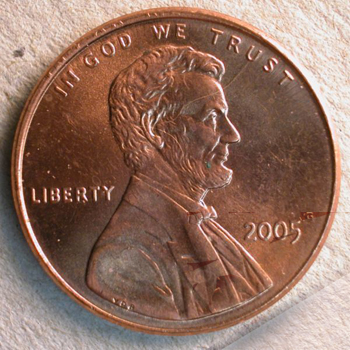
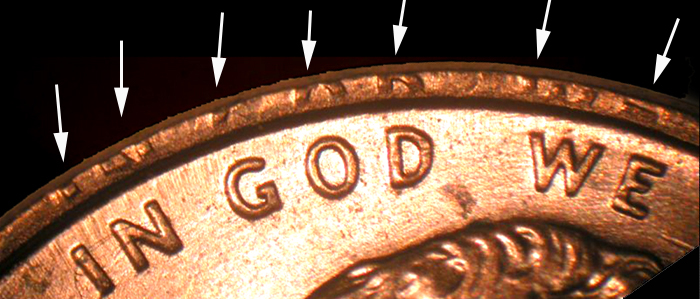
This 2005 cent received a normal first strike and a slightly off-center rim-restricted second strike.  Unlike a case of rim-restricted design duplication, die-struck design elements are present on both faces.

02a_rim-restricted_2nd_stk_1992P_25c_obv02b_rim-restricted_2nd_stk_1992P_25c_rev
02c_rim-restricted_2nd_stk_1992P_25c_obv_close copy 02d_rim-restricted_2nd_stk_1992P_25c_rev_close02e_rim-restricted_2nd_stk_1992P_25c_edge

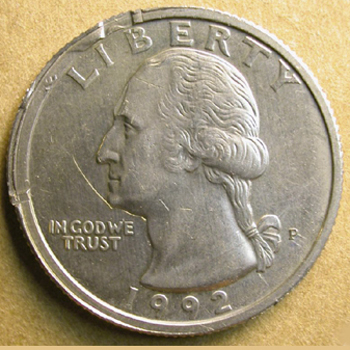
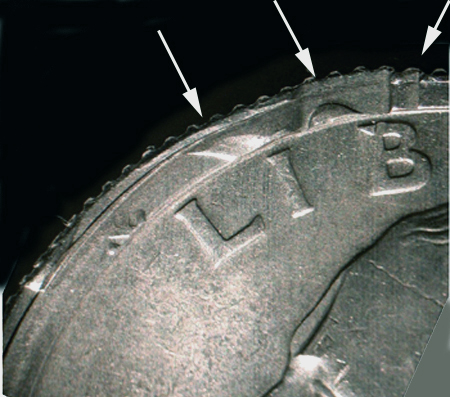
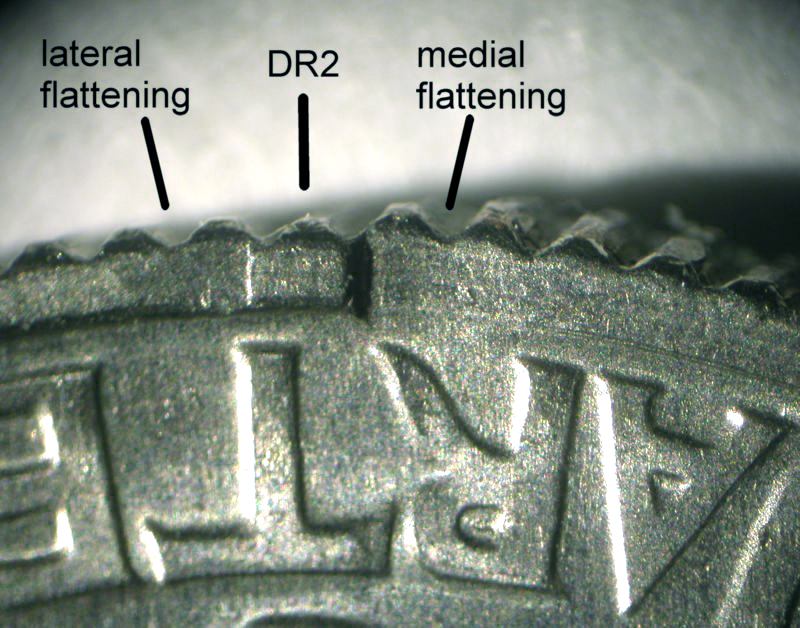
This 1992-P quarter received an abnormally strong first strike that caused finning of the design rim on the left side.  The second strike is about 75% off-center, rotated 90 degrees clockwise, and die-struck on both faces.  Second-strike design elements are almost completely restricted to the design rim.  On the reverse face, the only recognizable second-strike feature is the design rim.  No interior design elements are present on the reverse because much of the resistance to the impact of the hammer die was provided by a slightly elevated collar.  This simultaneously softened the impact of the anvil die so that no details managed to strike up.  DR2 = 2nd Strike Design Rim

Recurring die subsidence error

Part IV. Die Errors:

Die Deterioration/Deformation Errors:

Die Subsidence Errors:

Recurring Die Subsidence Errors:

Definition: Die subsidence (sunken die) errors are usually one-off events.  In other words, the error will only affect one die.  When die subsidence errors affect several dies, it’s usually the periphery of the die face.  This makes sense as differences in hardness would be expected to develop during flawed heat treatment (annealing, tempering, quenching).  These processes cool or heat up a die from the outside in, and circular or semicircular zones of weakness can develop in the case of heat-treatment that is too rapid, too slow, or that is interrupted in some fashion.

The real mystery arises when you end up with highly localized, repetitive die subsidence errors in the same location well within the die face.

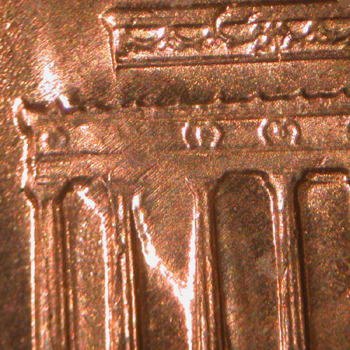
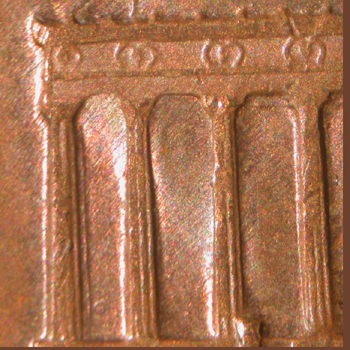
The most widespread epidemic of repeated interior die subsidence errors occurs among 1973-D cent.  Only the reverse die is affected and at least 8 dies are represented.  The defect is always found on the left side of the Lincoln Memorial, between columns 1 – 3.  The outline and height of the zone of subsidence is slightly different from die to die, but the location is quite consistent.  Why only the reverse die is affected, and why the abnormally soft patch of steel is restricted to this area, is a profound mystery.  These defects are often mistaken for clash marks.

Another group of repetitive die subsidence errors is found among 1988-P nickels.  At least two obverse dies are affected.  The top of Jefferson’s head develops a smooth swelling.

03_die_defect_1973D_1c_rev_no302_die_defect_1973D_1c_rev_no2

01b_die_defect_1973D_1c_rev_no1_close

These three 1973-D reverse dies display a repetitive die subsidence error on the left side of the Memorial.  The columns, roof, and base of the Memorial are often visibly distorted as they cross the zone of subsidence.

04_die_subsidence_1988P_5c_LDS_close

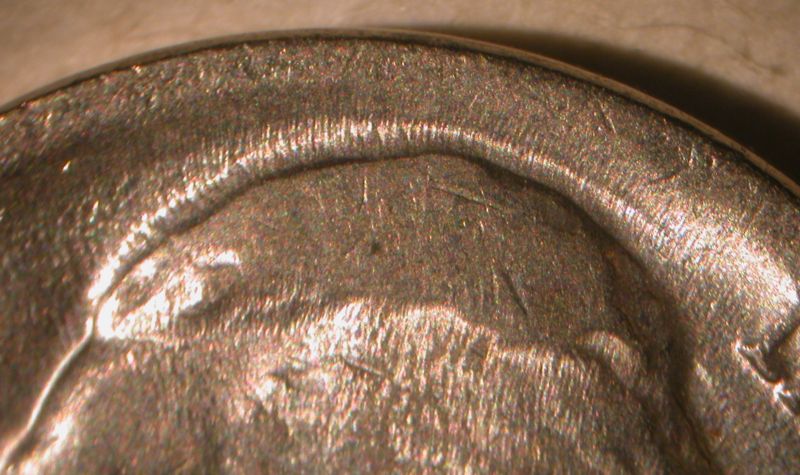
This 1988-P nickel displays a smooth swelling at the top of Jefferson’s head.  At least one other die suffers from the same defect, which is where the die steel sank in.

  • « Previous Page
  • 1
  • …
  • 3
  • 4
  • 5
  • 6
  • 7
  • …
  • 21
  • Next Page »
  • Home
  • Introduction To This Website
  • Error-ref.com News
  • Comprehensive Error-Variety Checklist
  • Index Of Completed Entries
  • Part I. Die Subtypes:
  • Part II. Die Varieties:
  • Part III. Die Installation Errors:
  • Part IV. Die Errors:
  • Part V. Planchet Errors:
  • Part VI. Striking Errors:
  • Part VII. Post-Strike Mint Modifications:
  • Part VIII. Post-Strike Striking Chamber Mishaps:
  • Part IX. Post-Strike Mint Damage:
  • Part X. Wastebasket / Composite Categories:
  • Part XI. Non Errors:
  • Featured Articles Of Interested
  • Interest & Not So Interesting Facts
  • Other Sites And Forums Of Interest
  • Our Thanks Go To
  • About The Authors
  • Contact Us

Copyright © 2026