Error-Ref.com

You are here: Home / Search for "off center"

Search Results for: off center

Broadstrikes

PART VI. Striking Errors:

Broadstrikes

Definition:A coin that is struck outside the collar.  The collar is the retaining ring that establishes the final diameter of the newly-struck coin.  A broadstrike will expand beyond the diameter of a normal coin, sometimes drastically so.

A perfectly centered coin that is struck out-of-collar is simply called a “broadstrike”.  An imperfectly centered coin that is struck out-of-collar is called an “uncentered broadstrike”.

In order to qualify as a broadstrike, the full design must be present on both faces.  If the design is cut off on either face, it is called an “off-center strike”.

The images below show a 1916-D Lincoln cent that has assumed the form of an uncentered broadstrike.
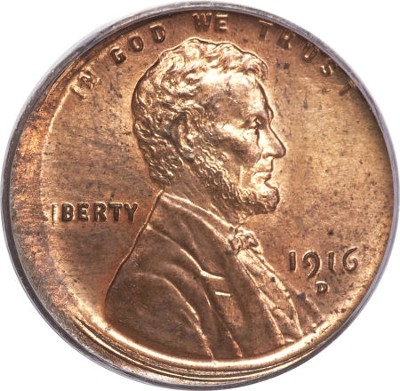
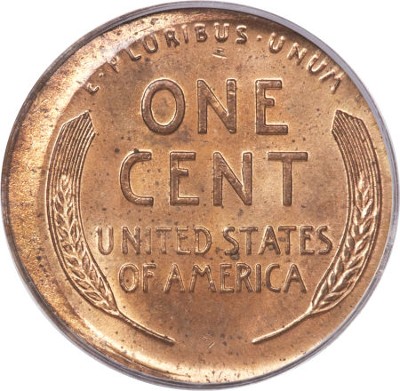
Images are courtesy of Heritage Auctions.


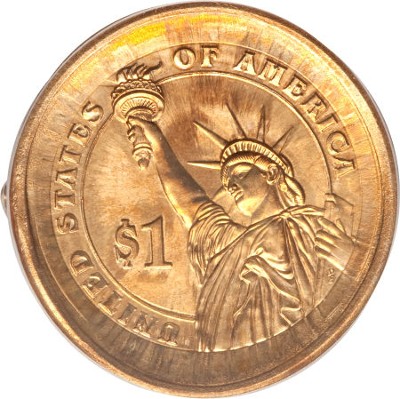
The images below show a broadstruck 1997-(?) Washington dollar coin.  Due to its enlarged diameter, this dollar coin did not receive the edge inscriptions.
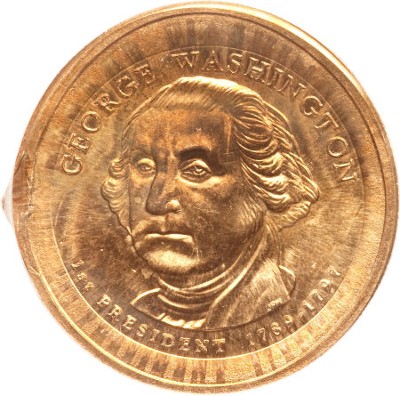
Images are courtesy of Heritage Auctions.
Anvil Die Collar Clash

Part IV. Die Errors:

Collar Clash:

Anvil Die Collar Clash:

Traditional die setup


Definition: Collar clash on the reverse die, with the reverse die acting as the anvil die.

Collar clash is virtually unknown on reverse dies installed in the traditional fashion, i.e., with the reverse die acting as the anvil die. Anvil die collar clash can develop if the neck of the die is shoved violently into the ridged working face of the collar or vice versa. Anvil die collar clash can also develop if the neck of the collar grinds up and down against the collar (or vice versa).

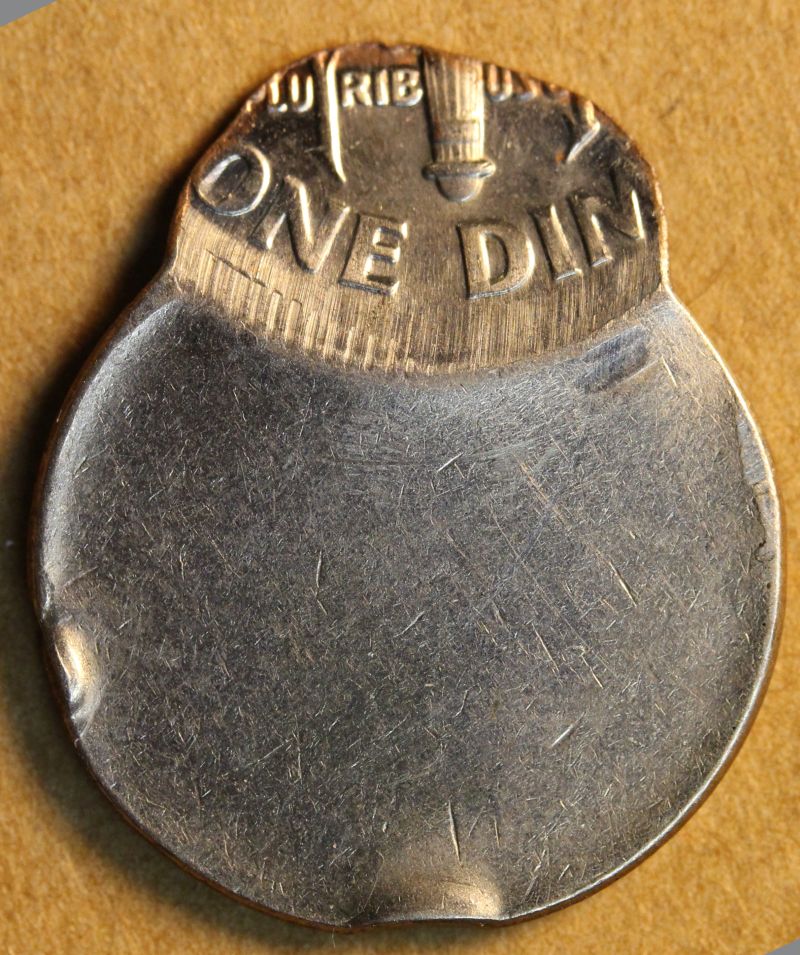
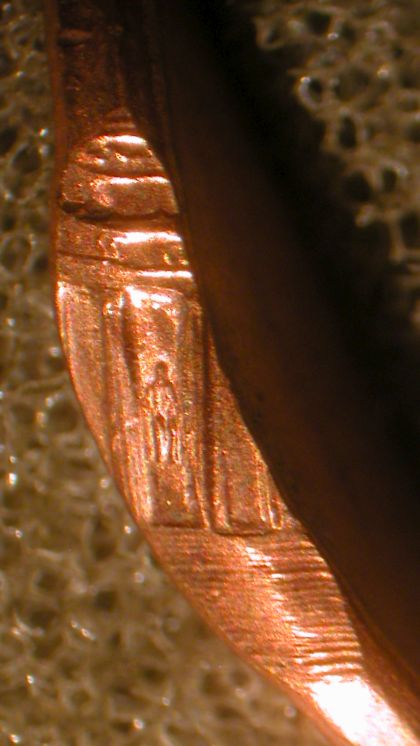
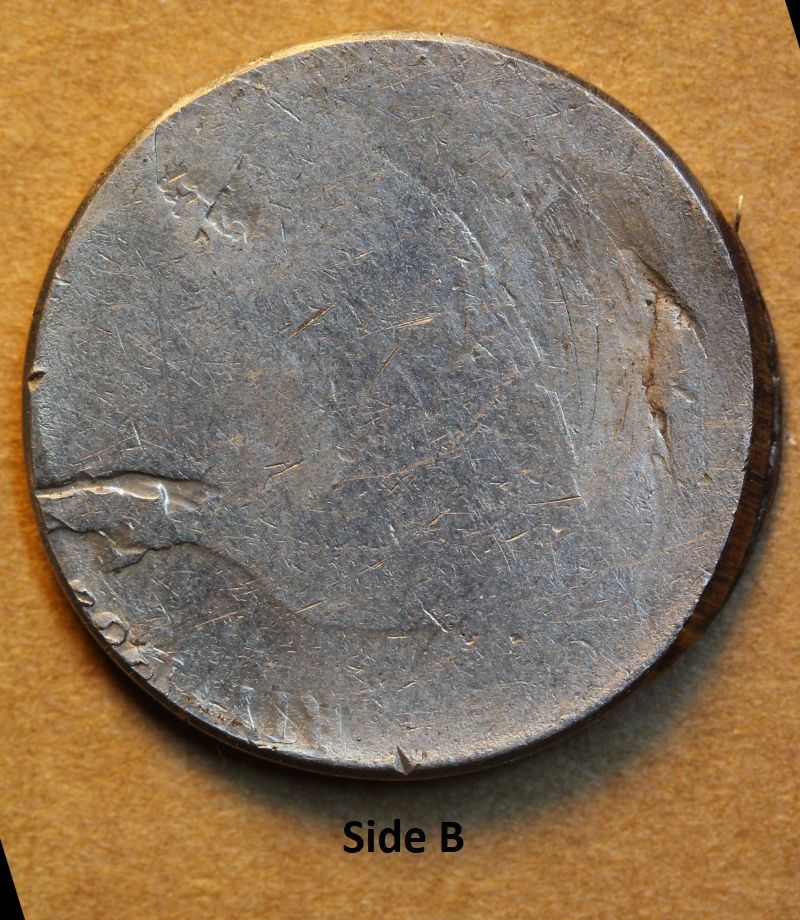
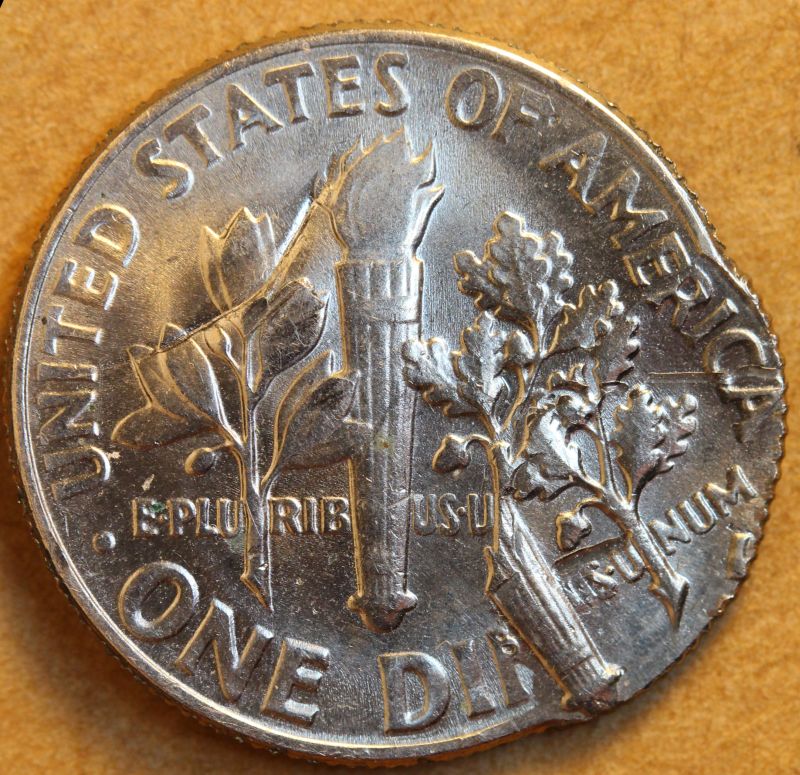
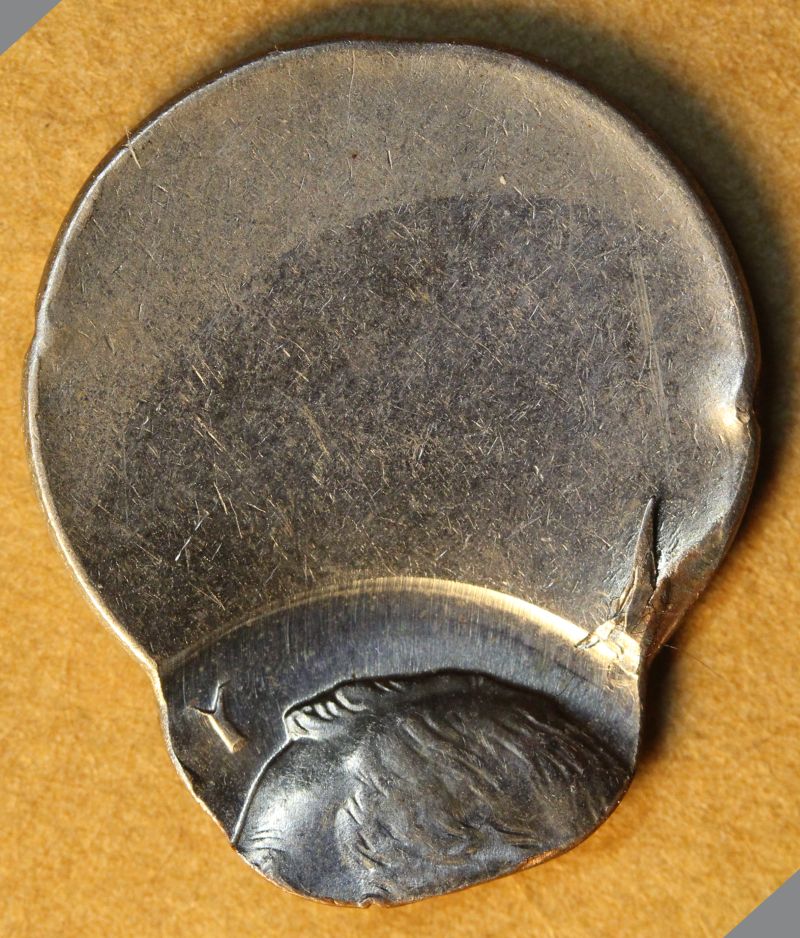
This undated, off-center dime shows anvil die collar clash on its reverse face. Because the coin was struck out-of-collar, the familiar serrations of collar clash have been transformed into a series of transverse grooves located within the coin’s slide zone. This dime also displays three indentations in its edge, which represent pre-strike planchet damage.

Struck-In Die Fragments

Part VI. Striking Errors:

“Struck-Through” Errors:

Retained Struck-Through Errors:

Struck-in die fragments


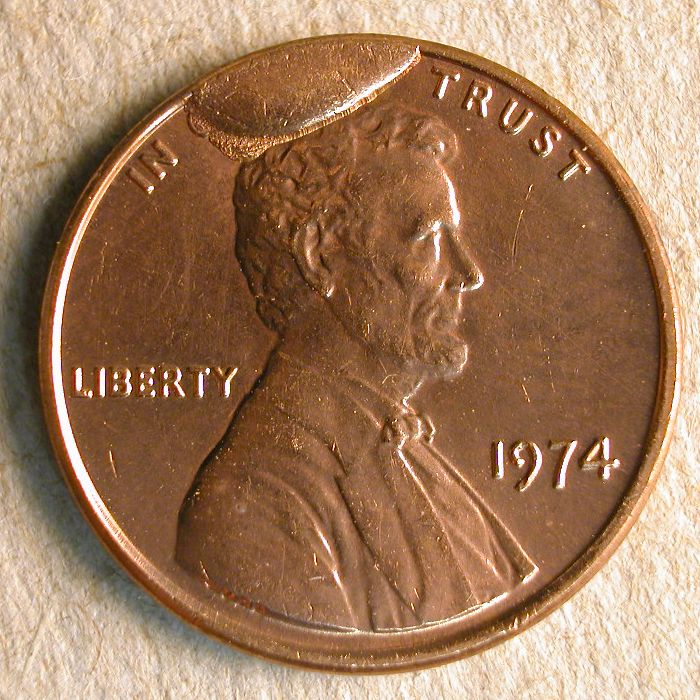
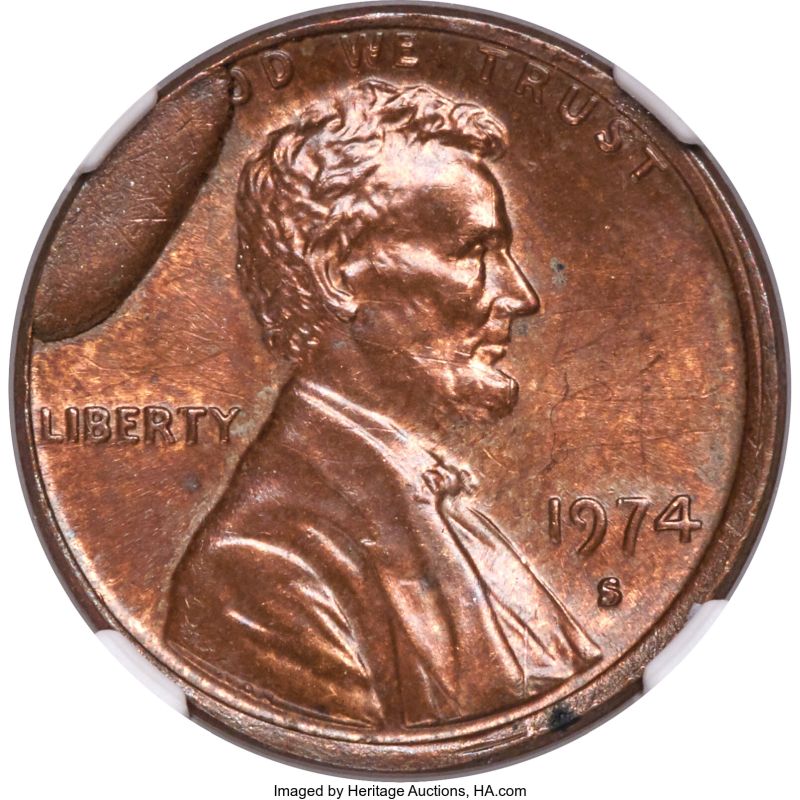
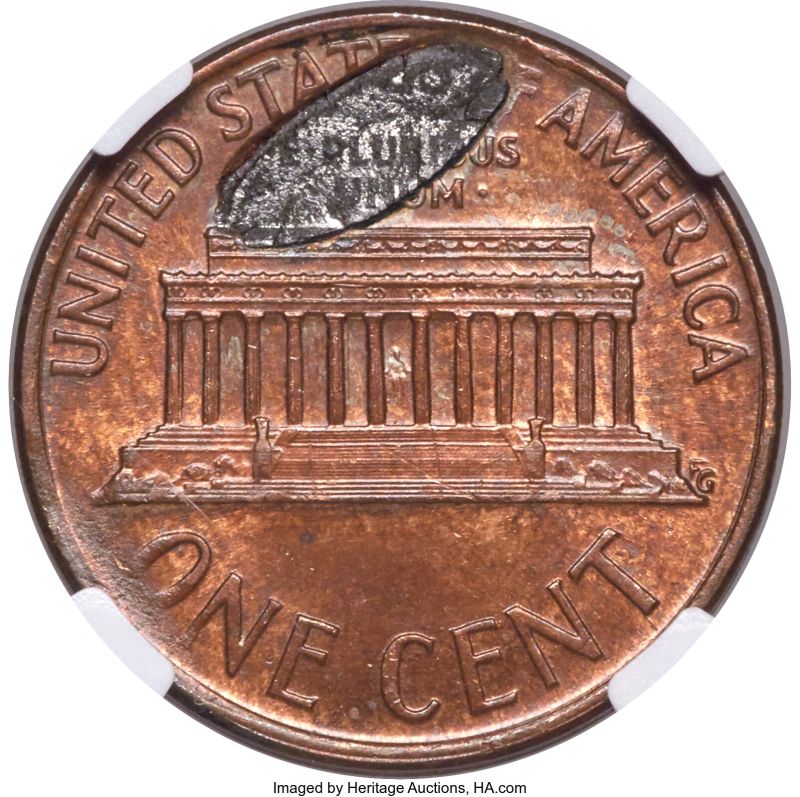
Definition: A die fragment that is struck into a planchet and retained. Retained die fragments are quite rare. Most are derived from one of the dies responsible for striking the coin that carries the fragment.


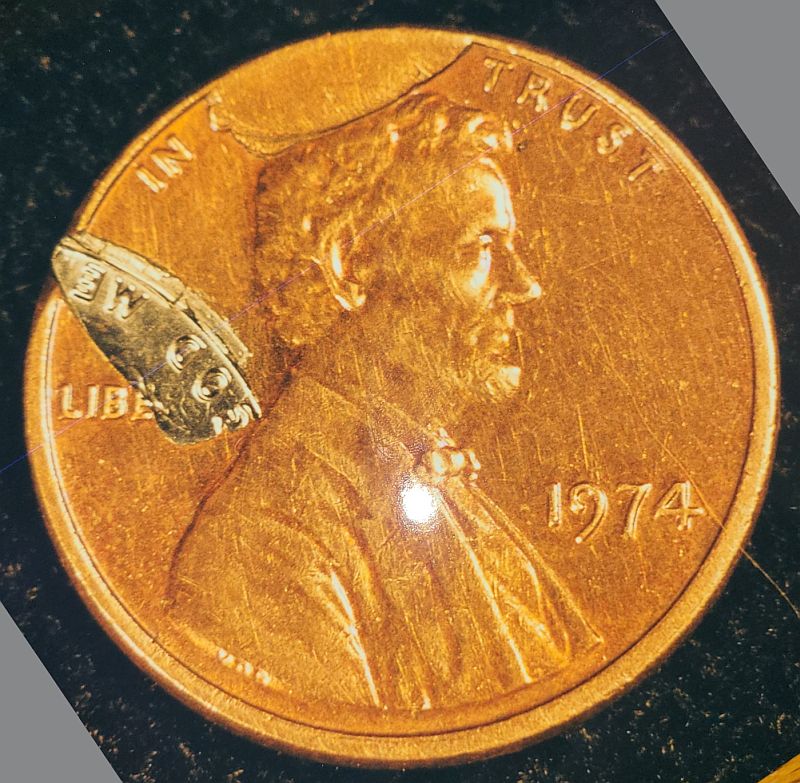
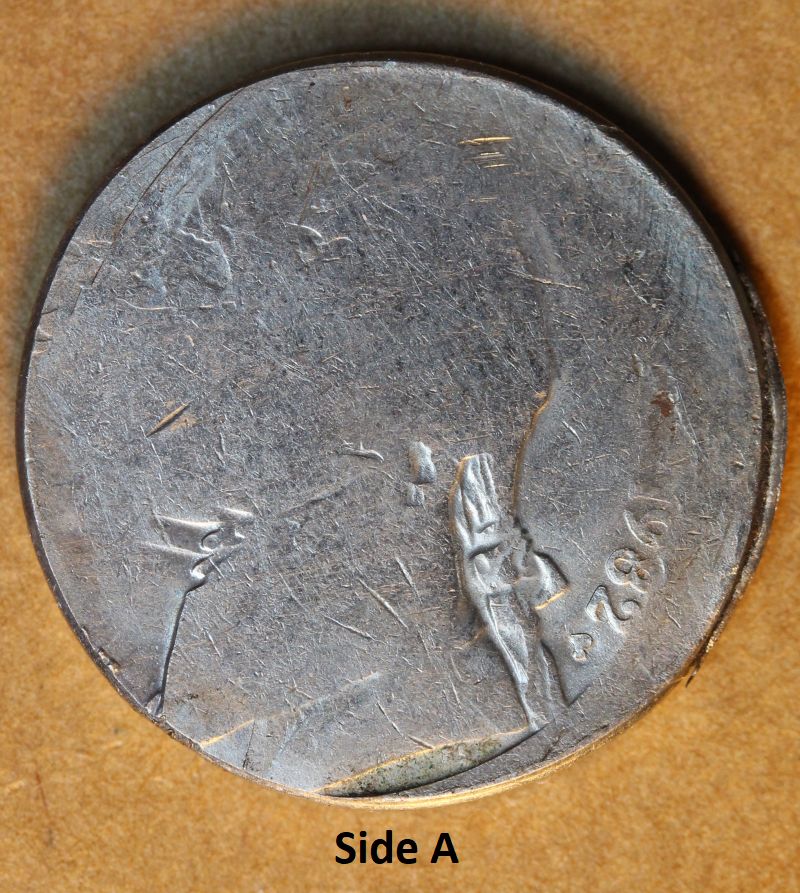
A fragment broke away from this 1974 obverse cent die and landed upside down on the planchet represented by the illustrated cent. The fragment was driven into the cent, where it remained until discovery. The impact between the intact portion of the die and the fragment generated a floating die clash, which appears on every cent struck afterward. Photo courtesy of James Krieb.


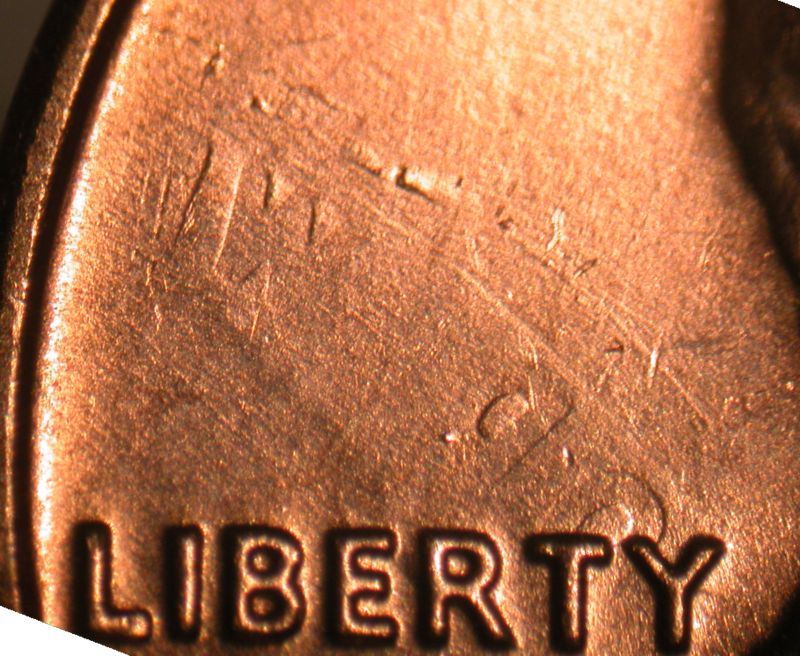
This 1974 cent was struck later by the broken, damaged obverse die and displays the floating die clash produced when the obverse die struck the fragment.


A die fragment broke off the left side of this 1971-S obverse die and landed on the reverse die, with its lettering apparently facing upward toward the obverse die. A planchet was then fed in on top of the fragment so that the fragment was driven into the reverse face of this cent.

Wrong Ring

Part V. Planchet Errors:

Bimetallic Errors:

Wrong ring


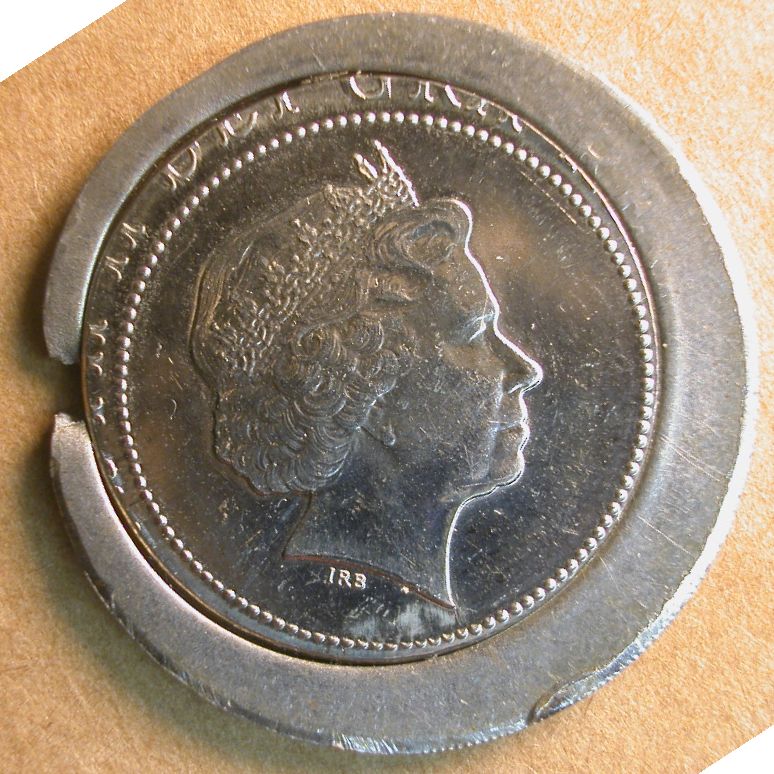
Definition: A bimetallic planchet that is assembled using the correct core but the wrong ring. Bi-metallic error coins are restricted to foreign countries. These coins may experience any of the many types of striking errors listed in the Error-Variety Ready Reference however, one must understand we are dealing with two components, a ring and a core. Any number of exotic possibilities or combinations of die varieties, die errors, planchet errors and striking errors can be found on bi-metallic coinage. These errors are unequivocally rare.

There are any number of sources for the incorrect ring.

  1. It might be a ring that was intended for a different bimetallic denomination
    with a similar-sized hole.
  2. Punched out of stock intended for a different bimetallic denomination.
  3. Punched out of stock intended for a solid-alloy denomination.
  4. Punched out of stock intended for the core.
  5. An inadvertently holed, solid-alloy blank or planchet intended for another
    denomination.
  6. A previously-struck, solid alloy coin that was accidentally holed.
Coin courtesy of Jeff Ylitalo

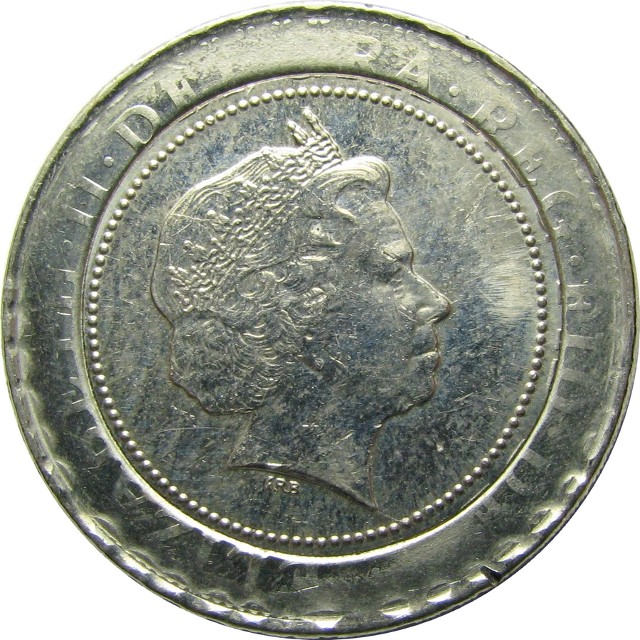
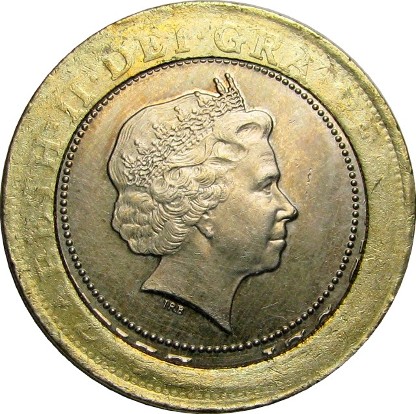
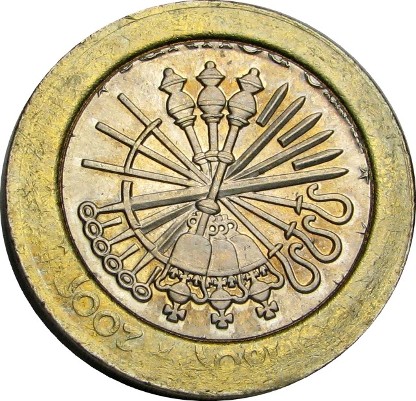
This 2001 British 2 pound coin has a normal copper-nickel core surrounded by a steel ring instead of the expected nickel-brass ring. The steel ring is substantially thinner than both the core and normal ring, which is why so few peripheral design elements appear on it. The steel ring weighs an estimated 2.6 grams instead of the normal 5.9 grams. The edge of the off-metal ring displays a few letters of “ON THE SHOULDERS OF GIANTS”. This shows that the composite disc passed through the appropriate edge-lettering device and that its original external diameter was close to that of an assembled 2 pound blank.

The center hole was presumably punched to normal diameter, since British 2 pound bi-metallic blanks are pre-assembled. The hole’s offset position may be partly due to the slightly undersized steel disc occupying an uncentered position within the hole-punching device. The offset appearance was accentuated by uneven expansion of the core during the strike, which split the ring at 9:00.

Photos courtesy of Jeff Ylitalo

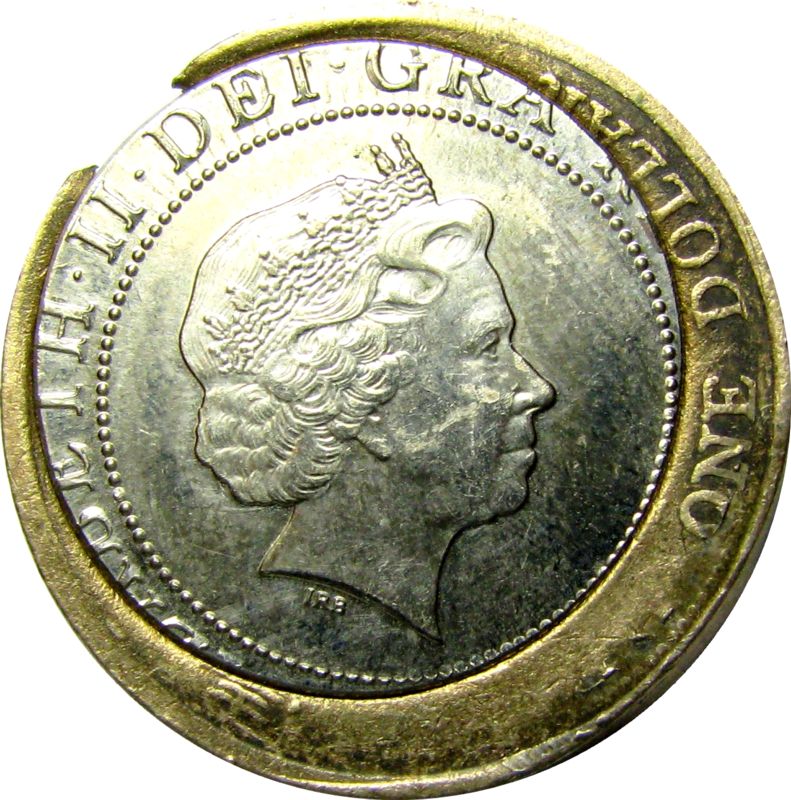
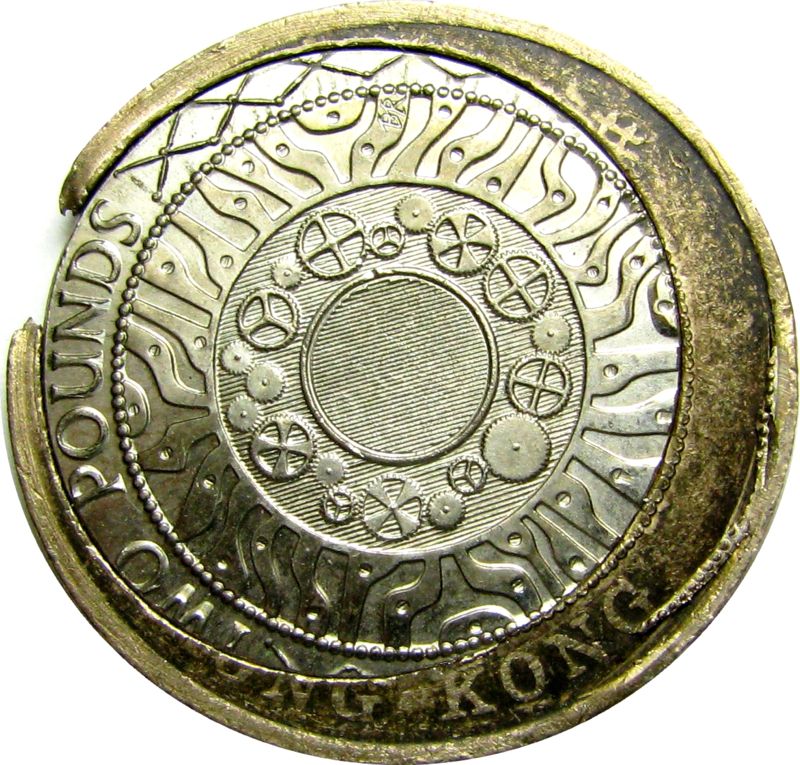
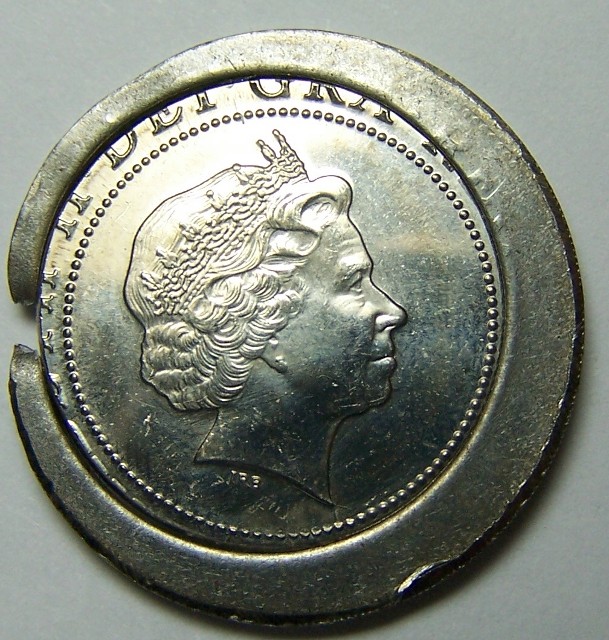
The ring on this British 2 pound coin was derived from a worn, battered, and discolored Hong Kong dollar (1993-1998). Composed of a solid copper-nickel alloy, this coin had its center punched out and filled with a British 2 pound core. A misaligned hole, combined with uneven expansion of the core, caused the ring to split at 10:30 when it was struck by the 2 pound dies. The edge of the ring carries no edge lettering. It either bypassed the edge lettering device or was too small to betray its passage through the device.

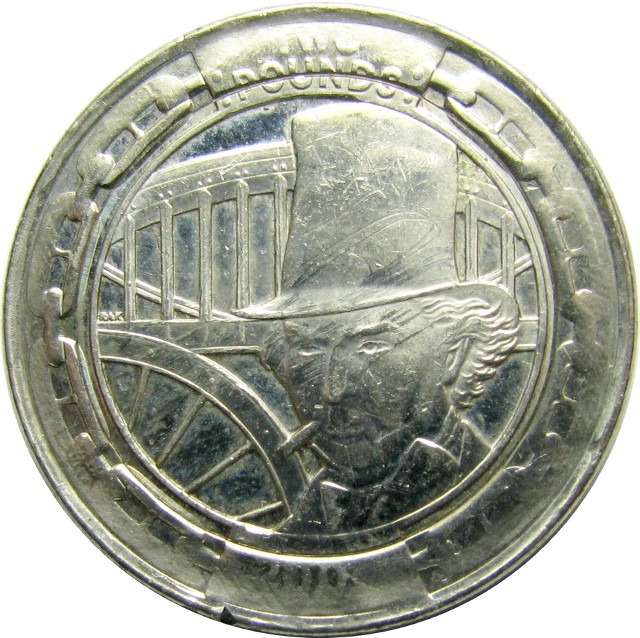
A two pound 2006 Isambard Brunnel from Great Britain. The ring is is strongly attracted to a magnet. (Either elemental nickel or steel composition). Weight: 10.30 grams.

Note the following specification information regarding U.K. outer rings: 12.0 g is normal weight for a bi-metallic of this series. A two pound ring consists of the following composition and weight: Two pound ring 76% Copper, 4% Nickel, 20% Zinc Weight – 6.0 g

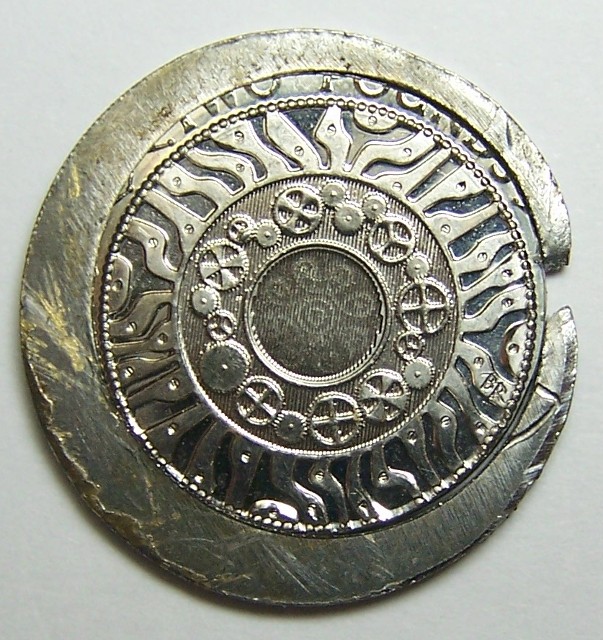
A two pound Technology from Great Britain. Ring is strongly attracted to a magnet (steel ring). The ring also has a misaligned center hole. The ring is much thinner than the core resulting in the near incomplete absence of design transfer on either face of the ring. The ring also sheared & snapped when struck.

A two pound 2007 Gun Powder Plot from Great Britain with wrong ring. The ring also has a misaligned center hole. The ring is thinner than the core resulting in the absence of some design transfer on either face of the ring.

Misaligned Hubbing (Uncorrected)

Part II. Die Varieties:

Misaligned hubbing (uncorrected)


Definition: A working die that receives an uncorrected misaligned impression
from a working hub.

Misaligned hubbings occur every so often. If the initial hubbing is misaligned, it is always corrected by a properly centered hubbing. Sometimes the offset hubbing occurs after the properly centered hubbing. In either case, the result is a Class IV doubled die (offset hub doubling).

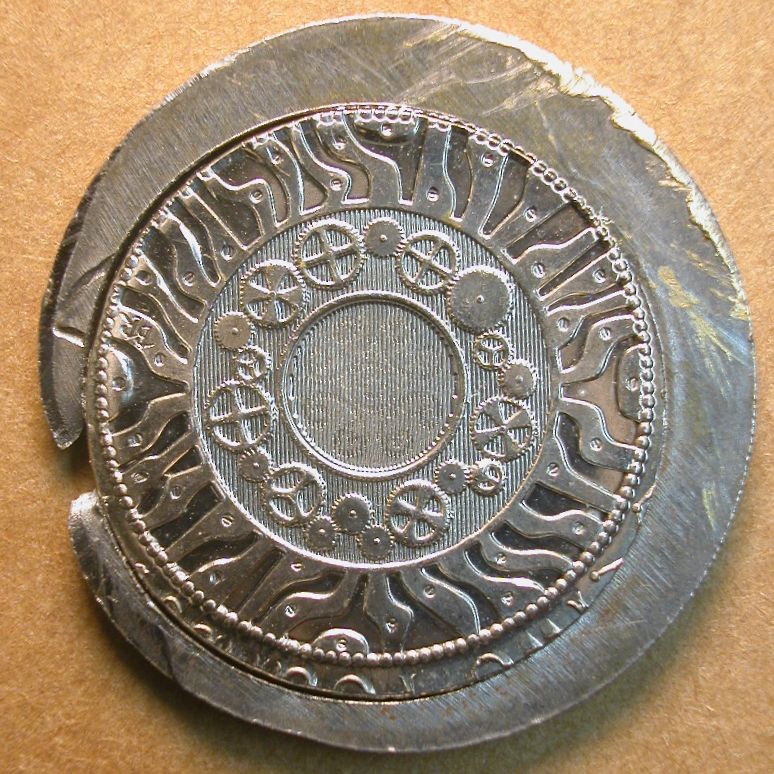
Uncorrected misaligned hubbings are currently unknown among domestic or world coins. However, Daniel Carr has created some silver rounds that replicate the appearance of an uncorrected misaligned hubbing.

Photos courtesy of Daniel Carr.

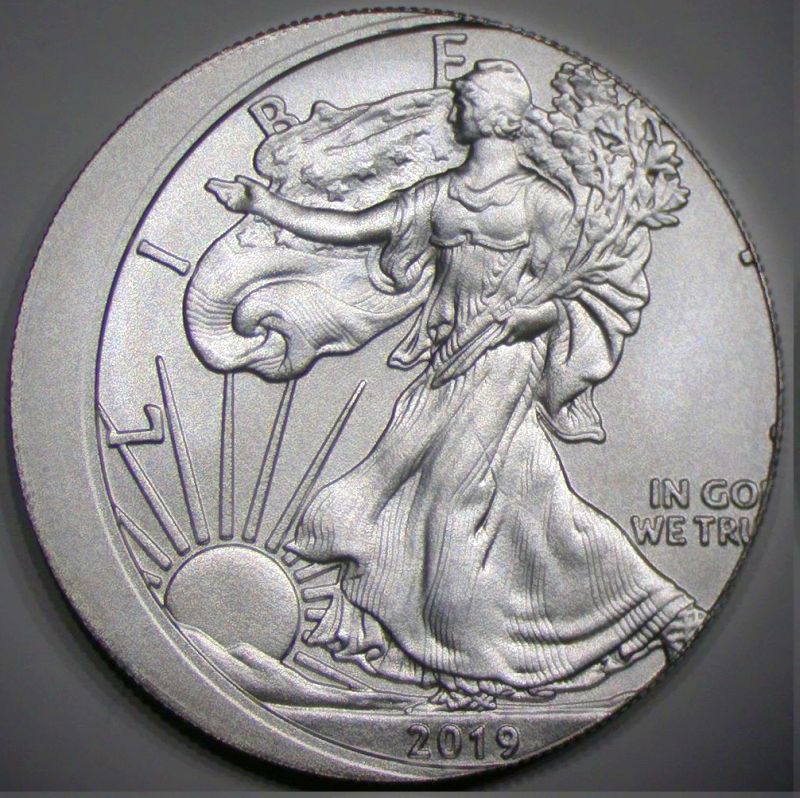
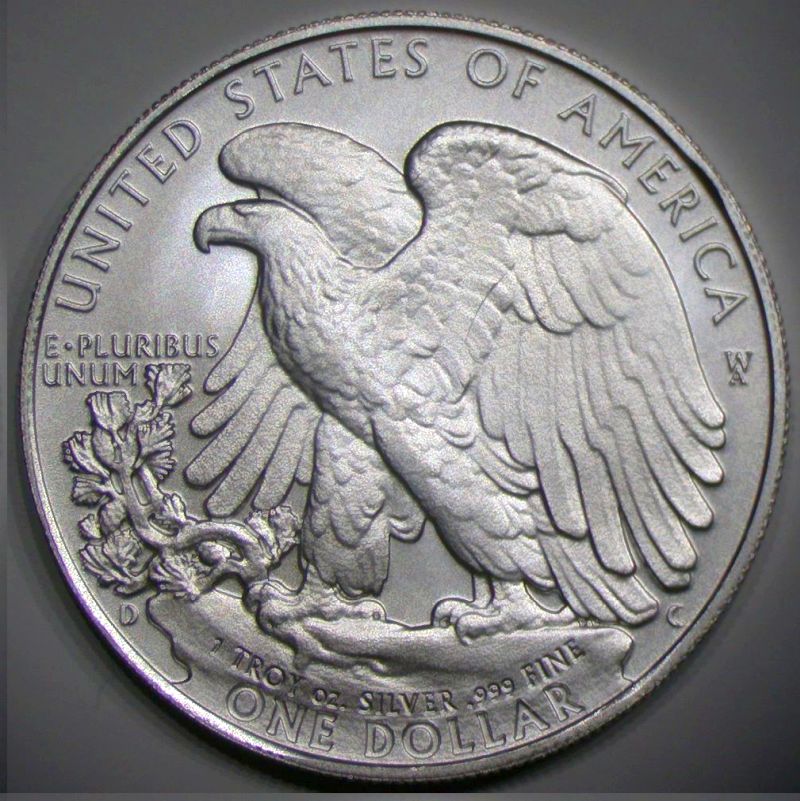
This American Silver Eagle bullion coin was overstruck by a pair of private-issue dies that closely replicate the design of the Walking Liberty half dollar. The host coin’s design has been nearly obliterated. The obverse design was engraved directly into the obverse die in a 15% offset position.

While the result looks like a misaligned die error, there are key differences:

  1. There is no weakness on the reverse opposite the featureless obverse crescent.
  2. The obverse crescent is perfectly flat and smooth. The unstruck crescent of a misaligned strike would bulge toward the viewer, show tumbling marks or, in the case of proofs, display a pocked, burnished surface.
  3. The outer margin of the featureless crescent makes a sharp, right-angle junction with the coin’s edge. A misaligned strike would preserve the planchet’s proto-rim.
  4. The reeding is strong next to the featureless crescent. A misaligned strike would show weakness in the reeding.

Multiple Misaligned Strikes

Part VI. Striking Errors:

Die alignment errors:

Horizontal misalignment:

Multiple misaligned strikes


Definition: The presence of two or more misaligned strikes on the same face of the same coin. The position of the affected die can be stable or quite unstable.

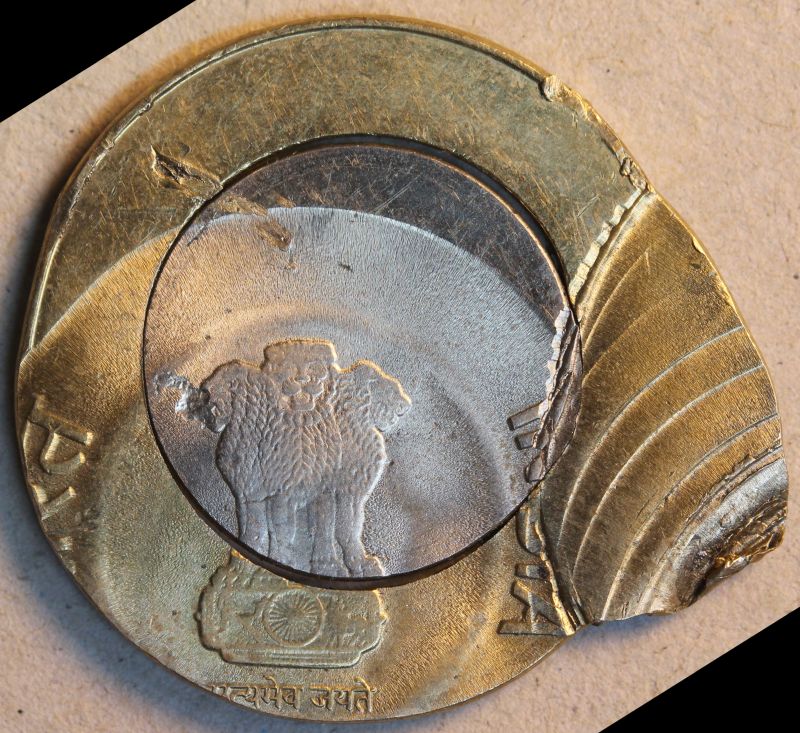
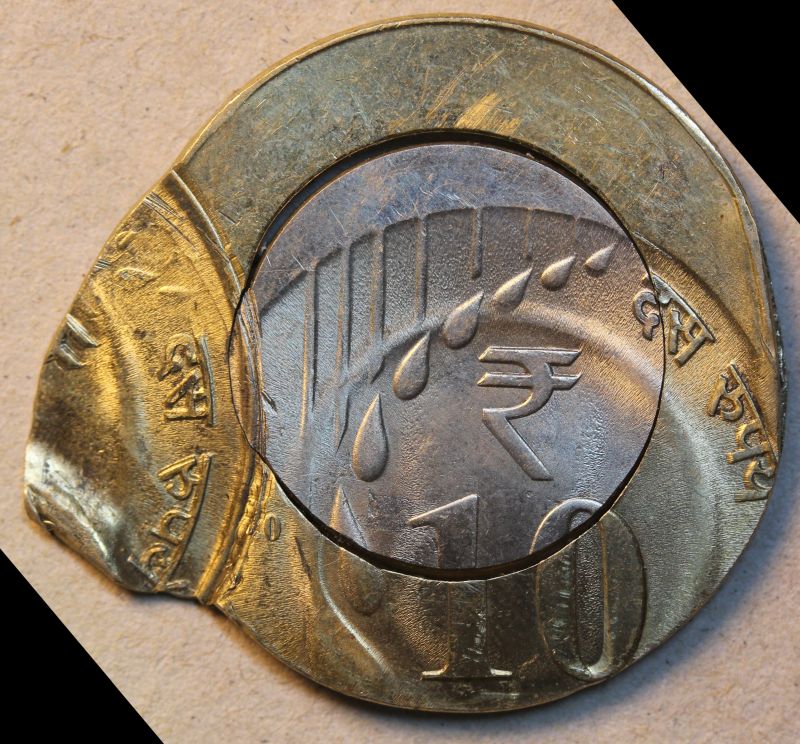
It is rare for a coin to be struck more than once by a misaligned die. It is even rarer for those strikes to be well-separated as the result of die instability. This undated India 10 rupees coin (2019 – present) features a 31% off-center first strike and a series of at least six additional off-center strikes that were all 79% off-center. The hammer die was properly centered during the first strike. However, during the later off-center strikes, the hammer (obverse) die became progressively more misaligned until it finally migrated beyond the coin. The coin showed very little movement during those later strikes and the anvil die remained fixed in position.

Edge Strikes

PART VI. Striking Errors:

Edge strikes


Definition: A planchet or coin that is struck on-edge.

Edge strikes occur when a planchet or a previously-struck coin is positioned on edge when the dies come together. The disc may enter the striking chamber spinning on its edge or rolling on its edge. It may be kicked up into a vertical position by the feeder/ejector or a neighboring planchet or coin that occupies the striking chamber at the same time. It might be caught on edge by the descending hammer die as the disc flies across the striking chamber.

In all cases, the disc is not quite vertical when struck. If it were, it would be transformed into a foldover strike.

This is a prototypical edge strike. The coin was kicked out of the striking chamber as it bent beneath the impact of the dies The two poles carry die-struck design elements while the unstruck area between them has buckled.

Other edge strikes can take on a very different appearance. In some cases, the coin falls on its side within the striking chamber in a centered, slightly uncentered, or visibly off-center position and receives a follow-up strike as the hammer die completes its downstroke. In other cases, one or both poles bend, or the metal is dragged over onto one of the adjacent faces, so that a “paraxial foldover flap” appears at one or both poles.

Illicitly Applied Die Impressions

Part IX. Post-Strike Mint Damage:

Illicitly applied die impressions


Definition: Planchets and coins that have a new design impressed into them inside the Mint but without the use of a coining press. These illicit impressions have one or more of the following characteristics.

1) Frequent use of proof dies, normal and impaired.

2) Frequent use of proof planchets, normal and impaired.

3) Presence of odd patterns and textures.

4) One or both designs strongly misaligned (horizontally, vertically, or rotationally).

5) Design impressions often weak.

6) Multiple, overlapping impressions common.

7) Nonsense die sometimes used on one face.

8) Counterfeit die sometimes used on one face or superimposed over the original illicit die impression.

9) Oversized coins and planchets sometimes used to host the illicit impression.

10) Wrong planchet or different denomination sometimes used to host the illicit impression.

11) Heavy damage to the planchet or coin prior to, coincident with, or following upon, the illicit die impression.

12) Dies often heavily damaged or vandalized.

13) Opposing designs applied sequentially, rather than simultaneously.

14) Creation of false brockages before, during, or after application of the genuine die.

15) Raised image confined to one face.

16) Strange forms of doubling, often of an extreme nature.

This nickel planchet received two sequential impressions from either the same obverse die or two different 5-cent obverse dies. Both designs are weakly impressed and off-center toward the left. One face is rotated 90 degrees relative to the other.  Both dies were also tilted. One obverse design shows strong doubling while the other is grossly smeared. During each impression, the opposite face rested against a textured surface. One or both designs seem to have been damaged after the final impression was generated.

Depending on their provenance, how convincing they look, how much damage is present, and whether proof dies and planchets were involved, these creations can fetch prices ranging from a few tens of dollars to over $10,000.

The status of such coins as “errors” is highly controversial. Though created inside the Mint by personnel employing genuine dies, the use of techniques other than a coining press make them more like fantasy pieces.

External Disc Impressions

Part VI. Striking Errors:

Indents:

External disc impressions


Definition: An impression on the underside of a broadstrike or off-center coin generated by a coin or planchet positioned just outside the striking chamber. The hammer die forces the expanded perimeter of a broadstrike or the protruding portion of an off-center planchet down onto the externally positioned disc. The result is a crescentic, half-moon shaped, or bell-shaped indentation that lies lateral to the die-struck lower face. The area above the indentation is forced upward, creating a type of forced cupping.

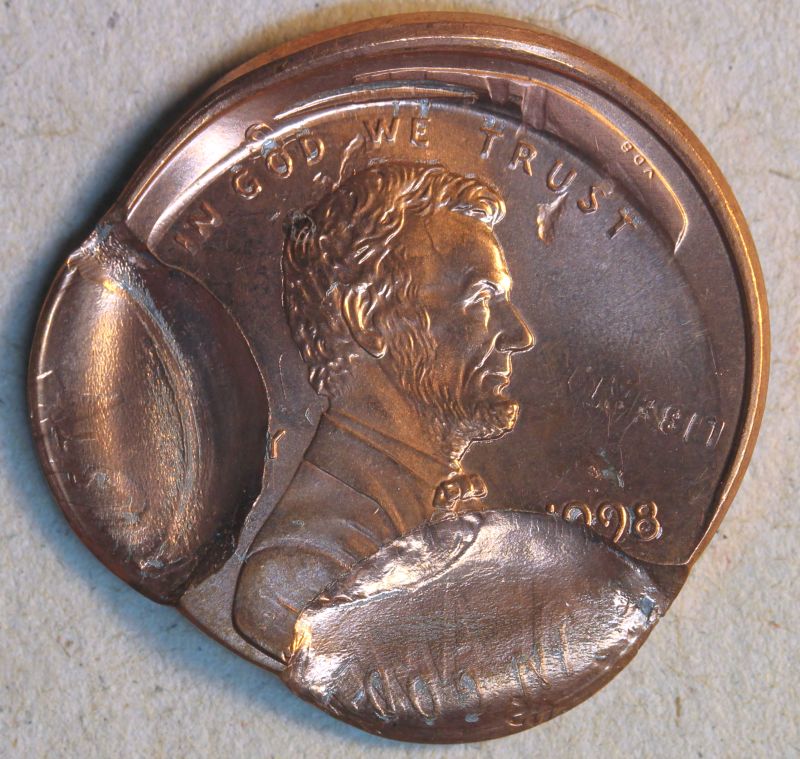
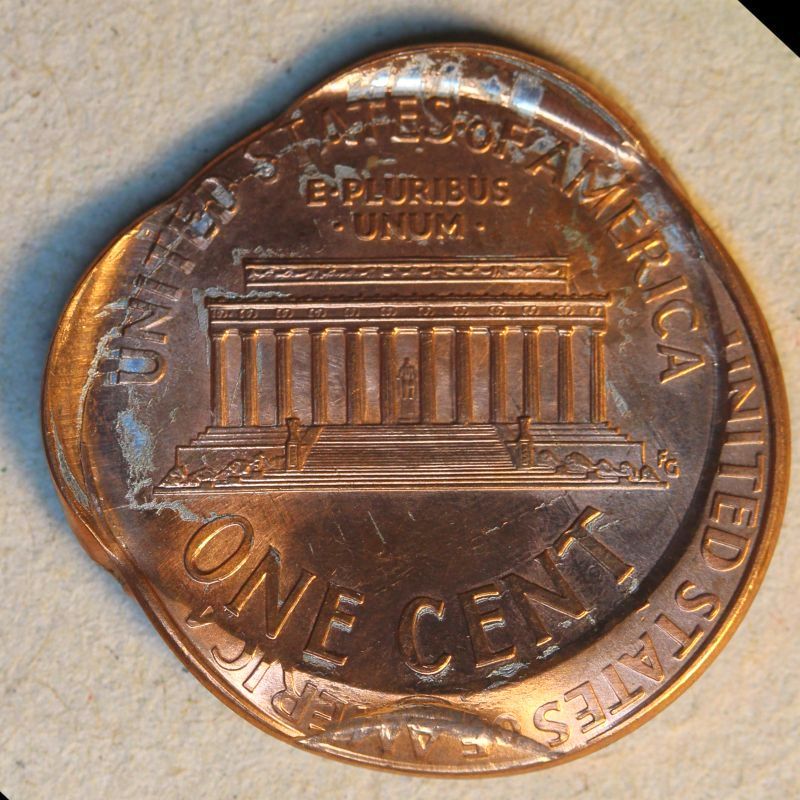
After a normal first strike, this 1998 cent rotated almost 180 degrees. The next strike was off-center and overlapped by two previously-struck cents. The area lying outside the second strike was pushed upward at 4:30 (first-strike clock position) by a coin or planchet lying just outside the striking chamber. A crescentic indentation runs through the first-strike letters OF AM.

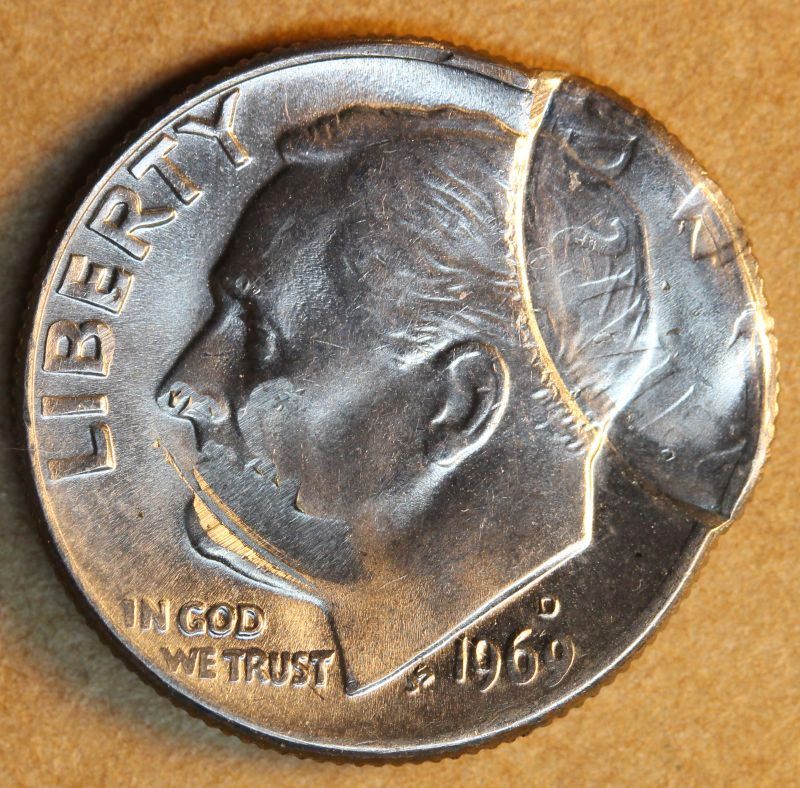
After a normal first strike, this 1969-D dime was struck 20% off-center while overlain by a previously-struck dime in the northeast quadrant. Prior to the second strike, minimum die clearance increased by more than the thickness of a dime, generating an invisible strike in areas where there was no intrusive object to take up the excess space. The intrusive, previously struck dime in the northeast permitted an opposing area of die-struck design to strike up on the reverse face. An underlying coin or planchet located just outside the striking chamber at the opposite pole allowed a second-strike design rim and a few interior design elements to strike up on the side of Roosevelt’s face. The externally positioned disc generated a thin crescentic indentation on the reverse face that runs through the olive sprig. This area of the dime is tipped up slightly from the resistance generated by the underlying disc.

Inverted Hump

PART VI. Striking Errors:

Saddle Strikes:

Inverted hump


Definition:
A saddle strike in which the hump or saddle buckles toward the reverse die.

In almost all saddle (tandem) strikes, the unstruck interval between the two off-center strikes buckles toward the hammer die, which is usually the obverse die in such errors. Buckling toward the reverse die can be an indicator of an inverted die setup (reverse die as hammer die). In cents, this is a factor only for those struck after after 1996 (or possibly 1995). The earliest unmistakable evidence for cents being struck with inverted dies appears in 1997. Inverted dies appear earlier in other denominations (as early as 1992 quarter dollars). At least one indisputable example of a saddle-struck cent generated by inverted dies is known (a quad-struck 2000 cent).

The other reason for buckling toward the reverse die is a rare reversal of the usual tendency. In other words, and for unclear reasons, the hump will bulge toward the anvil die. This reversal of the usual hump direction presumably depends on the collar being in an unusually depressed position; otherwise, it will impede the growth of the hump.

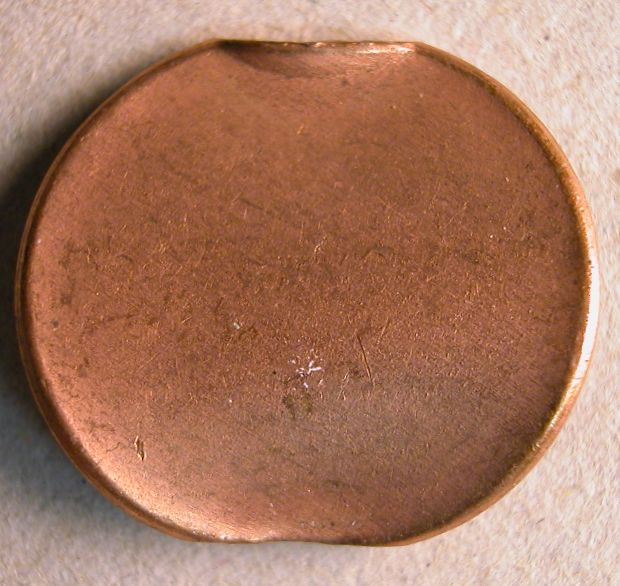
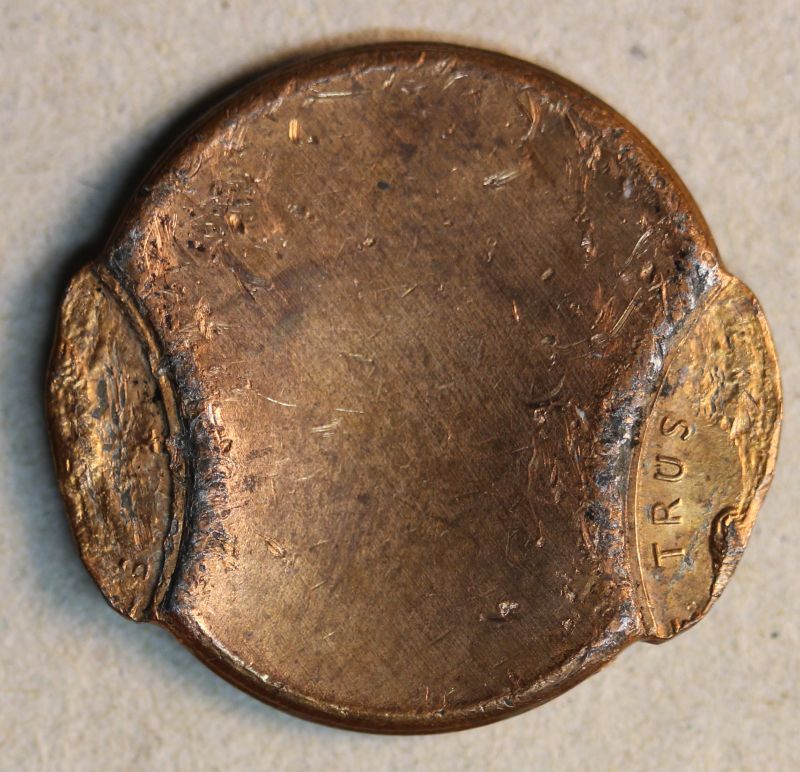
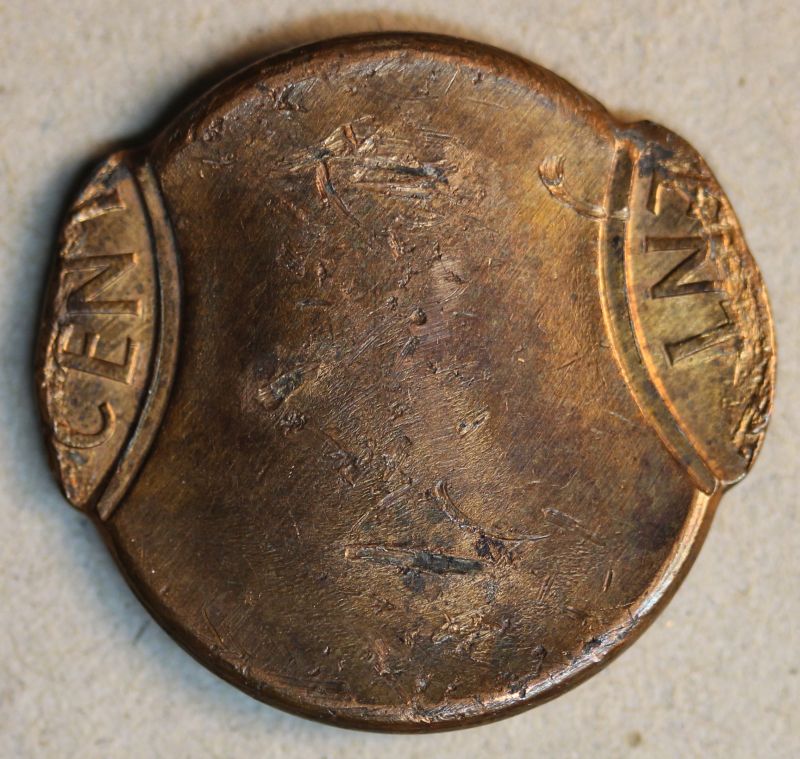
This rather battered, undated cent shows a hump pointing in the direction of the reverse die. In the absence of a date or any indicator of collar location, it’s impossible to say whether the inverted hump indicates an inverted die setup (reverse die as hammer die) or a rare instance of warping in the direction of the anvil die. Both faces of each off-center strike display roughly-textured struck-through areas.

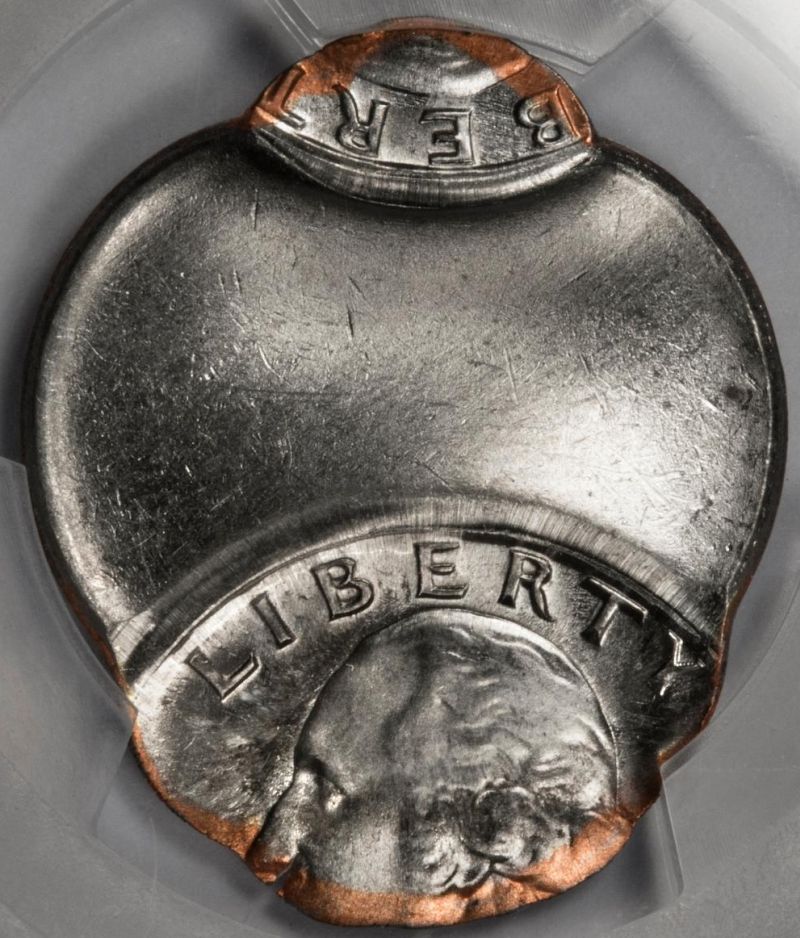
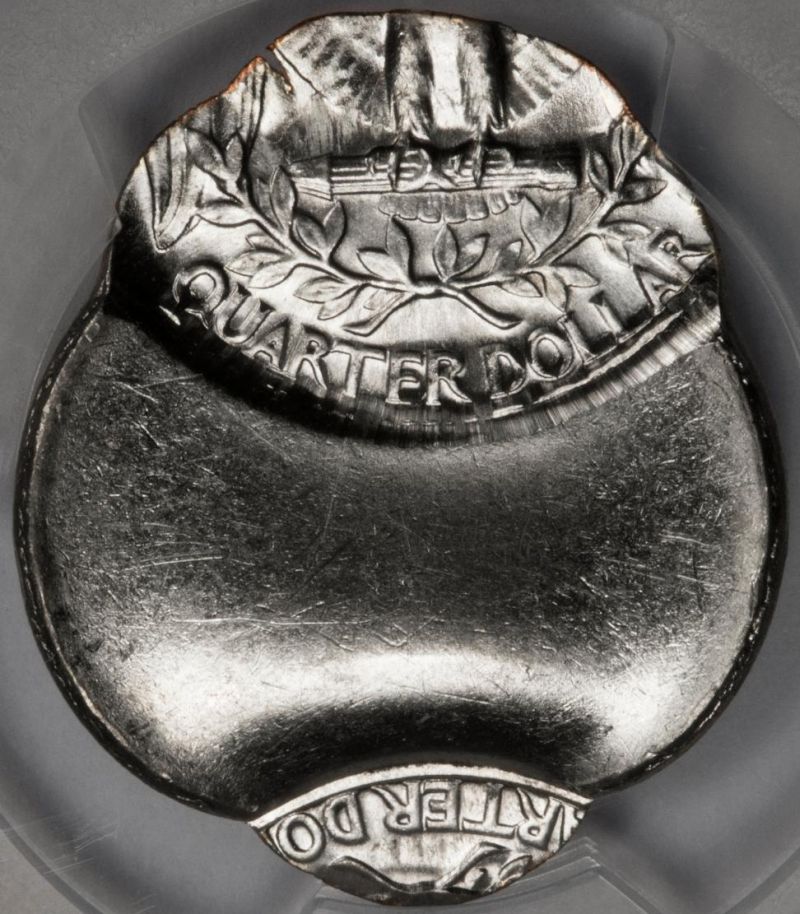
This saddle-struck quarter dollar shows a hump that points toward the reverse die. The relatively high relief and lack of detail of Washington’s head indicates it was struck long before the modern introduction of the inverted die setup. It was most likely struck in the San Francisco Mint between 1965 and 1967. Other saddle-struck quarters from this same time period show a hump that points toward the obverse die. So it’s likely that the inverted hump on this specimen is due to a rare instance of warping toward the anvil die. Very few saddle-struck quarter dollars are known, and they may represent a short-lived experiment in adapting a dual or quad press for a denomination larger than a nickel.

  • « Previous Page
  • 1
  • 2
  • 3
  • 4
  • 5
  • …
  • 21
  • Next Page »
  • Home
  • Introduction To This Website
  • Error-ref.com News
  • Comprehensive Error-Variety Checklist
  • Index Of Completed Entries
  • Part I. Die Subtypes:
  • Part II. Die Varieties:
  • Part III. Die Installation Errors:
  • Part IV. Die Errors:
  • Part V. Planchet Errors:
  • Part VI. Striking Errors:
  • Part VII. Post-Strike Mint Modifications:
  • Part VIII. Post-Strike Striking Chamber Mishaps:
  • Part IX. Post-Strike Mint Damage:
  • Part X. Wastebasket / Composite Categories:
  • Part XI. Non Errors:
  • Featured Articles Of Interested
  • Interest & Not So Interesting Facts
  • Other Sites And Forums Of Interest
  • Our Thanks Go To
  • About The Authors
  • Contact Us

Copyright © 2026