Error-Ref.com

You are here: Home / Search for "off center"

Search Results for: off center

2012 01 16


High-bouncing
die leaves offset, incuse machine doubling


By
Mike Diamond-Special to Coin World
 | Jan. 07, 2012
9:56 a.m.
 

Article
first published in 2012-01-16, Expert Advice section of Coin World


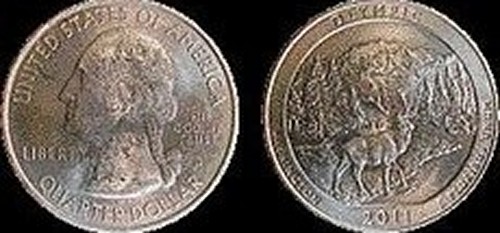
This 2011-D Olympic
National Park quarter dollar shows incuse machine doubling affecting the
southeast arc of peripheral lettering (E PLUR). The bottom of each affected
letter is smeared, and a second set of letters peeks out above the normal
letters.


                                                                                                                                                             Images by Mike Diamond

In 2010, the U.S. Mint
began striking quarter dollars for its America the Beautiful program. Each coin
features a reverse design that celebrates a national park or other site of
national significance. A raised perimeter ring on the reverse face houses an array
of incuse design elements.


The presence of these
incuse elements raises the odds of seeing new or unusual effects, even in so
humble an error category as machine doubling.


Machine doubling
occurs immediately after the hammer die has reached the lowest point of its
downstroke. It generally reflects instability in the die, die assembly or the
coinage press as a whole.


In some cases, either
die can rebound from the surface of the coin, shift laterally and land lightly
on the newly struck design elements. This produces marginal shelving at the
edge of the design, but can result in clear duplication of interior design
details.


In other cases, a die
simply shifts laterally after the hammer die reaches its lowest point. This
causes smearing of the newly-struck design and the piling up of relocated metal
into a series of ridges.


Raised and incused
designs


While the same die
motions affect both raised and incuse design elements, the resulting appearance
is rather different in the latter. This has caused some cases of incuse machine
doubling to be mistaken for a doubled die (hub doubling), a mishap that results
from multiple impressions of a working hub into a working die. An example of
deceptive machine doubling in a 2010 Grand Canyon National park 5-ounce silver bullion
coin was recently discussed by Ken Potter (http://numismaster.com/ta/numis/Article.jsp?ad=article&ArticleId=17345).


A commemorative
quarter dollar recently found in pocket change by Alex Tuel further illustrates
the ease with which incuse machine doubling can be mistaken for other sorts of
minting errors and die varieties. The coin in question is a 2011-D Olympic
National Park quarter dollar.


Tuel first presented
his specimen on the message board of Lincoln Cent Resource (www.lincolncentresource.net/forums/showthread.php?t=17470&page=3).
Photographs provided by Tuel showed a second set of overlapping letters (E
PLUR) that were offset and independent from their normal counterparts. The
extra letters are much thinner than the normal ones.


Early opinions
gravitated toward a doubled die or a Type II counterclash. The latter is a form
of patterned die damage that results when a hard piece of metal is struck twice
(see Collectors’ Clearinghouse, Sept. 29, 2008).


I suspected machine
doubling (as did others), but couldn’t be sure just by looking at the photos.
So I asked Alex to send me the coin and he generously obliged. An examination
under a microscope confirmed my suspicions.


The bottom (outer)
portions of the letters E PLURIBUS show conspicuous smearing, a sign of
unwanted movement in the reverse (hammer) die or hammer die assembly. The
second set of letters was evidently caused by a high bounce of the hammer die
after it reached the lowest point of its downstroke.


Forming incused
letters


Remember that the
incuse letters on the coin are created by raised letters on the die face that
extend well beyond the plane of the surrounding field. In this series, the
perimeter ring is recessed on the die face and the letters stick up from its
floor. The hammer die’s bounce would have carried those raised letters
completely out of the recessed letters they’d just created. A slight shift to
the northwest positioned those raised letters directly above the raised
perimeter ring of the coin. Descending from the apex of its bounce, the hammer
die made light contact with the coin’s perimeter ring. This light impact
produced the second set of letters in the field. The reason they’re so thin is
that, in cross-section, the apex of each raised letter is narrower than its
base, and only the apex left an impression.


A high bounce with a
strong lateral shift will sometimes generate odd effects on coins with
conventional raised designs. Previous installments of Collectors’ Clearinghouse
introduced the phenomenon of “rim-restricted design duplication” (Feb. 22,
2010, Aug. 22, 2011). This form of machine doubling leaves an entirely separate
set of raised design elements on the newly-formed design rim.


Coin
World’s
 Collectors’ Clearinghouse department
does not accept coins or other items for examination without prior permission
from News Editor William T. Gibbs. Materials sent to Clearinghouse without
prior permission will be returned unexamined. Please address all Clearinghouse
inquiries tocweditor@coinworld.com
 
or to 800-673-8311,
Ext. 172.


http://www.coinworld.com/articles/high-bouncing-die-leaves-offset-incuse-machin/


Copyright
2012 by Amos Hobby Publishing Inc. Reposted by permission from the March 22,
2012, issue of Coin World.)


MD-4

Outlying half-ring points to pre-plating damage to 1-cent planchet

By Mike Diamond–Special to Coin World | Jan. 14, 2012 9:58 a.m. 

Article first published in 2012-01-23, Expert Advice section of Coin World


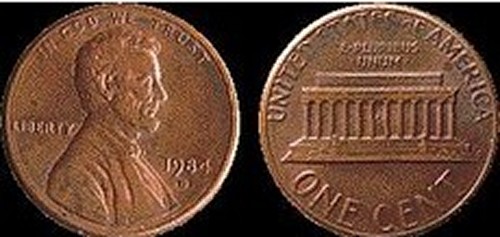
This 1984-D Lincoln cent was struck on a planchet that was probably damaged before it was plated with copper. The damage generated a thin apron that was eventually struck into the coin.

Images by Mike Diamond.


A few weeks ago die-variety authority and dedicated roll-searcher Robert Piazza sent me a 1984-D Lincoln cent with an unusual planchet error.

On each face (mainly on the left side) a partial ring of metal extends in from the design rim and terminates internally at a narrow fissure. On the obverse face the half-ring extends clockwise from approximately 4:00 to 11:30. On the reverse face it extends clockwise from 6:00 to 12:30. The presence of the fissure, and the fact that the ring is flush with the interior field, indicates that the ring was struck into the coin.

Occasionally the thin copper plating (present on cents from 1983 to the present and some 1982 cents) will crack just inside and parallel to the design rim. But I quickly rejected this prosaic explanation when it became clear that the planchet was originally thicker at the site of the ring. The increased thickness resulted in a locally stronger strike. This is best seen in the letters of STATES. The upper parts of the letters, which overlap the ring, are very well-struck, while the lower parts are weakly struck. The aforementioned fissure separates these two areas.

Pre-strike damage a culprit

A scenario involving pre-strike damage best explains this coin’s appearance. The edge of the planchet (or blank) was battered or squeezed, causing some of the metal to be relocated onto each face in the form of a thin apron that was later struck into the coin. The damage probably occurred prior to plating; otherwise some of the zinc core would have been exposed.

This type of damage usually occurs after the strike and is most often seen in abused coins that have tumbled around the fins of an industrial dryer. An example of such a “dryer coin” is shown here in the form of a 1962-D Jefferson 5-cent coin. The obverse and reverse designs have been pummeled into mush. Some metal has been relocated from the edge and design rim onto the field and peripheral letters in the form of a thin apron. The apron forms a complete ring that lies loosely on each face.

I doubt that the planchet represented by Piazza’s coin tumbled around a clothes dryer before it returned to the production stream to be plated and eventually shipped to the Mint. Some other piece of machinery must have been responsible.

I am aware of at least one precedent for Piazza’s coin. It is an off-center
Jefferson 5-cent coin struck sometime in the 1980s. Although its size, weight and density are unremarkable in comparison to other copper-nickel 5-cent coin planchets, its appearance is bizarre. The color is a leaden gray, and the interior has a fine, uniform, matte texture that is devoid of tumbling marks. A thin, pleated apron of metal extends in from the planchet’s proto-rim on both faces.

The proto-rim itself is quite odd, and I suspect both it and the apron formed simultaneously. The proto-rim shows no damage. The internal margin is sharp and its upper surface takes the form of a wide, flat, gently sloping plane that almost appears to be machined. The sloping surface meets the planchet’s smoothly rounded edge at an abrupt junction.

It might be that this is not a proto-rim at all. Instead of being generated by an upsetting mill, it might instead be circumferential damage produced by a very different mechanism.

I have no confidence that this planchet was even intended for a Jefferson 5-cent coin. It might well be an orphan off-metal/wrong planchet error, struck on a planchet of uncertain purpose.

Coin World’s Collectors’ Clearinghouse department does not accept coins or other items for examination without prior permission from News Editor William T. Gibbs. Materials sent to Clearinghouse without prior permission will be returned unexamined. Please address all Clearinghouse inquiries tocweditor@coinworld.com or to 800-673-8311, Ext. 172.


http://www.coinworld.com/articles/outlying-half-ring-points-to-pre-plating-dama/

Copyright
2012 by Amos Hobby Publishing Inc. Reposted by permission from the March 22,
2012, issue of Coin World.)


MD-5

Not all folded planchet errors are foldover strikes

By Mike Diamond–Coin World Staff | Jan. 21, 2012 9:58 a.m.

Article first published in 2012-01-30, Expert Advice section of Coin World

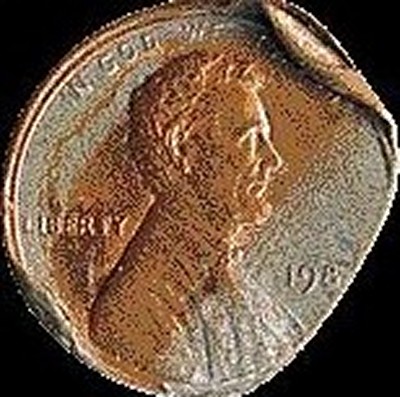
This Lincoln copper-plated zinc cent, struck some time in the 1980s, is an in-collar foldover strike. The planchet, momentarily standing (or spinning) on-edge, was folded in half by the impact of the dies.

Images by Mike Diamond.


Collectors of minting errors occasionally come across terms that have fallen into disuse.

One such moniker is the “folded planchet error.” It has largely been supplanted by the label “foldover strike.” A foldover strike is a coin that is struck on-edge and folded over in the process.

A rather unusual example is shown here in a Lincoln cent struck some time in the 1980s. It’s an in-collar foldover strike. When it was struck, the planchet was standing up in the far northwest quadrant of the striking chamber. The side of the planchet that faced toward the interior of the striking chamber did so.toward the southeast. It was bent perfectly in half by the force of the strike, with the bend also occurring in the southeast direction. The edge of the folded-over flap can be seen just inside the design rim on the obverse face.

Given the precise three-dimensional positioning required to generate an in-collar foldover strike, it’s not surprising that I’ve only come across three examples in my years of collecting.

Less precise terminology

General abandonment of the term “folded planchet error” may be due to its being a less precise term than “foldover strike.” But it’s fortunate in another sense. Coinage dies are not the only machine parts that can fold a planchet in two.

Folding can also occur before the strike. Pre-strike damage that folds over part of a blank or planchet is rare, but it’s important to recognize its existence and the potential for misidentification.

I’ve chosen to illustrate this category of damage with a 1964-D Jefferson 5-cent coin. Part of the planchet was torn up and folded over onto what would ultimately become the obverse face. The flap — free at both ends but connected in the middle — was struck into the planchet.

Its hatchet-shaped outline is marked by a thin fissure. Any struck-in or rolled-in piece of metal will usually be demarcated by a thin fissure.

The coin weighs 4.91 grams —slightly underweight (it should weigh 5 grams) but still within the normal range of variation for this denomination.

5-cent coin not unique

I have no idea what piece of machinery generated this damage, but it’s not unique. I’ve seen at least one other 5-cent coin with the same kind of struck-in flap. Neither of these coins was correctly diagnosed and described. While neither was pegged as a foldover strike (or folded planchet error), they were also not correctly identified as examples of pre-strike damage. Coin dealers and grading services are most likely to identify such errors as “defective planchets,” “straight clips” or “ragged clips.”

Whatever piece of machinery is responsible for this damage, it more often tears off the flap completely. This is what happened to a second 1964-D Jefferson 5-cent coin illustrated here.

It was sold to me years ago as an off-center strike on a straight clip planchet by a prominent error dealer. The ends of the straight margin are beveled on both faces and taper to a sharp edge.

Otherdenominations known

I’ve encountered this more severe type of pre-strike damage on denominations from cent to quarter dollar. The most recent example is a 1999-P Roosevelt dime that can be found on the Combined Organizations of Numismatic Error Collectors of America website (http://coneca
online.org/content/recentfinds.htm).

Based on the evidence provided by the different pre-strike planchet damage coins encountered, evidently, the minting mechanism responsible for this planchet damage has been in use for decades.

Coin World’s Collectors’ Clearinghouse department does not accept coins or other items for examination without prior permission from News Editor William T. Gibbs. Materials sent to Clearinghouse without prior permission will be returned unexamined. Please address all Clearinghouse inquiries tocweditor@coinworld.com or to (800) 673-8311, Ext. 172.


MD-10


New Type II counterclash on 1985 cent only sixth of its type

By Mike Diamond-Special
to Coin World
 |
March 31, 2012 9:57 a.m.

Article
first published in 2012-04-09, Expert Advice section of Coin World


Two
inverted copies of the letter E (from E PLURIBUS) adorn the reverse face of
this 1985 Lincoln cent. They represent a Type II counterclash.

Photo courtesy of BJ Neff.


Among the rarest and most desirable forms of die damage is the Type II counterclash. Such errors occur when a chunk of unusually hard metal is struck twice, with movement between strikes.

The first strike leaves the fragment with a set of raised design elements. The second strike transfers the raised elements on the fragment back to the die face. Usually only the field picks up an impression, as this portion of the die face is most vulnerable to damage. Every coin struck afterward has a set of raised, normally oriented design elements in an unexpected location.

It should be noted that only a remote relationship exists between the two types of counterclash. A Type I counterclash is a form of close, raised doubling that is simply an occasional side effect of multiple, staggered clash marks (see “Collectors’ Clearinghouse,” Dec. 13, 2010).

Until this year, error specialists had identified only five universally recognized Type II counterclash errors among United States coins. They consist of a 1969-S Lincoln cent, two 1983 Lincoln cents, a 2000-P Sacagawea dollar and a 1999-P Delaware quarter dollar (see Clearinghouse, Sept. 29, 2008).

Previously unreported

Recently, veteran die variety researcher Robert (“BJ”) Neff sent me a 1985 Lincoln cent with an unreported Type II counterclash. It was discovered by Joe Koelling, who adds this coin to a long string of previous discoveries.

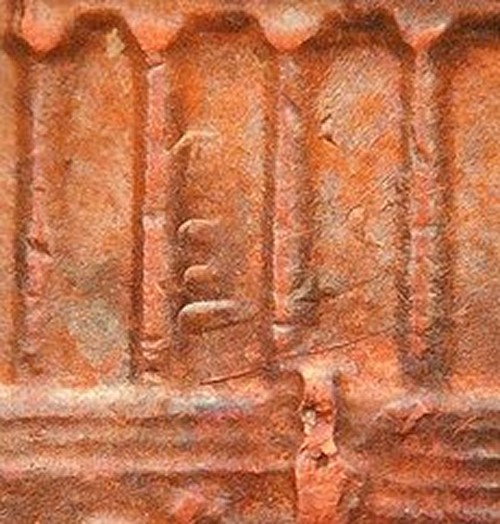
As shown in the accompanying photo, the coin actually shows a double counterclash. The E of E PLURIBUS appears twice on the reverse face within the Lincoln Memorial. Both letters are upside-down, relative to the rest of the reverse design. They sit one above the other within the second bay from the left in the memorial. The lower E is considerably stronger than the one above.

The two letters might represent two successive impressions from a second and third strike (with the fragment shifting position between strikes).

Alternatively, the fragment may have already been double-struck, with the two letters being transferred to the die face during a single subsequent strike.

Interestingly, the area around the normal E PLURIBUS shows no signs of damage, leaving open the possibility that the fragment was struck in a different striking chamber.

Other Type II counterclashes

Several other Type II counterclashes show two sets of raised design elements. It has long been acknowledged that the less dramatic counterclash 1983 Lincoln cent shows the N GO of IN GOD in two rows that are quite close to each other and to the normal motto (see photo). This counterclash is cataloged as CCL(TII)-1c-1983-02 on www.maddieclashes.com.

Few are aware that the other counterclash cent from 1983 also shows two sets of letters. Listed as CCL(TII)-1c-1983-01, this second 1983 Lincoln cent shows the inverted letters IBER above the date. It also shows close doubling of the same letters in the normal version of LIBERTY. Previous authors had generally attributed this doubling to nameless “damage.” But it’s clear to me that this is also a Type II
counterclash.

What evidently happened is that a die fragment broke off the reverse die (the coin shows a “cud” on this face). It bounced over to the left side of the striking chamber where it was struck twice by the obverse die (the reverse die was most likely protected by a planchet). The fragment moved slightly between the first and second strike, producing the first counterclash. The die fragment then bounced over to the right side of the striking chamber where it received a third strike.

That strike transferred the letters from the fragment to the field above the date as the second counterclash.

Confined to one face

Turning back to the 1985 Lincoln cent, we find that the counterclash — and all other related signs of impact damage — are confined to one face. This is true of every other counterclash currently identified. It would seem that in every instance the opposite die was protected from damage by an intervening planchet.

Next to the two E’s, we find erratic die damage in the form of two thin curved lines below the letters and two small bumps in the bay to the right of the one occupied by the letters. The two curved lines may mark the edge of the metal fragment.

Erratic die damage is found in close association with most Type II counterclashes except the 2000-P Sacagawea dollar and 1999-P Delaware quarter dollar.

Coin World’s Collectors’ Clearinghouse department does not accept coins or other items for examination without prior permission from News Editor William T. Gibbs. Materials sent to Clearinghouse without prior permission will be returned unexamined. Please address all Clearinghouse inquiries tocweditor@coinworld.com or to (800)
673-8311, Ext. 172.


http://www.coinworld.com/articles/new-type-ii-counterclash-on-1985-cent-only-si/

Copyright
2012 by Amos Hobby Publishing Inc. Reposted by permission from the March 22,
2012, issue of Coin World.)


2012 04 30

Second cupped, two-tailed Canadian cent surfaces

By Mike Diamond-Special to Coin World | April 14, 2012 9:58 a.m.

Article first published in 2012-04-30, Expert Advice section of Coin World

This deeply cupped 1968 Canadian cent carries the reverse design on each face. It is almost certainly a double-struck pseudo-mule.

Images by Mike Diamond.
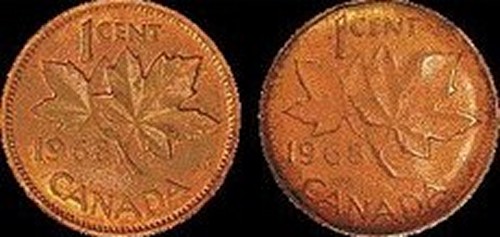
 

In the March 19 Collectors’ Clearinghouse column, I reported on a deeply cupped 1978 Canadian cent allegedly struck by two reverse dies. Considered unique at the time, it now has a companion.

After my column came out, I was contacted by Jeff Chapman who sent me photos of a nearly identical example that was struck in 1968. The presence of this second specimen further undermines the idea that either cent represents a two-tailed mule. Chapman’s cent is almost certainly a pseudo-mule that was produced under one of three scenarios described in my earlier column.

1. A cent is struck normally, flips over, and lands on top of another planchet, with the Maple Leaf design facing the planchet. A second strike flattens the original maple leaf design but does not erase it, while the hammer die obliterates the queen’s bust and simultaneously imparts the second Maple Leaf design.

2. Two planchets are struck together within the collar, creating two in-collar uniface strikes. The top coin flips over and comes to rest on the same blank surface or on top of a fresh planchet. The next strike flattens the original Maple Leaf design, while the original featureless surface is struck by the hammer die, which imparts the second Maple Leaf design.

3. A cent sporting an in-collar first-strike brockage of the Maple Leaf design on its bottom face flips over and comes to rest on the anvil die. Another planchet is inserted on top of the brockaged coin and is struck into it. The bottom face of that newly-struck coin carries a first-strike counterbrockage of the Maple Leaf design.

The second scenario would seem to be the most likely explanation for both the 1968 and 1978 cents.

Interestingly, when the 1968 cent was encapsulated by Professional Coin Grading Service, it was provided with a diagnosis entirely different from the 1978 cent. Instead of claiming it was a “die cap struck by two reverse dies,” PCGS described it as an “obverse die cap with reverse counterbrockage.”

It seems PCGS may have entertained a pseudo-mule hypothesis of its own, similar to the third scenario. It’s hard to say for sure, as the description is rather muddled. Chapman’s coin obviously cannot be an obverse die cap, since it is the reverse design that decorates the inside of the cup. Perhaps PCGS meant to call it a reverse die cap. Maybe the grading service was confused in thinking that the Maple Leaf design is on the obverse face. Or perhaps PCGS conflated the hammer die with the obverse die for the cent.

Identifying it as a die cap is easier to understand, but even this claim can be disputed. Effective striking pressure is greatly increased when two discs are stacked on top of each other. If both discs are struck out-of-collar, the top coin will curl up to surround the neck of the hammer die (see the Dec. 7, 2009, Collectors’ Clearinghouse). Only one strike is needed to form an impressive cup.

While the third scenario requires only one strike, scenarios 1 and 2 require two. But since the coin has to flip over between strikes, we still can’t consider the resulting coin a die cap. By definition, a die cap has to be affixed to the same die face through both strikes.

It seems unlikely that the flattened Maple Leaf design on either cent is a flipover, first-strike counterbrockage. Even under carefully managed conditions, the peripheral portions of any first-strike counterbrockage should be closer to the coin’s edge, and might even run off the edge of the coin.

While I haven’t encountered any cupped pseudo-mules among U.S. coins, I have seen coins that were almost certainly struck by them.

Shown here is a Lincoln cent with a perfectly centered, mid-stage flipover brockage of the obverse design on the obverse face. Struck in-collar, it was generated by a “two-headed” pseudo-mule most likely produced under the first scenario. In this case the pseudo-mule definitely became a die cap.

The next specimen is a massively expanded, broadstruck 5-cent coin with an almost perfectly centered flipover brockage of the obverse design on the obverse face. Although faint, the incuse design is complete, establishing it as a first-strike brockage. The strike that generated the brockage also undoubtedly converted the overlying 5-cent coin into a two-headed pseudo-mule (scenario No. 1).

Coin World’s Collectors’ Clearinghouse department does not accept coins or other items for examination without prior permission from News Editor William T. Gibbs. Materials sent to Clearinghouse without prior permission will be returned unexamined. Please address all Clearinghouse inquiries to cweditor@coinworld.com or to 800-673-8311, Ext. 172.

http://www.coinworld.com/articles/second-cupped-two-tailed-canadian-cent-surfac/

Copyright 2012 by Amos Hobby Publishing Inc. Reposted by permission from the March 22, 2012, issue of Coin World.)


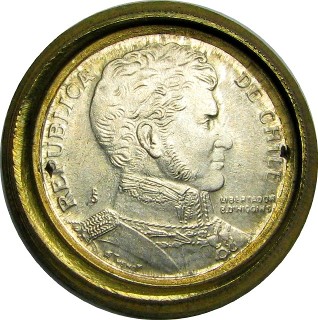
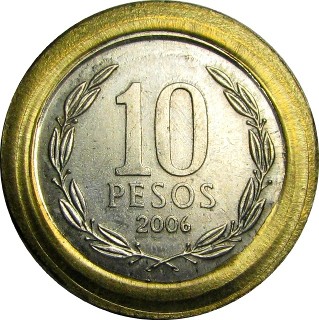
2006 Chilean 10 Pesos Struck On 100 Pesos Bi-metallic planchet

Part V: Planchet Errors:

Wrong planchet and off-metal errors: 

Struck on larger planchet or coin, 2006 Chilean 10

pesos struck on a 100 pesos bi-metallic planchet

A 100 pesos planchet is larger (25 mm) than a 10 pesos planchet (21 mm). This bi-metallic planchet was struck by solid denomination dies. Undoubtedly, it was intentionally made.
1883 Liberty Head Nickel With And Without The Word “cents”

PART I. Die Subtypes:

Mid-year Design Modifications:

1883 Liberty Head Nickel; with and without the word

“CENTS”

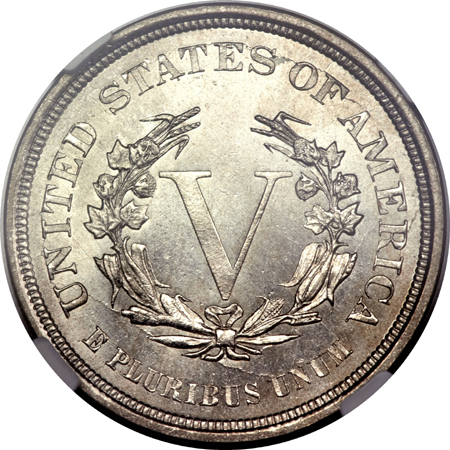
Definition: After 17 years, the Shield nickel (1866 to 1883) was changed to the Liberty Head type nickel design by Charles Barber. The design for the new nickel can be seen below in the first set of images.  This new nickel was released to the public on February 1st, 1883.

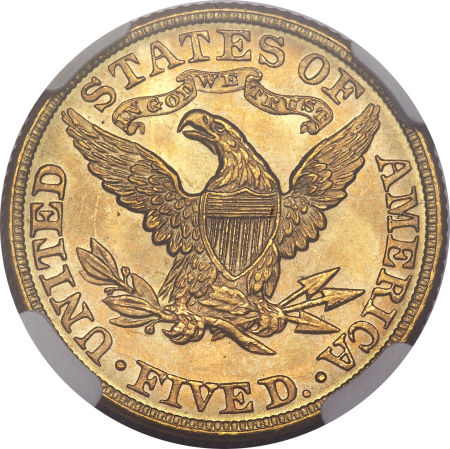
Almost immediately a problem arose with the new design. The omission of the word “CENTS” on the reverse led some unscrupulous persons to add reeding to the coin and then plate the coin in gold. It was then passed off to the unwary as a $5.00 gold piece, which had a similar diameter (21.6 mm) to that of the nickel (21.2 mm).

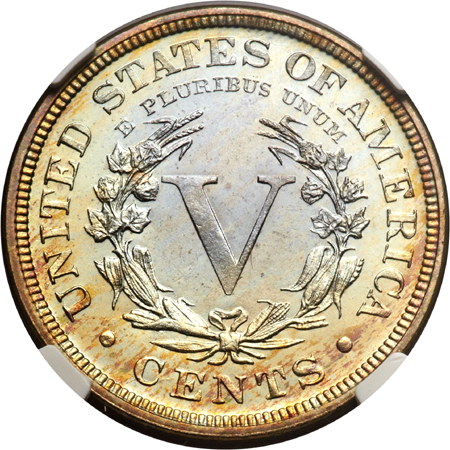
These altered nickels became known as “Racketeer” nickels.  Whether Barber intentionally omitted the word cents (following the design of the nickel three cent piece which was still in production in 1883) or simply forgot to add that word to the reverse design is unknown. However, the production of the new nickel was halted and Barber re-designed the reverse, this time including the word cents.

After a short delay in production, the Liberty Head nickel was again re-introduced to the public on June 26th, 1883. This design change caused the 1883 Liberty Head nickel without the word cents to be hoarded by the public, which thought that the government might recall that particular coin.
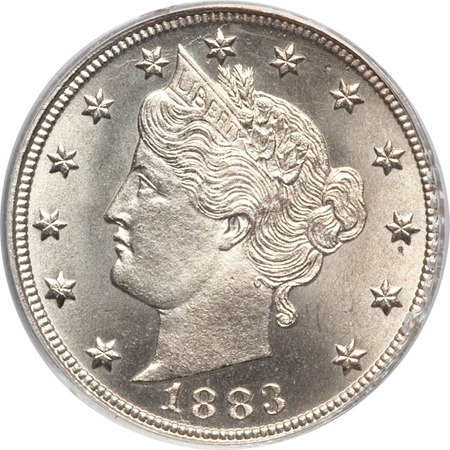
The change of design can be seen as an addition of the word CENTS below the bow, the Roman numeral V becoming smaller and the motto E PLURIBUS UNUM being relocated to an area above the wreath.
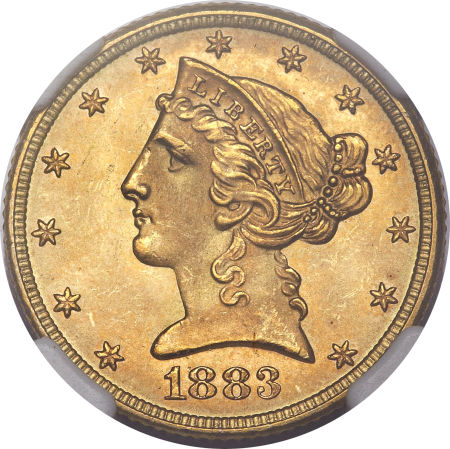
 

There seems to be little similarity between the designs of the Liberty Head nickel and the 5 dollar gold piece (the latter shown above). However, as mentioned before, the critical similarity may have been the similar diameters.

*** CAUTION ***

True “Racketeers” nickels are in high demand. These coins should be of high grade and always reeded. Beware of reproductions of the “Racketeer” nickel, which are normally found in low to very low grades and with smooth edges (not reeded).
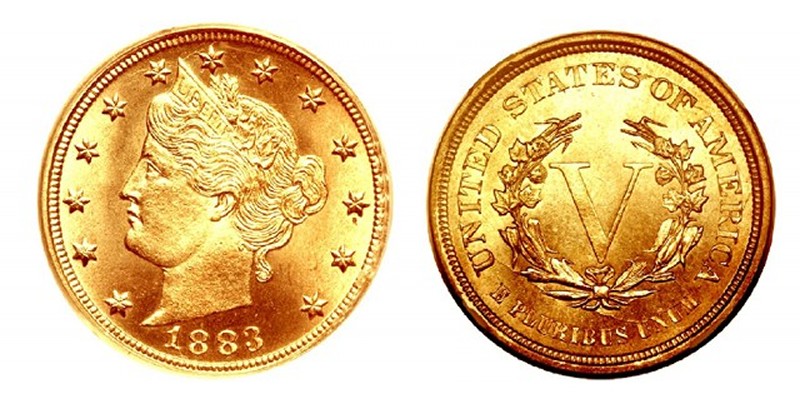
The above image shows a “Racketeers” nickel.

Images are courtesy of Heritage Auctions.

Straight Clips

Part V. Planchet Errors:

Blanking and Cutting Errors:

Straight clips

Definition: A straight clip is thought to result when a blanking die (punch) slices through the leading or trailing end of the coin metal strip.  This pre-supposes that the ends were trimmed prior to the coil being fed into the blanking press.

Another possibility is the blanking die slicing through one side of a strip that is too narrow.  This situation might arise if the splitter, which divides the original wide strip into narrower slips, is not positioned right in the middle of the coil.

A small percentage of straight clips mark the termination of a planchet taper.  This may be where the rollers squeezed the leading or trailing end of the strip down to an abnormally thin gauge.

The edge texture of a straight clip is highly variable.  It can be smooth, rough, irregular, or serrated in some fashion.  This probably reflects a variety of machines employed for the task — shears, saws, guillotines are three possibilities.

A straight clip appears on a coin as a straight edge.  Not all straight edges are straight clips, however.  They are sometimes confused with chain strikes, broken planchet and broken coin errors, and various forms of pre-strike damage.  When a straight-clipped planchet is struck out of collar, the straight edge often bows out due to the pressure of the strike and attendant expansion of the coin.  These secondarily convex straight clips have been mistaken for elliptical clips.

For expanded treatment concerning clip diagnostics click here.


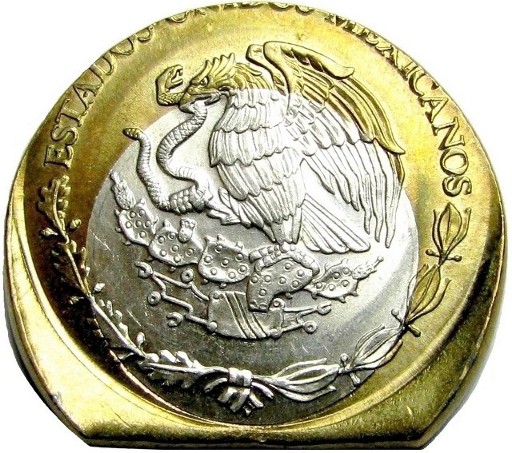
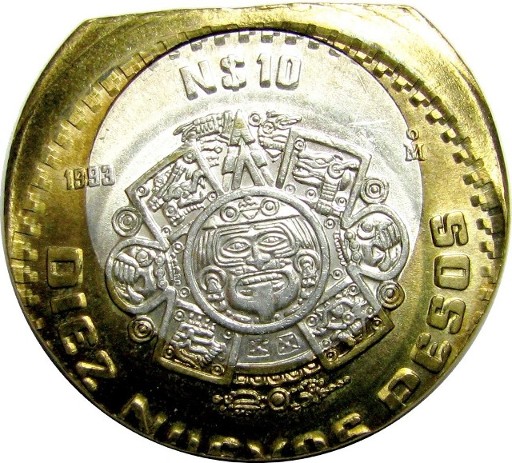
Depicted below is a 10 nuevos pesos Mexican bi-metallic with an extremely rare straight clip of the outer ring. This coin has also been struck off-center. 


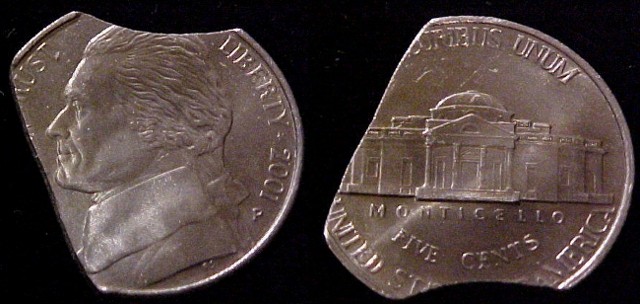
Below is a 2001-P Jefferson nickel with a combination curve and straight clip.
Image courtesy Ynes Zavala


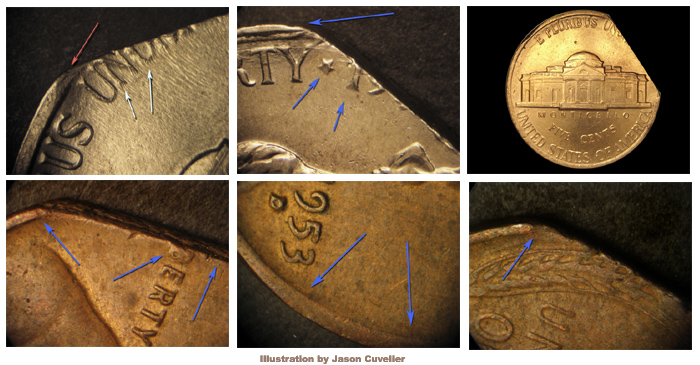
The below sequence of images illustrate metal flow and the taper and fadeout of the design rim. This is what we would expect to see when dealing with authentic straight clips. Top images include both faces of a Jefferson nickel and Lincoln wheat ear cent.
Illustration courtesy of Jason Cuvelier


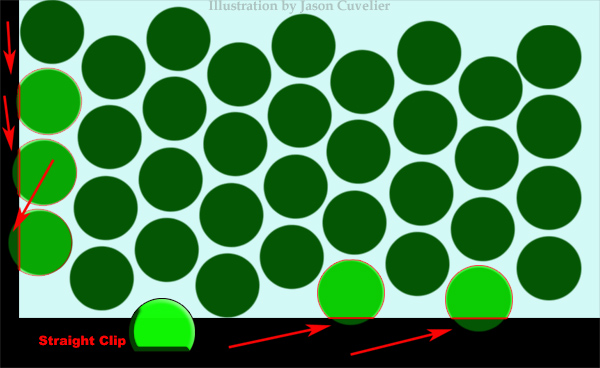
The illustration below shows the overlapping punches on the coin
metal strip and what hypothetically could happen if the punches (red
arrows) went over the leading or back edge of the metal strip; if the
strip was not cut straight; if the strip was
too narrow; or if the strip was somehow fed into the blanking press at
an angle. All would result in some configuration of a straight clip as
shown in green

Illustration courtesy of Jason Cuvelier


Ragged Clips

Part V. Planchet Errors:

Blanking and Cutting Errors:

Ragged clips

Definition: A coin with a ragged clip has its circular outline interrupted by a very irregular edge.  Ragged clips are traditionally thought to be derived from the unfinished leading or trailing end of the coin metal strip.  While these ends are supposed to be trimmed, this step can be accidentally (or intentionally) skipped.

While ragged clips are sometimes referred to as “end of sheet” or “end of strip” clips, this same area is also a likely source for straight clips (see Straight Clip).  Therefore the term “ragged clip” is preferred.

Ragged clips can also be derived from the middle of the strip.  As the strip is rolled out, ragged fissures sometimes develop.  If a blanking die slices through such a fissure, the resulting blank will have a ragged clip indistinguishable from one derived from the ends of the strip.

The shape of a ragged clip is highly variable.  Many are straight, some form “ragged notches” and some turn into “ragged fissures”.

The edge texture of a ragged clip is invariably rough and shows some graininess.

Ragged clips are sometimes confused with broken coin and broken planchet errors.

For expanded treatment concerning clip diagnostics click here.

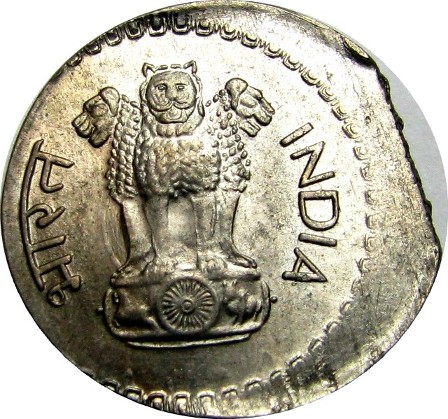
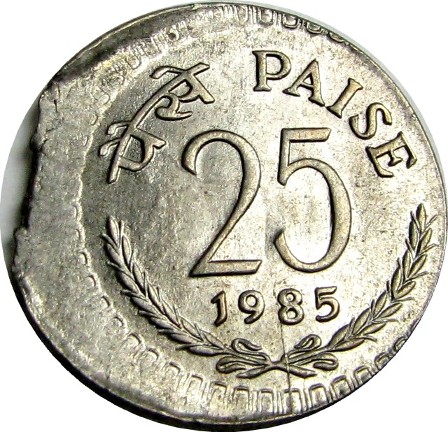
The three images below are a 1985 Indian 25 paise struck off-center with a ragged clip planchet. The lower image is an oblique angle of the grainy edge of the ragged clip.
 

  • « Previous Page
  • 1
  • …
  • 19
  • 20
  • 21
  • Home
  • Introduction To This Website
  • Error-ref.com News
  • Comprehensive Error-Variety Checklist
  • Index Of Completed Entries
  • Part I. Die Subtypes:
  • Part II. Die Varieties:
  • Part III. Die Installation Errors:
  • Part IV. Die Errors:
  • Part V. Planchet Errors:
  • Part VI. Striking Errors:
  • Part VII. Post-Strike Mint Modifications:
  • Part VIII. Post-Strike Striking Chamber Mishaps:
  • Part IX. Post-Strike Mint Damage:
  • Part X. Wastebasket / Composite Categories:
  • Part XI. Non Errors:
  • Featured Articles Of Interested
  • Interest & Not So Interesting Facts
  • Other Sites And Forums Of Interest
  • Our Thanks Go To
  • About The Authors
  • Contact Us

Copyright © 2026