Error-Ref.com

You are here: Home / Search for "off center"

Search Results for: off center

Asymmetrical Split Die

PART IV. Die Errors:

Split Dies:

Asymmetrical split die

Definition: A split die develops when a rim-to-rim die crack extends deep into the die neck and die shank (shaft). The width of the split is proportional to its depth of penetration. Split dies usually divide the die face into two sub-equal parts. These may be termed “median”, “bisecting”, or “symmetrical” split dies. When the split is off to one side, we call it an asymmetrical split die. The path can be straight, curved, or irregular.

An asymmetrical split die shows only lateral spread. This allows collectors to discriminate this error from retained cuds. While the latter may show lateral spread, they also exhibit vertical displacement and/or horizontal offset (see retained cud).

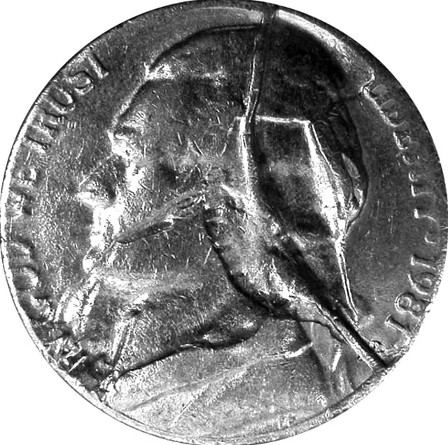
Below is an asymmetrical split die on the obverse of a 1981 (P or D) nickel. The surface appears irregular and fuzzy because it also has a multi-level strike-through error, evidently produced by some thin, folded metal. That metal was probably derived from a torn and crumpled die cap. Split die errors often co-occur with capped die strikes.
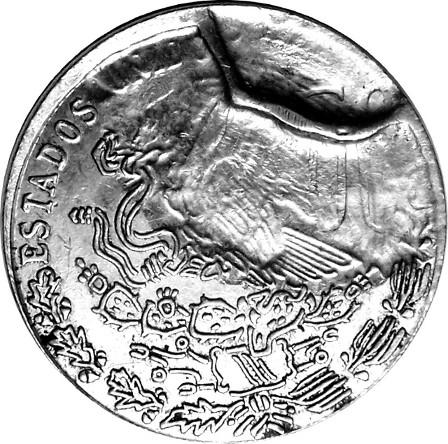
 

Below is an asymmetrical split die on the obverse of a 1978 Mexican 20 centavos.

About The Authors

Senior Editor – Mike Diamond

43510070

Mike Diamond has been collecting, researching, and writing about error coins since 1997. He currently writes the thrice-monthly column “Collector’s Clearinghouse” for the national coin weekly Coin World. He usually has at least one article in every issue of Errorscope, the bi-monthly magazine of CONECA, the Combined Organizations of Numismatic Error Collectors of America. Mike served as President of CONECA for two full terms and was a board member for several cycles previous to his election as President.  He is one of two error examiners for the club.

Mike has discovered, defined, or refined the understanding of countless error types of the years, including design ablation errors, stutter strikes, invisible strikes, ejection impact doubling, stiff collar errors, “greasy ghosts”, atypical chain strikes, external chain strikes, rim-restricted design duplication, die subsidence errors, and surface film effects.

Mike was instrumental in developing maddieclashes.com, a site dedicated to the world of unusual die clashes and also is a co-author on traildies.com.

Contributing Editor – BJ Neff

picture for FUN

Robert (BJ) Neff became interested in numismatics after retiring with honors from the U.S. Navy Submarine Force in October of 1982. He spent 21 years of service on 4 different submarines in both the Atlantic and Pacific Oceans. BJ Neff retired from the service in Hawaii, while stationed at NSTCP, teaching anti-submarine warfare.

At first, the main focus of his interest in this hobby was with the United States Lincoln and Indian head cents. However, in 2003, after discovering his first accredited variety Lincoln cent, he became enamored with error and variety coins. Since that time, most of his efforts have been devoted to that sector of numismatics.

While serving in the U.S. Navy, he became a qualified instructor and he has taken this learned skill to conduct presentations on various coin topics for the F.U.N. conventions, the Central Florida Coin Club and other local coin clubs. He has also written numerous articles for FUN Topics, The HUB (NCADD’s bi-monthly publication) and Errorscope (CONECA’s bi-monthly publication). His article in the 2009 summer FUN Topics, “Something New from China?” was presented the “Charles B. Fine” award for best article of that year.

BJ Neff is presently an active member of ANA, Central Florida Coin Club, CONECA, Florida United Numismatists, Fly-In-Club and the Numismatic Literary Guild. He is also a variety coin attributer for Coppercoins.com. Jeanie Neff (his wife) and BJ Neff were presented the Dr. Lyndon King award from CONECA for the most outstanding club member(s) of that organization for the year 2008.

A few years ago, BJ Neff began a new endeavor and developed a numismatic web site called traildies.com. This site is dedicated to a die anomaly found on both United States and Foreign coinage called trails / wavy steps. In mid 2010, BJ Neff and Mike Diamond designed another numismatic web site named maddieclashes.com. This site provides the numismatists with information concerning the many different and varied die clashes that are found not only on U. S. coins, but foreign coins as well. Both maddieclashes.com and traildies.com are free information sites.

Contributing Editor – Jason Cuvelier

50192117

Jason Cuvelier is an artist who was born in Colorado in 1973. At the age of 10 he became interested in type collecting U.S. coins from pocket change and was encouraged by his grandfather, a lifelong collector of coins himself. Always a collector of about everything, from comic books to action figures and stamps, numismatic varieties won out and became his primary interest. In the last few years Jason has been able to combine his expertise with photography and Photoshop to document hundreds of different varieties and errors. He is currently on the CONECA Bod (Secretary) and a moderator at The lincolncentresource.net. Jason currently is an artist educator at a high school in Chappaqua, NY. He received a BFA from the Maryland Institute College of Art in 1995, an MFA from Yale University in 1998. Jason taught drawing and painting as a Lecturer at Yale from 1999-2001, worked at Christie’s Auction House in New York from 2001-2007. Jason currently attributes for maddieclashes.com and traildies.com, as well as cataloging coins with Lathe Lines listed on errorvariety.com.

Contributing Editor – Jeff Ylitalo

48824795

Jeff Ylitalo has collected error & variety coins since 1993. He has avidly researched & written about this area of numismatics since 2006. Jeff is the editor for the Erroscope, CONECA’s bi-monthly magazine since 2008. A highly decorated combat veteran, Jeff enlisted in the US Army in 1979 ending his 32 year professional soldiering career as an aviation expert in 2011. Jeff’s numismatic interests & inquisitiveness eventually led him down a path which converged with like minded individuals whose ambition & established notoriety in the hobby includes the authors listed above.

Senior Consulting Editor – Fred Weinberg

48834337

Fred Weinberg is the President of the Pacific Rim Numismatics (DBA Fred Weinberg & Co.) with offices in Encino, California (Los Angles). The firm offers numismatic coin and trading expertise in the areas of United States Rare Gold & Silver coinage, as well as specializing in buying and selling Major Mint Error coinage of all types. The company is an active force in the wholesale market, trading with dealers, banks and investors internationally. He is one of the original 31 firms selected as an authorized PSGS dealer in 1986

Fred Weinberg is a highly respected numismatist, with 33 years of full time experience in the rare coin market. He has provided the numismatic expertise to the Federal Deposit Insurance Corporation (FDIC), Federal Trade Commission (FTC), many U. S. and European banks and insurance companies. He has also been called on by the U. S. Secret Service for his help in determining the authenticity of gold coins and has made hundreds of trips to Europe in the last 25 years, purchasing over $500 million in U. S. gold coins from European banks, dealers and estates alone. He has also worked on cases for the Los Angles District Attorney’s Office and many other law enforcement agencies throughout the country.

Additionally, in 1973 he was the only professional coin dealer selected by the U. S. General Services Administration (GSA) to examine and identify the many varieties represented among the 2.5 million Carson City silver dollars held at the U. S. Bullion Depository, at West Point, New York. He has also made special “floor tours” of the Philadelphia Mint to study ongoing changes in the Minting Process.

He is a contributor to the “Red Book” (Guide Book of United States Coins) and has been featured on CNN, Discovery Channel and many local TV news programs in cities across the United States. He is the co-author of “The Error Coin Encyclopedia – 3rd Edition” published in 2000 and the “The Error Coin Encyclopedia – 4th Edition” published in 2004. He has contributed to numerous numismatic books and rare coin articles, including research on the Minting Process and Major Mint Error coins.

His interest in Mint Error coins and currency goes back to the early 1960’s. He has a reputation worldwide for being a strong buyer of Major Error coins and maintains an inventory of almost 100,000 pieces. Mr. Weinberg is an in-demand speaker on the topics of Numismatic Errors, the Minting Process and the Coin Industry. He is the authenticator for all Major Mint Error Coins for the Professional Coin Grading Service (PCGS) Mint Error encapsulation program.

An avid coin collector since the age of 12, he understands the interest of both collector and investor. His professional associations include the American Numismatic Association (ANA) (36 years), The Professional Numismatist Guild (PNG) (29 years), The Industry Council for Tangible Assets (ICTA) (19 years) and the Numismatic Literary Guild. He is past President of the Professional Numismatist Guild (1999-2001).

Consulting Editor – Jon Sullivan

50192147

Jon Sullivan became interested in coins when I attended a Civil War relic show which was also being held in conjunction with a coin show. I wandered into the coin show and was intrigued and fascinated by all the coin designs as well as how old they where! I bought several coins and a few weeks later bought a coin price guide and some coin albums and began collecting coins in earnest. A year or two later, I received a book entitled “U.S. Coin Variety and Oddity Guide” by Spadone. The book introduced me to the anomalies which can occur on coins, and I began searching rolls for mistakes, as well as collecting errors and varieties. Later, when I was 13, I decided I wanted to be a coin dealer, and a year or two later, I decided to become an error coin dealer. I currently deal in error coins part-time, and also collect error coins as well as U.S. Type coins. In a few years I will be a full-time error coin dealer.

I live in Tennessee near Nashville, and travel much of year due to my job, which is working as a PDR (paintless dent repair) technician. I fix vehicles which were damaged by hail storms, but due to the small number of hail storms, I have to travel wherever the work is in the U.S. Some of my non-numismatic interests include mountain biking, history, my church, fishing, and business.

Consultant Editor & Web Master – Peter Lukic

Peter 

Peter Lukic is an accomplished art director, designer and photographer specializing in print, web and marketing. Based in Northern New Jersey, he has a broad client base and has worked on projects ranging from national magazine accounts to museum installations and catalogs. He is currently the art director of the Garden State Film Festival in Atlantic City, NJ and is working on a variety of marketing and identity projects for his other clients.

Peter is a co-owner of the Lincoln Cent Resource and specializes in collecting Lincoln varieties and errors. Through his work with BJ Neff, he has helped to do outreach and expand the hobby to a younger generation of potential hobbyists.

Contributing Editor – JC Stevens

J.C. Stevens is a retired information technology specialist who lives in Colorado. He studied at the University of Colorado at Colorado Springs. He worked for Cray Research, Cray Computer & MCI. He is currently a general partner in a number of restaurants on the Western Slope of Colorado.

JC started collecting the Lincoln Cent in the 1950’s. He became interested in error and variety coins in the late 1990’s.

JC is presently an active member of ANA, CONECA, CSCC & CSNS.

Contributing Editor – Will Brooks

Will Brooks is a water treatment specialist working primarily in the Amish dairy industry in beautiful Lancaster County, PA. He studied mathematics and philosophy at the University of Pittsburgh and Millersville University. He is the president of the central Pennsylvania chapter of Mensa, and is also a member of the International Society for Philosophical Enquiry. His collecting interests are focused on U.S. cent varieties. He is also an editor and does attributions for traildies.com, and you can often find him at  lincolncentforum.com answering questions. He also enjoys swimming, writing, and all things Frisbee.

Editor – Shane Daniel

Shane Daniel has been collecting coins since his early teen years and became more serious about the hobby roughly half a decade ago. His particular focus is on minor errors and varieties found in circulation and through coin roll hunting. He is addicted to the thrill of the hunt and the frugality of finding rare numismatic treasures at face value.

Specific interests include design subtypes, die errors (e.g., cuds, BIEs, clashes, cracks, dents), die varieties (e.g., RPMs, OMMs, and mintmark styles), rotated dies, and the various types of doubling. He enjoys skimming through old and new catalogs containing such anomalies and has contributed to the hobby with numerous personal discoveries.

Shane values education and has been blessed with several high-quality mentors through the years. He enjoys collaborating with other coin enthusiasts to create mini-research papers, synopses, and detailed graphics.

You can find Shane on Facebook groups (some of which he helps manage) and occasionally online forums, answering coin questions and providing error-variety knowledge.

Abnormal Upset

Part V: Planchet Errors:

Upset Mill Errors:

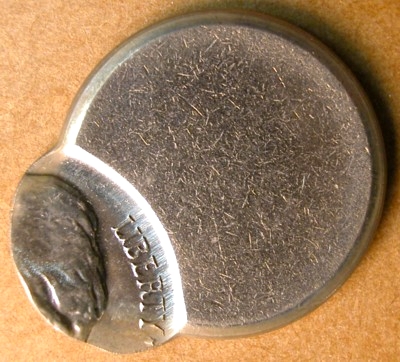
Abnormal Upset

Definition: This anomaly is visible only on unstruck planchets and off-center strikes. Affected planchets carry a pattern of upset that is distinctly different from other planchetsof the same denomination and time period.

Possible causes for abnormal upset are:

1. A worn or damaged groove in the upset mill.

2. Improperly machined grooves

3. Use of upsetting equipment intended for a different

denomination (domestic or foreign)

4. Use of upsetting equipment with grooves of an experimental nature

5. Circumferential pre-strike damage that resembles the effects of upsetting

The appearance of abnormal upset is highly variable and suggests many different causes.

Note: Several Examples are shown below.

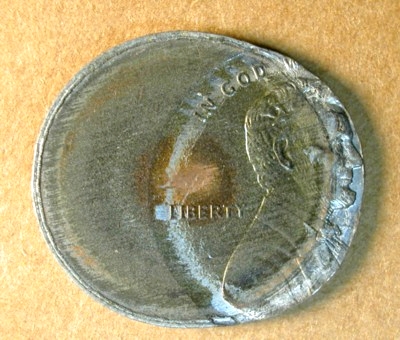
Depicted below is an undated, off-center nickel showing an unusually prominent proto-rim, a very wide bevel, and a thin, flattened center strip along the edge. Nickel planchets generally show a very low proto-rim, a very short bevel (or one that is entirely absent), and a broad, flat edge.


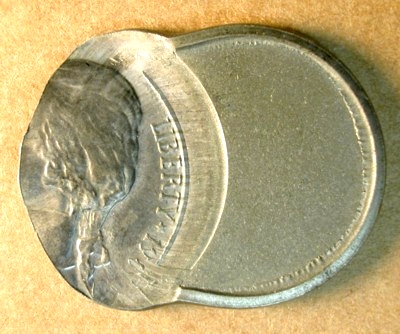
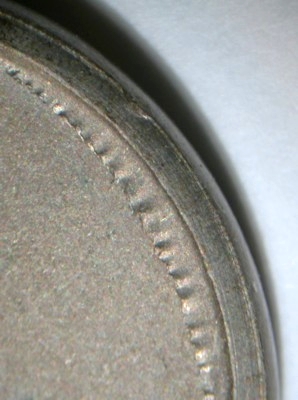
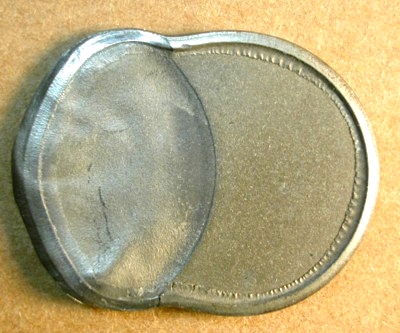
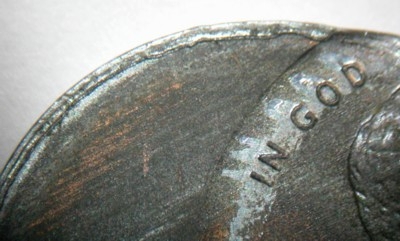
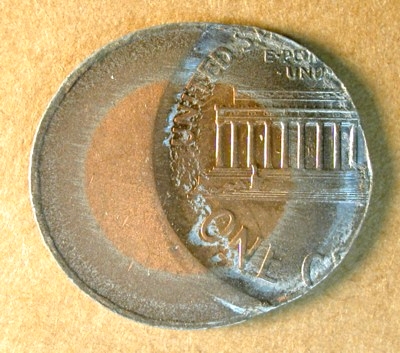
The three images below depict an undated, off-center nickel that may not even have been struck on a nickel planchet. The leaden gray color, matte interior texture, and complete absence of tumbling marks suggests an unexpected origin and an unorthodox entry into the production stream. In any case, the pattern of upset (if that’s what it is) is bizzare. The proto-rim is broad and tall and has a sharp internal margin. A thin, pleated apron extends in from the internal margin of the proto-rim and rests lightly on the planchet’s surface. The upper/outer surface of the proto-rim shows a broad slope that almost looks machined. The edge is smooth and strongly convex.

The pleated apron suggests that this is a form of circumferential pre-strike damage, and not any intended style of upset.


This undated, zinc cent depicted below has a light dusting of copper plating distributed in a bulls-eye fashion. The pattern of upset is wholly unlike a normal cent. The proto-rim is narrow, moderately tall, and sharply defined. There is no bevel. The edge is flat and vertical. A normal cent planchet shows a reasonably distinct, but blunt proto-rim with a beveled rim/edge junction.

MD-6

Retained cud diagnostics sometimes leave room for

doubt

By Mike Diamond – Special to Coin World | Jan. 10, 2011 9:00 a.m.Article first published in 2011-01-24, Expert Advice section of Coin World


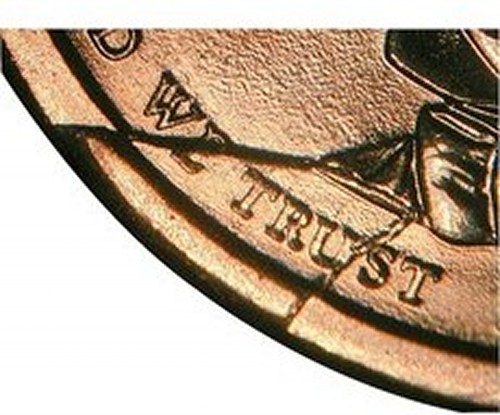
Close-up image depicts the obverse face of a 2010 Millard Fillmore dollar with a retained cud at 7:00.

Mike Diamond

Dies are subject to brittle fracture, and this occasionally leads to a piece of a die face breaking off. The general term for such errors is “die break.”

The corner of the die (where die face meets die neck) is particularly vulnerable to breakage. A die break that carries off the rim gutter and at least a little bit of the adjacent field is called a “cud.” Coin metal flows into the resulting void, leaving a lump on the coin’s surface that is also called a cud.

Occasionally, a loose fragment that breaks off the corner of a die does not fall away but is instead held in place. It is then termed a “retained cud.” In the case of the anvil die, the die fragment is held in place by the collar. In the case of the hammer die, the die fragment is held in place by the bolts or clamp that secures the die shaft. Retained cuds of the hammer die are quite rare.

Despite the frequency with which retained cuds occur, misidentification is frequent both in and out of “slabs” (grading service capsules).

In order to diagnose a retained cud, there must be clear evidence of movement. The two key diagnostics to look for are vertical displacement and horizontal offset.

Vertical displacement is more commonly encountered. A retained die fragment will usually sink below the level of the intact portion of the die face. This leaves a “step” on the surface of the coin at the site of the break. The portion of the coin struck by the retained die fragment is consequently elevated above the rest of the coin.

The illustrated 2010 Millard Fillmore dollar shows a retained cud in which the letters e tru (of we trust) sit on a low plateau. Vertical displacement is evident all around the break. It is one of two examples struck by the same broken die sent to me by Fred Weinberg. Remarkably, each example also lacks an edge inscription — a completely unrelated error since the edge device is applied after the coin is struck.

More severe vertical displacement is seen on a retained cud that bisects the obverse face of a 2001-P Roosevelt dime illustrated here. The left side of the break also shows the second diagnostic — horizontal offset. Contiguous portions of the design are out of register with each other, documenting sliding movement on the part of the loose die fragment.

The reverse face of a 1985 Lincoln cent shows a large cud in the southeast quadrant and an arcing, rim-to-rim die crack in the northwest quadrant. Also called a “pre-cud” die crack, it shows neither vertical displacement nor horizontal offset. It simply shows lateral spread. The tenuously connected portion of the die splayed outward, producing a wide crack into which coin metal flowed. This left a jagged raised line on the coin. When the crack is even wider, it is designated an asymmetrical split die.

Arcing rim-to-rim die cracks and asymmetrical split dies are often mistaken for retained cuds.

When horizontal offset or vertical displacement is present and involves the entire margin of the break, the long-standing assumption has been that the die fragment was fully detached. But this conclusion may not always be correct, especially when the signs of movement are modest. Die steel is subject to bending, compression and distortion. This can produce some degree of vertical displacement or horizontal offset even when the die is still in one piece.

Vertical displacement within an intact die can be seen on the illustrated 2007-P Roosevelt dime. It shows a long, curved bilevel die crack on the face struck by the obverse (anvil) die. A later die stage has the same crack connecting with the rim at 6:30 to form what we would ordinarily diagnose as a retained cud. But is it really?

At least seven 2007-P Roosevelt dimes with presumed retained cuds of the obverse (anvil) die are known. Are all of them fully detached? I have my doubts.

Since we can’t directly observe the condition of the die that strikes any coin with a presumed retained cud, we must admit to an element of uncertainty in all but the most severe cases.


Coin World’s Collectors’ Clearinghouse department does not accept coins or other items for examination without prior permission from News Editor William T. Gibbs. Materials sent to Clearinghouse without prior permission will be returned unexamined. Please address all Clearinghouse inquiries to cweditor@coinworld.com or to (800) 673-8311, Ext. 172.


http://www.coinworld.com/articles/retained-cud-diagnostics-sometimes-leave-room/

Copyright 2012 by Amos Hobby Publishing Inc. Reposted by permission from the March 22, 2012, issue of Coin World.)

MD-7

Crescentic plateau emerges from Proof polishing

mishap

By Mike Diamond | Jan. 31, 2011 9:00 a.m. 

Article first published in 2011-02-14, Expert Advice section of Coin World

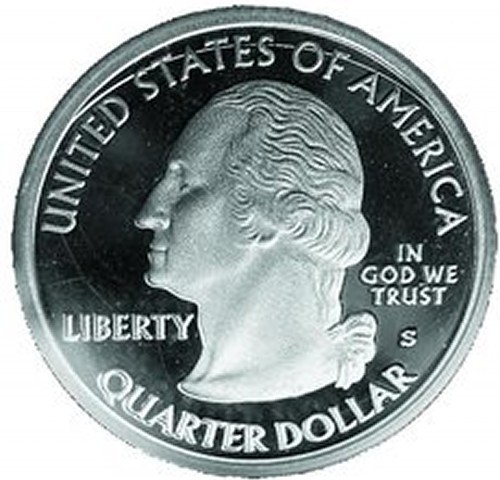
Obverse face of a 2009-S Northern Mariana Islands quarter dollar exhibits a raised crescent at its northern pole. It appears to represent a mishap during polishing of the field after the frosted texture was applied to the design.

When Clair Alan Hardesty received his 2009-S Proof set, he immediately saw that something was wrong with his Northern Mariana Islands quarter dollar. A thin, bright line could be seen arcing across the obverse face, cutting through the legend united states of america. The end-points of the line coincided with the inner margin of the design rim and extended from a point above the t of united to the e of america.

Recognizing it as a probable die error, Hardesty sent the coin to PCGS under their Mint error service. The response was disappointing and confusing. A customer service representative informed Hardesty that the grader had determined that “this is not an error coin. They are as struck.” Hardesty insisted that they look again, and the second response was similar, “The coin was re-evaluated for the error a second time. The information you provided was taken into account. Unfortunately the graders did not feel it was an error.”

Undeterred by the failure of PCGS to recognize a grossly obvious flaw, Hardesty sent the coin tome for analysis. Upon receiving the coin I immediately agreed that this is a significant die error. We next had to determine what kind of die error we were dealing with.

The bright arc is actually a sharply defined step. The crescentic area demarcated by the step is raised above the rest of the field. This indicates that the corresponding field portion of the die was recessed. The field has a mirror-like Proof finish above and below the step. However, faint radial ripples distort the surface of the abnormally polished crescent.

How was recess formed?

The question now turned to how this recess formed. A die dent seemed unlikely as this would have probably dulled the finish. A major clue as to what transpired can be found in the letters that cross the step. Above the step the letters are narrowed or constricted. This is most evident in the letters sta of states and the word of. Thinning of design elements is caused by only one thing — mechanical removal of the field surrounding each design element. As the field is lowered on the die face, the letters get narrower. This is because the sides of each letter converge as you go deeper into the die face.

The available evidence indicates that the step and recessed crescent were caused by a mishap in polishing the die face to a mirror-like finish. Die polishing is the exclusive province of Proof dies and dies that strike collector issues, like the coins in the Special Mint sets issued from 1965 to 1967. The intent is to create a highly reflective surface on the die and on the coins it strikes. If taken too far, this process can cause thinning of design elements and loss of details in the lowest parts of the design.

Die polishing of this sort should not be confused with intentional die abrasion designed to remove clash marks and other forms of die damage. Primarily applied to circulation-strike dies, such salvage attempts typically leave lots of die scratches and certainly don’t produce a mirror-like finish. The term “die polishing” is still sometimes used to refer to such salvage efforts, causing interminable confusion among collectors.

Alternative scenario unlikely

Hardesty proposed a slightly more complex scenario to explain this unusual error. He suggests that a strongly misaligned obverse (hammer) die collided with the top of the collar and that this collision left the step and the recess. He then suggests that Mint workers tried to salvage the die by polishing the damaged area.

A scenario involving collar clash and a subsequent repair job seems unlikely to me. It makes no sense to a repair such a heavily damaged die. There are no recorded cases of collar clash this offset and this severe among circulation strikes. A die dent generated by such a collar clash is unlikely to produce such a sharp step. Finally, the outer margin of the obverse die face retained its convexity (leaving a bowl-shaped perimeter on the coin). A collision as severe as Hardesty proposes should have flattened out that convexity.

Since die errors are repetitive, it is possible that more of these 2009-S Northern Mariana Islands quarter dollars remain to be found.

Coin World’s Collectors’ Clearinghouse department does not accept coins or other items for examination without prior permission from News Editor William T. Gibbs. Materials sent to Clearinghouse without prior permission will be returned unexamined. Please address all Clearinghouse inquiries to cweditor@coinworld.com or to (800) 673-8311, Ext. 172.

http://www.coinworld.com/articles/crescentic-plateau-emerges-from-proof-polishi/

Copyright 2012 by Amos Hobby Publishing Inc. Reposted by permission from the March 22, 2012, issue of Coin World.)

MD-2


Centralized, bifacial design weakness can have many causes

By Mike Diamond | April 02, 2011 10:00 a.m.

Article first published in 2011-04-11, Expert Advice section of Coin World


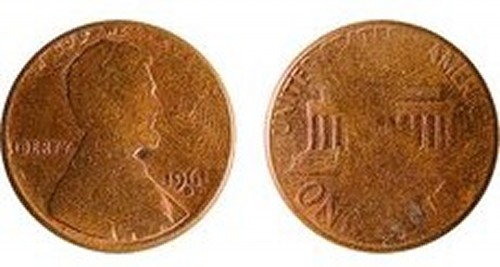
A weakly-struck 1961-D Lincoln cent displays a smooth bust of Lincoln on the obverse and an incuse ghost of Lincoln on the reverse. Its weight is normal.


Images courtesy of Mike Diamond.


Some months back (Dec. 20 issue), I devoted a Collectors’ Clearinghouse column to an assortment of errors that share the same end result — weakness and loss of design elements at one pole and on both faces. This week’s column focuses on a somewhat different assortment of errors that produce weakness and loss of centrally located design elements on both faces.


For a planchet of normal size, weight, thickness and density, the most common cause of centralized weakness is a weak (low-pressure) strike. The illustrated 1961-D Lincoln cent is a typical example.

Lincoln’s bust is devoid of details. On the opposite face, a vague, incuse ghost of Lincoln was formed when coin metal bulged upward toward the recess in the obverse die and away from the reverse die. There simply wasn’t sufficient tonnage applied to the planchet to redistribute the amount of metal necessary to fill all the recesses of both dies. Persistence of the original proto-rim of the unstruck planchet provides additional evidence of abnormally low striking pressure.

A planchet punched out of rolled-thin stock will often end up looking like this 1961-D Lincoln cent. Overall effective striking pressure is reduced because the planchet is closer to the minimum die clearance and because the force delivered by the press “knuckle joint” tails off as the latter approaches maximum extension. Of course, any coins struck on thin planchets will be underweight.

Centralized weakness in conjunction with a well-formed design rim points to an entirely different scenario. This combination of features is seen in a 1983-P Jefferson 5-cent coin found by 15-year-old Alex Ness while roll-searching. The side of Jefferson’s face looks scooped-out and lacks all detail. On the reverse, the portico of Monticello is nearly smooth.

In this case, I suspect striking pressure was normal but that the planchet was too hard.

If a planchet is not sufficiently annealed prior to the strike, it resists plastic deformation.

I have seen photos of one other 1983-P Jefferson 5-cent coin with well-formed design rims and with the centralized weakness even more exaggerated. It was evidently struck by a different die pair since the Mint mark is slightly tilted. Finding two examples with the same peculiar appearance and carrying the same date and Mint mark suggests that a load of abnormally hard planchets was delivered to several presses.

A weak strike that leaves the center of the design so poorly defined will also generally show weakness in many other areas, including the design rim and adjacent design. Also, weak strikes are quite variable with respect to how much detail is present.

Since coins struck through compacted die fill (“grease”) on both faces are rather common, one might assume that this could be a frequent cause of centralized, bifacial design absence. That assumption would be incorrect. Grease accumulations strictly confined to the center of both faces are actually quite rare. When grease is the culprit, it generally finds its way to other areas of the die face. Grease also tends to be asymmetrically distributed.

On rare occasions, centralized design loss is caused by a collapsing die. While a “die subsidence” or “sunken die” error can occur anywhere (April 4 issue), it frequently develops in the center. The center of the die is the last area to heat up during annealing and tempering, and the last area to cool during quenching. Uneven heat treatment can leave an area of abnormally soft metal in, the center of the die neck, and the die face can collapse into it during a press run.

The illustrated 1974-D Roosevelt dime shows a split die that bisects a smooth bulge on the side of Roosevelt’s face. This part of the die face sank in while simultaneously losing fine details. During the strike, as coin metal rose to fill the abnormal recess in the obverse die, it simultaneously withdrew from the reverse die, leaving a smooth hollow in the middle of the torch.

Split dies often straddle die subsidence errors. It is not known if the collapse of the die face precedes, follows or occurs simultaneously with the splitting of the die neck/shank.

Coin World’s Collectors’ Clearinghouse department does not accept coins or other items for examination without prior permission from News Editor William T. Gibbs. Materials sent to Clearinghouse without prior permission will be returned unexamined. Please address all Clearinghouse inquiries tocweditor@coinworld.com or to (800)
673-8311, Ext. 172.


http://www.coinworld.com/articles/centralized-bifacial-design-weakness-can-have/

Copyright
2012 by Amos Hobby Publishing Inc. Reposted by permission from the March 22,
2012, issue of Coin World.)


2011 04 18

Dimpled Andrew Johnson Presidential dollars defy diagnosis

 By Mike Diamond | April 09, 2011,10:00 a.m.

Article first published in 2011-04-18, Expert Advice section of Coin World

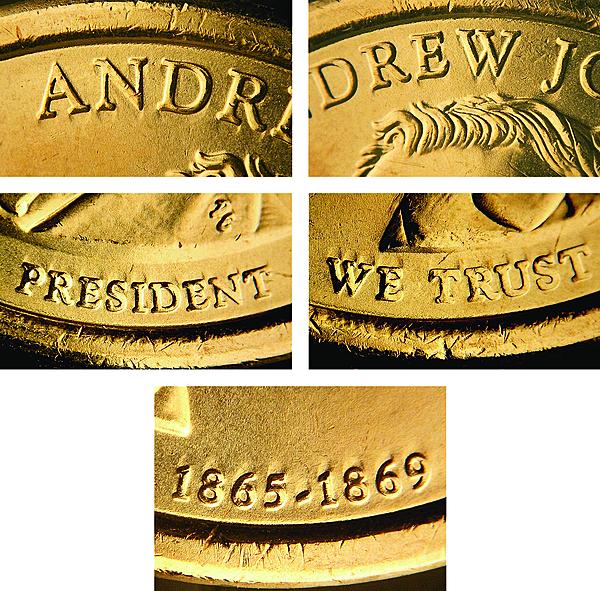
 Dimples extend inward from all the peripheral letters and numbers on the obverse face of this 2011-D Andrew Johnson Presidential dollars. The dimples were apparently produced by corresponding elevations on the field portion of the die. The origin of these elevations is unclear.

 Images courtesy of Mike Diamond

 51810228 (1)

In my capacity as an error researcher I am frequently confronted with unfamiliar and, at times, inexplicable errors. It is an experience that most longtime collectors and researchers find familiar.

My colleague Robert “BJ” Neff was recently handed a doozy of a mystery by error dealer Fred Weinberg. He sent Neff three 2011-D Andrew Johnson Presidential dollars that show a peculiar effect on the obverse face. All of the peripheral design
elements display a shallow dimpled field along their inner side. In other words, the dimples form a centrally directed, converging radial pattern. The effect is easily seen in the accompanying photos, all of which were taken by Neff.

The first problem to address was whether these dimples represented a die error, a planchet error or a striking error. It was immediately apparent that the anomaly was present on the die face. The dimples are identical on all three dollars, and a careful study of die markers undertaken by Neff showed that they were all struck by the same die pair. The presence of dimples on the coin means that the field portion of the die face must have been elevated right next to each peripheral design
element.

But what could produce such elevations? My thoughts initially gravitated toward some form of die deterioration doubling. Incuse forms of die deterioration doubling are known among copper-plated zinc cents and on some state quarters. But I’ve never seen a case in which the incuse doubling is located along the inner margin of the normal, raised design elements. Most of the time the doubling extends from the lateral margin of the affected design elements.

Finally, incuse die deterioration doubling is associated with other signs of die deterioration, such as a swollen field or concentric ripples in the field. None of the Andrew Johnson dollars show signs of die deterioration; they seem to conform to an early die state. Still, I can’t entirely dismiss a novel form of premature,
incuse die deterioration doubling.

Could the defects have been present on master die or a working hub? Probably not, since we’d then expect the dimples to be more widespread among Andrew Johnson dollars. Right now it looks like the dimples are restricted to a single working die.

I had to abandon the idea that the dimples were caused by an abnormally soft working hub or an abnormally hard working die. Either could result in slight compression of raised elements on the face of the working hub and possibly displace enough metal alongside each element to a form pressure ridge. However, were that pressure ridge to be driven into the face of the working die, it would leave a recess. And that, in turn, would leave a bump instead of a dimple on the coin.

 Neff has speculated that the dimples arose during the final phases of hubbing as a result of uneven cooling and contraction of the working die face. He correctly notes that the working die heats up during hubbing as the harder working hub forces its way down through the cone-shaped face of the unfinished working die.

After the “squeeze” is completed, the working die begins to cool and, according to Neff, contracts ever so slightly. If the cooling and contraction is uneven and particularly severe, one side of each peripheral recess on the working die face might find its way blocked by the corresponding raised element on the face of the working hub. This could cause a slight pressure ridge to form before the hub is lifted off the die face. The pressure ridge would be responsible for the dimple on the coin’s surface.

While this scenario is possible, I would have expected the phenomenon to have appeared before now and to be much more common.

 Until we have a better understanding of the nature and origin of these dimples, it’s best to assign them a nonspecific designation. I would suggest something along the lines of “dimpled design extensions” or “design extension dimples.” While I’m not a great fan of placeholder terms, it’s the best we can do. We certainly wouldn’t be alone in this. After all, astrophysicists have applied the terms “dark matter” and “dark energy” to phenomena that they don’t understand.

I invite the readers of this column to submit other examples of dimples. Perhaps other dies will show the effect. A larger, more diverse sample might illuminate the situation.


Coin World’s Collectors’ Clearinghouse department does not accept coins or other items for examination without prior permission from News Editor William T. Gibbs. Materials sent to Clearinghouse without prior permission will be returned unexamined. Please address all Clearinghouse inquiries to: cweditor@coinworld.com or to (800) 673-8311, Ext. 172.


http://www.coinworld.com/articles/dimpled-andrew-johnson-presidential-dollars-d/


Copyright
2012 by Amos Hobby Publishing Inc. Reposted by permission from the March 22,
2012, issue of Coin World.)


2011 04 25

Two-headed, two-tailed ‘pseudo-mules’ delight and

deceive

By Mike Diamond–Special to Coin World | April 16, 2011 10:00 a.m.

Article first published in 2011-04-25, Expert Advice section of Coin World

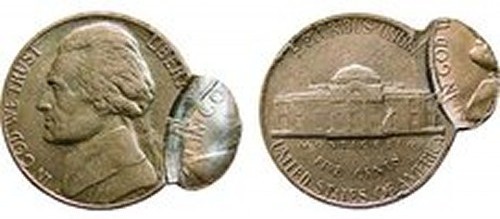
This triple-struck undated Jefferson 5-cent coin received two successive and fully overlapping off-center uniface strikes. The coin flipped over between the second and third strike.

Among the rarest of all errors are two-headed and two-tailed mules (mules are coins struck by mismatched dies).

Only one double-obverse (“two-headed”) mule is known among U.S. coins — an 1859 Indian cent. Only three known double reverse (“two-tailed”) mules are known — two copper-nickel clad quarter dollars and one copper-nickel clad dime.

These mules owe their existence to the accidental or intentional installation of two hammer or two anvil dies. But at least three other pathways can lead to a two-headed or two-tailed coin, and none require mismatched dies. One pathway is illustrated by an undated Jefferson 5-cent coin provided by Scott Taylor.

The first strike was normal. What initially looks like a second strike is 90 percent off-center and carries raised, normally oriented obverse design elements on each face. The two designs are almost perfectly aligned in vertical space.

Numerous clues demonstrate that the off-center designs were not generated by a muled pair of obverse dies. Next to the centered obverse face, the off-center strike is strongly convex and shows a matte texture. Design elements on this face are slightly expanded and flattened. All these clues indicate that this area was struck against another planchet. Finally, die markers are identical on the centered obverse face and the crisper of the two off-center obverse designs.

This 5-cent coin exhibits an off-center pseudo-mule (false mule) struck in a press with a normal die set-up. It required three strikes. After a normal first strike, it received a 90 percent off-center second strike that was uniface (struck against an underlying planchet). It then flipped over and received a third off-center strike, which was also 90 percent off-center, also uniface and directly on top of the second strike.

Pseudo-mules are much more compelling and deceptive when the two obverse or reverse designs are complete. The illustrated 2005 Malaysia 1-sen coin is a pseudo-mule that carries the obverse (hammer die) design on each face. Two steps were necessary to create it.

In the first step, two planchets were placed together in the collar and struck. The top coin was left with a die-struck obverse design and a featureless reverse face. Such an error can occur naturally and is called either a “uniface strike” or a “full indent.” The coin was then flipped over and placed back into the collar on top of a fresh planchet. When the two discs were struck, it left the top coin with a fresh die-struck obverse design on the original featureless surface. The original die-struck obverse face was flattened from where it rested on the planchet during the second strike.

Many similar 1-sen pseudo-mules emerged around this time period and are clearly intentional errors. Several have been erroneously encapsulated by Professional Coin Grading Service as double-obverse mules.

A double-reverse pseudo-mule can be created in the much the same way. One simply uses the bottom member of an in-collar uniface pair. Flip it over, place a fresh planchet on top it, deliver a second strike, and you’ve got two reverse designs (one flattened, of course).

A pseudo-mule doesn’t even require two uniface strikes in sequence. A simpler scenario involves a normal coin flipping over and landing perfectly on top of (or beneath) a fresh planchet. The two discs are then struck together in- or out-of-collar. The increased effective striking pressure generated by two stacked discs is sufficient to obliterate the original design on the face struck directly by one of the dies.

This kind of pseudo-mule error will generate a perfectly centered, flip-over, first-strike brockage on the planchet that rests against it.

A final sequence of events requires only a single strike to be delivered to the planchet that will become the pseudo-mule. In this scenario, a coin with an in-collar, first-strike brockage flips over and lands beneath or on top of a fresh planchet. When the two discs are struck together (in- or out-of-collar), the brockaged coin acts like a die and generates a raised, normally oriented design — a counterbrockage. I have not yet encountered this type of pseudo-mule.

However it’s produced, a pseudo-mule will have the raised design flattened on one face. If struck out-of-collar, it will often assume the cupped shape of an anvil or hammer die cap, with the design on its “working” face grossly expanded and distorted.

Have any domestic pseudo-mules been mistakenly encapsulated as true mules? Possibly. A third encapsulated two-tailed quarter dollar is known, but this one was double struck in-collar, the second time against an unstruck planchet. One face is correspondingly flattened and distorted. While Numismatic Guaranty Corp. claims the coin was struck by two reverse dies, its appearance is equally consistent with that of a two-tailed pseudo-mule produced in a manner described earlier.

Coin World’s Collectors’ Clearinghouse department does not accept coins or other items for examination without prior permission from News Editor William T. Gibbs. Materials sent to Clearinghouse without prior permission will be returned unexamined. Please address all Clearinghouse inquiries to cweditor@coinworld.com or to (800) 673-8311,

Ext. 172.

http://www.coinworld.com/articles/two-headed-two-tailed-pseudo-mules-delight-an/

Copyright 2012 by Amos Hobby Publishing Inc. Reposted by permission from the March 22, 2012, issue of Coin World.)

2011 05 03

Reverse of 2007 silver Eagles

Key clue to variation is u in united

By Erik Martin | May 22, 2011 10:00 a.m. 

Article first published in 2011-05-03, Expert Advice section of Coin World

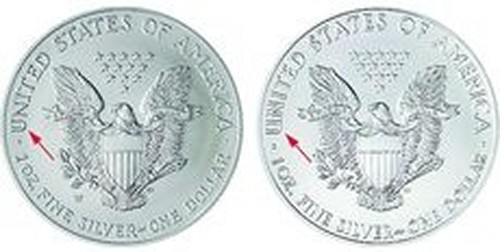
The style of the u in united is one distinct difference between Reverse of 2007, left, and Reverse of 2008, right, American Eagle silver coins. Some Uncirculated 2008-W coins were struck using older reverse dies, creating a variation.

Images courtesy of John Nanney and Harlan J. Berk Ltd.

This is a question regarding the American Eagle silver dollars of 2008, 2009 and 2010 and the reverse side of the coin at the legend united states of america. The u in united has a different shape, unlike the u on the other silver
American Eagles.

Is this an error? I would appreciate knowing the next step in having my coins verified.

Frank Seminara, Citrus Springs, Fl.

Beginning with 2008 strikes, the U.S. Mint began using a slightly modified design on American Eagle 1-ounce silver bullion coins, Uncirculated (with W Mint mark) silver coins and Proof (with W Mint mark) silver coins. However, some of the Uncirculated (often termed as “Burnished Uncirculated” by collectors) 2008-W strikes featured the older font style on the reverse, used on 2007 and prior strikes. The difference was most noticeable on the u in united states of america.

The United States Mint admitted that it released 47,000 Uncirculated 2008-W American Eagle silver coins struck with the older reverse dies. These are referred to in collecting circles as “Reverse of 2007” strikes.

In early January 2008, Mint officials confirmed that style changes, primarily in the lettering for better metal fill, were intentionally made on the obverse and reverse of the Proof, Uncirculated and bullion 2008 American Eagle silver coins. No one outside the Mint was aware of the change until the 2008-W Reverse of 2007 coins began to turn up in the marketplace side by side with coins bearing the updated reverse.

Mint spokesman Michael White said the Mint made the “artistic design changes” while moving from hand-engraving to digital engraving. American Eagle silver coins struck in 2008 to the present feature the newer style lettering on their reverse legends. While use of the older style was an unintended “error” on the part of the Mint, the 2008-W Reverse of 2007 coin is more or less considered a variety rather than an error. Other than the aforementioned 47,000 pieces, Coin World is currently unaware of any other American Eagle coins exhibiting the Reverse of 2007.

Before sending a suspected 2008-W American Eagle, Reverse of 2007 silver coin to a third-party grading service, the collector should determine if the coin is indeed a Reverse of 2007 variation. Here is a quick tutorial:

? The u on the normal reverse (Reverse of 2008) has a spur on the right side of the letter.

? The Reverse of 2007 has a simple bowl-shaped u, without a spur or down-stroke.


Coin World’s Readers Ask department does not accept coins or other items for examination without prior permission from staff member Erik Martin. Readers Ask also does not examine error or variety coins. Materials sent to Readers Ask without prior permission will be returned unexamined. Please address all Readers Ask inquiries to  emartin@coinworld.com or call (800) 673-8311, Ext. 274.

http://www.coinworld.com/articles/reverse-of-2007-silver-eagles/


Copyright 2012 by Amos Hobby Publishing Inc. Reposted by permission from the March 22, 2012, issue of Coin World.)

MD-9

Certain error coin production patterns often

mystifying.

By Mike Diamond. | April 30, 2011 10:00 a.m. 

Article first published in 2011-05-09, Expert Advice section of Coin World


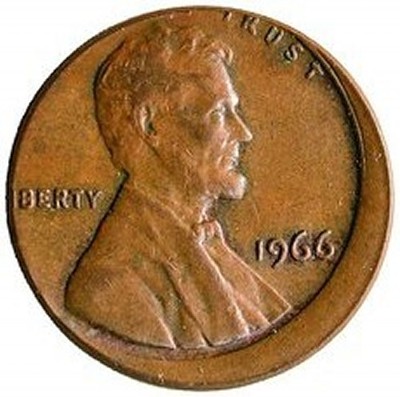
This Lincoln 1966 cent was struck by a horizontally misaligned obverse (hammer) die. The coin was struck in-collar and the reverse face is perfectly centered.

Image by Mike Diamond

The 20th and 21st centuries are studded with numerous spikes (and drops) in the production of specific error types. These spikes affect numerous categories of die, planchet and striking errors. Some surges in striking errors are easily explained. The year 1966 produced numerous rotated die errors (mostly 90 degrees) among Jefferson 5-cent coins. The vast majority can be traced to a single malfunctioning press. This same year brought us a less easily explained rash of Lincoln cents struck by horizontally misaligned obverse (hammer) dies. The misalignments are unusually severe, and head off in several different directions (see photo of 1966 Lincoln cent).

Lining up a quartet such errors, I was unable to match up the patterns of die scratches. Each coin was clearly struck by a different die pair; how many different presses were involved cannot be ascertained. Equally puzzling is the failure to see a similar error pattern in other denominations struck in 1966. Except for some rare instances, coinage presses are not dedicated to a specific denomination. Once the production totals for one denomination have been satisfied, the dies, collar and feeder assembly are changed to accommodate a different denomination.

Error production patterns confined to a single denomination are actually quite common and can stretch over several years. In the July 12, 2010, “Clearinghouse” column, I reported on a nine-year run of Lincoln cents with faint, oddly positioned clash marks (see photo of 1996 cent here). The clashes all occurred when the hammer die was tilted and horizontally misaligned to a remarkable degree — up to 50 percent. They’re so different from ordinary clash marks that it seems likely the mishaps occurred during installation rather than during a press run. Restricted to the years 1992 to 2000, the current count is 19 die pairs. Again, it’s unclear why the same mishap failed to occur when these presses were switched to other denominations.

An error production pattern can even be confined to a single design sub-type. In the Jan. 3 “Collectors’ Clearinghouse,” I reported on research conducted by Robert “BJ” Neff on tilted die clashes found in 1960-D Lincoln, Small Date cents (and one 1960 Small Date cent). An example of the 1960-D cent is shown here.

A tilted die clash occurs when the hammer die makes direct contact with the anvil die at an angle, leaving a set of reciprocal clash marks at one pole on each die. Such clashes are quite rare — except in this sub-type. At the time of writing, 35 such clashes have been cataloged, with at least 15 waiting in the wings for cataloging.

While examining more than 5,000 Small Date cents from both the Philadelphia and Denver Mints, Neff noticed some other intriguing patterns. Not a single conventional die clash (which produce the familiar “Lincoln in jail” effect) was found. Many of the dies from both Mints were covered by heavy die scratches, regardless of whether clash marks were visible. Die scratches are the product of intentional die abrasion, performed to remove clash marks and other types of superficial damage.

Neff also detected a high frequency of “conflicting dies” (switch-outs). These examples show clash marks on only one face; the opposite die was replaced before the press was restarted. Neff thinks that the presses responsible for the tilted die clashes and other effects were plagued by a number of problems: 1) difficulty in maintaining a horizontally oriented hammer die face, 2) difficulty in maintaining the minimum die clearance necessary to prevent a clash in the case of a planchet misfeed, and 3) an abnormally high rate of complete planchet misfeeds.

Neff thinks it’s possible that a different kind of press was used, or that a standard press was modified for the production of these Small Date cents. Whatever the changes, they didn’t work out very well and the experiment was abandoned.

Neff’s scenario only works if we surmise that the novel press design was used strictly for the small date cents. It also raises the question of why the cent design was modified after the experimental presses were abandoned. Conjecture aside, his evidence at least calls into question the standard explanation for the switch to the Large Date sub-type — a propensity for die chips to develop in digits of the small date.

Further details of Neff’s investigations can be found at www.maddieclashes.com.

Coin World’s Collectors’ Clearinghouse department does not accept coins or other items for examination without prior permission from News Editor William T. Gibbs. Materials sent to Clearinghouse without prior permission will be returned unexamined. Please address all Clearinghouse inquiries tocweditor@coinworld.com or to (800) 673-8311,


http://www.coinworld.com/articles/certain-error-coin-production-patterns-often-/


Copyright 2012 by Amos Hobby Publishing Inc. Reposted by permission from the March 22, 2012, issue of Coin World.)

  • « Previous Page
  • 1
  • …
  • 17
  • 18
  • 19
  • 20
  • 21
  • Next Page »
  • Home
  • Introduction To This Website
  • Error-ref.com News
  • Comprehensive Error-Variety Checklist
  • Index Of Completed Entries
  • Part I. Die Subtypes:
  • Part II. Die Varieties:
  • Part III. Die Installation Errors:
  • Part IV. Die Errors:
  • Part V. Planchet Errors:
  • Part VI. Striking Errors:
  • Part VII. Post-Strike Mint Modifications:
  • Part VIII. Post-Strike Striking Chamber Mishaps:
  • Part IX. Post-Strike Mint Damage:
  • Part X. Wastebasket / Composite Categories:
  • Part XI. Non Errors:
  • Featured Articles Of Interested
  • Interest & Not So Interesting Facts
  • Other Sites And Forums Of Interest
  • Our Thanks Go To
  • About The Authors
  • Contact Us

Copyright © 2026