Error-Ref.com

You are here: Home / Search for "off center"

Search Results for: off center

Circumferential Cuds

PART IV. Die Errors:

Cuds: 

Circumferential Cuds

Definition: A circumferential, or 360 degree cud, occurs when the entire perimeter of the working face of a die breaks away.  This can occur incrementally, as chunks of the die break off at different times.  A circumferential cud is thought to occur when the outside of the die neck is unusually brittle and when there is a sharp transition zone between the brittle exterior and a softer interior.

Circumferential cuds are extremely rare and are unknown among U.S. coins.  A few examples are known from other countries.
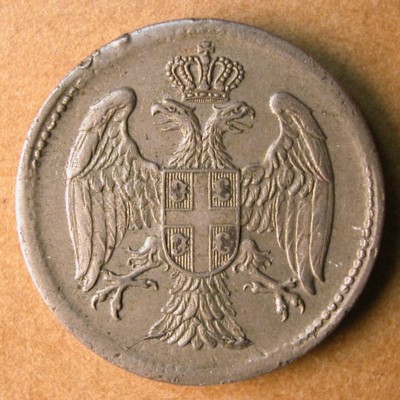
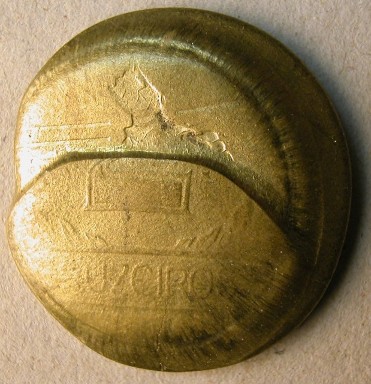
This 1918 Serbian 20 para shows a 355 degree cud
Class I

Part II. Die Varieties:

Doubled Dies:
Class I (Rotated Hub Doubling):
This class of doubled die is probably the easiest to conceptualize and diagnose.  It emerges from two separate hubbings.  Prior to the second hubbing, the working hub or the working die rotates around its vertical axis (the axis that passes though the center of the hub/die face). Class I doubled dies are listed as showing a clockwise (CW) or counter-clockwise (CCW) rotation.  The direction is determined by which hubbing is clearest and most complete. This is usually the second hubbing (which tends to be deepest).  Exceptions do exist, however.

Doubling typically has a rounded appearance.  When the hubbing impressions are extremely close, the doubled die may only be recognizable from notched serifs and corners, subtle separation lines, or extra thickness.

Below is an overlay diagram of a fictitious Class I doubled die that has a clockwise rotation similar to the King of Doubled Dies, the 1955P DDO-001. Notice how the spread is equal on all devices and increases the farther out you go from the center of the coin.  DDO refers to a doubled die that affects the obverse face of a coin.  DDR refers to a doubled die that affects the reverse face of a coin.

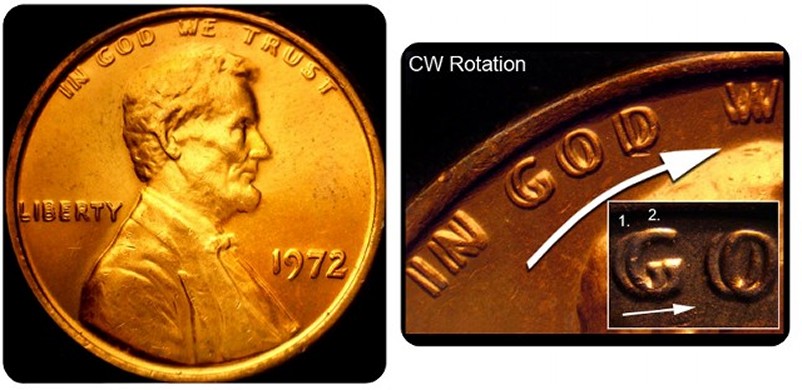
Below are photos of 1972P DDO-001, a Class I DDO with a strong CW spread on all outlying devices and parts of the jacket. A second hubbing typically eliminates interior parts of the design produced by the first hubbing. Therefore doubling is often only detectable in areas bordering the field. Here, only the outside elements of the portrait of Lincoln and the motto show doubling while the centrally-located details are lost to the second hubbing.

Hubbings are ordered from lightest to deepest, either CW or CCW. On the G of GOD you can see that the heavier of the duplicate letters (G-2) is located to the right (clockwise) of the lighter letter (G-1).  It is likely that the heavier letter represents the second hubbing, but this cannot be proven.

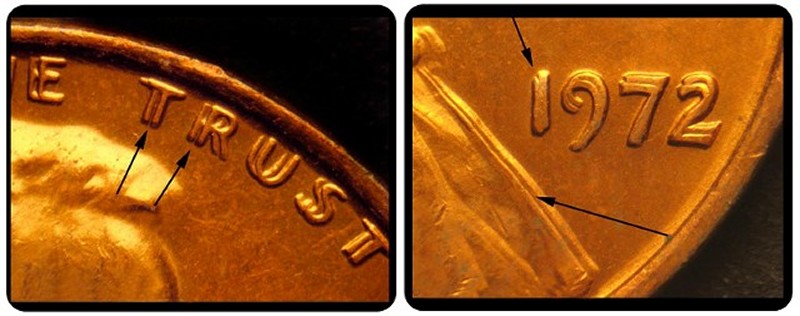
Below you can see clear separation between the letters of TRUST. On the first few digits of the date, where design elements are more closely bunched (due to being closer to the center of the design), distinct notching can be seen at the upper and lower corners of numeral 1.

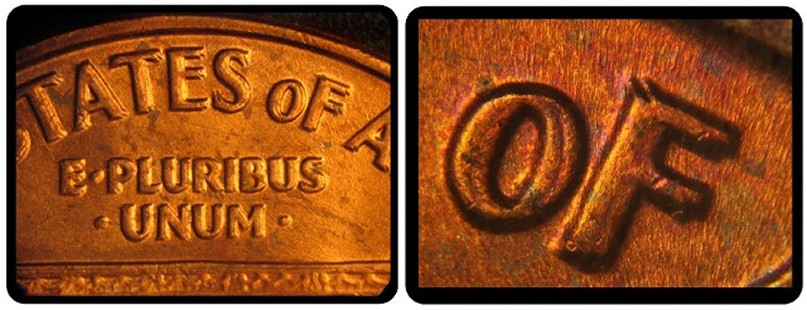
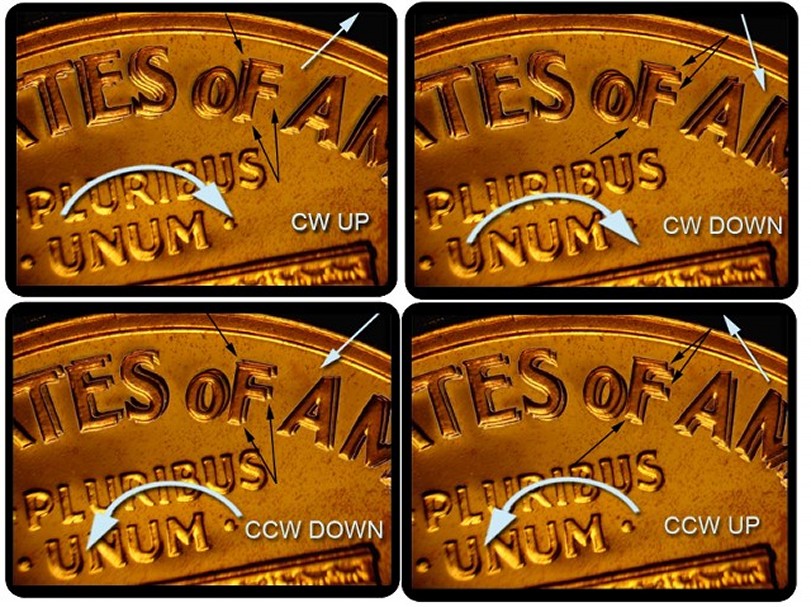
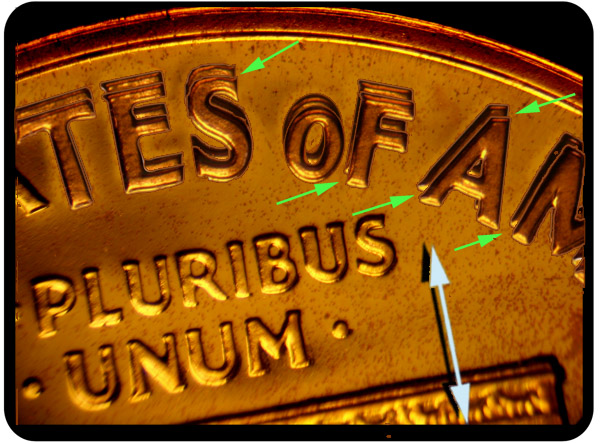
Below is a Class I doubled die on the reverse face of a 1964 cent ( 1964P DDR-001).  It shows a counterclockwise (CCW) spread. Again there is clear separation, notching, and rounded doubling. The doubling is strongest in “STATES oF” due to the axis of rotation being located slightly south of center.

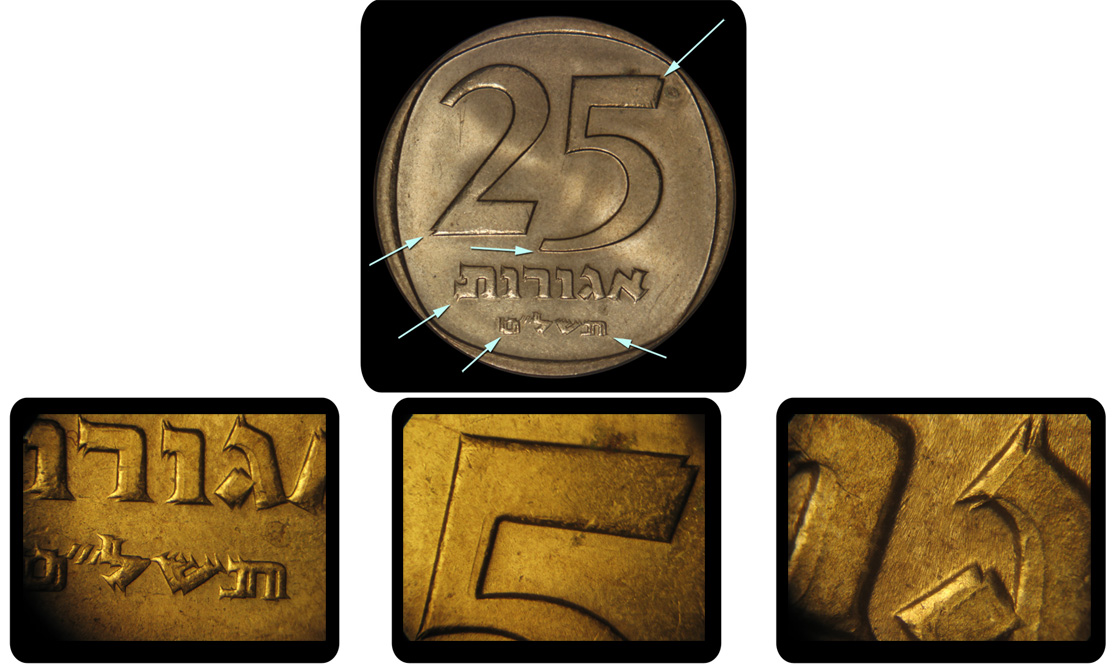
The next example is a DDR on a 1979 Israeli 25 agorot. The spread, best seen in the Hebrew letters located near k12, is elsewhere indicated by notches and subtle separation lines. As would be expected of any Class I doubled die, the doubling is weakest toward the center and strongest toward the perimeter of the coin.

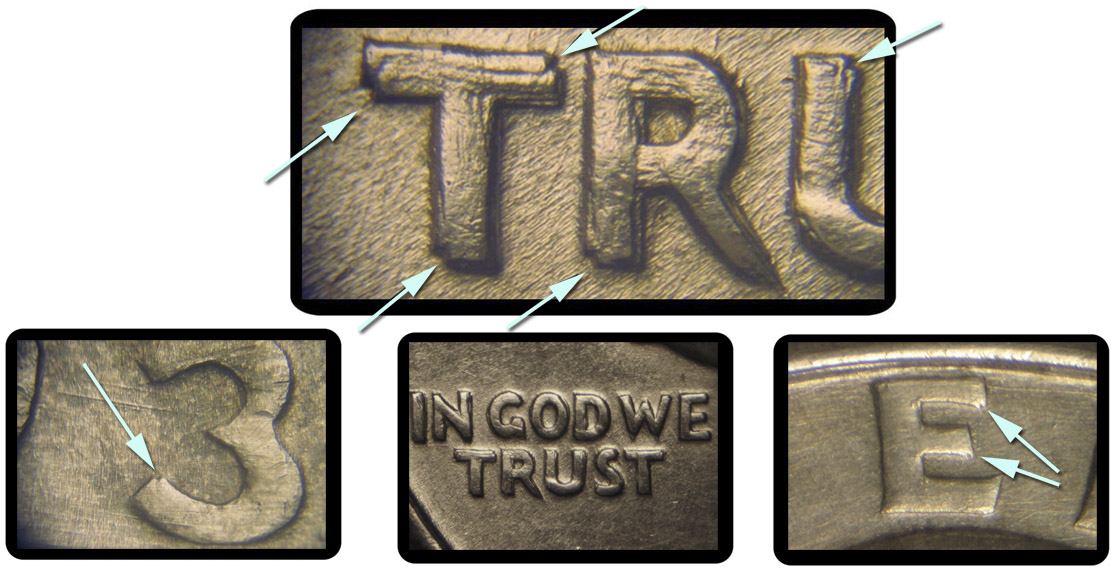
Notching of corners and serifs reflects the presence of closely-spaced letters and numbers.  Often there is a difference in height as well between the closely overlapping design elements. Below is a 1934-D quarter listed as DDO-001 that shows very obvious stepped notching in IN GOD WE TRUST. Subtle doubling, also in the form of notching, is evident on all the peripheral design elements. Detailed photos presented below depict notching in the E of LIBERTY, as well as the 3 of the date.

NOTCHES EXPLAINED:
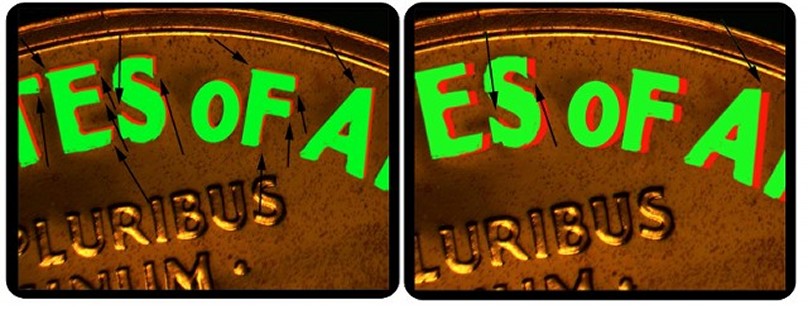
If a die shows hub doubling and there is a rotational shift, the notches will be more apparent. The following illustrations show a hypothetical CCW rotation with Red being the first hubbing and Green the second. The green letters are also slightly south (or down) in relation to the red. While the spread is minor, the notches are obvious. Rounded portions of letters (like the o and S) show the development of a secondary, offset ellipse.

Now we will see a stronger CCW spread where there is very little degree of offset between the hubbings. The result is fewer notches overall, but where the design drops off, such as the serifs on the S or the top of the A, there will be
minor notching or splits. Below are some notching diagrams that will give you an idea of where  Class I (and also Class V) hub doubling can produce notches.

Below are examples of Class I Doubled Dies on various Lincoln cents. 1941 DDO-001

1941 DDO-002

1936 DDO-001

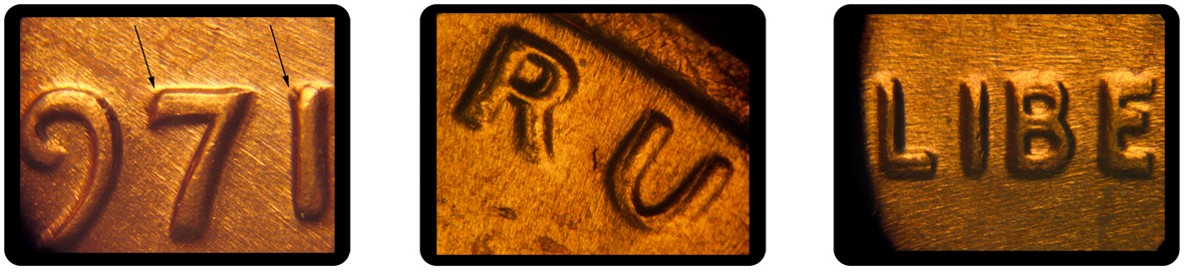
1971 DDO-002

On to CLASS II

All doubled die illustrations are by Jason Cuvelier


Class IV

Part II. Die Varieties:

Doubled Dies: 

Class IV (Offset Hub Doubling)

This class of Doubled Die is produced when two hubbings have their centers misaligned. It is characterized as having doubling that is evenly spread in one direction. The doubling is unlike that found on Classes I or V, where the misalignment-event shows a rotation at or near the center (I) or at or near the rim (V). Doubling is often rounded, found closer to the center, and when identified on numeric or alphabetic characters, shows notching.

It has been hypothesized that the reason many examples do not show doubling near the rim is because one of the hubbings only received an uncharacteristically incomplete hubbing. Such an incomplete hubbing would result in design elements not being pressed deep enough in the middle of the die, and not at all along the perimeters. The die originates in a conical shape until it is completely pressed down, if the incomplete hubbing was the first, the outer devices may not have been hubbed the first time around.

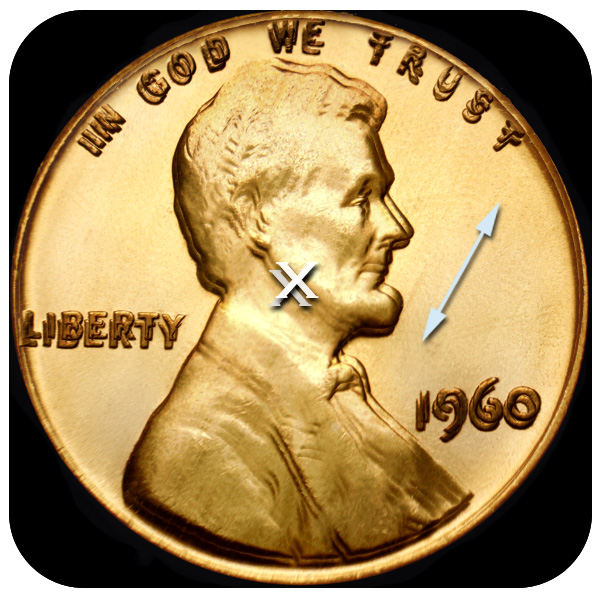
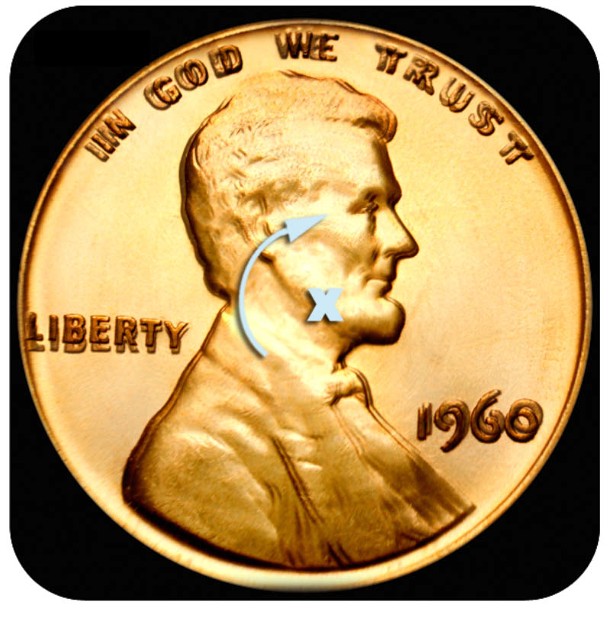
Below is a facsimile of a fictitious 1960P with a strongly doubled Class IV DDO. In this case the first hubbing would have been centered and complete, with the second hubbing having its center oriented N-NE from the first. It should be noted that this example is showing universal doubling on all design elements (including the whole portrait) which has never been documented but shown for effect.

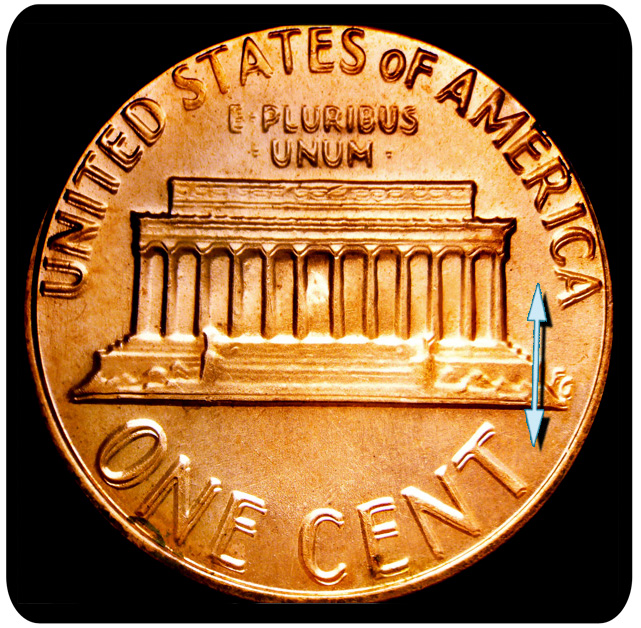
Below is 1983 DDR-001, which exhibits a large spread going North, it is stronger than the above hypothetical illustration. The ’83 DDR shows strong peripheral doubling. The central elements show some doubling around the parameter of the memorial and in a few sections of the building itself (like the upper portions of the columns). Notice the notching (a clear indication of hub doubling), rounded secondary images and how the deeper hubbing shifts consistently in one direction from the lighter hubbing.

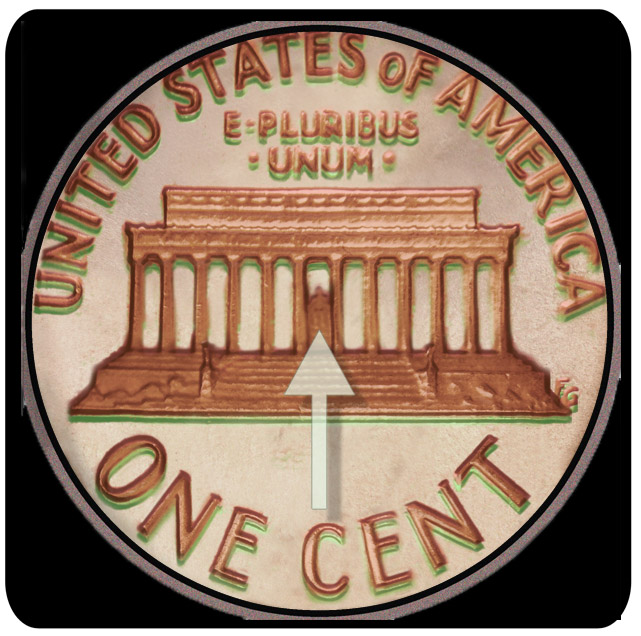
Below is a colored overlay demonstrating that the ’83 DDR has a wide northerly shift between the hubbings. Green is the lighter hubbing followed by red, which is the deepest.
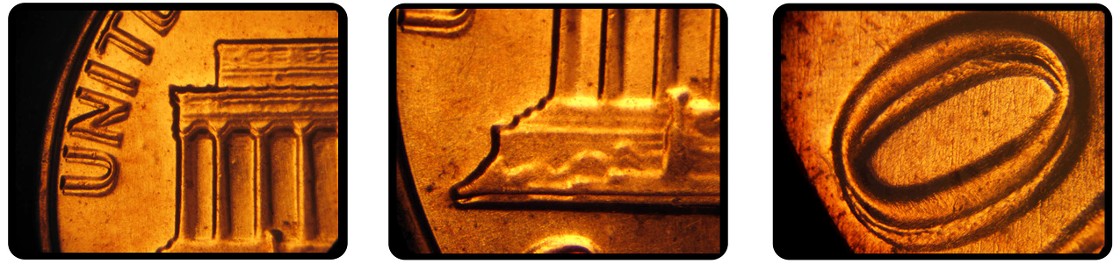
Below are details of 1983 DDR-001
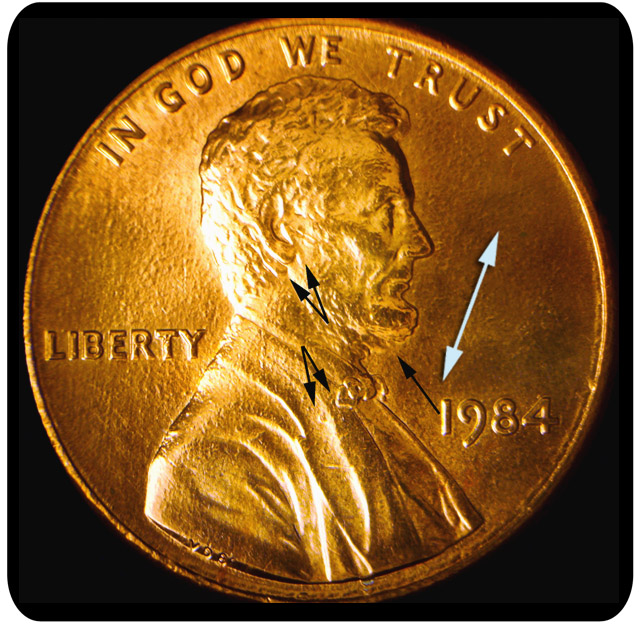
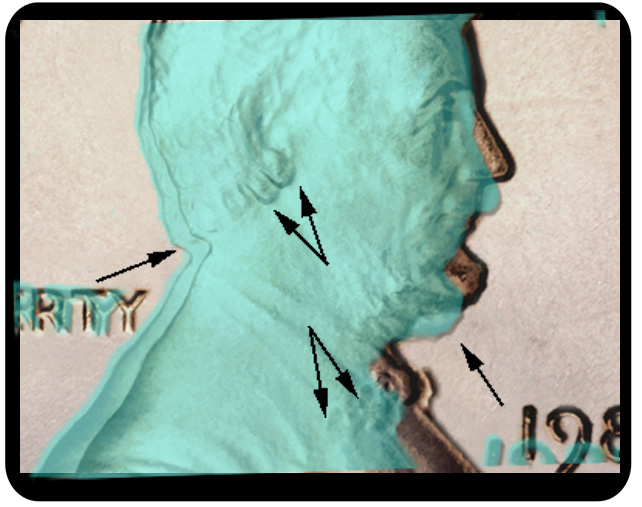
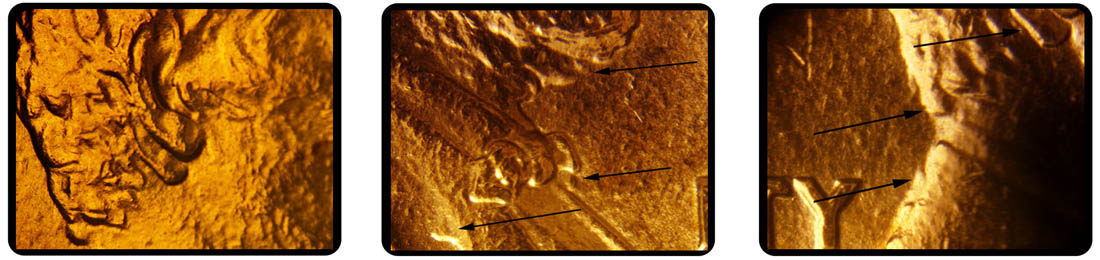
Another bold example, yet displaying only an incomplete hubbing, is 1984 DDO-001. It displays a widely doubled ear, beard details, back of head and bow tie.
1984 DDO-001 also appears to be ever so slightly pivoted as the second piece of the bow-tie resides further away proportionally than the second ear. Analysis suggests the center of rotation would be off at least a centimeter to the side of the die past IN of IGWT. An overlay and details are below.
Notches: As has been pointed out by most variety specialists and attributers: notching, even though the doubled areas are shallow, is always, to a degree, present. MD will seemingly smear the doubled area away from the device impacted but it will not leave notches, how could MD leave notches? …Think about it while viewing a fictitious notching diagram of Class IV doubling going south illustrated below. While the degree of doubling is strong, there would be clear evidence of notching whereas MD would have pushed or flattened metal over the areas that display notching.


1909 DDO-001, the doubled areas indicate a incomplete hubbing. Although hard to identify, RTY has notches, most evident on the SW corners.
1942-S DDO-001. Another incomplete hubbing, doubling is faint, and confined to central elements and the upper motto.
Below is a Jefferson nickel known as 1939 DDR-001. This doubled die displays a strong, yet partial second hubbing, showing on MONTICELLO, FIVE CENTS & the right side of the building. The notching and separation are spectacular.
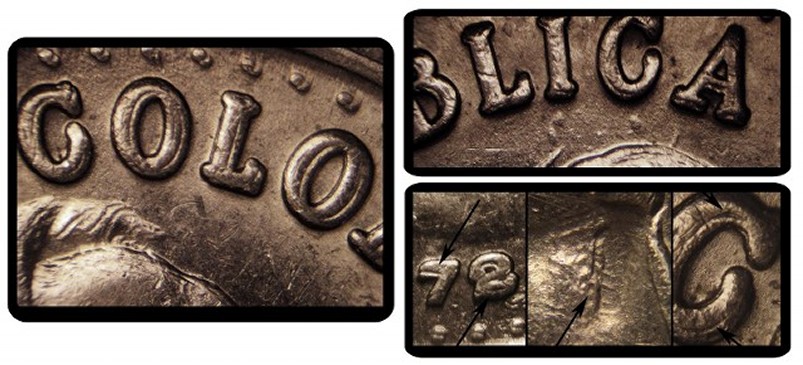
Our final example is on a 1972 Colombian 20 Centavos. Here we see a nice a northerly spread that shows across the motto, date and parts of the portrait.
Pictures of the Class IV doubled die obverse 1988 DDO-003 (1DO-010) FS-101 which has a strong extra ear south – HERE.

On to CLASS V

All doubled die illustrations are by Jason Cuvelier


Plating Blisters

PART V. Planchet Errors

Plating blisters

Definition: This error type occurs only on copper-plated zinc cents from 1982 to the present. Blisters form during the strike when expanding gas pushes up the copper plating from heat and pressure. A weak bond between the copper plating and the zinc core is a necessary prerequisite as are contaminants within or under the plating.

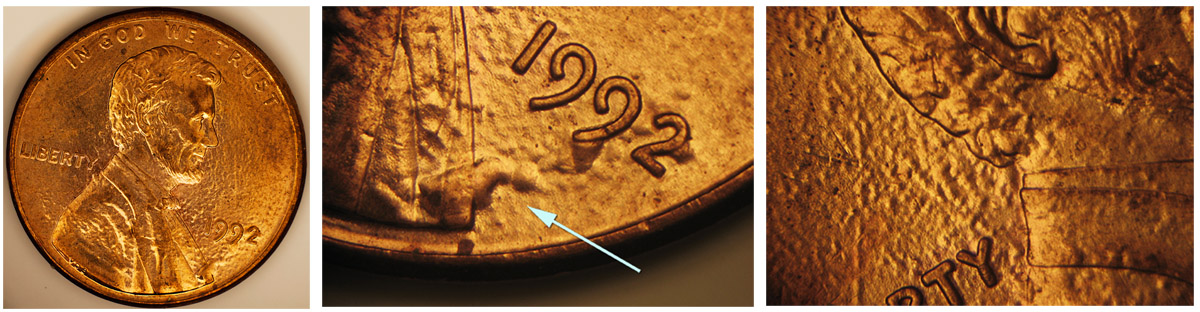
Below is a 1992 Lincoln cent with circular plating blisters. The largest blister is oblong and irregular, it runs through Lincoln’s coat into the field and below the date.

Illustration by J. Cuvelier

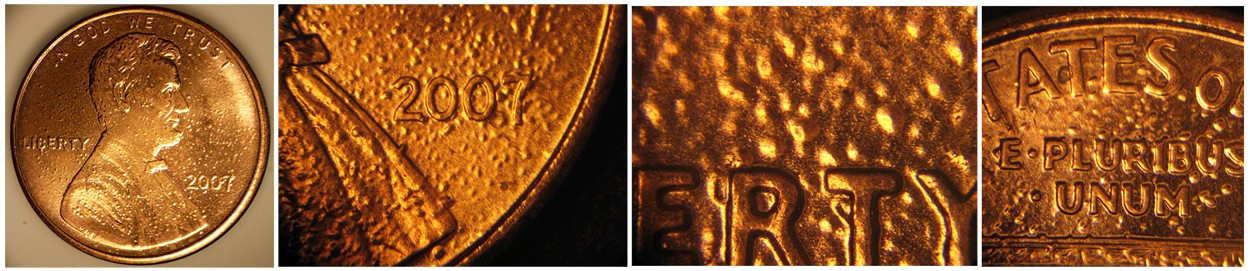
A 2007 Lincoln cent with circular plating blisters on both the obverse and reverse.

Illustration by J. Cuvelier

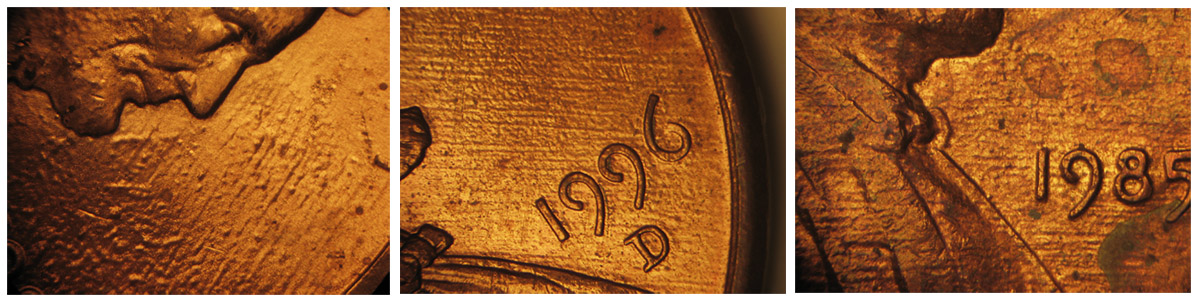
Three Lincoln cents (1984, 1996-D and 1985) with linear plating blisters. The 1984 has some circular blisters mixed in.

Illustration by J. Cuvelier

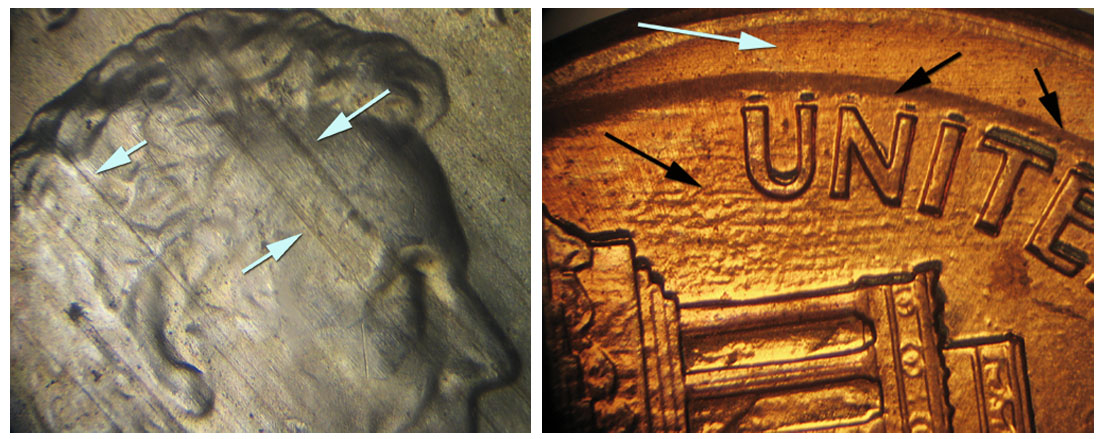
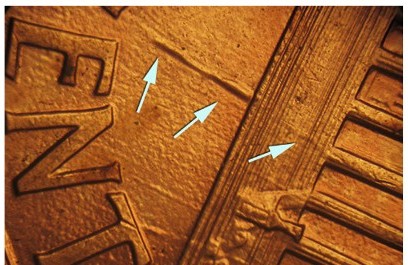
Below to the left are planchet striations on the surface of an unplated Lincoln cent. Below to the right is an off-center cent that shows the matte surface of the planchet free of blisters. The struck portions of the coin show both circular and linear plating blisters. The linear blisters run parallel to the planchet striations present on the unstruck portions.

Illustration by J. Cuvelier

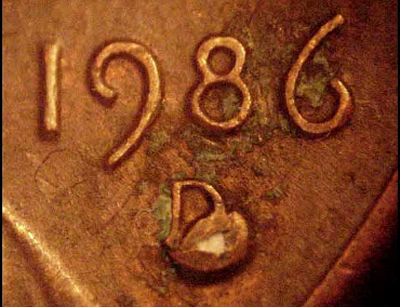
For comparison purposes, the upper image is a 1995 Lincoln cent reverse with a long linear plating blister; below and to the right, is a 1986-D Lincoln cent that shows a solid blister from corrosion on the mintmark. More specifically, it shows a dome of subsurface corrosion that has ruptured or that began as a slight tear in the copper plating. It should not be confused with a normal plating blister.

Plating blisters are hollow.   They look similar to, but should not be confused with, solid blisters pushed up by subsurface corrosion.  Solid blisters are pushed up by gas under the expanding metal.  Zinc corrosion (“zinc rot”) can be induced by contaminants trapped between the zinc core and the copper plating.  A more common cause of zinc rot is the presence of a small perforation or tear in the copper plating.  This allows oxygen and reactive compounds to reach the zinc core.

Illustration of 1995 by J. Cuvelier

Image of 1986 by Richard Cooper

Brockage-Counterbrockage Combination 8 Types

PART VI. Striking Errors:

Counterbrockages:

Brockage-Counterbrockage Combination (8 types):


There are eight ways in which such a combination may occur. All are rare.

Several are represented by an actual example. Others remain entirely theoretical. For the theoretical, visual reconstruction is presented of the conditions immediately preceding the production of the brockage-counterbrockage error.

1) Counterbrockage/clashed cap strike.

A “clashed cap” is a die cap that collides with the opposite die when a planchet fails to be fed into the striking chamber. A “clashed cap strike” is a planchet that is struck by such a cap. A clashed cap strike is a type of brockage.

A counterbrockage/clashed cap strike occurs when an obverse die cap that is striking counterbrockages collides with the reverse die when a planchet fails to enter the striking chamber. The working face of the die cap picks up a die-struck reverse design, which is often incomplete owing to the reduced thickness of the floor of the cap. The next several coins that are struck feature intermingled brockage and counterbrockage design elements. The brockaged elements are derived from the clash, while the counterbrockage elements are from the original incuse design on the working face of the die cap.

Permutations: This scenario could also apply to a reverse (anvil) die cap.

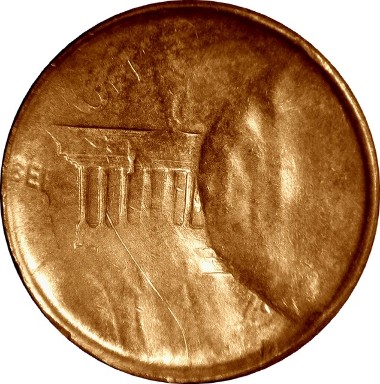
A typical counterbrockage/clashed cap strike. The counterbrockage elements include much of Lincoln’s bust (e.g., his coat and ear), the numbers “19”, and the letters “BER”. These were generated by the original incuse design on the working face of the die cap, elements that were not obliterated by the clash. The incuse, mirror-image Memorial design elements are sharp, normal-sized, and undistorted, indicating that this coin was struck immediately after the cap clashed with the reverse die. The largely featureless swelling on the right side of the obverse face of this Lincoln cent represents an area of the cap that was indented by a planchet that intruded into the striking chamber.


2) A die cap that is producing brockages is, in turn, brockaged by a struck cent that intrudes into the striking chamber. 

The error began with a normal cent that stuck to the obverse (hammer) die. It struck perhaps one or two coins (each of which ended up with an early-stage brockage of the reverse design on the obverse face) before a cent from elsewhere (possibly from an adjacent striking chamber) found its way into the striking chamber. When this cent was struck, it transferred part of the obverse design (primarily LIBERTY) to the working face of the die cap. The image below- an early-stage brockage on the left side and a first-strike counterbrockage of the obverse design on the right side.
Permutations: This scenario could also occur with a reverse (anvil) die cap, but such an event has never been documented. A full, centered counterbrockage of the anvil die design on the face normally struck by the anvil die has yet to be encountered.
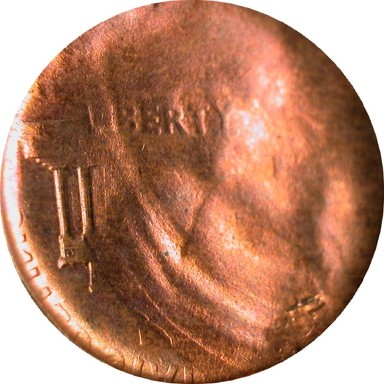
This brockage-counterbrockage error was produced by a conventional early-stage die cap that was brockaged by a struck coin that intruded into the striking chamber. The counterbrockage consists of LIBERTY and the outline of the back of Lincoln’s coat.

3) A coin inserts itself between a die cap that is producing counterbrockages and an underlying planchet.

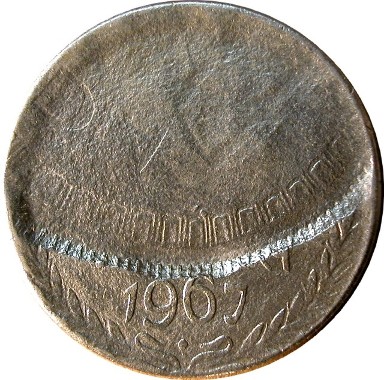
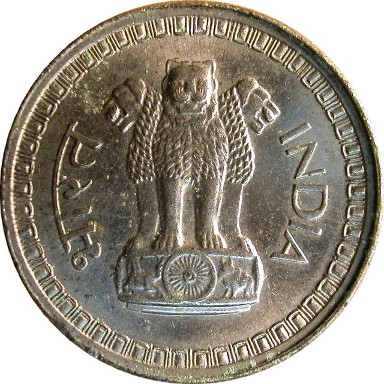
See example & images of 1967 India 50 paise below.

Permutations: This scenario could also conceivably occur with an anvil die cap.

A 1967 India 50 paise. The counterbrockage can be seen in the lower third of the reverse face (top image), which, as with most Indian coins, was struck by the hammer die. It  is a centered, first-strike counterbrockage, since only a little bit of the design runs off the edge. The upper two-thirds of the reverse face is taken up by a first-strike brockage of the obverse design. It was produced by a struck 50 paise that intruded into the striking chamber immediately after the die cap that generated the counterbrockage was formed.
4) A planchet is fed in on top of a coin with a partial brockage.

Such an error has not been found among U.S. coins, however. The distinctive result of such an event has been seen in coins from Argentina, Brazil, Costa Rica, and Canada.

1) Part of the reverse face shows a first-strike brockage of the obverse design.

2) The rest of the reverse face shows a counterbrockage of the reverse design. The counterbrockage would rest on top of a bulge or plateau located on the reverse face of the affected coin.

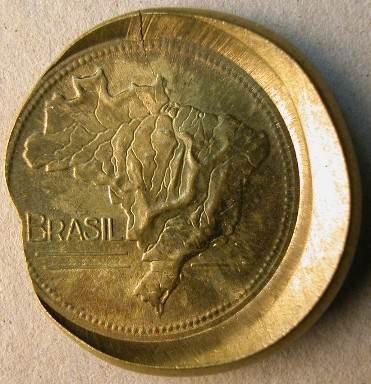
Below is a Brazil 2 cruzeiros (1942-1956) that was struck into an underlying coin with a partial brockage. On the reverse you can see a raised, normally-oriented version of the bottom of the 2 and the word CRUZEIROS. Above that is a brockage of the southern end of the country of Brazil. Since the counterbrockage is properly aligned with the die-struck obverse design, it’s likely that the brockage that generated it was itself the product of a first strike by a partial (off-center) die cap.

Permutations: This error could also develop on a planchet fed in beneath an error coin that featured a partial brockage of the obverse design on the reverse face.

5) A planchet is fed in on top of a normal coin and a brockaged coin.

The normal coin and the brockaged coin would lie side-by-side within the striking chamber or would overlap. One possible arrangement is shown below. This particular combination in any coin, foreign or domestic has yet to be found.

Permutations: This error could naturally appear on a planchet fed in beneath two coins, one normal and one with a brockage of the obverse design on the reverse face.

A brockaged coin and normal coin, side by side. If a planchet were to be fed on top of and straddle both coins, the resulting error would present a first-strike brockage and a first-strike counterbrockage next to each other on its reverse face.
6) A brockaged coin is struck into another brockaged coin, with the two brockages facing each other.
Each coin will carry a counterbrockage of the other. Where the brockages are in direct contact, the counterbrockage will overlie the brockage.  This thought-provoking combination has not been encountered.
7) A brockaged coin is struck a second time, off-center. Then a planchet is struck into it.
The coin that results will have a brockage side-by-side with a counterbrockage. This error has not been encountered.
Permutations: The brockage could be on the obverse face or the reverse face. The planchet would respectively rest on top of, or beneath, the brockage.
8) A coin receives a second, off-center strike while overlapped by another coin. Then a planchet is struck into it.

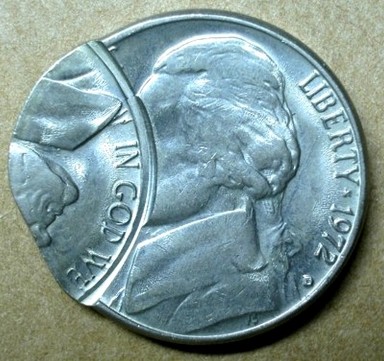
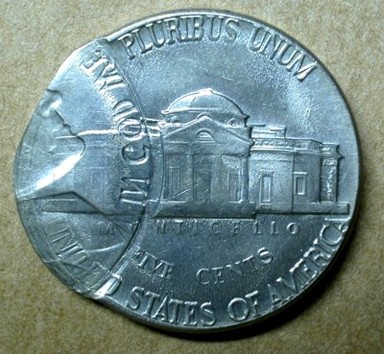
The second, off-center strike leaves a brockage on the part of the coin that was in direct contact with the second coin. The image below shows such an error, a double-struck 1972-D nickel with a first-strike brockage of the obverse design on the reverse face of the second strike.

If a fresh planchet were to be fed beneath this double-struck coin (or if this coin was fed on top of a planchet), the result would be a coin with a brockage and a counterbrockage that lie side-by-side. Some brockaged elements would likely persist within the counterbrockage. This error type has not been encountered.

Permutations: The brockage could be on the obverse face or the reverse face. The planchet would respectively rest on top of, or beneath, the brockage.

A double-struck 1972-D nickel with a first-strike brockage of the obverse design on the reverse face of the second strike. If this coin were to be fed on top of a planchet (or if a planchet were to be fed beneath this coin), the resulting error would show a first-strike brockage of the reverse design and a first-strike counterbrockage of the obverse design on the obverse face. The counterbrockage would retain some brockaged elements remaining from the first strike.
Beyond the eight-fold path

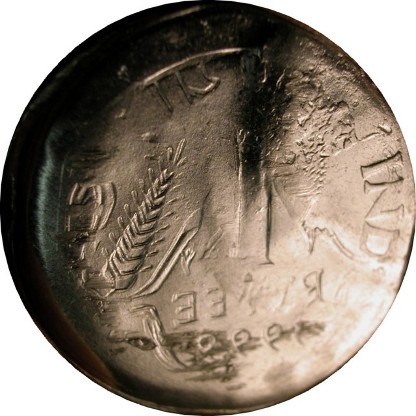
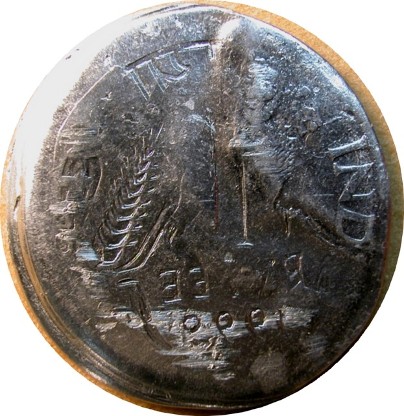
The eight scenarios presented above represent the simplest paths to a brockage-counterbrockage error. Naturally, things can get much more complicated. A case in point is this 1999 India 1 rupee coin shown further below.

The obverse face (struck by the anvil die) features a mixture of brockage and counterbrockage design elements over the entire surface, with the brockage dominating. The brockage is an incuse, mirror-image version of the reverse (hammer) die design, which features the numeral 1, the date, and the stalks of grain. It is neither enlarged nor appreciably distorted, indicating it is a first-strike brockage. The brockage shows close doubling.  An exception to the dominance of the brockage is the northeast quadrant where a counterbrockage dominates. It mainly shows the three-headed lion and the letters IND (of INDIA) – the motifs of the anvil die. The counterbrockage shows no expansion and little distortion, which would indicate that it, is a first-strike counterbrockage. The counterbrockage elements in the northeast quadrant occupy a low plateau that is elevated above the rest of the obverse face, including
the scattered counterbrockage elements found elsewhere. The die-struck reverse design on the opposite face – the face struck by the hammer die – shows evidence of only one strike.

In a normal 1 rupee coin of this year, the center of the die-struck lion’s middle face is even with the apex of the number 1 on the opposite face. The center of the counterbrockage lion’s middle face is located several millimeters up and to the left of the die-struck “1”. Their significantly dislocated position (relative to the die-struck face), and their
elevated position are clear signs that the lion and the letters IND are counterbrockage elements (as opposed to mashed first-strike, die-struck design elements).

The steps necessary to produce this specimen are enumerated below.

1. A coin is struck normally or is, perhaps, a minor broadstrike.

2. The coin sticks to the hammer die.

3. A planchet  intrudes into the northwest corner of the striking chamber and is struck off-center. The anvil die strikes only the off-center coin, not the die cap. This may have been due to insufficient die approximation.

4. The off-center coin sticks to the underside of the die cap as a partial die cap. The unstruck portion of the partial die cap protrudes beyond the confines of the striking chamber.

5. The full die cap and partial die cap are struck into a planchet fed in beneath them. This produces a centered, mirror brockage and a partial, aligned brockage in the northwest corner of the newly struck coin. The partial, aligned brockage is recessed relative to the main brockage. There is little or no horizontal offset between the centered brockage and the aligned brockage. (An “aligned brockage” is one whose incuse design is aligned with the corresponding normal die-struck design on the opposite face.)

6. The full die cap and partial die cap fall off and are ejected.

7. The bottom coin (with the centered and aligned brockages) is struck twice (die-struck on both faces), with slight movement of the coin between strikes. The brockage is 80% obliterated, except in the northwest quadrant, which was recessed and therefore largely protected.

8. A fresh planchet is fed in on top of this coin and struck. The bottom face of this planchet ends up with a double brockage (from the close double strike of step 7) and a counterbrockage (from step 5) in the northeast quadrant.

This extraordinary chain of events is not likely to be repeated. But, then again, half of the eight simpler scenarios presented have yet to be documented.

A 1999 India 1 rupee coin with an exceedingly complex brockage-counterbrockage error on the obverse face. The obverse face was struck by the anvil die.

Aligned Partial Brockages

PART VI. Striking Errors:

Brockage:

Partial Brockage:

Aligned partial brockages:

Definition: A partial brockage in which the incuse, mirror-image design elements line up with the corresponding die-struck design elements on the opposite face. Aligned partial brockages arise in three ways:

1. Brockage from an off-center (partial) die cap. This is the most common cause. A planchet is fed into the striking chamber in an off-center position. It is struck by the dies on both faces and then sticks to one of the dies (usually the upper or hammer die). Another planchet is fed into the striking chamber and the partial die cap is struck into it. The result is an incuse, mirror-image version of the design that is aligned with the die-struck design on the opposite face. These types of aligned partial brockages generally lack an impression of the design rim. When struck in-collar, metal often flows over the top of the collar to form a horizontal lip

2. Brockage from an elliptical clip coin. An oval planchet (an elliptical clip) enters the striking chamber and settles against the collar. It is struck by the dies on both faces and then sticks to one of the dies (again, usually the hammer die). Another planchet is fed into the striking chamber and the elliptical coin is struck into it. Once again you end up with an incuse mirror-image version of the design that is aligned with the die-struck design on the opposite face. This type of aligned partial brockage will usually show an impression of the design rim and will lack horizontal lipping.

3. Brockage from an elliptical strike clip. A planchet is fed into the striking chamber in an off-center position. During the strike it is sheared in two between the hammer die and a collar that is frozen in the “up” position. The oval remnant of the coin within the striking chamber then sticks to one of the dies (usually the hammer die) and is struck into the next planchet. This type of aligned partial brockage may show an abnormally broad “rim” impression, which actually represents an impression of the rounded shoulder that often forms on the face struck by the anvil die. Horizontal lipping is generally absent.

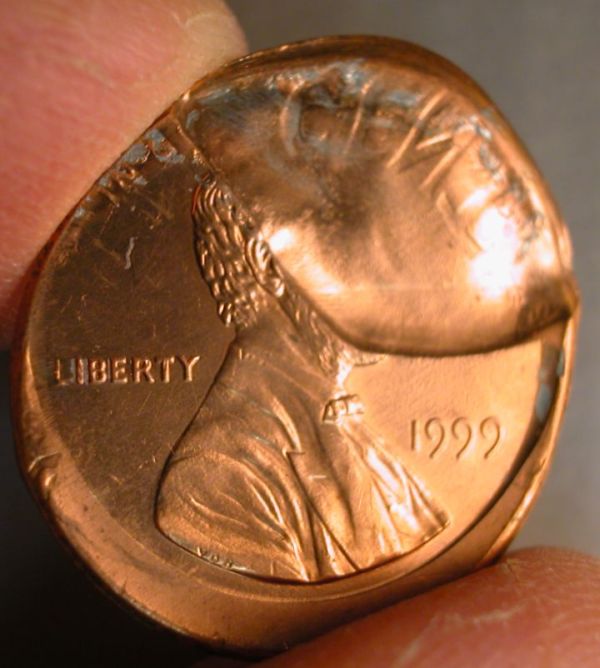
aligned_part_brkg_1999_1c

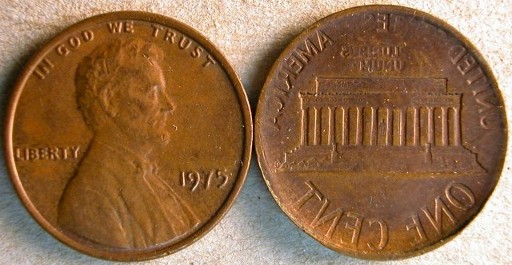
This broadstruck 1999 cent shows an aligned partial brockage of the reverse design on the obverse face. It was almost certainly generated by a partial die cap.
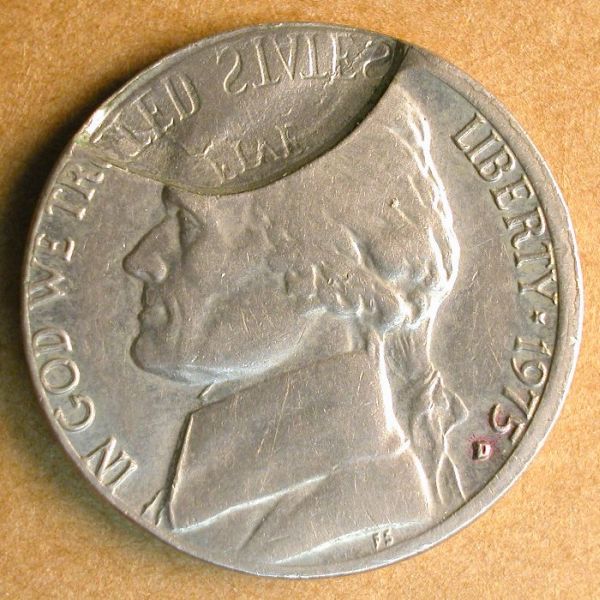
aligned_part_brkg_1975D_5c

This 1975-D nickel shows an aligned partial brockage of the reverse design on the obverse face. It was struck fully within the collar. The presence of a design rim impression and the absence of horizontal lipping indicates that this brockage was probably generated by a small elliptical clip nickel.

Brockages Aligned Partial Elliptical Strike Clip

PART VI. Striking Errors:

Brockages:

Aligned partial brockages:

From elliptical strike clip

Definition: It is possible for an elliptical clip blank to enter the striking chamber and land in such a way that one side of the ellipse nestles against the collar. Once it is struck, this elliptical clip blank can adhere to the hammer die or remain in place on the anvil die. It will then create an aligned brockage on the next  planchet to be fed into the striking chamber.

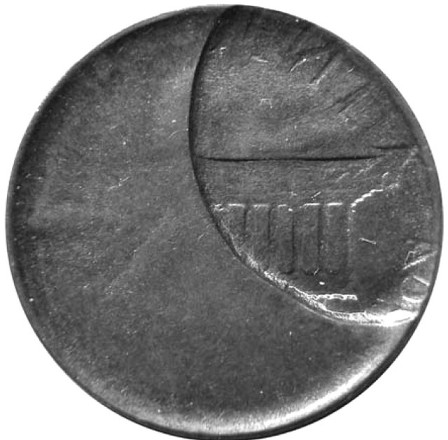
The Lincoln cent below shows a possible example of an aligned brockage caused by an elliptical clip cent or an elliptical strike clip cent. The case is complicated by the fact that the coin was also struck by a late-stage die cap. The obverse (hammer) die was covered by a late-stage die cap that still had a little bit of the Memorial design left on it. Some faint incuse columns of the Memorial to the left of the aligned brockage can be seen. One of three scenarios
transpired to create that aligned brockage:

Scenario 1: An off-center planchet was struck by the capped die, adhered to the bottom (reverse) face of the die cap, and was struck into the next planchet (this cent).

Scenario 2. An elliptical clip blank entered the striking chamber, nestled against the NE quadrant of the collar, and was struck. It then adhered to the bottom of the die cap and was struck into the planchet that became this cent.

Scenario 3. An off-center planchet was sheared in two between the capped hammer die and the collar. The resulting elliptical strike clip adhered to the bottom of the cap and was then struck into the planchet that became this cent.

Brockages


VI. Striking Errors:


Brockages:


First Strike Brockages


Definition: A brockage is an incuse, mirror-image design generated when a coin is struck into a planchet.


NOTE: Brockages can be in-collar, out-of-collar, centered, or off-center.
They can be aligned with, or rotated relative to, the opposite, die-struck
face. The degree of expansion and distortion depends on how many previous
planchets were struck and whether one or both participants in the error were
confined by the collar.


A Lincoln memorial cent with an
in-collar, first-strike brockage of the reverse design on the obverse face. A
cent that had stuck to the obverse (hammer) die was struck into the next
planchet that was fed into the striking chamber beneath it.


Business Strike On A Proof Planchet

PART V. Planchet Errors:

Wrong Planchet & Off Metal Errors:

Business Strike on a Proof Planchet

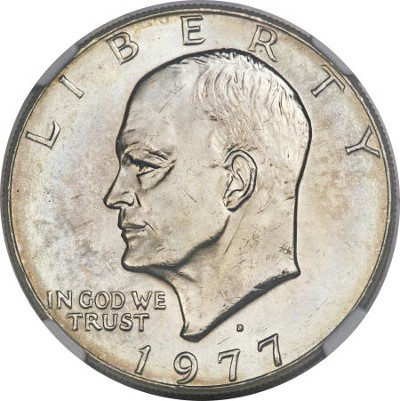
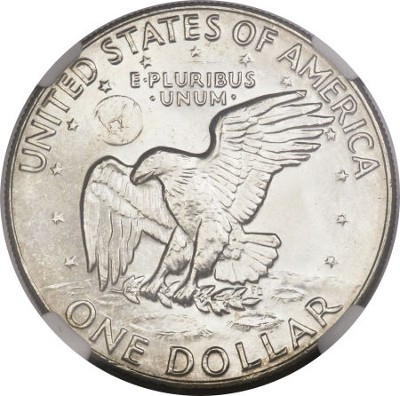
Definition: This occurs when a proof planchet is struck by business-strike dies.

The 1977-D Eisenhower Dollar pictured below was struck at the Denver Mint. The planchet has a 40% silver clad composition and was intended to be struck as a proof at the San Francisco Mint.

Images are courtesy of Heritage Auctions.

Bi Metallic Errors


Error-Variety Ready Reference

Bi-metallic Errors

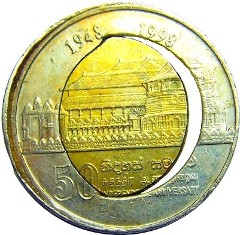
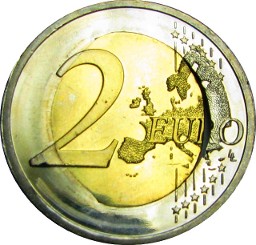
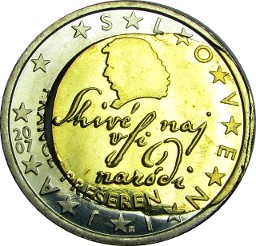
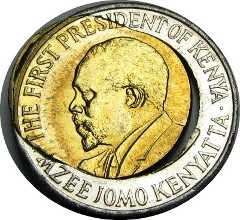
Bi-metallic error coins are restricted to foreign countries. These coins may experience any of the many types of striking errors listed in the Error-Variety Ready Reference however, one must understand we are dealing with two components, a ring & a core. Any number of exotic possibilities or combinations of die varieties, die errors, planchet errors & striking errors can be found on bi-metallic coinage.


Misaligned Cores


A misaligned core may occur for various reasons. Three scenarios are listed below:


(1) Center hole of ring too small, grossly misshapen or both, (too
small or too misshapen to accommodate a correct fit for a
correctly-sized core).


(2) An incorrectly sized core which will not fit into a normal sized center hole of the ring.


(3) An improperly inserted core due to malfunctioning equipment
or inattentive workers, (even when both components are without flaw).


Three images below include obverse face (left), low angle view of edge (center), & reverse face of Sri Lankin 10 Rupees having a misaligned core.


2007 Slovenian two euro with grossly misaligned core.


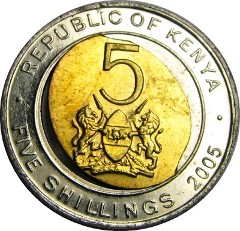
2005 Kenyan 5 Shillings with grossly misaligned core.


Misaligned Center Hole


Either the punch or the solid ring
planchet was misaligned when the disc was peirced. The core itself
appears misaligned only because the center hole is off-set.

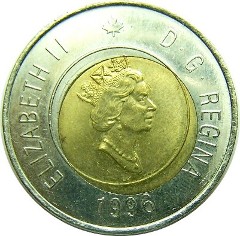
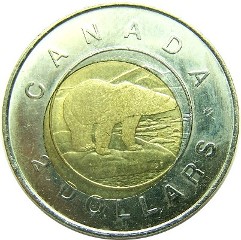
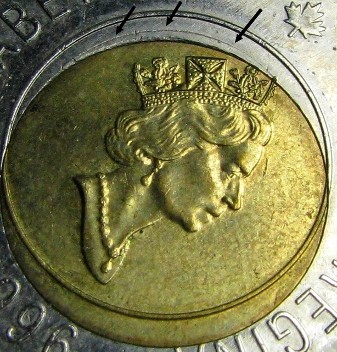
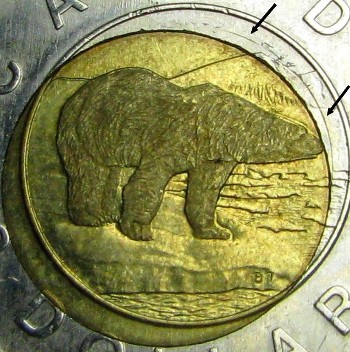
1996 Canadian polar bear two dollars. The center hole is clearly misaligned.


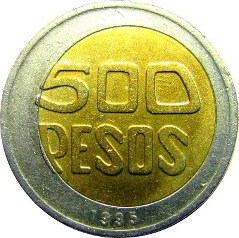
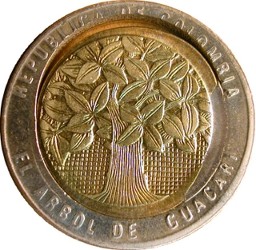
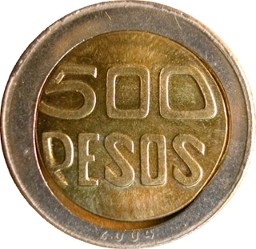
1995 Columbian 500 pesos with center hole misaligned.


Double Punched center hole


2004 Columbian 500 pesos. The center hole has clearly been double punched.


Incomplete Second Punch


1996 Canadian polar bear two dollars. While the center hole is clearly misaligned, there was an unsuccessful attempt to punch the ring a second time. Second punch scaring is evident on both obverse & reverse face (black arrows indicate second punch scaring).


Struck Outer Rings


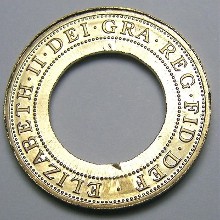
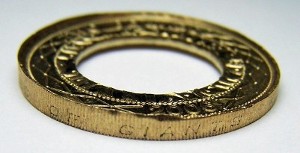
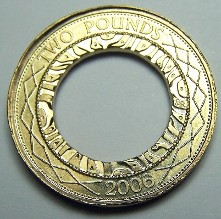
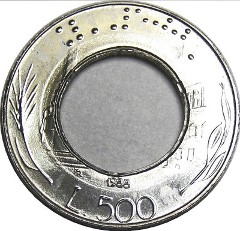
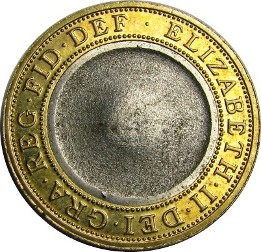
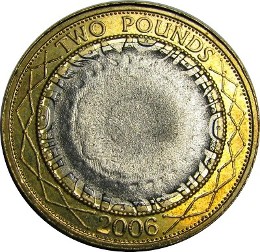
An outer ring struck without a core will expand inward. This results in design elements that are normally restricted to the core appearing on the inner portion of the abnormally wide ring.


This type of error allows in-depth study of how the ring and core interlock and join together.


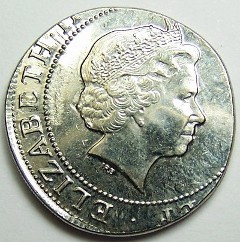
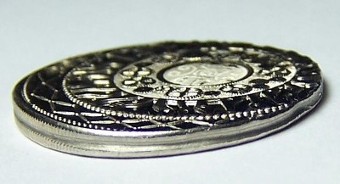
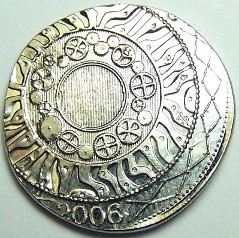
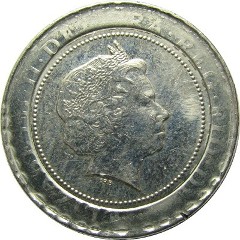
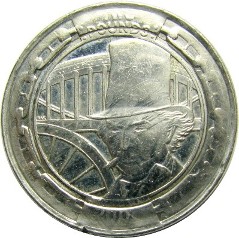
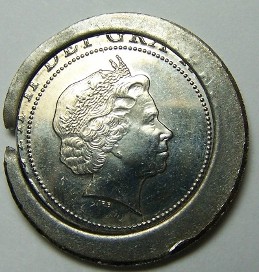
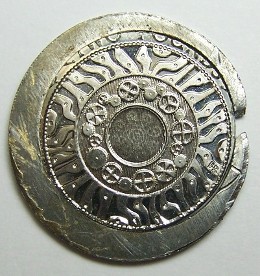
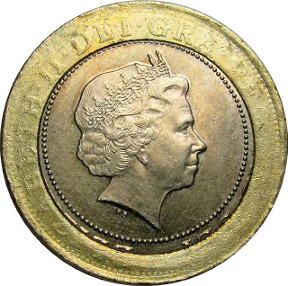
Three images below include obverse face (left), low angle view of edge (center), & reverse face of 2006 Great Britain two pound Technology coin with no core present.


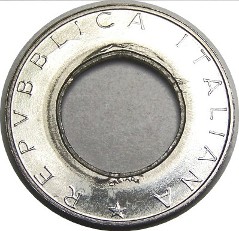
1988 Italian 500 lire coin with no core present.


Struck Core


A core enters the striking chamber without having been joined or mated with its ring.


The nature of this error allows a complete study as to the method of interlock joining the ring and core together.


Obverse face (left), low angle view of edge (center), & reverse face (right) of Great Britain two pound Technology core. Note the groove along the edge of the core. The groove accommodates metal from the ring that is extruded into it. At the same time, the metal on either side of the groove is designed to penetrate the innermost portion of the outer ring when joined.


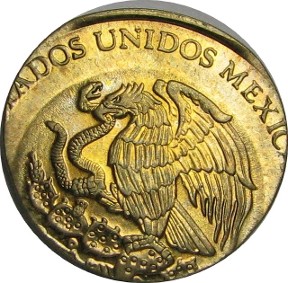
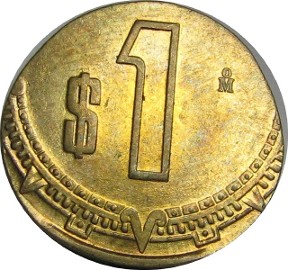
Mexican one pesos struck on core.


Struck Core from another country


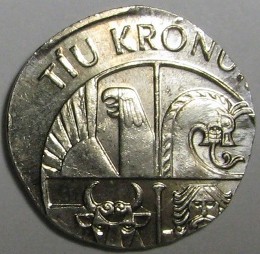
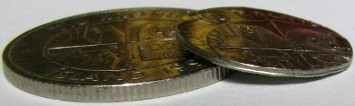
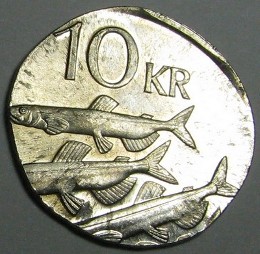
A mind blower, these are an extremely rare encounter. The example shown below is from Iceland which has never used bi-metallic coinage during its entire history.


Obverse face (left), low angle view of edge (center),
& reverse face (right) of Icelandic 10 kronor.
(Center image is a comparison with a normal 10 kronor. The groove around the edge is quite obvious).


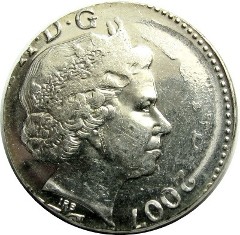
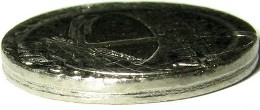
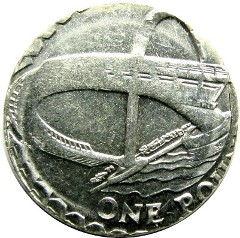
Another mind blower. While Great Britain has bi-metallic coinage, this magnetic nickel core was destined for a one euro denomination bi-metallic coin (country unknown). This core found its way into the striking chamber for a 2007 British one pound Gateshead coin.


Obverse face (left), low angle view of edge (center),
& reverse face (right) of British one pound Gateshead struck on a one euro core.
(Center image clearly indicates groove around the edge).


Wrong Ring


Occurs when a normal core is joined with a wrong ring. These errors are unequivocally rare.

Two pound 2006 Isambard Brunnel from Great Britain. The ring is is stongly attracted to a magnet. (Either elemental nickel or steel composition).


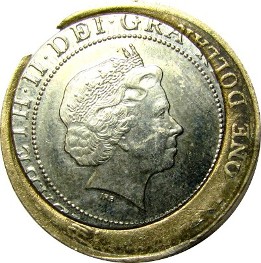
Two pound Technology from Great Britain. Ring is strongly attracted to a magnet (steel ring). The ring also has a misaligned center hole. The ring is much thinner than the core resulting in the near incomplete absence of design transfer on either face of the ring.


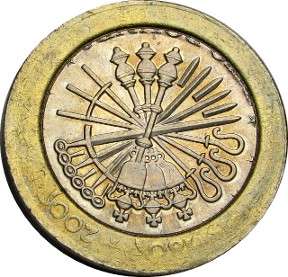
Two pound 2007 Gun Powder Plot from Great Britain with wrong ring. The ring also has a misaligned center hole. The ring is thinner than the core resulting in the absence of some design transfer on either face of the ring.


Ring accidentally punched from solid coin


Exotic and extremely rare encounter

An incredible occurrence; a previously
struck Hong Kong one dollar coin (solid) was center hole
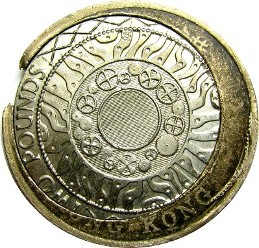
punched creating a morphed outer ring. This ring was then joined with a core and struck by two pound technology dies from Great Britain.


Wrong Core inserted


An incorrect core is wrongly inserted into the ring center hole. Occurrences are quite rare.

2006 two pound technology from Great Britain having a steel core inserted before strike. (Core is strongly attracted to a magnet).


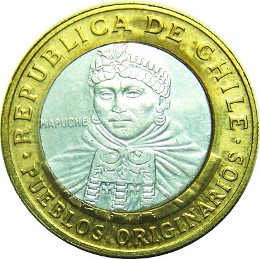
2005 Chilean 100 Pesos having an aluminum core inserted before strike.


Incomplete Trilaminar Core


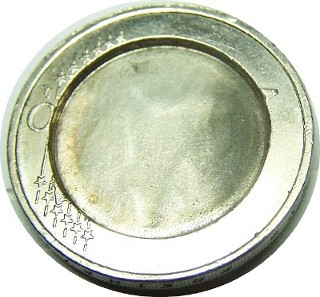
Two euro denomination bi-metallic coins have a trilaminar core. The core is a disc composed of elemental nickel sandwiched by a thin layer of nordic gold on either face.

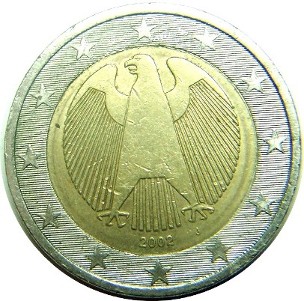
2002 two euro from Germany missing both the center nickel and outer trilaminar layer on the obverse face. Examples are known from various european countries.


Bi-metallic planchet struck with Wrong Bi-metallic Design


A bi-metallic planchet enters the striking chamber fitted with the wrong design dies.


2005 Chilean 100 pesos struck with wrong bi-metallic planchet design (ring & core).


Bi-metallic planchet struck by solid Denomination Dies


An unstruck bi-metallic planchet enters the striking chamber meant for solid planchets.


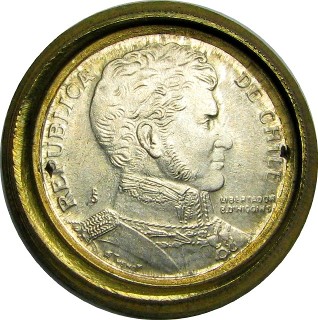
2006 Chilean 10 pesos on 100 pesos bi-metallic planchet. 


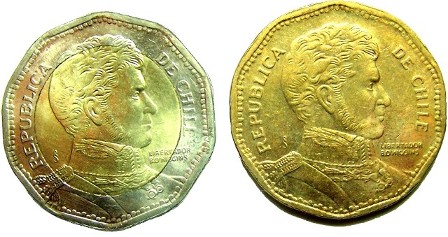
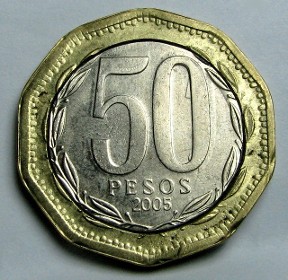
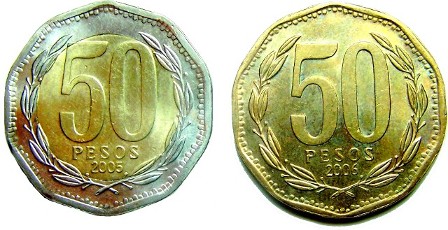
2005 Chilean 50 pesos struck on a multi sided bi-metallic planchet. While Chile has bi-metallic coins, none are multi sided. Side by side comparison images of obverse & reverse faces with a normal solid, multi sided 50 pesos is shown. Only the one, five & 50 pesos coins from Chile are currently multi sided.


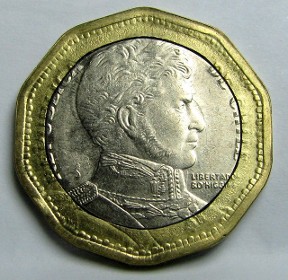
2005 Chilean 50 pesos struck on a multi sided bi-metallic planchet. While Chile has bi-metallic coins, none are multi sided. Only the 100 and 500 Chilean pesos coins are currently bi-metallic. 


Solid Denomination planchet struck by Bi-metallic Dies


A solid planchet enters the striking chamber meant for bi-metallic planchets. 


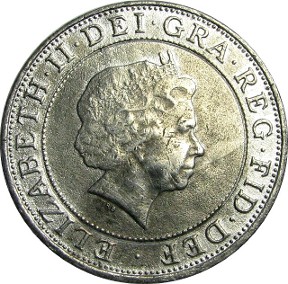
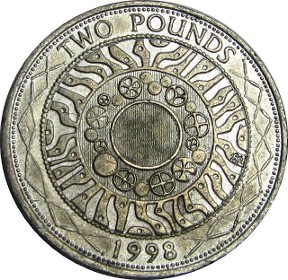
1998 British Two pound technology on unknown planchet. Struck by bi-metallic dies.


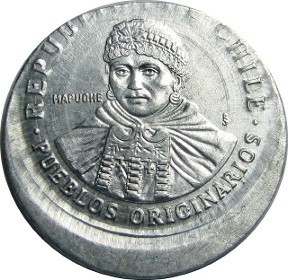
2003 Chilean 500 pesos on a bronze planchet. Struck by bi-metallic dies.


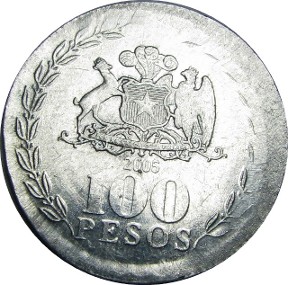
2005 Chilean 100 pesos on an aluminum planchet. Struck by bi-metallic dies.


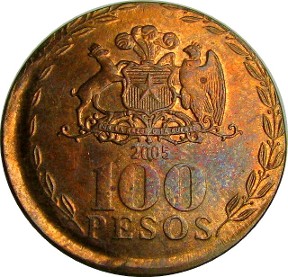
2005 Chilean 100 pesos on a copper planchet. Struck by bi-metallic dies.


2005 Chilean 100 pesos on a bronze planchet. Struck by bi-metallic dies.


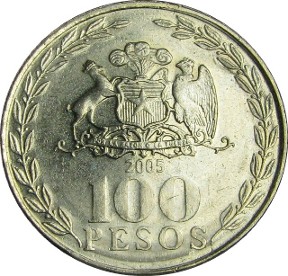
2005 Chilean 100 pesos on solid planchet. Struck by bi-metallic dies.


  • « Previous Page
  • 1
  • …
  • 16
  • 17
  • 18
  • 19
  • 20
  • 21
  • Next Page »
  • Home
  • Introduction To This Website
  • Error-ref.com News
  • Comprehensive Error-Variety Checklist
  • Index Of Completed Entries
  • Part I. Die Subtypes:
  • Part II. Die Varieties:
  • Part III. Die Installation Errors:
  • Part IV. Die Errors:
  • Part V. Planchet Errors:
  • Part VI. Striking Errors:
  • Part VII. Post-Strike Mint Modifications:
  • Part VIII. Post-Strike Striking Chamber Mishaps:
  • Part IX. Post-Strike Mint Damage:
  • Part X. Wastebasket / Composite Categories:
  • Part XI. Non Errors:
  • Featured Articles Of Interested
  • Interest & Not So Interesting Facts
  • Other Sites And Forums Of Interest
  • Our Thanks Go To
  • About The Authors
  • Contact Us

Copyright © 2026