Error-Ref.com

You are here: Home / Search for "off center"

Search Results for: off center

Crescent Curve Clips

PART V. Planchet Errors:

Blanking and Cutting Errors:

Curved Clips:

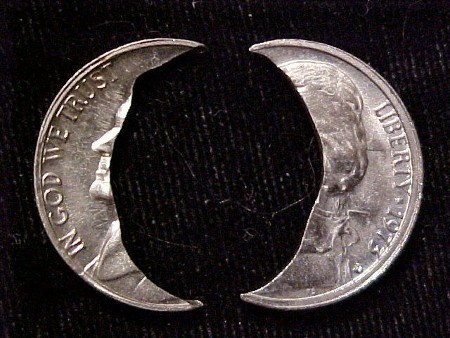
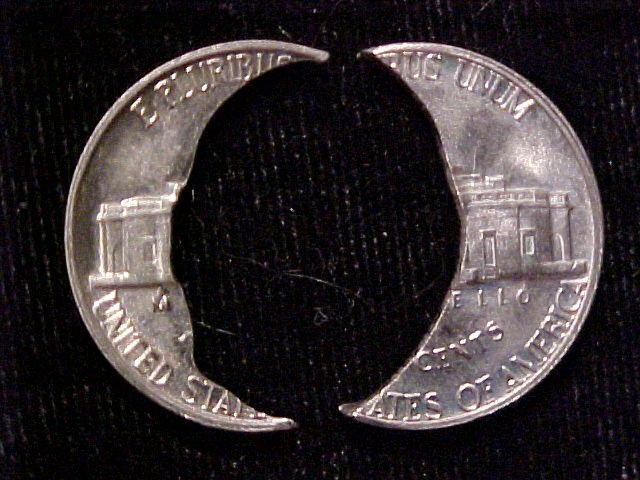
Crescent Clip


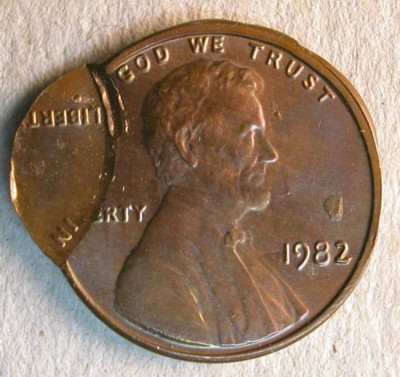
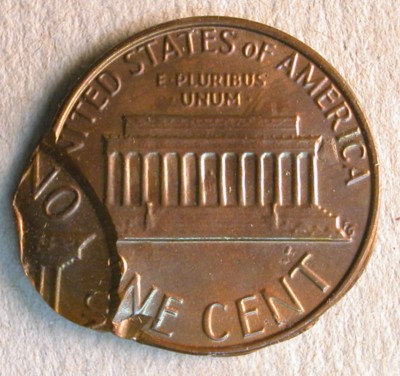
Definition: The term “crescent clip” or “crescent curved clip” is used for coins struck on planchets with exceptionally large clips.  Alan Herbert defines a crescent clip as one that has subtracted more than 61% of the normal weight.  We feel this is too generous and use a threshold of 75%.

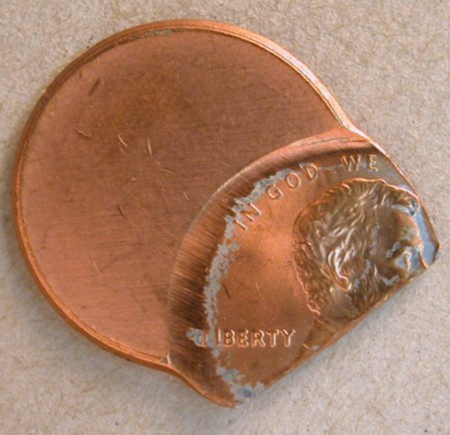
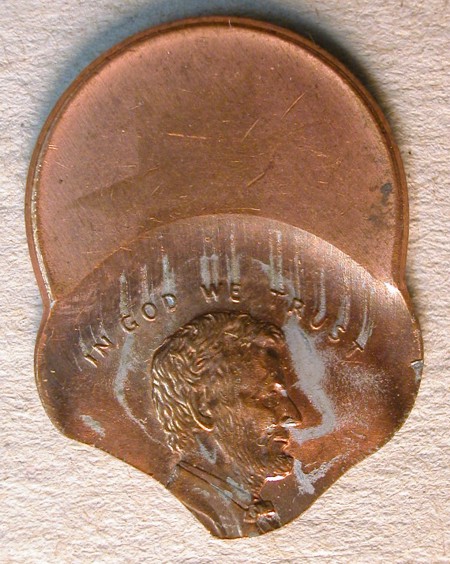
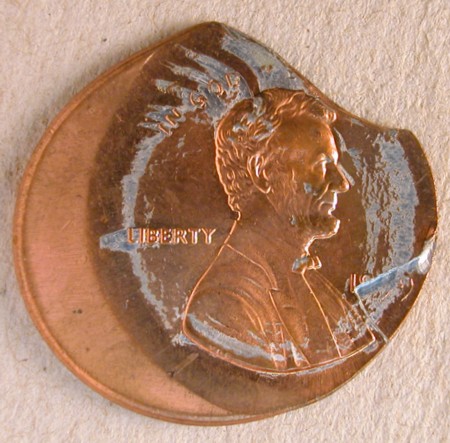
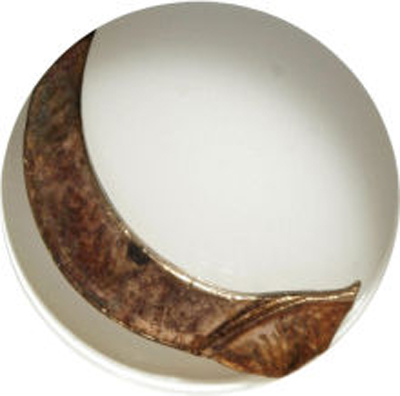
The images below show an undated cent with off-center strike on a crescent clip planchet. Images are courtesy of Heritage Auctions.
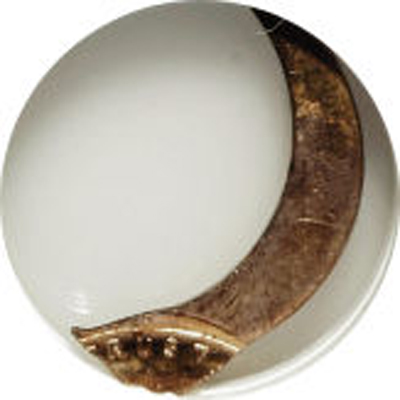
 

Below are images of a pair of crescent clip nickels. Images courtesy Ynes Zavala.


Crescentic Cud

PART IV. Die Errors:

Cuds: 

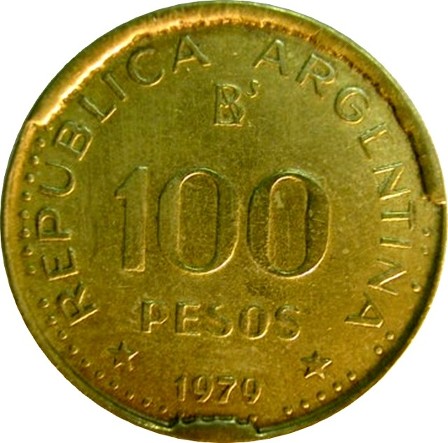
Crescentic Cud


Definition: A relatively uncommon form of cud is the crescentic cud. As the name implies, a crescentic cud is long and thin, and follows the curvature of the die. It results when the outer margin of the die neck breaks away.

Crescentic cuds reflect the presence of a circular or semi-circular zone of weakness somewhere near the periphery of the die neck.  Contributing causes may include improper heating, cooling, tempering, or quenching of the die.  This creates a boundary zone across which the hardness and brittleness of the die steel changes abruptly.  Under stress, the outer part of the die neck would tend to crack and break off.

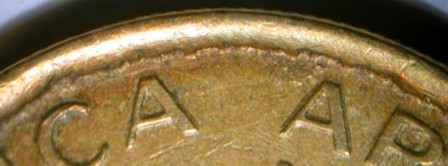
Depicted below is an Argentina 100 pesos with a long, thin, crescentic cud on the obverse face. A small ovoid cud is located at the opposite pole.

Cuds

Part IV. Die Errors:

Die Breaks:

Cuds

Definition:  A cud is a die break that involves the rim and at least a little bit of the adjacent field or design.  The vast majority of sizable die breaks are cuds.  Cuds can assume a wide variety of shapes including ovoid, crescentic, and irregular.  Most cuds represent spontaneous brittle failure.  A small minority arise as the result of impacts.

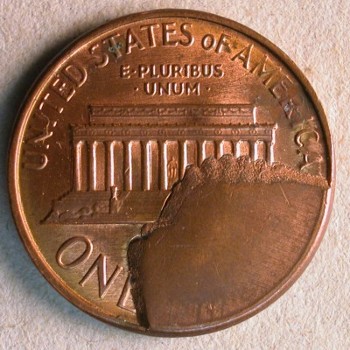
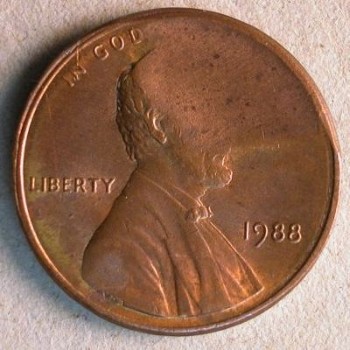
A large cud is seen on the reverse face of this 1988 cent.  The obverse face shows a featureless pucker where coin metal withdrew from the obverse die and bulged into the void in the reverse die face.

Many cuds maintain a consistent size and shape through a production run.  Some cuds grow larger through a production run as additional pieces of die steel break off.

69707299 69707301

69707303 69707308

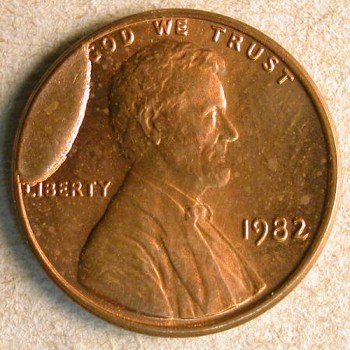
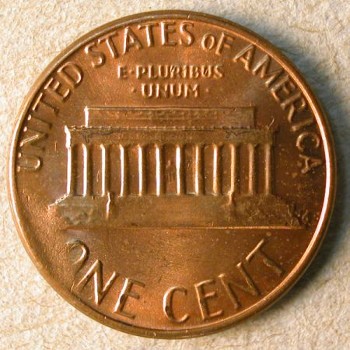
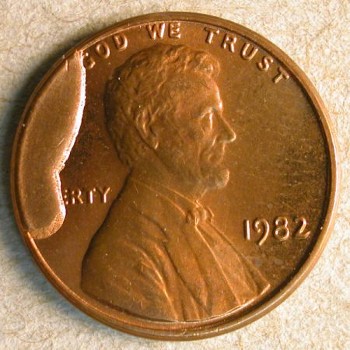
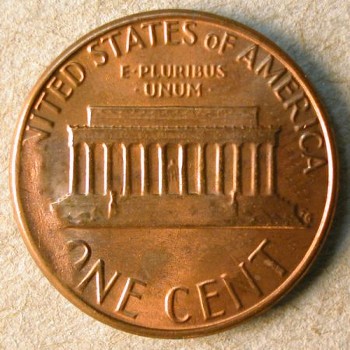
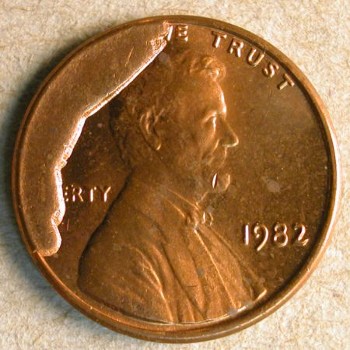
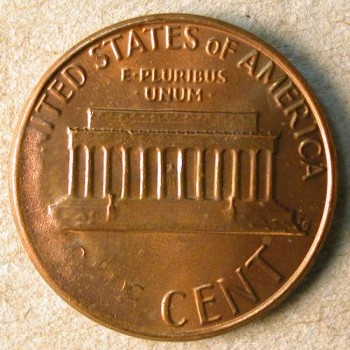
Shown above is a three-stage cud progression in a 1982 cent.  In Stage 1, the cud is ovoid.  In subsequent stages the cud grows larger and more irregular.

69707452 69707494 69707499 69707519

Shown above is a three-stage cud progression on the reverse (1062 Flud) of an 1863 Broas Pie Baker store card token from the Civil War era.

Canadian Assisted Errors

PART V. Planchet Errors:

Wrong Planchet & Off-metal Errors:

Struck on Larger Planchet or Coin:

Canadian “Assisted” Errors

Definition: An assisted error is one that had a helping hand from inside the Mint.  The assist could occur at any stage in the minting process and may simply involve the intentional release or smuggling-out of an accidental error.  A subcategory is the “intentional error” which is a coin both intentionally fabricated and smuggled out.  It is also possible for a mint employee to intentionally create an error as a lark, with the coin leaving in a shipment of ordinary coins.

Assisted errors are not to be confused with coins or planchets manipulated outside the mint. Assisted errors are genuine mint products and carry a hefty premium.  Coins altered outside the mint are worthless.

The Royal Canadian Mint has been the source of many assisted errors.  The peak year seems to be 1978.

Click HERE for more information concerning assisted errors.

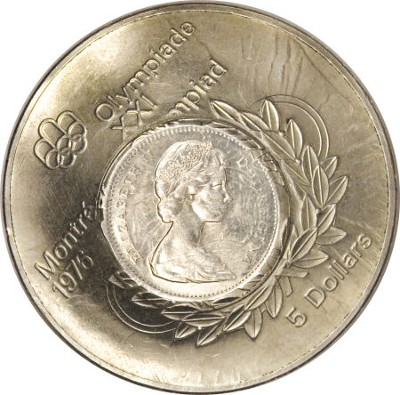
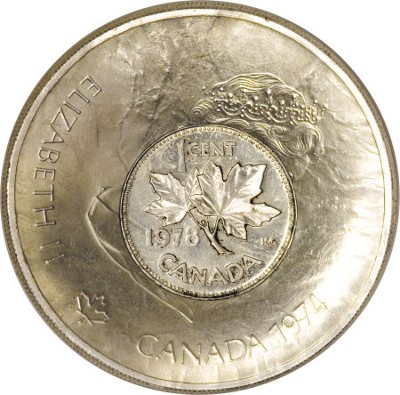
This 1974 Canada Olympic commemorative silver five dollar coin was later struck with 1978 Canada cent dies. This mint error undoubtedly required an assist from the press operator.

Images are courtesy of Heritage Auctions.
Capped Die Doubling Raised

Part VI. Striking Errors:
Capped Die Strikes:

Capped Die Doubling:

Raised Doubling

Definition: Capped die strikes sometimes develop patterns of raised doubling that are rather difficult to understand.  They can be quite variable in appearance.

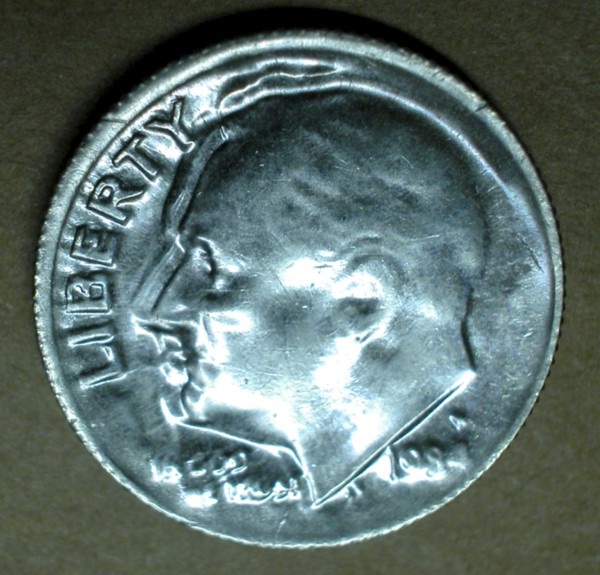
One form of raised doubling seen in capped die strikes has been given the name “expansion ripples”.  It takes the form of one or two offset raised outlines that parallel large, centrally-located design elements, like busts.


This 1984-P Roosevelt dime was struck through a late-stage die cap.  A well-defined expansion ripple can be seen to the left of Roosevelt’s face.
Close, raised doubling sometimes develops in association with coins struck through dislodged and shifted late-stage die caps or detached cap bottoms.  Both laterally shifted die caps and rotated die caps can show this effect.  The direction and extent of separation of the raised doubling bears no relationship to how much the cap shifted.

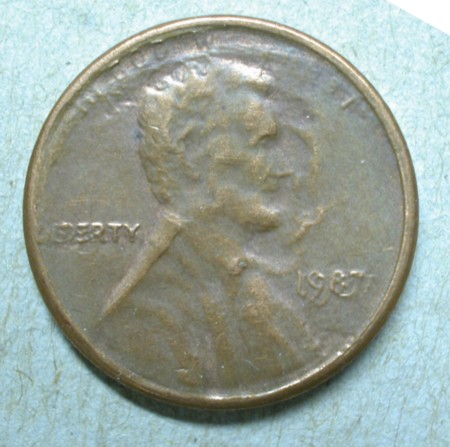
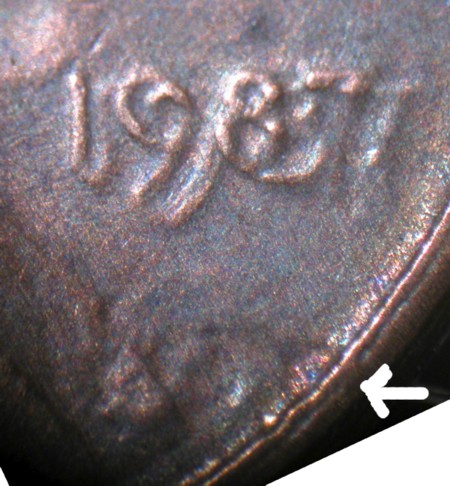
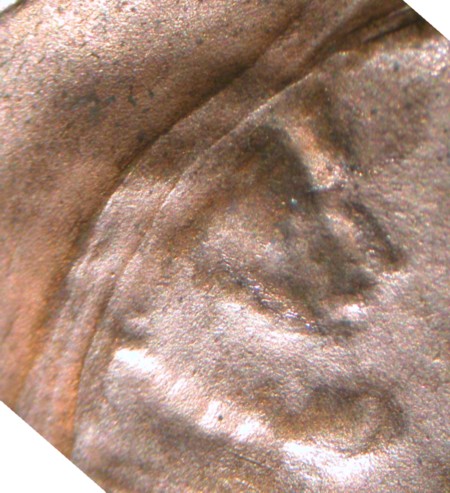
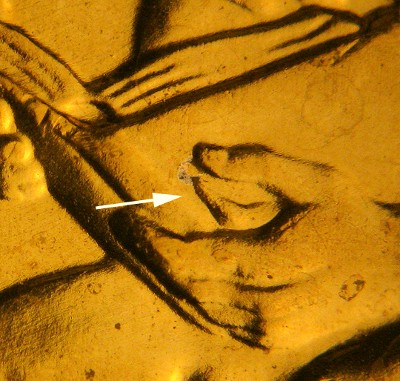
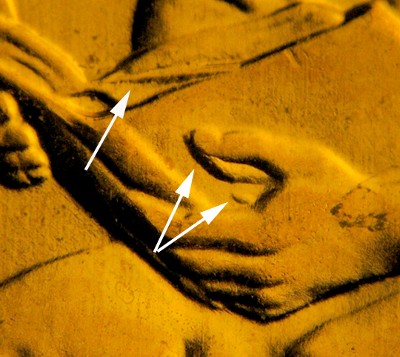
This 1987 cent was struck through a dislodged and laterally shifted late stage die cap.  The die cap shifted toward the southeast.  An extensive set of normally-oriented incuse design elements was left on the obverse face from the bottom of the die cap.  A sunken crescentic “zone of collapse” is located on the northern end of the coin.  This marks where the wall of the cap was crushed into the planchet.  Close, raised doubling can bee seen on the date.  The direction and extent of doubling is completely unrelated to the direction and extent of movement of the die cap.  A normally-oriented incuse date is indicated by the white arrow.
Whole blocks of raised letters are sometimes duplicated and completely offset from the normal letters.


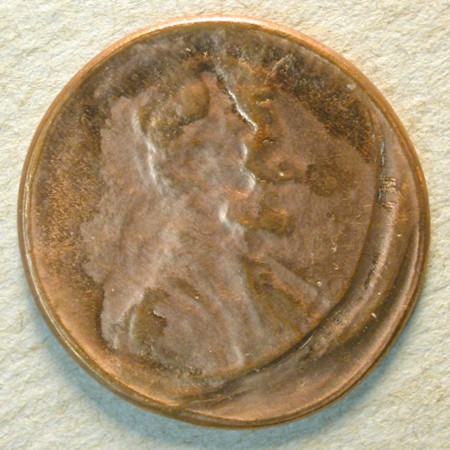
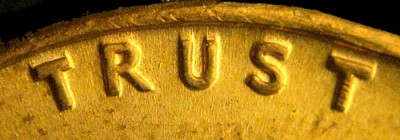
This broadstruck cent was struck through a late-stage die cap that fell off the obverse (hammer) die and shifted to the northwest.  A crescentic “zone of collapse” is located in the southeast quadrant.  When the cap was crushed into the planchet represented by this coin, it left a behind a normally-oriented incuse bust of Lincoln.  That much is to be expected.  What was unanticipated is the wholesale duplication of the word TRUST beneath the normal TRUST (the latter blurred from having been struck through the floor of the die cap.  Once again the direction of the raised doubling (SSW) and the distance between the two words is totally unrelated to the direction and distance of travel of the die cap.

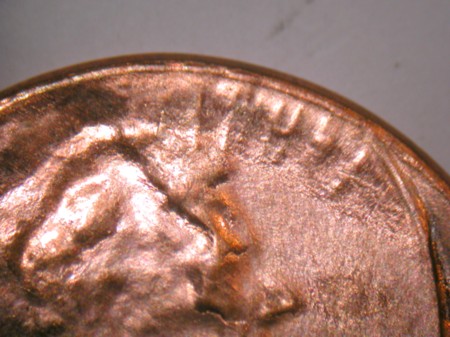
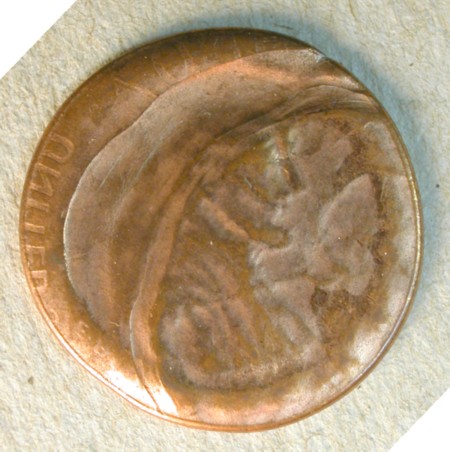
The massively broadstruck cent shown below was struck through a shifted, late-stage die cap.  The die cap shifted to the southeast before it was struck into the planchet represented by this coin.  The bottom of the die cap left an enlarged, normally-oriented incuse bust on Lincoln in the southeast quadrant.  A broad zone of collapse is seen hugging the back of the raised bust of Lincoln.  That raised bust is the normal “ghost image” that bled through the thin floor of the cap from the obverse die.  Close raised doubling is seen in Lincoln’s face.

Perhaps the most peculiar feature of this coin is the nearly centered, first-strike brockage of the reverse design.  As far as we know, such impression could only have been left by a normal (or nearly normal) cent.  That cent would have had to lie above or beneath the shifted cap.  But this presents and insuperable problem.  If the cent had been interposed between the obverse (hammer) die and the shifted cap, this should have prevented the appearance of a raised ghost image.  And if the cent had been interposed between the planchet and the shifted cap, it should have prevented formation of both the raised ghost image and the normally-oriented incuse image.  Evidently, something very odd transpired here.

A more detailed discussion of these specimens can be found in the June 9, 2012 Coin World.


Catastrophic Die Damage

Part IV. Die Errors:

Die Damage:

Catastrophic Die Damage

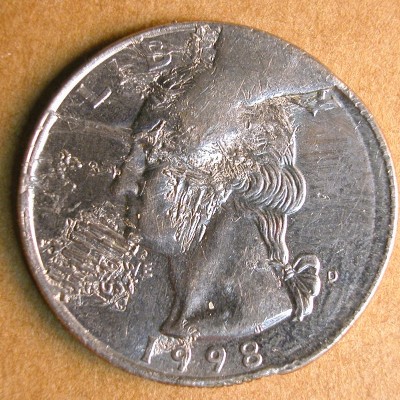
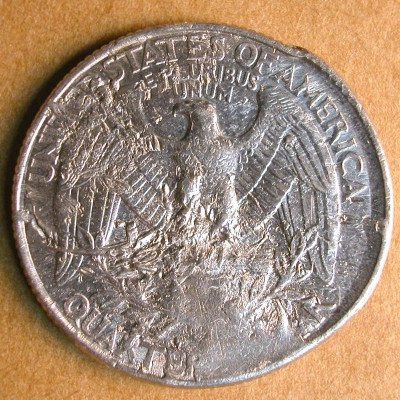
Definition: Severe impact damage that covers an extensive area on one or both die faces.  Such damage can result from the dies striking a large mass of foreign matter that is hard and brittle.  It can also result from a piece of a broken die or broken collar entering the striking chamber and shattering on impact.

Both of the dies that struck this 1998-D quarter were heavily damaged after installation.  In addition to widespread impact damage, the obverse die features a large cud (marginal die break).  The right side of the collar has also broken off, leaving a collar cud (collar break) that extends from 2:00 to 5:00 (obverse clock position).

It’s possible that the impact damage, cud, and collar cud were all generated when a large piece of brittle metal intruded into the striking chamber and shattered upon impact.  Alternatively, it could be that the process was initiated when a fragment from the obverse die or a fragment of the collar fell between the dies and exploded upon impact.

Centrally Located Doubling

PART II. Die Varieties:

Doubled Die:

Single Squeeze Hubbing:

Centrally-located doubling


Definition:  The majority of centrally-located doubled dies are generated by the single-squeeze method of hubbing. During the single- squeeze process, two mishaps may occur.  Sometimes a slightly tilted hub (or die) will settle spasmodically, causing a “skip” that will generate a secondary image.  At other times a technician will interrupt a hubbing in its early stages in order to re-position the hub or the die.  When the hubbing is restarted, this

may result in offset impressions.  This is not inevitable, however, as the second hubbing may obliterate the impression left by the first hubbing.

The following images (top left and right) depict some centrally-located doubled dies seen on the 2009(FY) Lincoln cent reverse die.

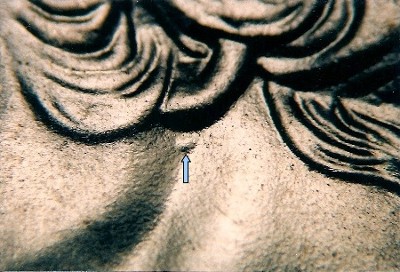
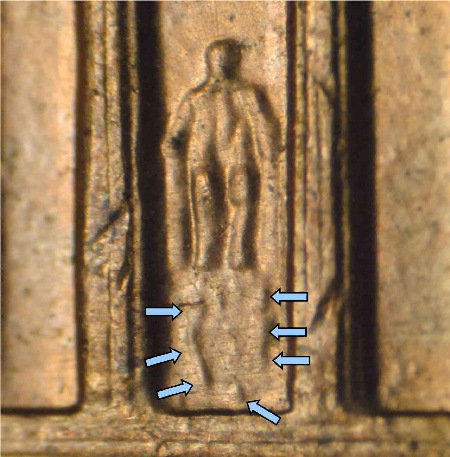
The image located above left shows a doubled ear lobe on a 2008 Alaska statehood quarter. The image to the right is a bit more unusual; this doubled die is found on a 2000P Lincoln cent. It shows a faint secondary statue of Lincoln located beneath and rotated 180° relative to the regular statue. The images are courtesy of John Wexler.

Chain Strikes

PART VI. Striking Errors:

Chain Strikes

Definition:  A chain strike occurs when two planchets, two coins, or a coin and a planchet lie right next to each other or abut one another within the striking chamber.  During the strike, the two expanding discs make contact where the original separation was narrowest.  The edges then flow together to form a line of contact whose length is variable.

While most chain strikes take the form of a straight edge, other shapes do occasionally appear.  Convex, concave, and sinuous chain strikes have been documented.  In some cases an indent lies alongside or is flanked by a chain-struck edge.

As one might expect, most chain strikes are associated with off-center strikes.  However, a subtype, the “external chain strike” is found in association with centered or uncentered broadstrikes.  In an external chain strike, the expanding edge of the broadstrike makes contact with the unstruck portion of an off-center coin protruding from an adjacent striking chamber.  The circular outline of the broadstrike is interrupted by a flat segment.

Chain strikes are sometimes mistaken for straight and curved clips.  Several diagnostics serve to distinguish the two errors:

  1. A chain strike shows a distinct contact facet while a clip doesn’t.
  2. Design elements bordering a chain strike show no metal flow.  Design elements bordering a clip will show metal flow.
  3. A coin with a chain strike will weigh the same as a normal coin.  A coin with a clip will be underweight

Above, at left, is a conventional chain strike with a straight edge.  At right is an off-center cent with a concave chain strike located along the lower left portion of the struck tongue of metal.

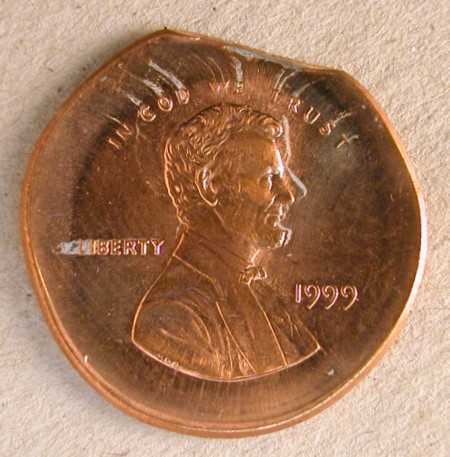
The off-center 1999 cent seen above (left) shows a sinuous (sigmoidal) chain strike.  The 1999 cent shown above right is a centered broadstrike with an external chain strike at the 1:00 position.

Change From 1960 Small Date To Large Date On The L


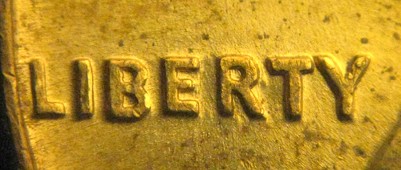
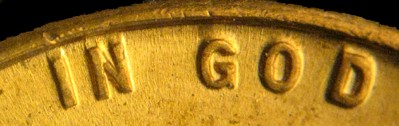
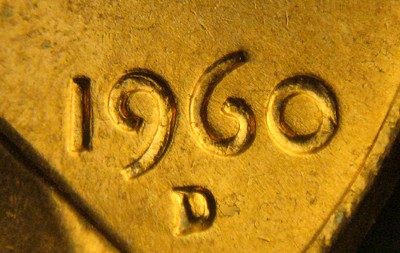
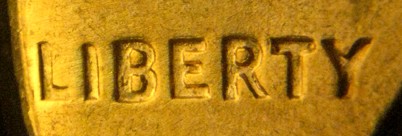
Change from the small date to large date on the 1960 Lincoln cent


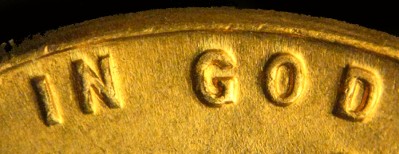
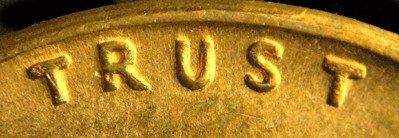
The first Lincoln cent for 1960 produced is referred to as the small date. It appears that the master hub had the date, LIBERTY and IN GOD WE TRUST abraded off the hub and a new master die was made missing these design elements.


The master die was then engraved with the date, LIBERTY and IN GOD WE TRUST. This in turn made the new master hub which made a new master die for the year.


In the later part of April or the beginning of May, the U.S. Mint introduced a new obverse for the 1960 Lincoln cent that incorporated some changes in the design elements.


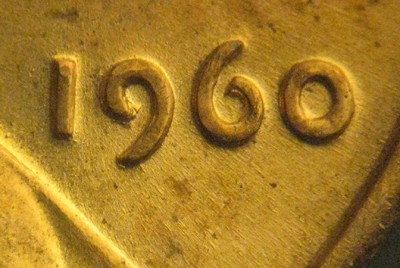
The digits in the date were thinned and the 6 and 0 digit enlarged. The Mint stated that there was a reoccurring problem with the last two digits of the date chipping out.


The word LIBERTY seemed to revert to the style found on the 1959 Lincoln cent.


While the words IN GOD WE saw no changes, the word TRUST did have some minor changes made, most notable to the R in TRUST.


There has been some contention as to why the Mint made this change. At first, the director of the Mint denied that a change had taken place and only later, when evidence arose that conflicted with his statement, did the story change.


There maybe more to this story than we know. For an in depth look at what may have happened CLICK HERE


Chipped Collar

PART IV: Die Errors:

Collar Cuds:

Chipped Collar


Definition: Bits of the collar can chip off, either spontaneously or as the result of impacts. Collar chips are recognizable on the edge of the coin as small, raised defects. Their appearance differs between smooth-edged and reeded issues. In smooth-edged issues, collar chips typically extend down from the rim struck by the hammer die but seldom reach the opposite rim. In reeded issues they are always vertically oriented and often extend from one rim to the other.

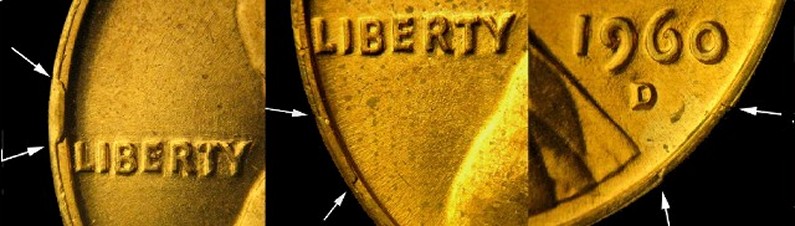
Double-struck 1982 cent with die dents and impact scars on both faces. Two large, contiguous collar chips on the edge extend from 11:00 to 2:00.

Close-up of the two collar chips showing how they extend down from the obverse rim (center image).


The above images show collar breaks on 1960 D small date Lincoln cents.


  • « Previous Page
  • 1
  • …
  • 15
  • 16
  • 17
  • 18
  • 19
  • …
  • 21
  • Next Page »
  • Home
  • Introduction To This Website
  • Error-ref.com News
  • Comprehensive Error-Variety Checklist
  • Index Of Completed Entries
  • Part I. Die Subtypes:
  • Part II. Die Varieties:
  • Part III. Die Installation Errors:
  • Part IV. Die Errors:
  • Part V. Planchet Errors:
  • Part VI. Striking Errors:
  • Part VII. Post-Strike Mint Modifications:
  • Part VIII. Post-Strike Striking Chamber Mishaps:
  • Part IX. Post-Strike Mint Damage:
  • Part X. Wastebasket / Composite Categories:
  • Part XI. Non Errors:
  • Featured Articles Of Interested
  • Interest & Not So Interesting Facts
  • Other Sites And Forums Of Interest
  • Our Thanks Go To
  • About The Authors
  • Contact Us

Copyright © 2026