Error-Ref.com

You are here: Home / Search for "off center"

Search Results for: off center

Incomplete Plating

PART V. Planchet Errors:

Plating Errors:

Incomplete Plating

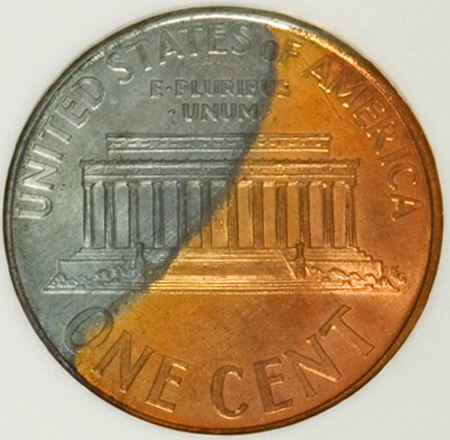
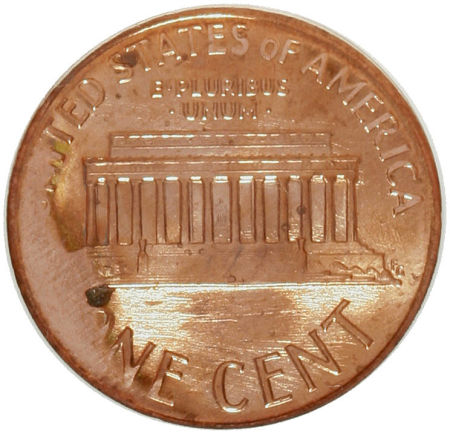
Definition: This error type occurs when a zinc cent planchet is not fully coated with copper in the plating bath.  The zinc core therefore remains exposed.

It is important to note that exposure of the zinc core prior to the strike can have other causes.  On rare occasions the copper plating peels off before the strike.  Pre-strike damage is another cause.  

The 1995-D Lincoln cent pictured below was struck on a partially plated planchet.
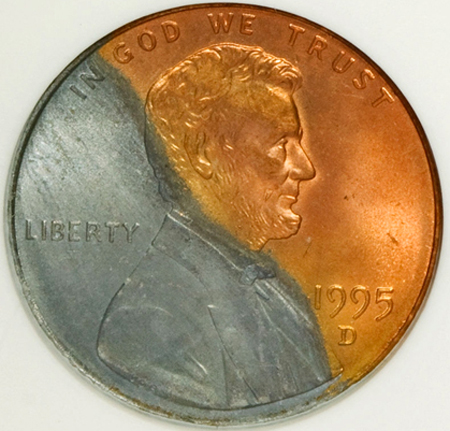
 Images are courtesy of Heritage Auctions.
Incomplete Punch

Part V: Planchet Errors:

Blanking and Cutting Errors:

Incomplete punch (a.k.a, incomplete clip):


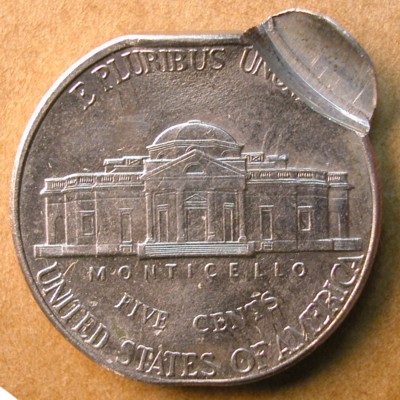
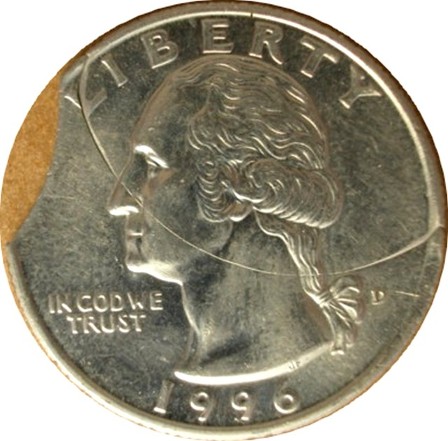
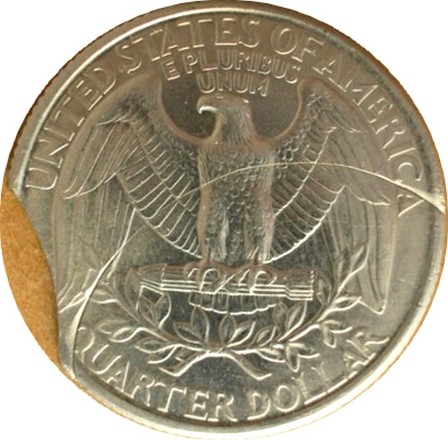
Definition: An incomplete punch represents an area of the coin metal strip where the blanking die (punch) failed to penetrate completely.  If the strip fails to advance properly, the blanking die will slice through part of the circular punch mark, creating a blank with a crescentic punch mark.

Incomplete punch errors may be derived from portions of the strip used to adjust the depth of penetration of the blanking die.  However, their frequent co-occurrence with conventional curved clips suggests that they can develop spontaneously and at any point along the strip.

Genuine incomplete punch errors are quite rare. The following diagnostics will assist in identifying an authentic incomplete punch:

1. A genuine incomplete punch is very sharp and narrow.

2. A genuine incomplete punch penetrates the surface of the coin.

3. On both faces, the surface of the coin should be undistorted on either side of the punch mark.

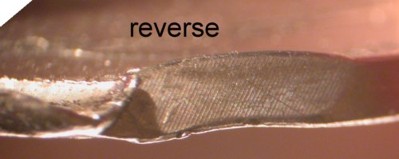
4. A genuine incomplete punch will be visible on the edge of the coin.

For expanded treatment concerning clipped coin diagnostics click here.

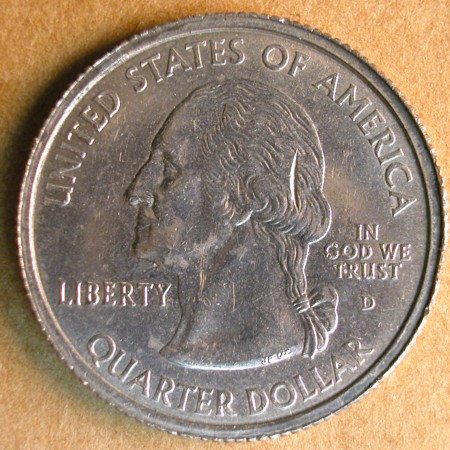
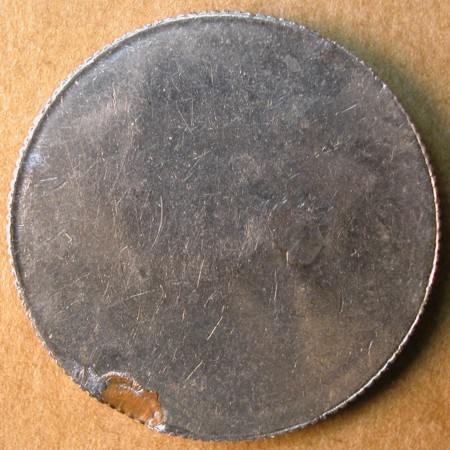
The 1996-D quarter shown here has both an incomplete punch and a conventional curved clip.

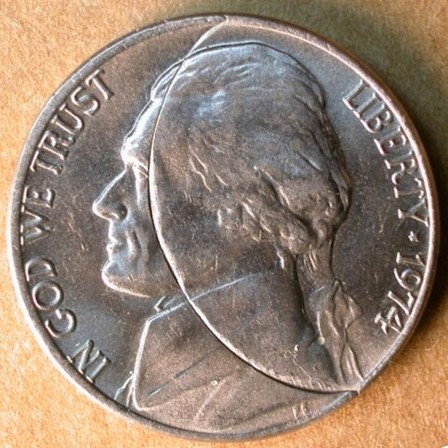
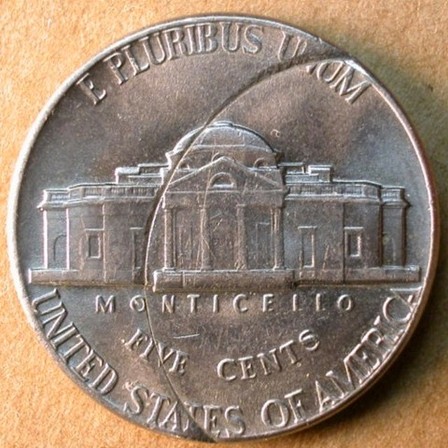
Below is a 1974 Jefferson nickel with a genuine incomplete punch error.

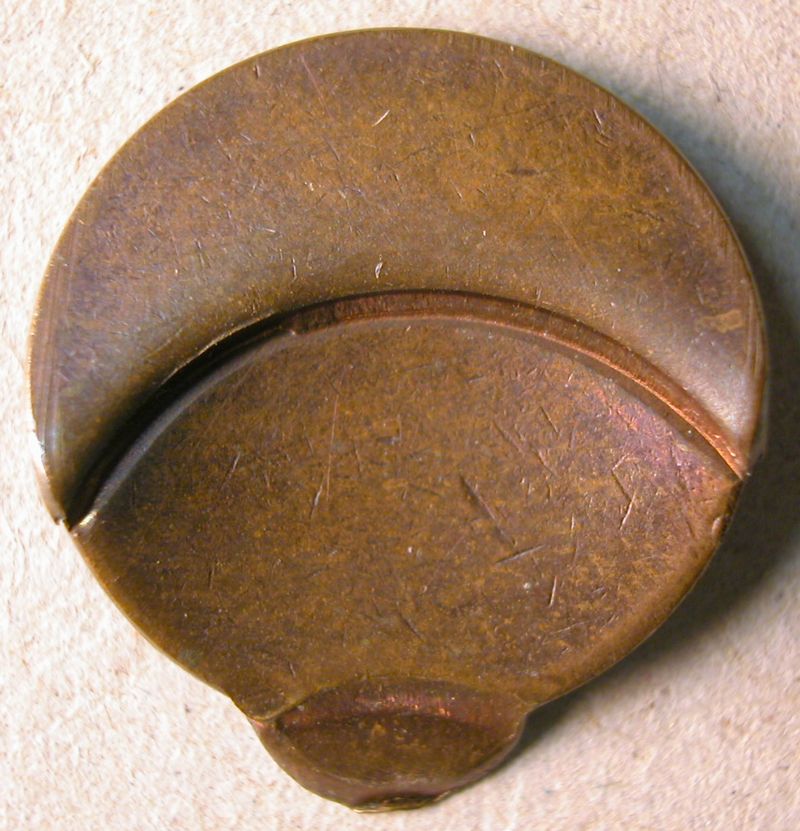
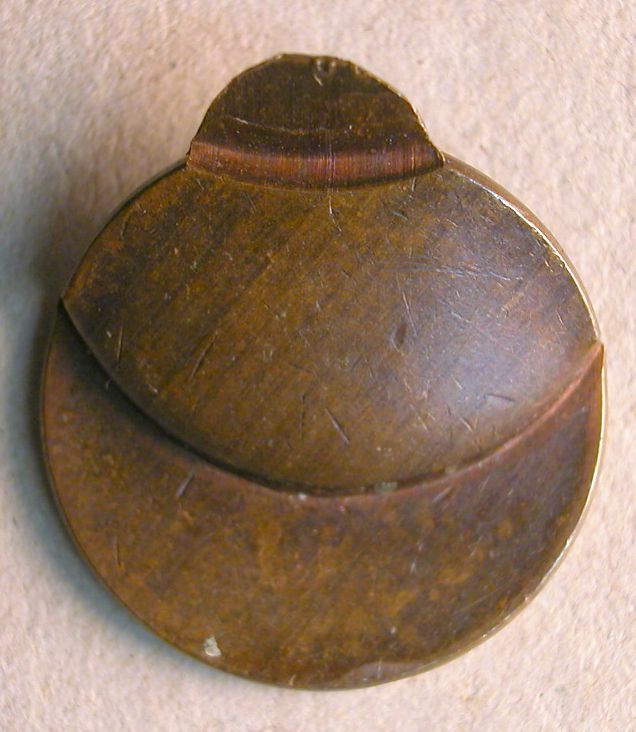
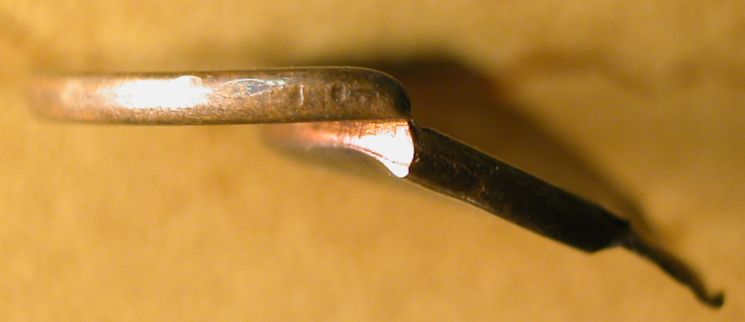
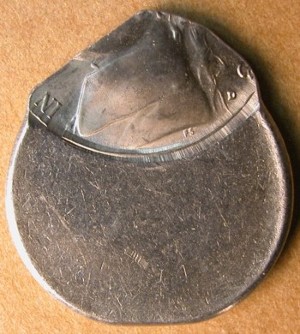
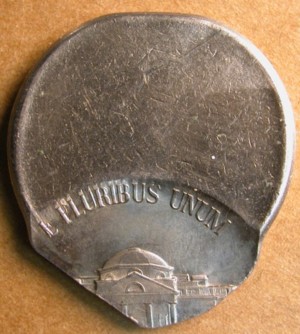
Below are images of the only known example of an off-center strike on a planchet with an incomplete punch.  In its first attempt, the blanking die fell just short of punching out a blank.  In it’s second attempt, the blanking die sliced through the incompletely punched hole in the coin metal strip.  Later on the coin received a tiny off-center uniface strike.  The only die-struck elements are the last two letters of GOD.

incomplete_punch_top

This image depicts what was originally the upper surface of the coin metal strip.  You can see how the blanking die pushed in a circular area of metal, generating a step-down in the middle of the planchet.

incomplete_punch_bottom

This image shows what was originally the bottom surface of the coin metal strip.  This surface was eventually struck by the obverse (hammer) die.  Orientation of any planchet relative to the dies is a random affair.

incomplete_punch_side

The pushing/shearing action generated by the blanking die and the opposing hole in the perforated base plate produced a dramatic step in the middle of the planchet.

Interior Die Break Connected To Die Crack

PART IV. Die Errors:

Interior Die Break:

Connected to a Die Crack or Split


Definition: When a thick flake spalls off the interior of the die face it leaves a void we call an interior die break.  It appears on the coin as a featureless lump.  Unlike a cud, an interior die break has no direct connection to the design rim.  Interior die breaks are often connected to die cracks and sometimes straddle a split in the die face (split die).  When it is not connected to a die crack, it is called a freestanding interior die breaks.


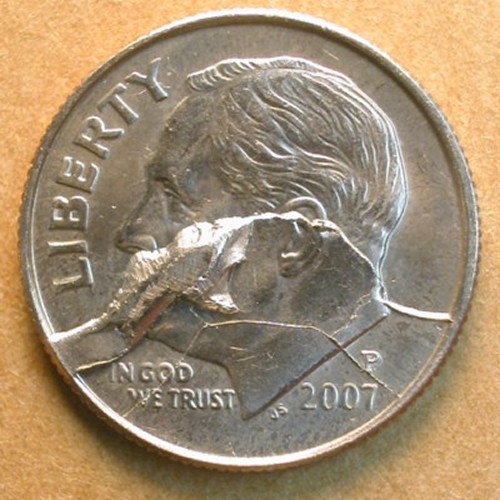
This 2007-D dime was struck by a shattered obverse die.  Many forms of brittle fracture are evident, including a 50% retained cud and many bi-level die cracks.  A large interior die break has replaced Roosevelt’s mouth and cheek.


Interstrike Damage

Part V: Planchet Errors:

Interstrike Damage:

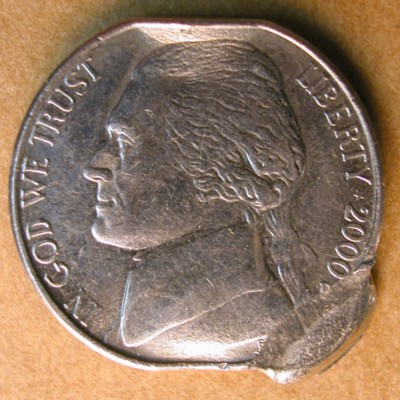
Definition: Interstrike damage can only be identified in double-struck and multi-struck coins.  It is damage that is inflicted between strikes.  It’s highly variable in appearance.  Shown here is a double-struck 2000-D nickel that was damaged between the first and second strikes.  The damage consists of two flat facets at 12:00 and 6:00.  The southern facet was crimped by the second, off-center strike.  The southern facet shows fine, oblique ridges. The northern facet is smooth, with some oblique scrapes that seem to have been received after the facet formed.

The presence of inter-strike damage may indicate the presence of a delayed second strike, but additional evidence is required to draw the latter inference.  See Delayed Second Strike.

.


Intra-Strike Damage

VI. Striking Errors:

Intra-Strike Damage

Definition: Damage to a coin or planchet that occurs during the strike but outside the boundaries of the striking chamber.  The damage is not caused directly or indirectly by the dies, collar, or other coins or planchets that occupy the striking chamber at the same time.  The damage is instead caused by a feeder, ejector, some other machine part, or an unknown obstruction.

Intra-strike damage occurs in two ways:

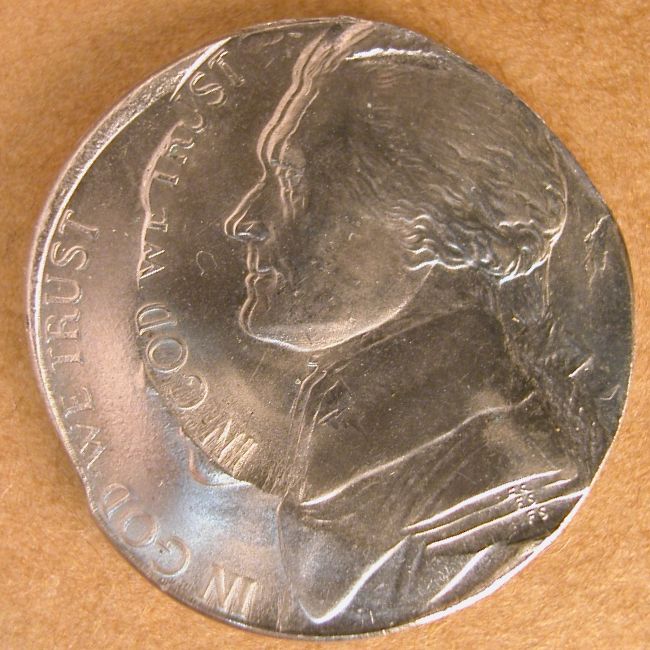
  1. The unstruck portion of an off-center planchet collides with an obstruction as it is pushed sideways by the expansion of the struck tongue of metal. This produces a contact facet at the pole opposite the internal margin of the die-struck area.  The contact facet is typically flat and devoid of any texture.  The planchet may buckle from being trapped between the dies at one pole and forced against the obstruction at the opposite pole.  Intra-strike damage of this sort is most commonly found in nickels and the flat facet is invariably located opposite the base of Jefferson’s bust at a consistent distance.  This kind of intra-strike damage is much less frequently found among Lincoln cents.  It has not been identified in any other denomination.
  2. The unstruck portion of an off-center coin or planchet  is pushed into a feeder/ejection finger by the expansion of the struck portion of the coin and the struck portion of the opposing feeder/ejection finger. This sort of damage typically takes the form of a dent in the edge of that portion of a planchet or multi-struck coin that protrudes outside the striking chamber.  The dent is sometimes deep and may cause the adjacent coin metal to buckle.  These dents are always associated with coins struck by inverted dies installed in the high-speed Schuler press. The vast majority of these coins are multi-struck.  The opposite pole almost always shows a foreign object chain strike  (from the other feeder/ejection finger).  Together, the dent and the foreign object chain strike comprise a pattern of  bilateral machine part impingement.

In this off-center nickel, the pole opposite the off-center strike was flattened by contact with an immovable object.  As the coin metal expanded beneath the dies, the unstruck part of the planchet was pushed laterally into the obstruction.  It’s not clear whether the object was a feeder/ejector, but that’s one possible candidate.  The flat contact facet characteristically lies opposite the base of Jefferson’s bust.  These errors should not be confused with sideneck strikes.  These leave a concave contact facet  that results from a collision with the side of the hammer die that belongs to the adjacent die pair in a dual or quad press.

This off-center strike also features a chain strike, but this has no relationship to the formation of the flat contact facet.

quad_stk_5c_obvquad_stk_5c_rev

This nickel received a normal first strike and then three closely-spaced off-center strikes.  It was struck with inverted dies (reverse die as hammer die) and was almost certainly struck in a Schuler press.

A dent can be seen on the left side of the coin’s edge next to the W of WE.  This area of intra-strike damage was produced when the portion of the coin lying outside the striking chamber was pushed laterally into a feeder/ejection finger.  The expansion of that portion of the coin and the adjacent feeder/ejection finger that lay inside the striking chamber provided the necessary lateral force.  At the pole opposite the intra-strike damage we see a foreign object chain strike, produced when the edge of the nickel and the internal edge of the feeder/ejector finger flowed together.

bilateral_MPI_10c_obvbilateral_MPI_10c_rev

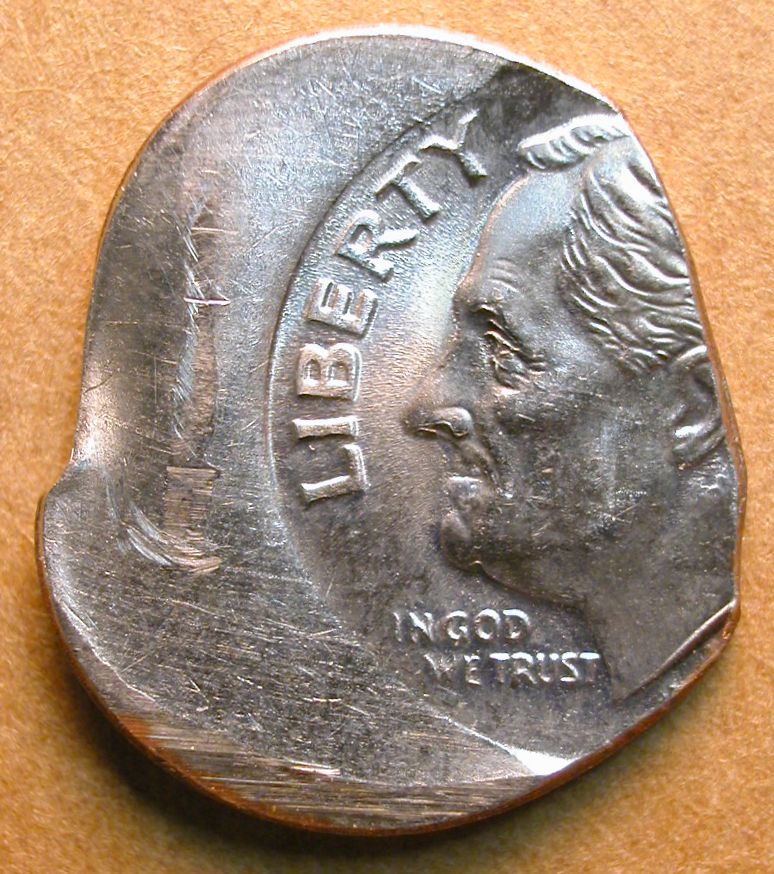
This off-center dime displays a case of bilateral machine part impingement.   On the left side, we see a dent from the left-side feeder/ejection finger.  The impact on the edge was so forceful that the unstruck portion of the dime buckled.  This area of intra-strike damage lies directly across from a foreign object chain strike produced by edge-to-edge contact with the right-side feeder/ejection finger.

Introduction To This Website


Error-Variety Ready Reference

There are a number of excellent general references on minting errors and die varieties available to collectors.  In the variety arena, The Cherrypickers’ Guide to Rare Die Varieties (Fivaz and Stanton) has proven to be indispensable. For error collectors, the Error Coin Encyclopedia (Margolis and Weinberg), the Official Price Guide to Mint Errors (Herbert), and Minting Errors and Varieties (Wiles), have provided a wealth of information.

Yet none of these sources is complete or entirely accurate, at least when it comes to documenting the vast range of mishaps that occur at all stages of the minting process.  The Error-Variety Ready Reference is designed to fill the remaining gaps and correct the occasional mistake.

Error-ref.com is a comprehensive illustrated glossary of every conceivable defect associated with the minting process.  It will contain detailed illustrated descriptions of hundreds of basic error types, numerous subtypes, and assorted effects associated with them.  It is not designed to cover compound errors and multiple errors, as these occur in an infinite number of combinations and permutations.  It is also not intended to be a catalog of specific coins and dies.

The Ready Reference is built upon a framework provided by a 22-page Comprehensive Error-Variety Checklist that was compiled by Mike Diamond some years back and that he continually updates.  The checklist is available on this website.

An online glossary has some advantages over “dead tree” formats.  There are no page limits.  Every photo can be a color photo.  There is no limit on the number of photos.  The website can be continually updated and any mistakes can be immediately corrected.  New information can be incorporated with a few keystrokes.  Readers can contact the site editors with suggestions, ask for clarification, or ask that a particular entry be expedited or expanded.  Naturally, no resource can be entirely free of mistakes or omissions, so we welcome your corrections.

We hope you find this site helpful and welcome your input.

– Mike Diamond, BJ Neff, Jeff Ylitalo, and Jason Cuvelier


Inverted Die Installation

Inverted Die Installation (and how to recognize it)

by Mike Diamond

Throughout most of the U.S. Mint’s history, coins were struck by dies that were set up so that the obverse die functioned as the hammer die and the reverse die functioned as the anvil die. The hammer die delivers the blow, while the anvil die receives the blow, with the planchet sandwiched in between. It is no longer safe to assume that the hammer die is the “top” die and the anvil die is the “bottom” die. Some of the newer presses reportedly operate with the dies oriented horizontally, and Alan Herbert tells me that at least one model of Graebner press first produced in the 1970’s employed a hammer die that thrust upward. At various points in the Mint’s history, the usual pattern of installation was inverted, so that the reverse die functioned as the hammer die and the obverse die functioned as the anvil die (Pilliod, 2000). Buffalo nickels and Mercury dimes were the last 20th century issues to be struck exclusively with inverted dies. It’s not clear why inverted installation was chosen for these and other obsolete issues. After 1945 (the last year in which Mercury dimes were produced), the mint returned to its usual habit of striking coins with a standard die installation (obverse die as hammer die). At least that was the case until the last decade of the 20th century. The status quo was interrupted when Arnold Margolis (1997a, b) reported the discovery of a 1992-D quarter with a reversed partial collar error – a clear indicator of inverted die installation. This was confirmed by personnel of the U.S. Mint after Margolis submitted the coin for examination.

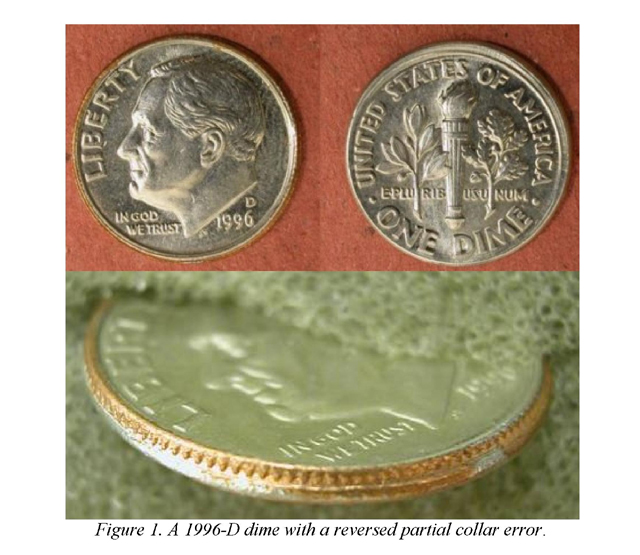
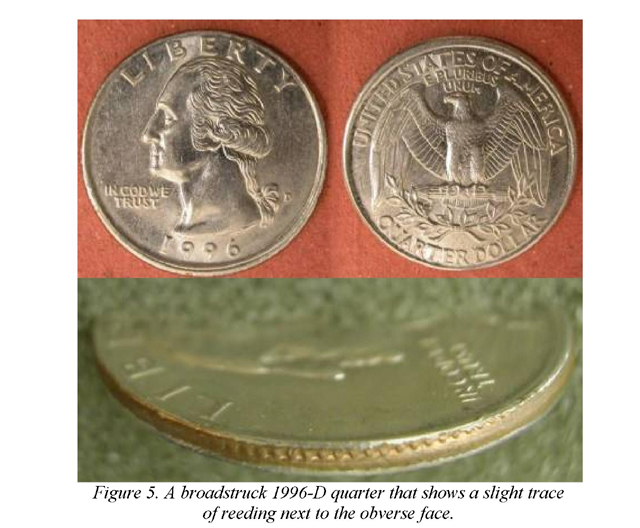
A partial collar error occurs when the collar (the retaining ring that establishes the final diameter of the coin) is not fully deployed during the strike. As a result, part of the coin protrudes above the collar, and it consequently expands beyond its normal diameter in this area. The edge will show a protruding “step” or “flange” that extends out from the face that was positioned above the level of the collar. This face is the one struck by the hammer die, since the collar always surrounds the neck of the anvil die. In coins with reeded edges, the smooth-edged flange will be associated with the face struck by the hammer die, while the thin band of reeding below it will be associated with the face struck by the anvil die. So far, this 1992-D quarter is the only error coin from that year that shows evidence of inverted die installation. It must be understood that it is impossible to determine which die functioned as the hammer die in a normal coin. The presence of inverted dies is only revealed when it is accompanied by certain kinds of errors. It must also be appreciated that inverted die installation itself is not an error, just an alternative setup that is fully intentional. I am not aware of any error coins from 1993 or 1995 that show evidence of inverted dies. I have one 1994-D dime with a reversed partial collar, so this tells us that the practice may have persisted throughout this period, albeit at a nearly undetectable level. In 1996, the practice of striking coins with inverted dies accelerated. A small number of nickels and dimes with inverted partial collars are known from this year, along with a 1996-D broadstruck quarter with a faint trace of reeding next to the obverse face (see below). All these early examples are from the Denver Mint. By 1997, error coins struck by inverted dies can be found in all denominations from cents to quarters, although they are still quite scarce. 1998 shows a conspicuous increase in the number of error coins struck with inverted dies, and the frequency of such coins seems to grow in each subsequent year. Since 2000, it appears that nearly all state quarters have been struck with inverted dies. Other denominations continue to be struck with both normal and inverted die setups, although today the inverted setup may actually dominate. It is unclear why the minted started tinkering with inverted die installation in 1992, why it remained so uncommon for the next three or four years, and why its frequency has increased steadily since 1998. It does appear that inverted die installation has some connection with some of the newer-style presses, (e.g., Schuler and Graebner), that have been installed in recent years.

Recognizing Inverted Dies


Only certain types of errors will betray the presence of inverted dies. Below is a list of errors that supply reliable clues about die installation.


Partial
collar

We have already mentioned the partial collar error. Figure 1 shows a 1996-D dime with partial collar error that was struck with inverted dies. As you can see, the obverse face has a normal diameter while the reverse face is wider than normal. An oblique view shows the narrow band of reeding next to the obverse face and the smooth flange that projects beyond it.

Off-center
strikes

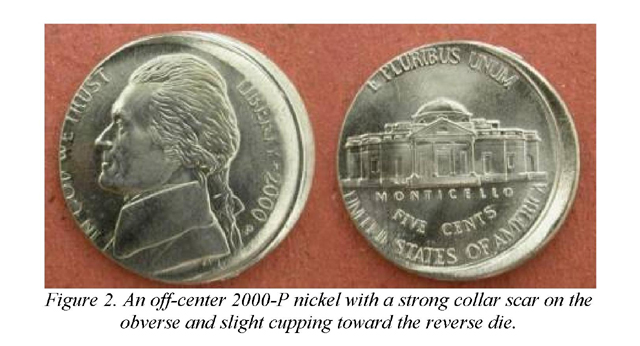
Most off-center strikes and some uncentered broadstrikes show a collar scar on the face struck by the anvil die. The collar scar is produced when the part of the misfed planchet that protrudes outside the striking chamber is forced down upon the top of the collar and depresses it. The collar floats on springs in the older style Bliss press and we may

presume that functionally similar arrangements exist in other press models. Figure 2 shows an off-center 2000-P nickel with a strong collar scar on the obverse. The unstruck part of the planchet is also slightly cupped up toward the reverse, another indicator of inverted die installation. While not all off-center strikes show cupping, its presence is a reliable indicator as to which die functioned as the hammer die. Cupping in a simple off-center strike (both faces die-struck) is always toward the hammer die.

Ram strikes

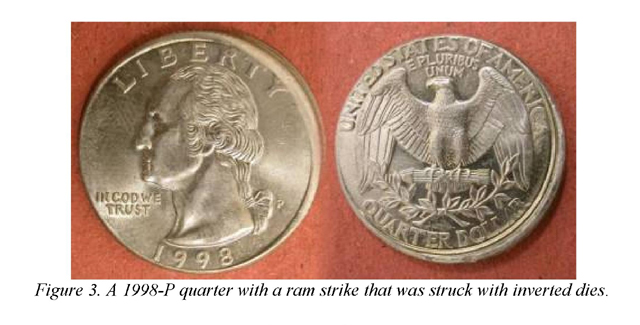
It is often assumed that all off-center strikes are struck out-of-collar. However, a small percentage are forced completely into a collar that is frozen in the “up” position. I have termed these errors “ram strikes” (Diamond, 2000, 2001). Ram strikes are very distinctive in appearance and are characterized by a total of 9 diagnostic features. Among the most distinctive of these features is the presence of a rounded shoulder on the face struck by the anvil die and a vertical flange on the face struck by the hammer die. Ram strikes go back to at least 1928, the date shown on a Mercury dime with this error (Diamond, 2001). However, I have seen at least one Indian cent with what looked like a ram strike, so it may extend back even farther. All the ram strikes that I have encountered dated1997 or later were struck with inverted dies. Ram strikes dated 1996 or earlier all seem to have been struck with a conventional die arrangement (with the exception of Mercury dimes). Figure 3 shows a 1998 quarter with a ram strike that was struck by inverted dies.

Broadstrikes

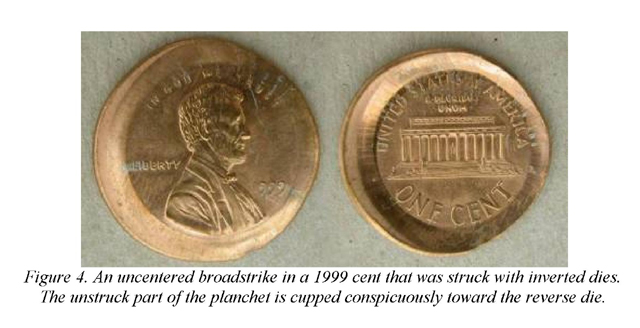
Simple broadstrikes – both centered and uncentered –may expand horizontally or may show cupping. Cupping, when present, is always toward the hammer die. Figure 4 shows a 1999 cent with very large uncentered broadstrike that was struck by inverted dies. Cupping is well developed and is directed toward the reverse die, which clearly functioned as the hammer die.

Another way that broadstrikes can provide clues about die installation is if there happens to be a trace of reeding (or some other sign of contact with the working face of the collar) somewhere along the edge. Whichever face the reeding trace is associated with is the face that was struck by the anvil die. Figure 5 shows a broadstruck 1996-D quarter with a trace of reeding next to the obverse face.


In-collar indents and partial brockages

Although indents and partial brockages that are struck out-of-collar do not provide reliable clues about die installation, those that are struck within the collar do. In-collar indents and partial brockages must be located on the face struck by the hammer die. If a coin or planchet is inserted between the coin and the anvil die, the coin has to be a broadstrike, since the collar must be located beneath both coins.

When a planchet or coin is struck into another planchet that remains seated in the collar, the metal beneath the intrusive coin is subjected to increased effective striking pressure. This often forces the metal to squeeze over the top of the collar, beneath the intrusive coin. The resulting “lip” will extend out from the face struck by the hammer die.

I have not yet seen any in-collar indents or partial brockages struck by inverted dies, but any such coin should be instantly recognizable.


Horizontal misalignments (in-collar)

Horizontal misalignments of the hammer die should also provide useful clues about die installation, provided that the coin is struck in-collar. In a major misalignment, the hammer die forces the collar down to the level of the coin, and this often produces a narrow “lip” along the edge. Whichever face is associated with this lip will be the one struck by the hammer die.

Major horizontal misalignments can confidently be assigned to the hammer die, provided that the coin is struck in-collar. Lateral movement of the hammer die is not constrained by a surrounding collar. Likewise, because the collar surrounds the neck of the anvil die, any horizontal displacement of the latter would require displacement of the former and the production of a broadstrike. In the past it was considered safe to assume that any major horizontal misalignment had to be affecting the hammer die, regardless of whether the coin was struck in or out of the collar. The collar was not thought to be capable of any significant horizontal movement. However, this assumption is no longer valid as it appears that some of the newer presses are permitting major horizontal misalignments of the anvil die together with the collar.


Collar Clash

Collar clash occurs when the hammer die collides with the top of the collar or scrapes along the working face of the collar. Such an accident leaves an impression inside the rim gutter of the die or at the junction between the rim gutter and the die neck. In denominations with reeded edges, collar clash takes the form of serrations located at the top of the rim.  The presence of collar clash on the reverse rim is a strong (but not infallible) indicator that the reverse die was employed as the hammer die.

On rare occasions collar clash will be found on the face struck by the anvil die or even on both faces of the same coin. Since the anvil die is surrounded by the collar, it’s clear that the anvil die would not have struck the collar from below. It might be caused by the anvil die scraping continuously along the working face of the collar. It also might be caused by a sudden sideways movement of the hammer die or the collar that is violent enough to leave marks at the edge of the rim gutter.


Summary

Inverted die installation in contemporary issues started at least as early as 1992, but only rose to detectable levels in 1996. By 1998, this die setup became relatively common and today seems to be at least as common as the conventional mode of die installation.

Inverted die installation can only be detected when it occurs in conjunction with certain error types. These include partial collars, off-center strikes, ram strikes, broadstrikes, and indents and partial brockages that are struck in-collar.


Addendum

In May, 2004, at the Central States Numismatic Society’s annual show, I stopped at a bourse table manned by James Essence and Len Roosmalen. In their case I saw a saddle strike on a previously struck 1996cent. I was surprised to see that the coin was struck with inverted dies. The area between the two off-center strikes bulged conspicuously toward the reverse die and the obverse face of each off-center strike was uniface (struck against a blank planchet) while the reverse was die-struck. Together, these features provide compelling evidence that the obverse die functioned as the anvil die in this press. This is the earliest recent cent I’ve come across struck with an inverted die set-up (although I’ve seen nickels, dimes, and quarters that date to this year or before). It also provides proof that inverted set-ups were at least occasionally used in dual or quad presses.


References

Diamond,
Mike (2000) The ram strike. Errorscope, Nov/Dec 2000

Diamond,
Mike (2001) Ram strike update. Errorscope, March/April 2001

Margolis,
Arnold (1997a) Help wanted for possible new error. Error Trends Coin Magazine,
February 1997, page 29

Margolis,

Arnold (1997b) What we used to know may not be so today! Error Trends Coin
Magazine, December 1997, page 29

Pilliod,
Chris (2000) A heads up. Errorscope, Nov/Dec 2000, page 6


Irregular Shaped Cuds

PART IV. Die Errors:

Die Breaks:

Irregular Cuds

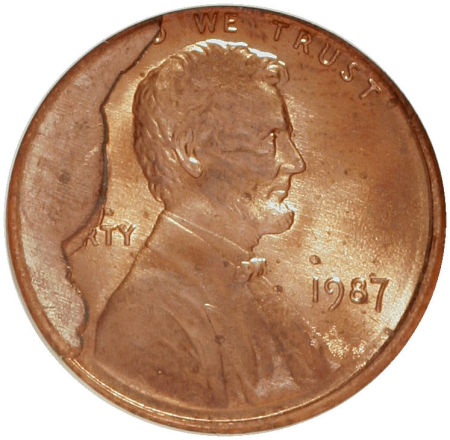
Definition: When an irregular chunk breaks off the corner of a die, it leaves an irregular cud on the coin.  A cud with a ragged internal border can develop gradually or instantaneously.

The images above show an irregular die break on a 1987(P) Lincoln cent.

Images are courtesy of Heritage Auctions.
Full Uniface Strike

Part VI. Striking Errors:

Uniface Strike:

Full Uniface Strike

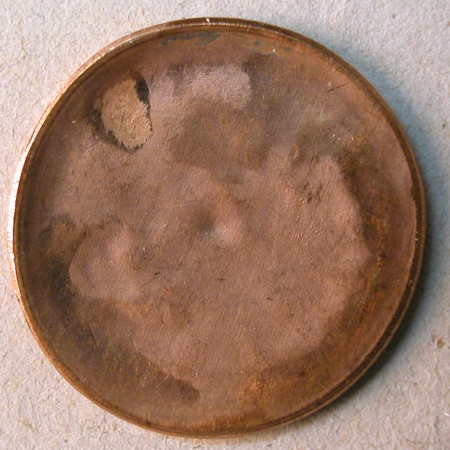
Definition: Occurs when a planchet is perfectly centered over another planchet or coin and the two are struck together.  This error is also known as a full indent.

When an off-center planchet or coin is struck against an underlying planchet, this is known as an off-center uniface strike.

A full uniface strike can affect the face struck by the hammer die or the anvil die.  The coin can be struck in-collar or out-of-collar.

Above are photographs of a state quarter with an in-collar uniface strike.  Since state quarters were struck with conventional and inverted die setups, there’s no way to determine whether the die-struck obverse design was struck by the hammer die or the anvil die.

The coin depicted above is a cupped, uniface broadstrike.  It is what the companion of the previous coin would have looked like.  When two planchets are placed on top of each other and struck out-of-collar, the top coin curls up toward the hammer die, which in this case was the obverse die.  Because of its steeply upturned wall, coins like this are often mistaken for die caps.  But there is no convincing evidence that this coin was struck more than once.

Floating Die Clash

PART IV. Die Errors:

Die Clashes:

Floating Die Clash

Definition: A floating die clash is generated in the aftermath of a die break.  After it breaks off, the die fragment remains behind in the striking chamber and is struck by the dies.  Usually one of the dies is protected by a planchet.  If the other die strikes the working face of the die fragment, the incuse, mirror-image design elements on the fragment are transferred to the intact die (or the intact portion of the broken die).  Those transferred elements are raised and normally-oriented on the die face.  Every coin that is struck afterward has incuse, mirror-image design elements in an unpredictable location.  Most floating die clashes are restricted to the field, as this is the portion of the die face that is most vulnerable to damage.

To see more floating die clashes, click HERE

  • « Previous Page
  • 1
  • …
  • 12
  • 13
  • 14
  • 15
  • 16
  • …
  • 21
  • Next Page »
  • Home
  • Introduction To This Website
  • Error-ref.com News
  • Comprehensive Error-Variety Checklist
  • Index Of Completed Entries
  • Part I. Die Subtypes:
  • Part II. Die Varieties:
  • Part III. Die Installation Errors:
  • Part IV. Die Errors:
  • Part V. Planchet Errors:
  • Part VI. Striking Errors:
  • Part VII. Post-Strike Mint Modifications:
  • Part VIII. Post-Strike Striking Chamber Mishaps:
  • Part IX. Post-Strike Mint Damage:
  • Part X. Wastebasket / Composite Categories:
  • Part XI. Non Errors:
  • Featured Articles Of Interested
  • Interest & Not So Interesting Facts
  • Other Sites And Forums Of Interest
  • Our Thanks Go To
  • About The Authors
  • Contact Us

Copyright © 2026